
On this page
Start here
Quick answer
Warm or hot air at the bottom, sides, or rear of a GE refrigerator, and warmth at the front edge or between the doors, can be normal because the appliance rejects heat and may use a warm mullion to prevent condensation. GE also says compressors are designed to run much of the time and may approach continuous operation in hot or humid conditions. Overheating becomes a service concern when the interior is warming, the unit cannot recover after settings, loading, doors, gaskets, vents, room temperature, and model-specific clearance are checked, or the power cord, plug, or outlet is hot, discolored, arcing, smoky, or smells burned. Check only accessible external conditions. Unplug before any model-authorized condenser maintenance, never clean or open a NeverClean condenser compartment unless the manual explicitly permits it, and do not touch the compressor, sealed refrigeration system, internal electrical parts, or perform live testing.
Before you begin
Safety first
- The owner may observe accessible surfaces, settings, door contact, vents, clearance, and visible power hardware without contact, and may perform only a model-authorized maintenance procedure after disconnecting power. A qualified technician must assess fans, compressor, start components, defrost, controls, wiring, and the sealed refrigeration system; an electrician must assess household electrical conditions.
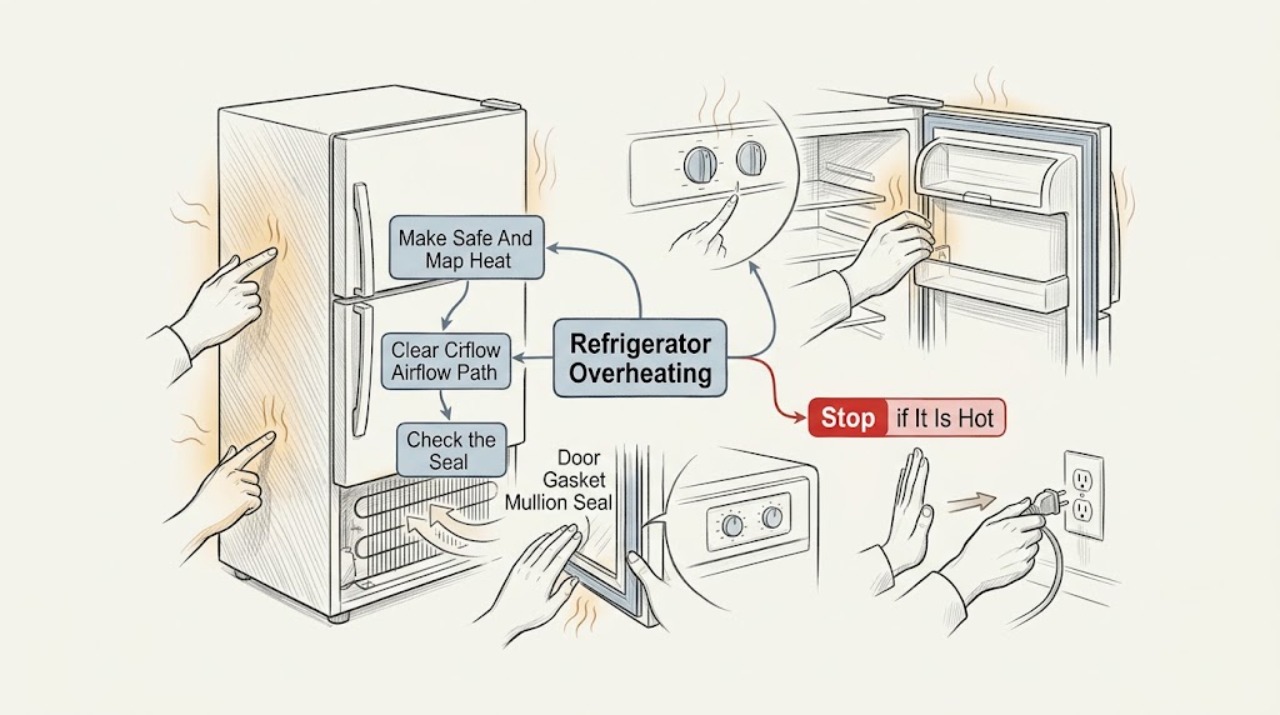
Work through in order
Diagnostic checks
Use only checks that match the exact appliance or system and its official guide.
-
Check 1
From a dry, non-contact position, note whether the heat is on the side panels, rear, bottom, front edge between the doors, around the control area, or at the power cord, plug, or outlet. Check whether the interior food is warming and look for smoke, a burning odor, discoloration, melting, arcing, or water near electrical hardware.
Expected result: Only the cabinet, lower rear, or door-divider area is warm and the interior remains cold; the interior is warming; or the cord, plug, or outlet is hot or damaged.
Next step: If there is smoke, burning odor, arcing, melting, a very hot plug or outlet, repeated tripping, or water near electricity, stop using the refrigerator and isolate power only from a safe accessible point; call qualified electrical or appliance service. If only normal cabinet warmth is present, continue with external checks.
Stop if: Do not touch wet electrical parts, move the refrigerator to expose wiring, open covers, or restore power to reproduce an electrical symptom.
Why this matters
Why: Surface warmth in GE's documented heat-rejection or anti-condensation locations can be normal. Interior warming changes the problem to a cooling-performance concern. Hot or damaged power hardware, smoke, odor, or arcing is an electrical stop-use condition rather than an owner cooling adjustment.
-
Check 2
Read the temperature setting and confirm the refrigerator is in its normal cooling mode. Without blocking vents, note recent warm-food loading, frequent door openings, a nearly empty freezer, blocked interior air passages, and unusually hot room conditions. Do not make repeated control changes; after a permitted adjustment, allow the model's stated recovery period.
Expected result: The setting was changed, warm food was recently loaded, vents or shelves obstruct airflow, the room is hot, or none of these conditions explains a rising interior temperature.
Next step: Restore the model-recommended setting, clear only accessible interior obstructions, close the doors, and monitor recovery for the period specified by the manual. If the interior continues warming or the compressor runs without recovery, arrange qualified appliance service.
Stop if: Do not remove interior panels, force damp or frozen parts, or treat a setting change as a repair for a persistent warm interior.
Why this matters
Why: GE identifies settings, warm loads, door activity, room temperature, freezer loading, and blocked airflow as contributors to long runtime or insufficient cooling. A refrigerator that remains warm after those external conditions are corrected is less likely to have a simple setting or load explanation.
-
Check 3
Visually inspect the door gasket and door alignment without removing parts. Look for a gasket pulled out of its channel, torn, dirty, or unable to contact the cabinet; a door held open by a container; and installation clearance or ventilation that does not match the exact GE manual. Do not push the appliance into a tighter space to hide the heat.
Expected result: The door does not close fully, the gasket has a visible defect or gap, containers interfere, or clearance differs from the model instructions; otherwise the door and accessible installation appear sound.
Next step: Remove only an accessible obstruction and clean or reseat a gasket if the model instructions permit it; do not remove the gasket or alter cabinetry. If the door seals and clearances are correct but the refrigerator still overheats or warms, schedule appliance diagnosis.
Stop if: Do not disassemble the door, cabinet, fan shroud, or refrigeration system, and do not compensate for inadequate clearance by operating the unit hotter.
Why this matters
Why: A door leak or insufficient clearance can add heat load and extend runtime. GE's general guidance is not a substitute for model-specific clearances, and a sound door and compliant installation make a hidden airflow, control, fan, or sealed-system problem more plausible if the interior is warm.
-
Check 4
Use the model and serial label to retrieve the exact GE Owner's Manual or Installation Instructions and identify whether the refrigerator has a NeverClean condenser, an accessible under-unit forced-air arrangement, or another design. Inspect only the visible floor and clearance around the appliance; do not reach toward the compressor, fan, coils, or wiring.
Expected result: The manual identifies NeverClean maintenance, permits external condenser cleaning, or does not clearly identify the condenser arrangement.
Next step: For a NeverClean or unclear design, leave the internal area alone and arrange service if cooling is poor. If the manual specifically permits owner cleaning, proceed only after disconnecting power and following that manual; otherwise request qualified service.
Stop if: Do not remove a rear or bottom cover, insert tools into a grille, touch a fan or coil, or perform maintenance while energized.
Why this matters
Why: GE's condenser guidance varies by construction: some models place the condenser in the compressor housing and do not call for routine cleaning, while other models may have accessible coils. Without the model document, cleaning or moving parts could be incorrect or unsafe.
-
Check 5
After one round of model-permitted external corrections, record whether the interior returns to its normal temperature and whether the exterior heat is limited to GE's documented warm locations. Record the model, room conditions, runtime pattern, door/gasket findings, settings, and any change in food temperature for the technician.
Expected result: The interior recovers and power hardware stays normal; the cabinet remains warm but interior cooling is stable; or the interior stays warm, runtime is continuous without recovery, or a safety warning appears.
Next step: Monitor a stable refrigerator without repeated setting changes. For persistent warming or unexplained long running, arrange qualified appliance service and provide the recorded pattern. For hot or damaged electrical hardware, use qualified electrical service urgently and keep the unit isolated.
Stop if: Do not continue operating a refrigerator with smoke, odor, arcing, melted power hardware, repeated trips, or food-safety temperatures that cannot be maintained.
Why this matters
Why: Stable interior temperature with warmth in the cabinet or door-divider locations is consistent with normal heat rejection. Persistent interior warming or an electrical warning is not explained by surface warmth alone and may involve airflow, controls, fan, defrost, compressor, or sealed-system diagnosis.
Use your observations
Decision map
Find the observation that best matches what you see, then follow the next safe action.
-
PATH 01Safety boundary
What you see
The sides, lower rear, or strip between the doors is warm, but the interior remains cold and there is no odor, smoke, damaged power hardware, or repeated trip.
Do this next
Keep the required clearance and monitor interior performance. Escalate if food warms or the location, intensity, or associated symptoms change.
Why this path and its safety boundary
Why it matters: GE documents these areas as normal heat-rejection or anti-condensation locations; surface warmth alone does not establish overheating failure.
Safety stop: Do not open the appliance to cool the cabinet or add an unapproved fan or electrical device.
-
PATH 02Safety boundary
What you see
The compressor runs for long periods after warm loading, frequent door use, hot weather, or a control change, but the refrigerator recovers and maintains its interior temperature.
Do this next
Reduce avoidable door openings, keep vents clear, and follow the exact manual's settings and clearance guidance; monitor rather than repeatedly cycling power.
Why this path and its safety boundary
Why it matters: GE says long runtime, including nearly continuous operation in hot or humid conditions, can be normal when the heat load is high.
Safety stop: Do not change the thermostat repeatedly or assume a long run is safe if food is warming or power hardware is hot.
-
PATH 03Safety boundary
What you see
The interior is warm and there is a blocked vent, door obstruction, failed gasket contact, inadequate model clearance, incorrect setting, or another accessible installation condition.
Do this next
Correct only the accessible condition in the model instructions, allow the specified recovery time, and arrange appliance service if cooling does not return.
Why this path and its safety boundary
Why it matters: An external heat load, air leak, or airflow restriction is more likely than normal surface warmth, but failure to recover after correction requires service.
Safety stop: Do not remove panels, alter cabinetry, or bypass a door switch or control to improve cooling.
-
PATH 04Safety boundary
What you see
The exact manual identifies an owner-accessible condenser that needs cleaning, or identifies a NeverClean/unclear arrangement.
Do this next
For an authorized procedure, disconnect power and follow the exact manual. For NeverClean, inaccessible, or unclear construction, leave it closed and call qualified service if cooling is poor.
Why this path and its safety boundary
Why it matters: GE's condenser architecture is model-dependent. A NeverClean or unclear design is not a license to remove covers; only a manual-authorized accessible procedure can be considered by the owner.
Safety stop: Do not clean energized coils, reach near the compressor or fan, or substitute advice from another model.
-
PATH 05Safety boundary
What you see
The cord, plug, or outlet is hot, discolored, smoky, wet, arcing, or repeatedly trips, or the refrigerator interior stays warm despite compliant external conditions.
Do this next
Stop using the refrigerator and isolate power only from a safe accessible point. Use a qualified electrician for the outlet/circuit and qualified appliance service for the refrigerator; preserve the model and symptom record.
Why this path and its safety boundary
Why it matters: This is no longer a normal cabinet-warmth question. Power hardware symptoms require electrical safety assessment; persistent warm interior or unproductive continuous running requires appliance diagnosis, potentially involving inaccessible components.
Safety stop: Do not reset repeatedly, use an extension cord or adapter, perform live measurements, open electrical compartments, or touch the sealed system.
Helpful context
Understand the symptom
The location and consequence of the heat matter
A warm cabinet side, lower rear, or front strip between the doors is not the same symptom as food warming or a hot power connection. GE explains that these surfaces can carry or reject heat during normal operation. Start by recording where the heat is felt, whether the interior is holding its normal temperature, and whether any power hardware shows a safety warning.
Long running can be normal, but it should be judged with the load and environment
A compressor may run for most of the day, especially after loading warm food, opening the doors often, during hot weather, or when the refrigerator is lightly loaded. A long run paired with rising interior temperature, blocked vents, a leaking gasket, or a door that does not close is a different branch and needs correction or service if it does not recover.
Condenser care is model-dependent
GE describes NeverClean condensers housed in the compressor area and other arrangements that use airflow under or behind the refrigerator. Do not infer the design from the brand alone. Retrieve the exact model manual before attempting any cleaning; if the manual permits accessible condenser cleaning, disconnect power first and avoid sharp fins or internal compartments.
Safety boundary
Stop conditions
- Stop using the refrigerator for smoke, burning odor, visible arcing, melting or discoloration, a hot or damaged cord or outlet, water near electrical hardware, or repeated breaker/GFCI operation.
- Do not repeatedly cycle power to reproduce overheating, bypass a door switch or control, use an extension cord or adapter, or perform live electrical tests.
- Do not touch the compressor, condenser fan, coils, sealed refrigeration system, internal wiring, or hidden panels; use the exact model manual for any permitted maintenance.
- If the interior cannot maintain safe food temperature, transfer perishable food as appropriate and arrange qualified appliance service rather than continuing to run a failing refrigerator.
Only after diagnosis
Potential parts
- door gasket
Consider only if inspection finds a model-confirmed torn, distorted, or non-sealing gasket and external cleaning or seating does not restore contact.
Gaskets are model-specific. A hot side panel alone does not justify ordering this part, and removal or replacement should follow the exact model instructions or qualified service. - condenser airflow or temperature-control component
Consider only after a qualified diagnosis finds persistent interior warming or abnormal runtime after settings, doors, vents, clearance, and model-authorized maintenance are ruled out.
Fan, sensor, control, compressor, and sealed-system parts vary by model. Do not infer a failed part from external heat or access these components while energized.
When checks do not resolve it
Need a professional?
Call qualified electrical service urgently for a hot, damaged, wet, smoky, or arcing cord, plug, or outlet, repeated protective-device trips, or suspected household wiring trouble. Call qualified appliance service when the interior remains warm, the refrigerator runs continuously without recovery, a model-compliant installation has no accessible explanation, or the exact condenser, fan, control, defrost, compressor, or sealed-system condition requires diagnosis. Normal warmth at documented heat-rejection locations with stable interior cooling can be monitored.
Safety scope: The owner may observe accessible surfaces, settings, door contact, vents, clearance, and visible power hardware without contact, and may perform only a model-authorized maintenance procedure after disconnecting power. A qualified technician must assess fans, compressor, start components, defrost, controls, wiring, and the sealed refrigeration system; an electrician must assess household electrical conditions.
Common questions
FAQ
Are hot sides on a GE refrigerator always a failure?
No. GE documents warmth from the sides, bottom, rear, and between the doors as potentially normal heat rejection or anti-condensation behavior. It becomes more concerning when the interior warms, the unit cannot recover, or power hardware is hot or damaged.
Should I clean the condenser because the refrigerator feels hot?
Not automatically. GE uses different condenser arrangements, including NeverClean designs. Identify the exact model and follow its manual; if cleaning is authorized, disconnect power first and do not open internal compartments.
When is refrigerator heat an electrical emergency?
Stop using it for smoke, burning odor, arcing, melting or discoloration, a hot or damaged cord, plug, or outlet, water near electrical hardware, or repeated protective-device trips. Isolate power only from a safe accessible point and use qualified service.
Read the exact guide
Official sources
- Refrigerator - Adjusting Temperature ControlsGE Appliances · Supports checking the setting and allowing the model-appropriate recovery period; settings and controls vary by model.
- Refrigerator - Cleaning Condenser CoilsGE Appliances · Supports the unplugged, manual-authorized maintenance boundary; it does not make every GE refrigerator owner-cleanable.
- Refrigerator - Area Between Doors Warm or HotGE Appliances · Directly supports the front-edge/door-divider branch; it does not establish that every model has the same heater arrangement.
- Refrigerator or Freezer - Normal Run TimeGE Appliances · Supports the long-runtime branch; runtime alone is not a component diagnosis.
- Refrigerator - Condenser TypesGE Appliances · Supports the model-identity requirement before condenser maintenance; does not authorize access to any particular model.
- Refrigerator - Not Cooling EnoughGE Appliances · Supports settings, doors, gaskets, vents, room conditions, clearance, light, and model-dependent condenser checks when the interior is warming.
- Refrigerator - Warm / Hot AirGE Appliances · Directly supports the distinction between documented exterior warmth and a cooling failure; exact model behavior can vary.
- Refrigerator - NeverClean CondenserGE Appliances · Supports not assuming routine coil cleaning on a NeverClean model and keeping any maintenance model-specific.
Community feedback
Share a repair observation
Share a plain-text repair observation. Accepted observations are published automatically; this page may take a moment to update.