
On this page
Start here
Quick answer
Do not judge a Kenmore refrigerator by exterior warmth alone. Record where the heat is felt—side, rear, top, plug, or cabinet—and whether the food compartment is actually warm, the compressor or fan runs continuously, condensation is increasing, or there is smoke, burning odor, arcing, or a hot cord. Kenmore's own refrigerator guidance says dust on condenser coils can make the compressor work harder, a door left open or a loose seal makes the refrigerator work harder, and unusually hot ambient conditions can make the compressor and fan struggle; it also gives general temperature targets of 37–40°F for the refrigerator and 5°F for the freezer. Those figures and any garage-ready range are not a universal setting for every Kenmore model, so use the exact manual. Clean only an externally accessible area the manual permits and keep the appliance out of use for smoke, burning, damaged electrical equipment, a repeated breaker trip, or food that is not being kept safely cold. Internal fan, compressor, sealed-system, wiring, and control work requires qualified service.
Before you begin
Safety first
- Owner scope ends at safe external symptom recording, model identification, manual-permitted temperature/environment checks, visible door-seal and accessible coil observation, and permitted cleaning. Moving the appliance, removing panels, accessing fans, compressor, controls, wiring, refrigerant, or sealed-system components requires qualified service.
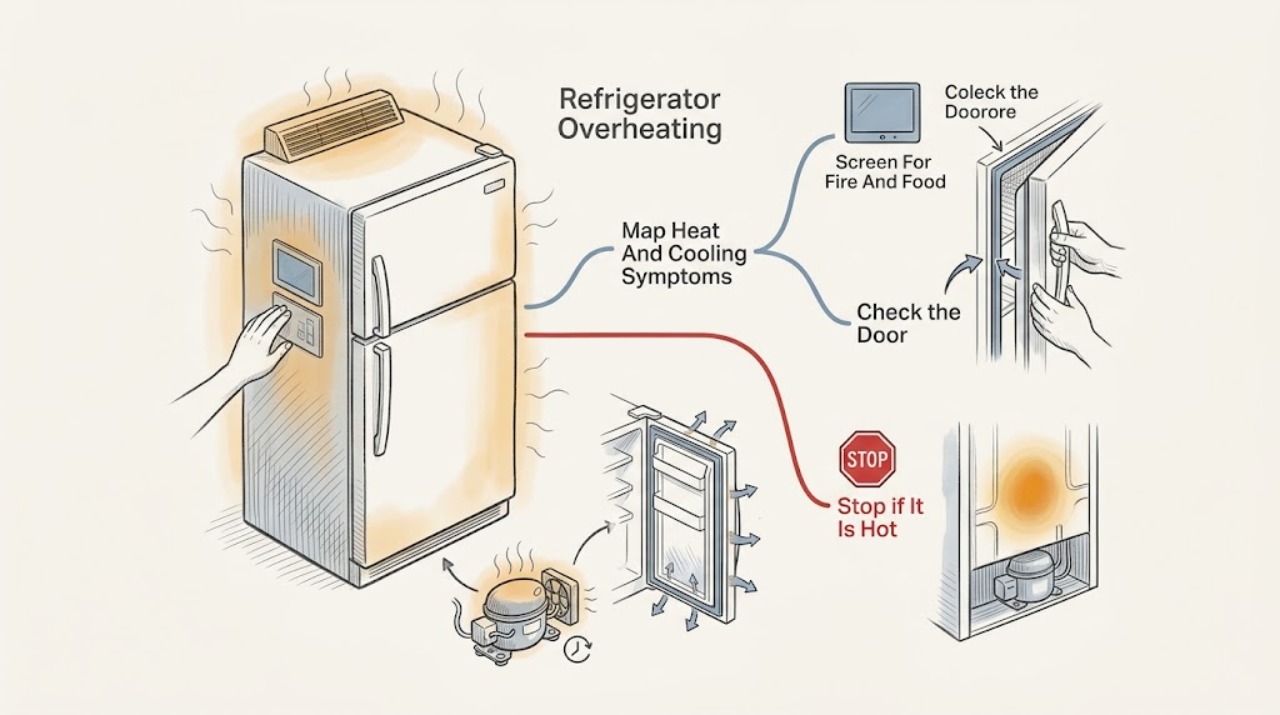
Work through in order
Diagnostic checks
Use only checks that match the exact appliance or system and its official guide.
-
Check 1
From a dry, safe position, check for smoke, burning odor, arcing, a hot or damaged plug/cord, a repeated breaker trip, water near electrical equipment, or food that is no longer being kept cold. Do not touch a hot plug or open an enclosure.
Expected result: There is no warning and food remains cold; the exterior is hot but electrical parts are normal; or an electrical, water, smoke, odor, or food-safety warning is present.
Next step: Keep the refrigerator out of use for smoke, odor, arcing, damaged electrical equipment, repeated trips, or unsafe food temperatures. Use qualified appliance, electrical, or food-safety guidance as appropriate.
Stop if: Do not repeatedly reset the breaker, touch wet or hot electrical equipment, or continue cooling tests after a fire or electrical warning.
Why this matters
Why: A warm cabinet without a warning is an observation to document, while a fire/electrical hazard or unsafe food condition changes the task to immediate stop and professional assessment.
-
Check 2
Record the first hot location and the refrigerator's performance without moving it: side, rear, top, plug/cord, or interior; actual refrigerator and freezer temperatures; whether the compressor or fan appears to run continuously; and whether condensation or food warming is occurring.
Expected result: Only one exterior area feels warm; the food compartment is warm; the unit runs constantly; condensation is increasing; or the cord/plug is the hottest point.
Next step: Use the exact Kenmore manual for the model's temperature display and operating behavior. If the interior is warming or the unit runs continuously, proceed only with safe external checks and arrange service if the condition persists.
Stop if: Do not place hands behind the refrigerator, remove a rear cover, or use a thermometer reading as permission to open the sealed system.
Why this matters
Why: Location plus cooling behavior separates a cabinet heat-rejection clue from an interior cooling problem or an electrical hazard. Exterior warmth alone does not identify a failed compressor, fan, or control.
-
Check 3
With the exact manual in hand and power isolated only if its instructions require it, inspect only externally accessible condenser-coil areas and the visible door-seal path. Look for heavy dust, a torn or visibly distorted seal, a door held open by loading, or hot items recently placed inside. Do not pull the refrigerator or remove panels to reach a coil or fan.
Expected result: Dust is visible in a permitted external area; the door does not seal visibly; the door is obstructed or often open; hot food was recently loaded; or no external clue is present.
Next step: Apply only the exact manual's accessible cleaning and loading guidance, then monitor from outside. Arrange service if heat, continuous operation, or poor cooling remains.
Stop if: Do not spray cleaner, bend fins, remove a fan shroud, vacuum inside the cabinet, or run a live test with panels removed.
Why this matters
Why: Kenmore's guidance links coil dust, open doors, loose seals, and hot food to extra compressor workload. A clear exterior does not rule out an internal airflow, fan, compressor, sensor, or sealed-system fault.
-
Check 4
Identify whether the refrigerator is in a hot garage, porch, basement, or other uncontrolled environment and whether the exact Kenmore model is labeled for that environment. Check the model manual or product documentation for its ambient-use range and temperature controls; do not assume every Kenmore refrigerator is garage-ready.
Expected result: The model is garage-ready; the model is not documented for the environment; the room is unusually hot; or the environment and model scope are unknown.
Next step: Move food only if it can be done safely and without disturbing the appliance connections; follow the exact manual for placement and controls. If the model is not approved for the environment or cooling remains poor, arrange service.
Stop if: Do not install an unapproved adapter, change a control setting beyond the manual, or reposition a connected refrigerator without qualified help.
Why this matters
Why: Kenmore's garage-ready guidance says unusually hot ambient conditions can make a regular refrigerator's compressor and fan struggle, while garage-ready models have a stated range. That condition is model-specific and is not a universal overheating diagnosis.
-
Check 5
If the refrigerator remains unusually hot, runs continuously, cools poorly, develops excess condensation, or has heat at a plug/cord after external checks, leave it off and record the model, location, temperatures, environment, and symptoms for service.
Expected result: The issue persists after permitted external cleaning/loading or environmental correction; the compressor or fan is abnormal; the interior remains warm; or the heat is concentrated at electrical equipment.
Next step: Arrange qualified Kenmore appliance service, with electrical service for a household circuit or damaged electrical equipment. Protect perishable food according to food-safety guidance while the refrigerator is out of service.
Stop if: Do not open the sealed system, access refrigerant, test energized wiring, remove the compressor cover, or bypass a thermal or control device.
Why this matters
Why: Internal fan, compressor, control, sealed-system, sensor, wiring, or installation faults remain possible, and no safe external observation selects one part.
Use your observations
Decision map
Find the observation that best matches what you see, then follow the next safe action.
-
PATH 01Next step
What you see
The exterior feels warm, but food temperatures and operation remain normal and there is no odor, smoke, arcing, or damaged electrical equipment.
Do this next
Monitor from a safe position and arrange service if the heat increases, cooling changes, or continuous operation begins.
Why this path and its safety boundary
Why it matters: A warm exterior alone is not enough to call a Kenmore refrigerator overheated; document the location and compare it with the exact manual rather than selecting a component.
-
PATH 02Next step
What you see
Dust is visible in a permitted external coil area, the door seal is visibly loose or damaged, the door is obstructed/open often, or hot food was recently loaded.
Do this next
Follow only the exact manual's accessible cleaning, loading, and seal guidance, then reassess cooling and run behavior without removing panels.
Why this path and its safety boundary
Why it matters: Kenmore identifies these conditions as making the compressor work harder or allowing room heat into the cabinet; they are workload clues, not proof of an internal failure.
-
PATH 03Next step
What you see
The refrigerator is in a hot uncontrolled space and the exact model is not documented as garage-ready, or the model's environment range is unknown.
Do this next
Verify the exact model's permitted environment and follow its placement guidance. If the model is unsuitable or cooling remains poor, arrange service rather than adding an unapproved modification.
Why this path and its safety boundary
Why it matters: Kenmore's garage-ready guidance says hot ambient conditions can make a regular refrigerator's compressor and fan struggle, while garage-ready use is a model-specific design condition.
-
PATH 04Next step
What you see
The interior is warm, the compressor or fan runs continuously, condensation increases, or external checks do not change the condition.
Do this next
Keep food safe, leave the appliance off if it is unsafe or worsening, and arrange qualified Kenmore appliance service.
Why this path and its safety boundary
Why it matters: A cooling-system, airflow, control, sensor, installation, or internal mechanical fault becomes more relevant than a brief surface-warmth observation.
-
PATH 05Safety boundary
What you see
A plug or cord is hot or damaged, or there is smoke, burning odor, arcing, water near electrical parts, or repeated breaker operation.
Do this next
Stay clear, isolate power only from a dry and safe position, and obtain qualified electrical/appliance service. Do not use the refrigerator until cleared.
Why this path and its safety boundary
Why it matters: This is an electrical or fire-safety stop condition, not a coil-cleaning or temperature-setting problem.
Safety stop: Do not touch the hot or wet connection, repeatedly reset protection, or open the appliance.
Helpful context
Understand the symptom
Define what is actually overheating
Write down the first hot location and compare it with the refrigerator's actual performance: exterior side or rear warmth, a hot plug or cord, a warm food compartment, continuous operation, excess condensation, or an odor. Warmth at one cabinet area is not a diagnosis by itself, and Kenmore's public guidance does not provide a brand-wide surface-temperature limit. A change in cooling, a persistent run condition, or an electrical warning is more important than a brief warm surface.
Kenmore identifies several workload causes
Kenmore's efficiency guidance says dust on condenser coils can force the compressor to work harder, a door held open brings room heat into the cabinet, and a warped or torn seal lets cool air escape. Its garage-ready guidance adds that unusually warm ambient conditions can make a compressor and fan struggle to run constantly and can lead to excess condensation and component wear. These are clues for an external inspection, not proof that one component has failed on every Kenmore refrigerator.
Model and environment control the next step
Kenmore sells multiple refrigerator configurations and directs owners to a model-number manual finder. A garage-ready model and a regular kitchen model do not have the same stated ambient-use scope, and smart or dual-cooling features are not present on every unit. Use the exact manual for temperature settings, permitted coil access, clearance, controls, and any operating mode; do not borrow a garage-temperature range or service procedure from another Kenmore model.
Know when heat is a stop condition
A hot cord or plug, smoke, burning odor, arcing, repeated breaker operation, or water on electrical equipment is not an airflow experiment. CPSC refrigerator guidance establishes the appliance-safety context, while Kenmore's support hub provides separate manual and repair routes. Isolate only from a dry, safe position and leave compressor, fan, refrigerant, wiring, and control diagnosis to a qualified professional.
Safety boundary
Stop conditions
- Stop immediately for smoke, burning odor, arcing, a hot or damaged cord or plug, water near electrical equipment, or repeated breaker operation.
- Do not repeatedly reset protection, touch wet or hot electrical equipment, pull the refrigerator, remove panels, or perform live electrical tests.
- Do not open the sealed system, access refrigerant, remove a compressor or fan cover, bypass a thermal/control device, or make an unapproved garage modification.
- Protect perishable food and arrange qualified appliance, electrical, or plumbing service when cooling is unsafe, heat persists, or internal access is needed.
Only after diagnosis
Potential parts
- exact-model condenser fan or fan motor
Consider this category only after qualified diagnosis confirms abnormal fan behavior or a documented model-specific cooling fault after external coil, door, and environment checks.
Kenmore refrigerator configurations vary; confirm the complete model and manufacturer fit information before ordering or installing. - exact-model door gasket
Consider this category only when the exact model documentation or qualified inspection confirms a damaged seal after a visible door-closure and seal-path check.
A loose seal can increase compressor workload, but a generic gasket is not a safe fit claim; confirm model-specific dimensions and installation requirements. - exact-model temperature sensor or control component
Consider this category only after qualified diagnosis identifies a control or sensor fault; heat or continuous operation alone does not select this category.
Controls and sensors differ across Kenmore refrigerator families. Do not access or test energized control wiring as a homeowner.
When checks do not resolve it
Need a professional?
Arrange qualified Kenmore appliance service when heat persists after the exact manual's permitted external checks, the refrigerator runs continuously or cools poorly, condensation increases, the model/environment is mismatched, or a fan, compressor, control, sensor, sealed-system, wiring, or installation diagnosis is needed. Use electrical service for a hot/damaged cord, outlet, household circuit, smoke, arcing, or repeated breaker operation.
Safety scope: Owner scope ends at safe external symptom recording, model identification, manual-permitted temperature/environment checks, visible door-seal and accessible coil observation, and permitted cleaning. Moving the appliance, removing panels, accessing fans, compressor, controls, wiring, refrigerant, or sealed-system components requires qualified service.
Common questions
FAQ
Is it normal for the outside of a Kenmore refrigerator to feel warm?
Exterior warmth alone does not identify an overheating fault, and Kenmore's public guidance does not give a universal cabinet-surface temperature limit. Record the hot location and check whether the interior is warm, the unit runs continuously, condensation increases, or an electrical warning is present. Use the exact model manual for model-specific interpretation.
Can dusty coils make a Kenmore refrigerator run hot?
Kenmore's efficiency guidance says dust on condenser coils can make the compressor work harder. Inspect only an externally accessible area that the exact manual permits; do not pull the refrigerator or remove covers to reach a coil or fan. Persistent heat or poor cooling needs service.
Can a hot garage cause a Kenmore refrigerator to overheat?
Kenmore says unusually hot ambient conditions can make a regular refrigerator's compressor and fan struggle, while garage-ready models are designed for a stated ambient range. Verify the exact model before applying a garage-ready range or changing placement; do not assume every Kenmore refrigerator is garage-ready.
What temperature should a Kenmore refrigerator be set to?
Kenmore's published efficiency article gives general targets of 37–40°F for the refrigerator and 5°F for the freezer, but exact controls and product guidance can vary by model. Use the model manual and a reliable food-temperature check rather than treating those figures as a fault threshold.
When is a hot Kenmore refrigerator unsafe to keep running?
Stop for smoke, burning odor, arcing, a hot or damaged cord/plug, water near electrical equipment, repeated breaker operation, or food that is no longer being kept safely cold. Stay clear, isolate only from a dry safe position, and obtain qualified appliance or electrical service.
Read the exact guide
Official sources
- Extra Storage for Holiday: NEW Garage Ready FridgesKenmore Livemore / Transform SR Brands LLC · Official Kenmore brand article; its garage-ready claims apply to the described model class and must not be generalized to all Kenmore refrigerators.
- Find Your Manual | Kenmore Appliance Manuals & GuidesKenmore · Official Kenmore manual finder requiring the complete model number.
- Customer Care & Support | Kenmore AppliancesKenmore / Transform SR Brands LLC · Official Kenmore support hub separating product documentation from repairs and services.
- Refrigerators & Freezers | French Door, Side-by-Side | KenmoreKenmore / Transform SR Brands LLC · Official Kenmore refrigeration overview showing multiple configurations and optional smart, temperature, and cooling features; it is not a fault diagnosis source.
- RefrigeratorsU.S. Consumer Product Safety Commission · Government refrigerator-safety FAQ used only for safety context and escalation, not for Kenmore temperature, ventilation, or component diagnosis.
- Tips for Running Your Fridge More EfficientlyKenmore Livemore / Transform SR Brands LLC · Official Kenmore brand guidance describing coil dust, temperature, open doors, seals, hot food, and compressor workload; it is not a model-specific service manual or surface-temperature standard.
Community feedback
Share a repair observation
Share a plain-text repair observation. Accepted observations are published automatically; this page may take a moment to update.