
On this page
Start here
Quick answer
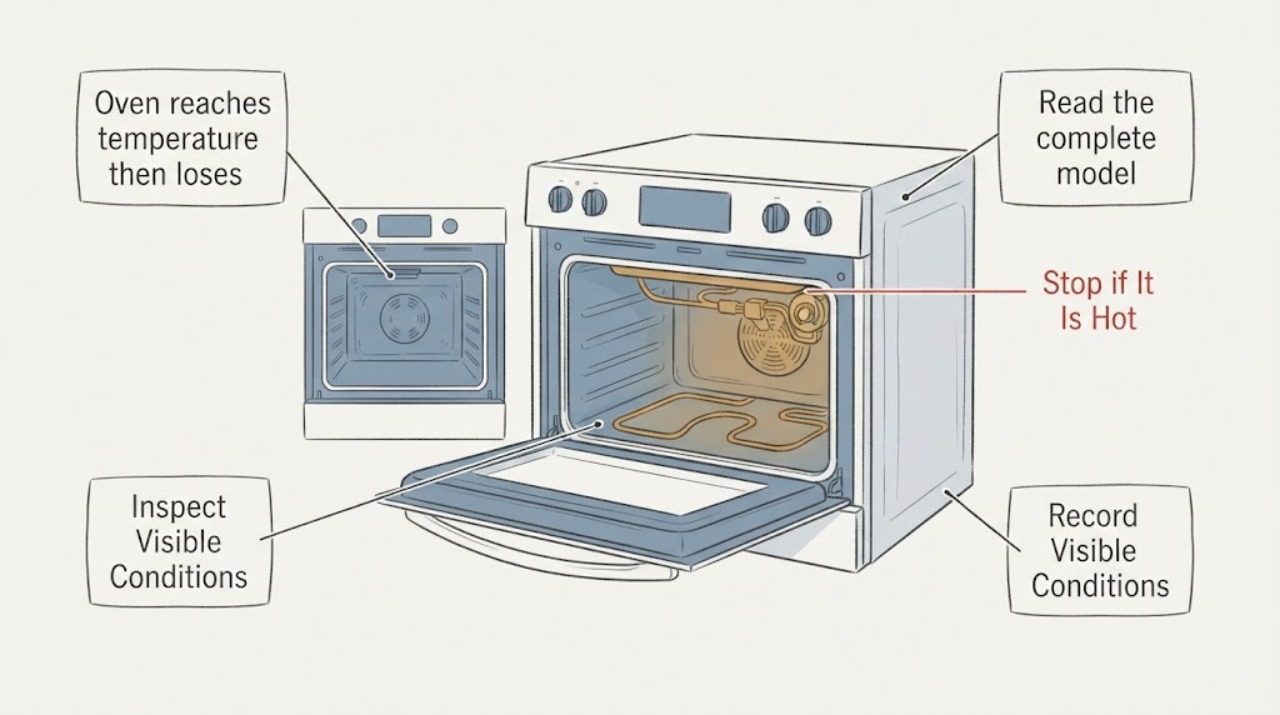
First confirm the complete Kenmore model 790.48903001 and whether the oven is an electric wall-oven/microwave combination or another platform; Kenmore's manual library is model-driven, so do not use a similar 790 manual by appearance. In Bake, measure the actual cavity temperature with an oven thermometer over a stable test and compare the trend with the setpoint instead of treating a single swing as a failed part. Check that Bake was started and no delay or alternate mode is active, that the door closes and its visible seal is intact, and that racks or cookware are not blocking the door or obvious vents. Some cycling around the set temperature is expected; a steady downward trend, repeated undercooking, or a display that does not match the cavity reading after these checks needs qualified service. Do not infer a sensor, relay, heating element, or control-board failure, and stop immediately for gas odor, smoke, sparks, burning odor, uncontrolled heat, damaged wiring, or repeated breaker trips.
Work through in order
Diagnostic checks
Use only checks that match the exact appliance or system and its official guide.
-
Check 1
Read the complete model and serial label, preserving every character in 790.48903001 and any suffix. Identify from the label and manual route whether the appliance is the oven cavity of a wall-oven/microwave combination and whether its heat source is electric or gas; do not move a built-in unit or remove a panel to find it.
Expected result: The complete label and platform are confirmed, or the number is incomplete, unreadable, or maps to more than one product description.
Next step: Use only the manual that matches the full label. If the platform remains uncertain, keep troubleshooting at the external symptom level and arrange model-specific support rather than guessing a part.
Why this matters
Why: Kenmore's manual library requires a complete model number; a similar 790 prefix or a different fuel/platform can change the controls, expected cycle, and safe service procedure.
-
Check 2
With the oven cool and safe, place an oven thermometer where the exact manual permits, start one normal Bake cycle at a documented setting, and record the actual temperature trend without repeatedly opening the door or changing the setting.
Expected result: The temperature cycles around the setpoint, reaches it then steadily falls, or the thermometer disagrees with the display while food repeatedly undercooks.
Next step: Repeat only the model-approved measurement if needed, keeping the test consistent. If the trend remains abnormal, stop owner diagnosis and provide the readings and cycle details to qualified service.
Why this matters
Why: A bounded cycle can be normal; a persistent downward trend or repeatable mismatch is evidence of a regulation problem but does not identify a sensor, element, relay, or control board.
-
Check 3
Confirm the intended Bake mode and temperature were accepted with Start, and look for a visible delay, lock, Sabbath, clean, warm, or convection setting that changes how the oven heats. Do not borrow a button sequence from another Kenmore model.
Expected result: A delay or different mode is active, the temperature was not confirmed, or the intended Bake cycle is confirmed but the measured temperature still drifts cold.
Next step: Correct only a clearly incorrect setting using the matching manual, then make one controlled observation. If Bake remains unstable, stop repeatedly changing controls and arrange service.
Why this matters
Why: A setting or mode can look like poor temperature holding without a component failure. Once the intended Bake cycle is confirmed, persistent drift needs a different diagnostic path.
-
Check 4
Inspect the closed oven door and its visible seal for a persistent gap, torn or displaced material, or cookware/racks that prevent full closure. Keep the door closed during the test and do not reshape, heat, remove, or replace a seal without exact model confirmation.
Expected result: The door does not close flush, the visible seal is damaged or uneven, an item blocks closure, or the door and seal appear normal.
Next step: Clear only a visible obstruction and arrange exact-model inspection for a damaged or misaligned door/seal. If the seal is normal, continue to service escalation when the measured trend remains abnormal.
Why this matters
Why: Kenmore's care guidance says an uneven oven-door seal can let heat escape. A sound visible seal makes heat loss less likely but does not prove the internal regulation system is healthy.
-
Check 5
From outside the appliance, note whether the display or controls change, whether any error message appears, and whether the household breaker or fuse operates. Do not remove panels, probe wiring, bypass a door lock, or perform a live electrical test.
Expected result: The display is stable and no breaker operates, or the oven shows a recurring code, loses control response, flickers, or trips power.
Next step: Record the exact display and stop using the affected function for a recurring code, unstable controls, or a trip. Use the complete model manual and qualified service; do not name a part from the symptom.
Why this matters
Why: A recurring code or unstable power symptom takes priority over generic temperature adjustments; an ordinary display does not rule out an internal heating or sensing fault.
-
Check 6
Check the appliance area for smoke, gas odor, delayed ignition or unusual flame if the confirmed platform is gas, burning electrical odor, sparks, abnormal heat at controls, damaged glass/wiring, or water near electrical parts. Do not touch a suspected hot spot or relight a gas appliance after an odor.
Expected result: No immediate hazard is present, or a gas, fire, burn, or electrical warning appears.
Next step: Turn controls off and keep clear. For gas odor or fire danger, leave and follow local emergency guidance; for smoke, sparks, abnormal heat, damaged wiring, or water near electrical parts, seek urgent qualified help. Do not restart to obtain another reading.
Why this matters
Why: A normal temperature test is not appropriate during a safety event, and a hazard cannot be resolved by calibration or part replacement speculation.
Use your observations
Decision map
Find the observation that best matches what you see, then follow the next safe action.
-
PATH 01Next step
What you see
A consistent Bake test reaches the set temperature and then cycles within a bounded range, with no repeated undercooking and no safety symptom.
Do this next
Use the exact manual for the model's cooking and measurement guidance, keep the door closed, and monitor repeat results before requesting parts or repair.
Why this path and its safety boundary
Why it matters: The observed variation may be normal temperature regulation rather than proof of a failed component.
-
PATH 02Next step
What you see
The measured temperature steadily falls after reaching the target, food repeatedly undercooks in Bake, and settings, door closure, and visible seal are normal.
Do this next
Stop owner diagnosis and arrange qualified model-specific service with the complete model, platform, temperature record, cycle, rack position, and display observations. Do not buy a part on the temperature symptom alone.
Why this path and its safety boundary
Why it matters: A persistent regulation or heating problem is more likely, but the outside observations cannot distinguish a sensor, heating element, relay, wiring, or control issue.
-
PATH 03Next step
What you see
The model or fuel/platform cannot be confirmed, or the number does not resolve to one matching Kenmore manual.
Do this next
Obtain the complete rating-plate information through Kenmore's manual/support route and keep the oven out of service if it is heating abnormally or the cause is unclear.
Why this path and its safety boundary
Why it matters: A model-specific calibration, reset, code meaning, or part fit is unresolved; another 790 procedure could be wrong or unsafe.
-
PATH 04Next step
What you see
The door has a visible gap or damaged seal, a rack or cookware prevents closure, or the door will not close normally.
Do this next
Clear only the visible obstruction and stop if the door or seal remains damaged. Have the exact model and door assembly inspected rather than reshaping or replacing parts by appearance.
Why this path and its safety boundary
Why it matters: Heat loss or door alignment is a plausible contributor, while a damaged seal does not establish the correct replacement part.
-
PATH 05Next step
What you see
Smoke, gas odor, unusual flame or ignition, burning odor, sparks, uncontrolled heat, damaged wiring/glass, water near electrical parts, or a repeated breaker trip appears.
Do this next
Turn controls off, leave the area for gas or fire danger, disconnect power only from a safe location, and seek qualified appliance, gas, electrical, or emergency help as appropriate.
Why this path and its safety boundary
Why it matters: This is an immediate stop-use condition, not a temperature-calibration problem.
Helpful context
Understand the symptom
Normal cycling versus a persistent temperature problem
An oven regulates heat by cycling its heating system, so the cavity can move above and below the setpoint. The useful distinction is whether a correctly started Bake cycle settles into a repeatable range or keeps drifting colder and undercooks food. Verify the actual cavity temperature with an oven thermometer and record the cycle, rack position, door openings, and elapsed time. A display that reaches the target once does not prove that a sensor, relay, element, or control board is healthy, and a visible cycle pause does not by itself prove a failure.
Confirm the platform before any deeper diagnosis
The supplied number is a detailed Kenmore identifier, but the article cannot safely substitute an unverified platform manual. Kenmore's official support route is model-based; use the complete label and confirm whether this is the oven cavity of a wall-oven/microwave combination, and whether it is electric or another configuration, before following reset, calibration, or service instructions. Do not open a control area or test energized wiring to identify the platform.
When to stop
A temperature complaint becomes a safety issue if heat is uncontrolled, smoke or a burning smell appears, gas is suspected, sparks are visible, wiring or glass is damaged, water reaches electrical parts, or the breaker trips again. Turn the controls off, keep clear, and use qualified appliance or emergency help as appropriate. Do not keep running Bake to reproduce the symptom.
When checks do not resolve it
Need a professional?
Arrange qualified Kenmore appliance service when a consistent Bake test shows a persistent downward temperature trend, repeated undercooking, a recurring display code, unstable controls, a door or seal problem, or an unconfirmed platform. Seek urgent help for gas odor, smoke, unusual flame or ignition, sparks, burning odor, uncontrolled heat, damaged wiring or glass, water near electrical parts, abnormal heat, or a repeated breaker trip.
Have this ready
- Provide the complete model and serial label, fuel/platform, Bake setting and start sequence, thermometer readings and test conditions, door/seal observations, any display message, breaker behavior, and every odor, flame, smoke, or heat observation.
Common questions
FAQ
Is it normal for a Kenmore oven temperature to move after it reaches the setpoint?
Some cycling is expected, so measure a consistent trend rather than reacting to one reading or one burner/element pause. A steady fall with repeated undercooking is not explained by normal cycling alone and needs model-specific service.
Should I replace the temperature sensor or heating element first?
No. The complete platform, actual temperature trend, Bake settings, door seal, and any display or power symptom should be recorded first. Those observations do not identify a specific component or compatible part.
What should I do with food if the oven is not holding temperature?
Do not rely on appearance or cooking time when the oven is unstable. Use a food thermometer and follow safe cooking guidance; stop using the oven if it cannot maintain the required cooking condition or shows any gas, smoke, flame, electrical, or uncontrolled-heat warning.
Read the exact guide
Official sources
- Find Your Manual | Kenmore Appliance Manuals & GuidesKenmore · Official Kenmore manual finder; the supplied 790 48903001 must be matched to the complete model and product type before applying controls or service instructions.
- Appliance Maintenance Tips to Help Maximize EfficiencyLivemore by Kenmore · General Kenmore appliance care guidance; it supports visible seal checks and service escalation, not model-specific parts or calibration values.
- Refrigerator Thermometers - Cold Facts about Food SafetyU.S. Food and Drug Administration · Used only for the article's food-safety reminder about not relying on appearance or unsafe conditions; it does not diagnose oven components.
Community feedback
Share a repair observation
Share a plain-text repair observation. Accepted observations are published automatically; this page may take a moment to update.