
On this page
Start here
Quick answer
An LG gas oven that does not maintain its set temperature should first be checked from the outside: confirm the temperature scale, selected mode and START confirmation, preheat as the recipe requires, keep the door closed, and compare the result with the exact model's owner's manual. LG says temperature ranges, rack guidance and thermostat adjustment vary by model, and some named LG gas families intentionally run hotter during preheat only; those values cannot be applied to an unidentified oven. If there is a gas odor, delayed or failed ignition, abnormal flame, smoke or an electrical burning smell, stop using the oven and do not keep testing it. Gas connections and service should be handled by an authorized licensed installer, service agency or gas supplier; the igniter, sensor, valve and control should not be diagnosed or replaced from this symptom alone.
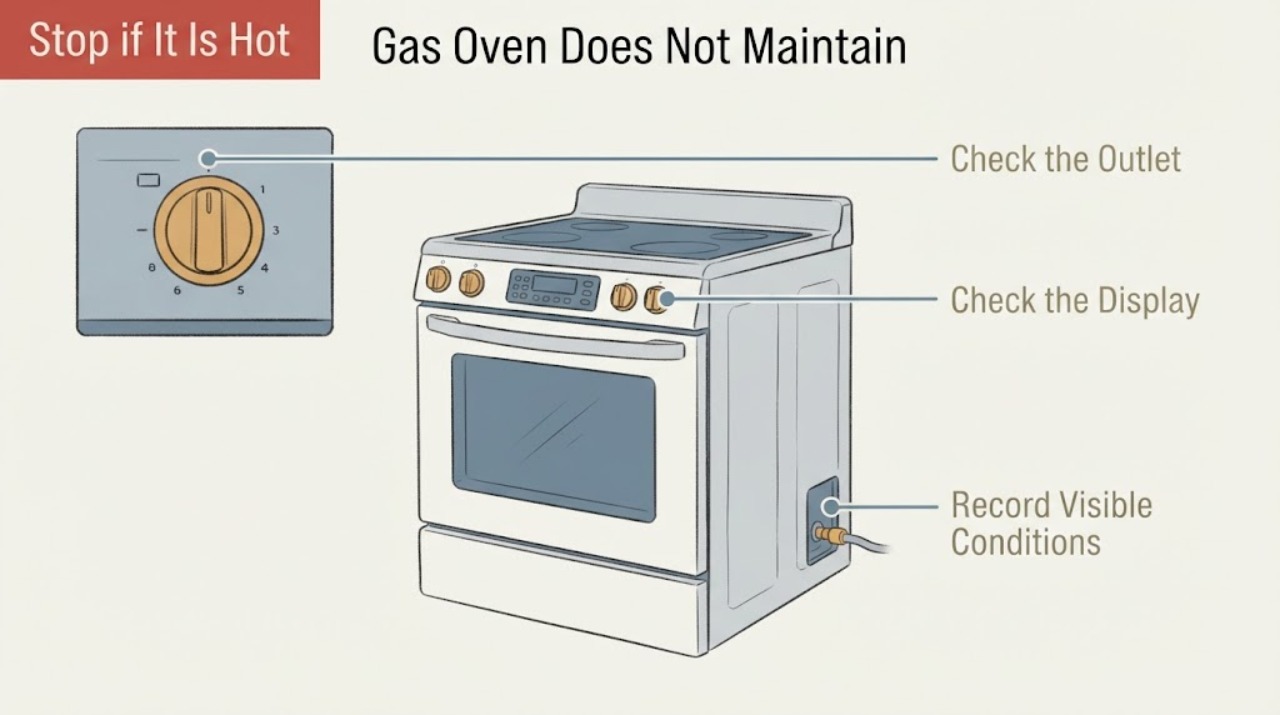
Work through in order
Diagnostic checks
Use only checks that match the exact appliance or system and its official guide.
-
Check 1
Before another heating cycle, check only for a gas odor, delayed or failed ignition, an unusual yellow or lifting flame, smoke, sparking, or a burning-electrical smell from the range or outlet.
Expected result: Any gas odor, ignition failure, abnormal flame, smoke, sparking or burning-electrical smell is present.
Next step: Turn the oven controls off if that is safe, leave the area if the odor is strong or worsening, avoid flames and electrical switching near a suspected gas leak, and contact the gas supplier, emergency services or an authorized appliance service provider from a safe location. Do not relight, repeat the cycle, remove panels or test live wiring.
Stop if: Stop using the oven immediately for gas odor, failed ignition, abnormal flame, smoke, sparking or burning odor.
Why this matters
Why: The temperature symptom is accompanied by a potential fuel, combustion or electrical safety condition; it is not a routine calibration problem to keep testing.
-
Check 2
With no safety warning present, verify the displayed temperature scale, cooking mode, set temperature and START confirmation. If the temperature was changed, press START within the model's stated confirmation window and note whether the oven actually begins heating.
Expected result: The scale or mode was wrong, the setting was not confirmed, or the oven starts normally after the correct setting is entered; alternatively, the same fluctuation remains with the correct setting.
Next step: Use the exact owner's manual for the model's modes, temperature range and confirmation behavior. If the correct setting is confirmed but the oven still fails to maintain temperature, record the setpoint and observed behavior and continue with the external checks or arrange service.
Why this matters
Why: A wrong scale, mode or unconfirmed setting can mimic poor temperature control. Persistent fluctuation after a correctly confirmed setting needs a model-specific assessment rather than a guessed part.
-
Check 3
Compare the complaint after the oven has completed its normal preheat, using a suitable oven thermometer if one is already available and keeping the door closed. Record the setpoint, the reading, whether the burner cycles, and whether the problem occurs during preheat or during the timed bake period.
Expected result: The difference is confined to preheat, or the oven remains materially inconsistent after preheat; opening the door or the measuring method changes the result.
Next step: Do not apply another model's calibration value. Photograph or record the model and serial label, setpoint and observations for an LG-qualified technician, and stop testing if any gas or ignition warning appears.
Why this matters
Why: LG documents model-specific higher preheat behavior and warns that door opening delays or restarts cooking. A preheat-only difference cannot be interpreted with the published offsets without the model; a repeatable bake-period problem is a reason to consult the model manual or service.
-
Check 4
With the oven cool, inspect only the external door closure and gasket area, rack position and pan spacing. Use the model manual for rack placement, keep the door closed while cooking, and do not cover a whole rack or the oven bottom with foil.
Expected result: The door does not close normally, a rack or pan blocks circulation, or foil covers a rack or oven opening; alternatively, these conditions are normal and the temperature problem remains.
Next step: Correct only the external loading or placement issue allowed by the exact manual. If the door, gasket or oven structure is damaged, or the symptom persists with normal placement, stop short of disassembly and arrange model-specific service.
Why this matters
Why: Door heat loss, blocked circulation, rack position and food loading can change cooking results without proving a gas or control failure. If these external conditions are correct and the symptom remains, the cause is unresolved.
-
Check 5
If the range was recently moved or cleaned and there is no gas odor or abnormal flame, look from a safe position for an obviously closed external gas shutoff; do not remove a regulator protector, handle a gas line or change a conversion setting.
Expected result: The range was moved and the external shutoff is visibly closed, or the shutoff is open but heating remains inconsistent; the valve location or status is uncertain.
Next step: For an uncertain or abnormal gas condition, leave the gas connection untouched and contact an authorized licensed installer, service agency or gas supplier. Do not perform a live ignition test or gas-pressure adjustment.
Why this matters
Why: LG says loss of gas supply can prevent heating and that valve or regulator location depends on the model. An open valve does not identify a failed igniter, sensor, valve or control, and an uncertain valve status requires trained help.
Use your observations
Decision map
Find the observation that best matches what you see, then follow the next safe action.
-
PATH 01Next step
What you see
There is gas odor, delayed or failed ignition, an abnormal flame, smoke, sparking or a burning-electrical smell.
Do this next
Stop using the oven, avoid ignition sources and unsafe electrical switching, leave if necessary, and contact the gas supplier, emergency services or authorized service from a safe location.
Why this path and its safety boundary
Why it matters: A fuel, combustion or electrical hazard cannot be safely distinguished from a temperature-control complaint by remote observation.
-
PATH 02Next step
What you see
The scale, mode or START confirmation was wrong, and the oven behaves normally after the documented setting is corrected.
Do this next
Use the exact model manual and monitor ordinary baking results; do not recalibrate or order a part from the original complaint alone.
Why this path and its safety boundary
Why it matters: The original symptom can be explained by an unconfirmed or incorrect user setting rather than a proven component failure.
-
PATH 03Next step
What you see
The difference is seen during preheat but settles during baking, and there is no safety warning.
Do this next
Obtain the model number and check its owner's manual. Do not transfer another LG family's preheat offset or thermostat calibration.
Why this path and its safety boundary
Why it matters: LG documents higher preheat behavior for named model families, so a preheat-only difference may be model behavior; the unidentified oven cannot be matched to those values.
-
PATH 04Next step
What you see
The setting is confirmed, external loading and door conditions are normal, and the oven remains inconsistent during baking.
Do this next
Keep the oven out of service if ignition or gas behavior is abnormal; otherwise provide the model and serial, temperature records and symptom timing to an LG-authorized or otherwise qualified gas-appliance technician. Do not open the appliance or replace a sensor, igniter, valve or control based on this symptom alone.
Why this path and its safety boundary
Why it matters: A repeatable symptom remains, but the supplied topic has no model and does not establish which internal or gas component is responsible.
Helpful context
Understand the symptom
What the symptom does and does not establish
A temperature that rises and falls around a set point can reflect normal burner cycling, a measurement method, an incorrect mode or scale, loading and rack conditions, or a fault that needs service. The supplied topic has no model number and does not establish a failed sensor, igniter, valve or control. LG's public guidance treats these checks as model-dependent, so this page stays at safe external observations and does not assign a component diagnosis.
Preheat behavior is not the same as bake behavior
LG says some named gas-range families raise the temperature during preheating, then maintain the set temperature during baking. The page identifies specific model families for the published offsets; with no model supplied here, do not use those numbers to label an oven as defective or to recalibrate it. Compare the symptom after the oven reports preheat and follow the exact owner's manual.
Keep gas and ignition checks outside the user repair boundary
LG says an open gas valve is required for heating and that an igniter that does not work prevents the oven from heating, but it also says the gas-valve location and error-code response vary by model. Those statements support a safe observation and a service handoff; they do not prove which part is failing in an oven that heats inconsistently. Do not open panels, measure live circuits, adjust gas pressure, bypass an interlock or replace an igniter or sensor based on the symptom.
When checks do not resolve it
Need a professional?
Call qualified service when correct settings and safe external checks do not resolve a repeatable bake-period temperature problem, when the door or gas supply status is uncertain, or whenever ignition, flame or gas behavior is abnormal.
Common questions
FAQ
Can a fluctuating temperature be normal during preheat?
Sometimes. LG says some named gas-range families intentionally raise temperature during preheat and then maintain the set temperature during baking. Without the model, those published offsets cannot be applied to this oven.
Should I replace the igniter or temperature sensor?
No part should be selected from this symptom alone. LG's heating guidance discusses igniter operation and model-specific error codes, but a no-model temperature complaint does not establish an igniter, sensor, valve or control failure.
What if the oven was moved recently?
LG says a gas valve may have been shut off when a unit was moved, but the valve and regulator arrangement depends on the model. Observe only from a safe position and use an authorized installer, service agency or gas supplier for gas connections or uncertain conditions.
When should I stop using the oven?
Stop for gas odor, delayed or failed ignition, abnormal flame, smoke, sparking or a burning-electrical smell. Turn controls off only if safe, avoid ignition sources and unsafe electrical switching, and contact the gas supplier, emergency services or qualified appliance service from a safe location.
Read the exact guide
Official sources
- Oven Under Cooking - Gas RangesLG USA Support · Official LG USA support page for gas ranges. It provides external cooking-result checks while stating that temperature ranges and thermostat instructions vary by model.
- Oven Not Heating - Gas RangesLG USA Support · Official LG USA support page for gas ranges. It supports family-level external checks and explicitly says gas-valve location and error-code handling vary by model; no exact model is supplied by this task.
- LG Range – How to Install a Gas RangeLG USA Support · Official LG USA gas-range installation guidance. It supports the professional boundary for gas connections and service, not a diagnosis of this unidentified oven's temperature complaint.
- Oven Over Cooking - Gas RangesLG USA Support · Official LG USA support page for gas ranges. It names particular LG model families for preheat offsets; because this task has no model, only the existence of model-specific behavior is used.
Community feedback
Share a repair observation
Share a plain-text repair observation. Accepted observations are published automatically; this page may take a moment to update.