
On this page
Start here
Quick answer
Treat a gas-like smell from an LG gas oven as a possible gas leak until a qualified gas supplier or appliance professional says otherwise. Turn the oven and burners off if they are already within reach, do not try to relight anything, do not touch electrical switches or use a phone inside, and leave the building. From a safe location, call your gas supplier or emergency services and follow their instructions. Do not move the range, inspect the connector, test a fitting, or restart the oven yourself. A temporary odor from a brand-new range or a food or burning smell is a different possibility, but it should only be considered after the immediate gas-leak response and only when the appliance and home have been declared safe. If anyone has headache, dizziness, nausea, weakness, confusion, or breathing trouble, stay outside and request emergency medical help.
Before you begin
Safety first
- Do not move the appliance, test gas fittings, adjust gas components, relight the oven to reproduce the odor, or enter a building that has not been cleared by the gas supplier or emergency authority.
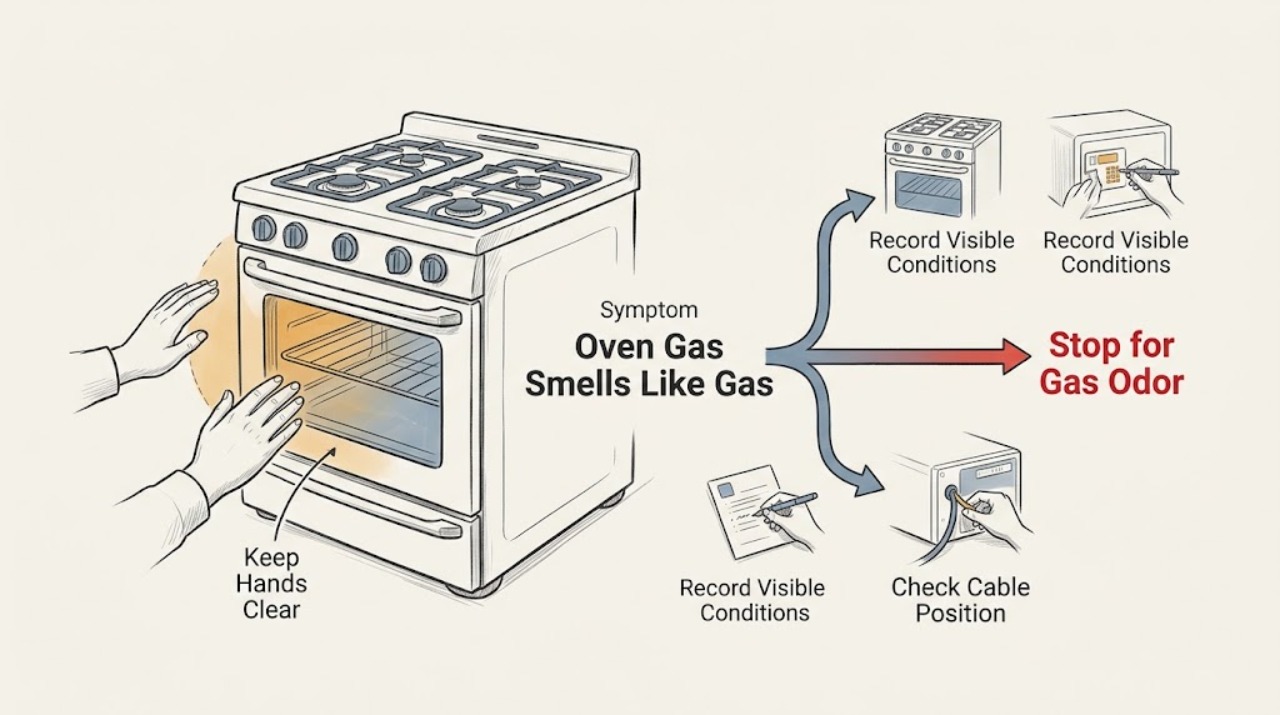
Work through in order
Diagnostic checks
Use only checks that match the exact appliance or system and its official guide.
-
Check 1
If the LG oven or surrounding room smells like fuel gas now, stop using the oven and burners. If a control is immediately within reach without delay or passing through the odor, turn it off; do not try to relight anything, operate a switch, use a phone, create a flame, or investigate the source indoors. Leave the building with people and pets.
Expected result: The odor is present, there is hissing or blowing, a flame is abnormal or out, the smell persists after leaving, or anyone feels unwell.
Next step: From outside or a neighbor's location, call the gas supplier or emergency services and follow their instructions. Do not return, restart, or operate the LG oven until the responsible authority or qualified professional says it is safe.
Why this matters
Why: Any of these patterns is compatible with a gas-release or combustion hazard that cannot be safely distinguished by an indoor visual check. An absent smell after leaving does not prove that the appliance or gas line is safe.
-
Check 2
From a safe location, record only what was already noticed before evacuation: whether the odor began during bake or broil, after a burner failed to ignite, after the oven was turned off, after installation or movement, or without any appliance operation. Do not go back inside to repeat the test or locate the smell.
Expected result: The odor followed an ignition failure, appeared while the oven was off, began after installation or moving the range, or was accompanied by smoke, soot, a yellow flame, hissing, or no visible symptom.
Next step: Give the timeline and LG model number to the gas supplier, emergency responder, or qualified appliance professional. Do not move the range, remove a connector, check a valve, or perform a leak test yourself.
Why this matters
Why: The history helps the gas supplier or technician choose the next inspection, but none of these patterns proves that the appliance is safe. LG identifies gas connection and installation work as professional tasks, and CPSC warns that moving an appliance can damage an older connector.
-
Check 3
After the gas supplier or emergency authority has cleared the building, ask a qualified professional to inspect the LG range's gas connection, shutoff, regulator, valves, burner system, and combustion setup as applicable to the exact model. Keep the appliance in place and do not open or adjust gas components during this process.
Expected result: The professional finds a leak or installation fault, identifies an ignition or combustion issue without a leak, finds no fault, or says the exact model information is needed before testing.
Next step: Follow the professional's repair, replacement, ventilation, and return-to-use instructions. If the odor returns, repeat the evacuation response rather than trying another home test.
Why this matters
Why: A gas odor can originate in the connection path or from unburned gas during ignition; the location and repair decision require trained gas-service evaluation. A no-fault result is not a reason to bypass the professional's return-to-use instructions.
-
Check 4
Once the appliance and home are explicitly cleared, compare the odor description with LG's limited non-gas examples: a temporary smoky or manufacturing odor from a brand-new range, or a food-residue burning smell. Do not use this comparison while a fuel-gas odor is still possible or before professional clearance.
Expected result: The odor occurred only during initial use and was described as smoke or packaging, or it tracks with food residue; otherwise it smells like fuel gas, persists when the oven is off, or returns after cleaning.
Next step: For a cleared new range, follow the exact model's ventilation and break-in instructions. For food residue, clean only as the model guide allows. For a persistent or fuel-like smell, stop use and call the gas supplier or qualified service again.
Why this matters
Why: LG says new-range manufacturing residue and food residue can produce temporary non-gas odors. A fuel-like, persistent, or unexplained odor remains a gas-safety issue even if the oven is new or contains food residue.
-
Check 5
Ask everyone who was near the oven whether anyone has headache, fatigue, nausea, dizziness, weakness, confusion, shortness of breath, or other illness after the odor or appliance use. Make this check outside or after medical responders advise it; do not remain indoors to monitor symptoms.
Expected result: Anyone has symptoms, a carbon-monoxide alarm sounded, or no one has symptoms and no alarm sounded.
Next step: For symptoms or an alarm, stay in fresh air and request emergency medical and fire-service guidance. For no symptoms, still follow the gas supplier or qualified professional's clearance and do not resume use based only on smell disappearing.
Why this matters
Why: Carbon monoxide cannot be smelled, and CPSC lists these symptoms as possible exposure signs. No symptoms or alarm does not rule out a gas leak or combustion fault.
-
Check 6
Before the next use after service, confirm that the responsible gas supplier or qualified appliance professional has identified what was corrected and has authorized operation for the exact LG model. Keep the service record, model number, and any recurring odor timeline together.
Expected result: The cause and correction are documented and the appliance is cleared, the cause is uncertain, or the smell returns when operation resumes.
Next step: Use the oven only after explicit professional clearance. If the odor returns, stop immediately, evacuate, and call from outside; do not reset, relight, or replace a part to see whether the smell goes away.
Why this matters
Why: A documented clearance separates a repaired gas system from an unverified assumption. A recurring odor or uncertain correction means the hazard remains unresolved, even if the oven appears to ignite or heat.
Use your observations
Decision map
Find the observation that best matches what you see, then follow the next safe action.
-
PATH 01Next step
What you see
A fuel-like odor, hissing, or an unlit burner is present now.
Do this next
Leave immediately without operating switches or phones inside, then call the gas supplier or 911 from a safe location. Do not return until authorities clear the building.
Why this path and its safety boundary
Why it matters: This is an active possible gas-release situation, not a normal oven-odor troubleshooting case.
-
PATH 02Next step
What you see
The smell started after the LG oven was installed, moved, or serviced.
Do this next
Evacuate if the odor is present and tell the gas supplier or licensed service professional exactly when the work occurred. Do not pull out the range or inspect the connector.
Why this path and its safety boundary
Why it matters: A connection or installation issue needs professional attention; moving the appliance again can worsen an older connector problem.
-
PATH 03Next step
What you see
The smell is reported as smoky or like packaging during first use of a new, professionally cleared LG range, and there is no fuel-like odor, hissing, or ignition problem.
Do this next
Follow the exact model's initial-use and ventilation instructions. Stop and escalate if the odor changes to fuel gas, persists beyond the expected break-in, or appears with an abnormal flame or ignition failure.
Why this path and its safety boundary
Why it matters: LG identifies temporary manufacturing or packaging odor as a possible new-range condition, but this distinction is safe to consider only after gas safety has been established.
-
PATH 04Next step
What you see
The oven has been cleared, and the odor tracks with food residue rather than fuel gas.
Do this next
Use the model-approved cool-oven cleaning method. Do not use this explanation to dismiss a returning gas-like smell or an odor that continues while the oven is off.
Why this path and its safety boundary
Why it matters: LG says oil stains or food residues can smell like burning when heated, which is a different mechanism from unburned gas.
-
PATH 05Next step
What you see
Someone has headache, nausea, dizziness, weakness, confusion, shortness of breath, or a carbon-monoxide alarm after using the gas oven.
Do this next
Stay outside in fresh air and call emergency services or request medical help. Do not re-enter to turn off equipment or investigate symptoms.
Why this path and its safety boundary
Why it matters: Possible combustion exposure needs emergency evaluation; carbon monoxide itself has no smell, so an odor-free room is not a safety test.
-
PATH 06Next step
What you see
The odor returns after professional service or there is no documented clearance for the exact LG model.
Do this next
Stop use, evacuate if the smell is present, and contact the gas supplier or qualified service again. Do not replace a connector, adjust the regulator, or relight the oven as a test.
Why this path and its safety boundary
Why it matters: The gas or combustion hazard is unresolved; ignition and heating do not prove that a connection or valve is safe.
Helpful context
Understand the symptom
Leave first; diagnose later
A gas-like odor is not a normal troubleshooting invitation. If the smell is present now, do not open panels, pull out the LG range, spray a leak detector, relight a burner, or search for the source indoors. Get people and pets outside, then call from a safe location. A technician or gas supplier can decide whether the cause is a connector, valve, regulator, burner, installation, or another gas-line problem.
Do not confuse a new-appliance odor with gas
LG says a new range can have a temporary smoky or manufacturing odor, and food residue can create a burning smell. Those descriptions are not permission to ignore an odor that smells like fuel gas, appears with hissing or ignition trouble, or returns after the oven is off. Only after the gas supplier or qualified service professional clears the appliance should a non-gas odor be investigated.
Safety boundary
Stop conditions
- If a gas-like smell is present, do not relight a burner or oven, operate an electrical switch, use a phone inside, light a match, spray or test a fitting, or remain indoors to locate the source. Leave and call from a safe location.
- Do not move the LG range to inspect a connector, loosen gas fittings, adjust a regulator, open gas lines, or replace a gas component as a home test. LG and CPSC reserve gas-connection work for qualified professionals.
- Do not resume operation after the odor disappears until the gas supplier or qualified appliance professional has cleared the building and exact LG model. Treat recurring odor, hissing, abnormal flame, smoke, or possible carbon-monoxide symptoms as an immediate stop condition.
Only after diagnosis
Potential parts
- gas appliance connector or connection seal
Consider only after a qualified gas professional identifies a leaking, corroded, improperly installed, or otherwise failed connector or seal and declares the appliance safe to repair.
Gas connectors and seals depend on the exact LG model, fuel type, installation, and local requirements. Do not select or install one from an odor symptom alone. - LG gas valve, regulator, or ignition component
Consider only when qualified diagnosis after the gas-safety response identifies a valve, regulator, ignition, or combustion component as the cause of unburned gas or abnormal operation.
Gas and ignition components are model-specific and require professional installation and testing. Confirm the exact LG model and service procedure before any part selection.
When checks do not resolve it
Need a professional?
Call the gas supplier or emergency services immediately from a safe location whenever an LG oven smells like fuel gas, hisses, has an unlit burner, or causes symptoms. After the immediate response, arrange an authorized licensed appliance or gas professional to inspect the exact model and connection. Do not return to use based on a temporary disappearance of odor or a self-test.
Safety scope: Do not move the appliance, test gas fittings, adjust gas components, relight the oven to reproduce the odor, or enter a building that has not been cleared by the gas supplier or emergency authority.
Common questions
FAQ
What should I do first if my LG gas oven smells like gas?
Stop using it and leave the building. Do not light anything, operate electrical switches, or use a phone inside. From outside or a neighbor's location, call the gas supplier or 911 and follow instructions. Do not return or restart the oven until the building and appliance are cleared.
Can a new LG oven normally smell like gas?
LG describes a temporary smoky or manufacturing odor from a new range, but that is not a reason to dismiss an odor that smells like fuel gas. Treat a gas-like smell as a possible leak first; only after professional clearance should a new-appliance odor be considered.
Can I pull out my LG range to check the gas connector?
No. CPSC warns that moving an appliance can cause a weakened connector to fail and says connector inspection or replacement is for a qualified professional. LG likewise says not to handle gas connections or lines yourself.
How can I tell a food burning smell from a gas smell?
Do not make that distinction indoors while the odor is active. After the gas supplier or qualified professional clears the appliance, LG says food residue or oil stains can create a burning smell. A fuel-like, persistent, unexplained, or returning odor requires another stop, evacuation, and gas-safety call.
Can a gas oven smell be related to carbon monoxide?
Carbon monoxide itself is odorless, so smell is not a carbon-monoxide test. If anyone has headache, nausea, dizziness, weakness, confusion, or breathing trouble, get outside and request emergency medical help. Do not re-enter to investigate or restart the oven.
Read the exact guide
Official sources
- LG New Range - Strong Odor or SmokeLG USA Support · LG new range or oven initial-use guidance; it applies only after a gas-like odor has been ruled out and the appliance is safe to use.
- gasU.S. Consumer Product Safety Commission · CPSC consumer safety bulletin for suspected gas leaks and older appliance connectors; emergency instructions take priority over appliance troubleshooting.
- LG Range – How to Install a Gas RangeLG USA Support · LG gas range installation support page; exact gas connection and fuel-conversion details are model and installation specific.
- Protect Your Family from Carbon Monoxide PoisoningU.S. Consumer Product Safety Commission · CPSC household carbon-monoxide safety guidance relevant to fuel-burning ranges and ovens.
- LG Range - Troubleshooting a Burning Smell From My OvenLG USA Support · LG range support article for a food or residue burning smell; it is not clearance for a fuel-gas odor.
Community feedback
Share a repair observation
Share a plain-text repair observation. Accepted observations are published automatically; this page may take a moment to update.