
On this page
Start here
Quick answer
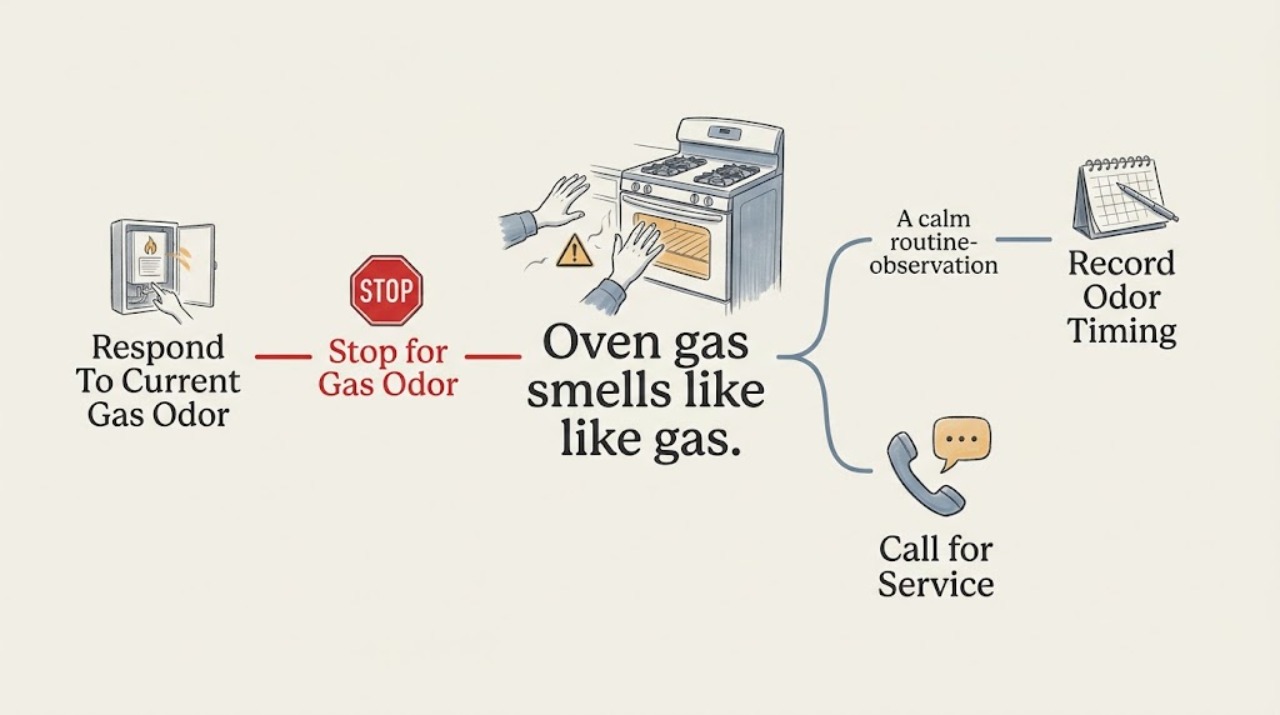
Treat a gas smell from a Frigidaire oven or range as a possible fuel leak until a qualified professional rules it out. If you smell gas now, leave the building and the suspected area immediately; do not light the oven, relight a burner, operate a light switch or appliance, use a phone inside, move the range, or try to find the leak. From a safe location, contact the gas supplier or emergency services. If the odor has already cleared, do not restart the oven just to test it. Record whether the smell occurred before ignition, during an attempted bake, after a burner went out, after cleaning or moving the range, or only as a brief odor at startup, then arrange qualified gas-appliance service. Frigidaire says burner caps, ports, and moisture can affect gas flames, but cleaning or adjustment is not a safe first response to an unexplained gas odor. Exact model, fuel type, installation, connector, ignition, burner, and control details determine the repair path.
Before you begin
Safety first
- This article supports emergency recognition, safe documentation from outside the suspected area, visible-history reporting, and model identification. It does not authorize relighting, gas-valve operation, connector inspection by moving the range, panel removal, leak testing, fuel conversion, or gas-component adjustment.
Work through in order
Diagnostic checks
Use only checks that match the exact appliance or system and its official guide.
-
Check 1
If a fuel or rotten-egg odor is present now, or if the source is uncertain, stop using the Frigidaire oven and leave the building and suspected area immediately. Do not light a burner, press an ignition control, operate a light switch or appliance, use a phone inside, or move the range; contact the gas supplier or emergency services from a safe location.
Expected result: The odor is present now, intensifies, is accompanied by hissing, or is near the oven, range, connector, or wall; or the odor has cleared before this check.
Next step: For a current or worsening odor, remain outside and follow emergency guidance. If the odor has cleared, keep the appliance off and proceed only with documentation for qualified service; do not perform a relight test.
Stop if: Do not re-enter to investigate, turn a valve, open a panel, search for a leak, or make a phone call until you are in a safe location.
Why this matters
Why: A current, strong, repeated, or unexplained fuel odor must be handled as a possible gas leak rather than a normal oven smell. A cleared odor is not proof that the appliance is safe to restart.
-
Check 2
Only after you are in a safe location and the odor is no longer present, write down when it occurred: before any ignition attempt, while the oven was trying to light, after a burner or oven flame went out, during an active bake, after cleaning, after installation or movement, or at an unknown time. Do not recreate the event.
Expected result: The odor was tied to an ignition attempt, followed a flame outage, continued during operation, appeared after installation or movement, or cannot be tied to a safe event.
Next step: Keep the Frigidaire appliance out of service and give the timeline to the gas-appliance technician. If the odor returns, repeat the emergency response rather than testing the same condition.
Stop if: Do not turn the oven or cooktop on to see whether the smell returns, and do not use a flame, detector, spray, or electrical device as a leak test.
Why this matters
Why: Timing helps a technician distinguish an ignition or combustion complaint from a connector, shutoff, valve, or installation concern, but no timing pattern proves that gas is safely contained. An unknown or recurring pattern is higher concern.
-
Check 3
When there is no current odor, the appliance is cool, and you can remain in a safe area, look at the front controls and accessible cooktop without moving the range or opening any panel. Note whether an oven or surface knob appears out of its normal OFF position, a burner cap is visibly displaced, or a spill or moisture is visible; do not operate the controls.
Expected result: A control is not clearly OFF, a burner cap is visibly out of position, moisture or residue is visible, or the accessible surfaces look normal.
Next step: Leave the controls untouched if their state is uncertain, document the visible condition from a safe distance, and arrange qualified service. If the odor returns, leave again and use emergency gas-leak guidance.
Stop if: Do not touch a control that may admit gas, lift a burner cap, wipe near a burner, or continue if any fuel smell returns.
Why this matters
Why: An out-of-position control or visibly displaced cap can help explain a technician's inspection, and Frigidaire identifies cap seating and moisture as flame-related factors. It does not make it safe to relight, clean, or adjust the gas appliance after an unexplained odor.
-
Check 4
Ask anyone who used the Frigidaire range whether a burner or oven flame failed to ignite, went out, burned unevenly or unusually high, or required repeated ignition. Do not relight the appliance to confirm the report, and do not clean burner ports after a gas odor unless a qualified professional directs it under safe conditions.
Expected result: There was no visible flame after gas was admitted, a flame went out, flames were yellow or uneven, ignition was repeatedly attempted, or no flame event is known.
Next step: Keep the appliance off and report the flame history, timing, and any error indication to qualified service. Treat another odor as a new possible leak emergency.
Stop if: Do not keep clicking ignition, hold a control open, probe burner ports, or use a match or lighter to test the oven or cooktop.
Why this matters
Why: A failed ignition or flame-out can leave unburned gas and requires service evaluation; Frigidaire identifies cap seating, moisture, clogged ports, and control position as possible contributors to abnormal flames. The history does not identify a safe owner repair or a specific failed part.
-
Check 5
Record whether the Frigidaire range was recently installed, converted between fuel types, serviced, cleaned around, or moved, and whether the odor was noticed near the back of the range or connector. Do not pull the appliance forward to inspect behind it.
Expected result: The odor followed installation, movement, fuel conversion, service, or cleaning; the appliance has an older or visibly questionable connector from a safe distance; or no installation change is known.
Next step: Leave the appliance in place and provide the history to a qualified gas-appliance professional. If installation is recent, also notify the installer through a safe channel; do not attempt to correct the connection yourself.
Stop if: Do not move the range, bend or touch the gas connector, remove a rear cover, or attempt fuel conversion or regulator adjustment.
Why this matters
Why: A change in installation or movement raises concern for a connector, shutoff, fuel setup, or disturbed connection. The CPSC warns that moving a gas appliance can cause an older weakened connector to fail, so the absence of a visible problem is not clearance.
-
Check 6
Keep the Frigidaire oven and cooktop out of service and prepare the exact model information, fuel type if known, odor timing, flame history, installation or movement history, and safe-distance photos of visible controls or surfaces for qualified service. Do not supply a replacement part or gas adjustment as the presumed fix.
Expected result: The odor was persistent or repeated, the appliance failed to ignite or had a flame-out, the smell followed movement or installation, the model or fuel type is unknown, or the odor has not returned but remains unexplained.
Next step: Arrange qualified gas-appliance service before further use. If an odor returns, leave immediately and contact the gas supplier or emergency services from outside the suspected area.
Stop if: Stop all troubleshooting for any current odor, hissing, fire, suspected damaged connector, carbon-monoxide symptoms, or water or electrical hazard, and use emergency help.
Why this matters
Why: Each pattern warrants professional diagnosis because a gas odor can involve the appliance, connector, shutoff, fuel setup, or building piping. A cleared smell still does not establish that a component is safe.
Use your observations
Decision map
Find the observation that best matches what you see, then follow the next safe action.
-
PATH 01Next step
What you see
A fuel-like or rotten-egg odor is present now, is getting stronger, or has an uncertain source around the Frigidaire oven or range.
Do this next
Leave immediately, avoid ignition and electrical operations, and contact the gas supplier or emergency services from a safe location. Do not return until cleared by the appropriate responders.
Why this path and its safety boundary
Why it matters: This is a possible gas-leak emergency, not a normal troubleshooting opportunity. The appliance must not be relit or moved to locate the odor.
-
PATH 02Next step
What you see
The smell followed clicking, an attempted oven start, a burner that did not light, or a flame that went out.
Do this next
Keep the appliance off and arrange qualified service; report the sequence and whether the odor cleared. Use emergency gas-leak guidance if the odor returns.
Why this path and its safety boundary
Why it matters: Unburned gas or an ignition, burner, cap, moisture, or control problem is possible. Frigidaire lists burner-cap seating, moisture, blocked ports, and knob position as factors in abnormal gas flames, but the history does not make relighting safe.
-
PATH 03Next step
What you see
The smell continued during baking, appeared near the control area or behind the range, or returned after the appliance seemed to be operating normally.
Do this next
Do not operate the oven or cooktop again. Leave the range in place and have qualified gas-appliance service inspect it and the installation.
Why this path and its safety boundary
Why it matters: A connector, shutoff, valve, regulator, combustion, venting, or installation issue remains possible; a normal-looking flame cannot clear the gas path.
-
PATH 04Next step
What you see
The odor began after delivery, installation, fuel conversion, cleaning behind the appliance, or any movement of the range.
Do this next
Do not move it again or inspect behind it. Keep it out of service and arrange qualified professional inspection, providing the installation history.
Why this path and its safety boundary
Why it matters: A disturbed connector, shutoff, fuel setup, or installation connection is more concerning. The CPSC warns that moving an appliance can cause an older weakened connector to fail.
-
PATH 05Next step
What you see
The odor was brief and has cleared, but the owner cannot confidently tie it to a harmless non-gas source or it has happened more than once.
Do this next
Do not recreate the smell. Keep the appliance off, document the timing and model, and arrange qualified gas-appliance service before using it again.
Why this path and its safety boundary
Why it matters: A cleared or intermittent odor is not proof of safe operation; intermittent leaks and ignition faults can be missed by an owner observation.
Helpful context
Understand the symptom
A gas smell is a safety decision before it is a repair diagnosis
A rotten-egg or fuel-like odor around an oven, range, connector, or nearby wall can indicate unburned gas, but smell alone cannot locate the source or tell you whether the appliance is safe. If the odor is present, leave immediately and get help from outside the suspected area. Do not keep testing ignition, checking valves, or searching behind the range.
Do not move the range to inspect the gas connection
The Consumer Product Safety Commission warns that moving a gas appliance can cause an older or weakened connector to fail. A Frigidaire delivery and installation guide also expects a sound gas shutoff at the appliance location and does not make connector inspection a homeowner test. Leave the range in place and have qualified service inspect the installation.
Flame symptoms can explain a service finding, not excuse an odor
Frigidaire lists seated burner caps, dry parts after cleaning, clear burner ports, and the control setting as factors in uneven or overly high flames. These observations can help a technician, but an owner should not relight a burner or clean a burner head while gas odor is present. If there is no current odor and the appliance is cold, limit observations to accessible, visible surfaces and follow the exact manual.
A repeated or unexplained odor needs professional diagnosis
A smell that returns during bake, after an ignition attempt, near the control area, or after the range was moved can involve a connector, shutoff, valve, igniter, burner, regulator, combustion, or installation condition. These components and fuel-conversion details vary by model. Do not buy a part or adjust gas hardware from the symptom alone; provide the model and odor pattern to qualified service.
Safety boundary
Stop conditions
- If gas odor is present, worsening, or unexplained, leave immediately and do not light a burner, operate a switch or appliance, use a phone inside, move the range, or search for the leak; contact the gas supplier or emergency services from a safe location.
- Do not relight a failed oven or surface burner, keep clicking ignition, hold a gas control open, use a match or lighter, or recreate the odor as a test.
- Do not move the Frigidaire range, bend or touch its gas connector, remove rear panels, adjust a regulator or valve, convert fuel type, or disconnect any gas fitting.
- Do not clean burner ports, lift caps, wipe near a burner, or use spray, detector, soap solution, or another improvised leak test when a gas odor is present or the source is uncertain.
- Arrange qualified gas-appliance service before further use for a repeated or unexplained odor, failed ignition, flame-out, unusual flame, odor after installation or movement, suspected connector damage, or any condition requiring gas-path access.
Only after diagnosis
Potential parts
- Frigidaire oven igniter or burner assembly
Consider this category only after qualified diagnosis finds a failed ignition or burner condition and confirms that the exact model's gas and ignition parts are involved.
Confirm the exact Frigidaire model, fuel configuration, and manufacturer's fit information; do not replace or adjust gas components as an odor test. - Frigidaire gas valve or regulator component
Consider this category only when qualified gas-appliance service identifies a valve, regulator, or gas-control fault after isolating the appliance safely.
Gas-control parts and fuel settings are model-specific and professional work; confirm the exact model and approved procedure before any replacement. - Gas appliance connector or shutoff connection
Consider this category only when a qualified professional finds connector, shutoff, corrosion, or installation damage and determines replacement is required.
Do not move the appliance or handle the gas connection to identify a part; the professional must verify the fuel type, local requirements, and exact installation.
When checks do not resolve it
Need a professional?
Use emergency gas-leak help immediately if a fuel odor is present, worsening, or unexplained, especially with hissing, fire, or carbon-monoxide symptoms. Arrange qualified gas-appliance service before using the Frigidaire oven or cooktop again for any repeated odor, failed ignition, flame-out, unusual flame, odor after installation or movement, suspected connector or control problem, or diagnosis that requires opening the gas path.
Safety scope: This article supports emergency recognition, safe documentation from outside the suspected area, visible-history reporting, and model identification. It does not authorize relighting, gas-valve operation, connector inspection by moving the range, panel removal, leak testing, fuel conversion, or gas-component adjustment.
Common questions
FAQ
What should I do if my Frigidaire oven smells like gas right now?
Leave the building and suspected area immediately. Do not light the oven, relight a burner, operate a switch or appliance, use a phone inside, move the range, or search for the leak. From a safe location, contact the gas supplier or emergency services and do not return until the situation is cleared.
Is a brief gas smell when a Frigidaire oven starts always normal?
Do not assume that it is normal when the cause is uncertain, the odor repeats, or the smell continues. Do not recreate the event. Keep the appliance off, record whether the odor occurred before ignition, during an attempted start, or after a flame-out, and arrange qualified gas-appliance service.
Can I relight the Frigidaire oven or clean the burner ports after smelling gas?
No. Do not relight, keep clicking ignition, hold a control open, or clean around the burner as a test after an unexplained gas odor. Frigidaire identifies cap seating, moisture, and port condition as flame-related factors, but a suspected leak or failed ignition requires safe professional diagnosis.
Should I pull my Frigidaire range out to inspect the gas connector?
No. The Consumer Product Safety Commission warns that moving a gas appliance can cause an older weakened connector to fail. Leave the range in place and have a qualified professional inspect the connector, shutoff, installation, and appliance when the area is safe.
When does a Frigidaire oven gas odor require service?
Use emergency gas-leak help for any current, worsening, or unexplained fuel odor. Arrange qualified gas-appliance service before further use for a repeated brief odor, failed ignition, flame-out, unusual flame, odor after installation or movement, suspected connector problem, or any diagnosis requiring access to gas components.
Read the exact guide
Official sources
- Gas Cooktop Ignition Port Cleaning GuideFrigidaire · Frigidaire's cleaning guidance for gas cooktops and ranges; use only under the exact manual and only when there is no gas odor or suspected leak.
- What should I do if my gas flames are uneven or too high?Frigidaire · Frigidaire support guidance for gas ranges and cooktops; it does not authorize relighting or owner gas-path repair after an unexplained gas odor.
- What should I do if some or all of my burners are not lighting?Frigidaire · Frigidaire support guidance for burners that do not light; it is not permission to relight or troubleshoot during a gas odor event.
- Delivery and Installation Guide - Duel Fuel or Gas RangeFrigidaire · Frigidaire's general delivery and installation guidance for dual-fuel or gas ranges; exact installation requirements vary by model and jurisdiction.
- How do I use my display or controls?Frigidaire · Frigidaire general controls guidance; it does not replace the exact gas appliance manual or emergency gas-leak instructions.
- Certain Older Gas Connectors May Be DangerousU.S. Consumer Product Safety Commission · Official CPSC safety alert for gas-appliance connectors and suspected gas leaks; it is emergency safety guidance, not a Frigidaire model repair manual.
- What To Do If Your Gas Range Won't StartFrigidaire · Frigidaire gas-range support page; it provides limited start-failure context and does not authorize repeated ignition attempts when gas odor is present.
Community feedback
Share a repair observation
Share a plain-text repair observation. Accepted observations are published automatically; this page may take a moment to update.