
On this page
Start here
Quick answer
Treat a gas smell from an Amana oven as a gas-safety issue until it is clearly ruled out. Turn the oven controls off without trying to relight anything; do not touch electrical switches or use a phone inside the building. Leave the area and call the gas supplier from outside or from a neighbor's phone, following its instructions. If the smell is only a new-oven manufacturing odor, Amana says it should fade after initial use, but a persistent, sulfur-like, unexplained, or returning gas odor is not a user-adjustment problem. Do not test the burner, purge the line, remove panels, or keep using the oven until the gas supplier or a qualified appliance professional says it is safe.
Before you begin
Safety first
- Keep the oven off for any gas odor, hissing, smoke, fire, damaged connector, abnormal flame, repeated ignition, or water or electrical damage. Do not relight, purge, adjust, bypass, or open the gas appliance.
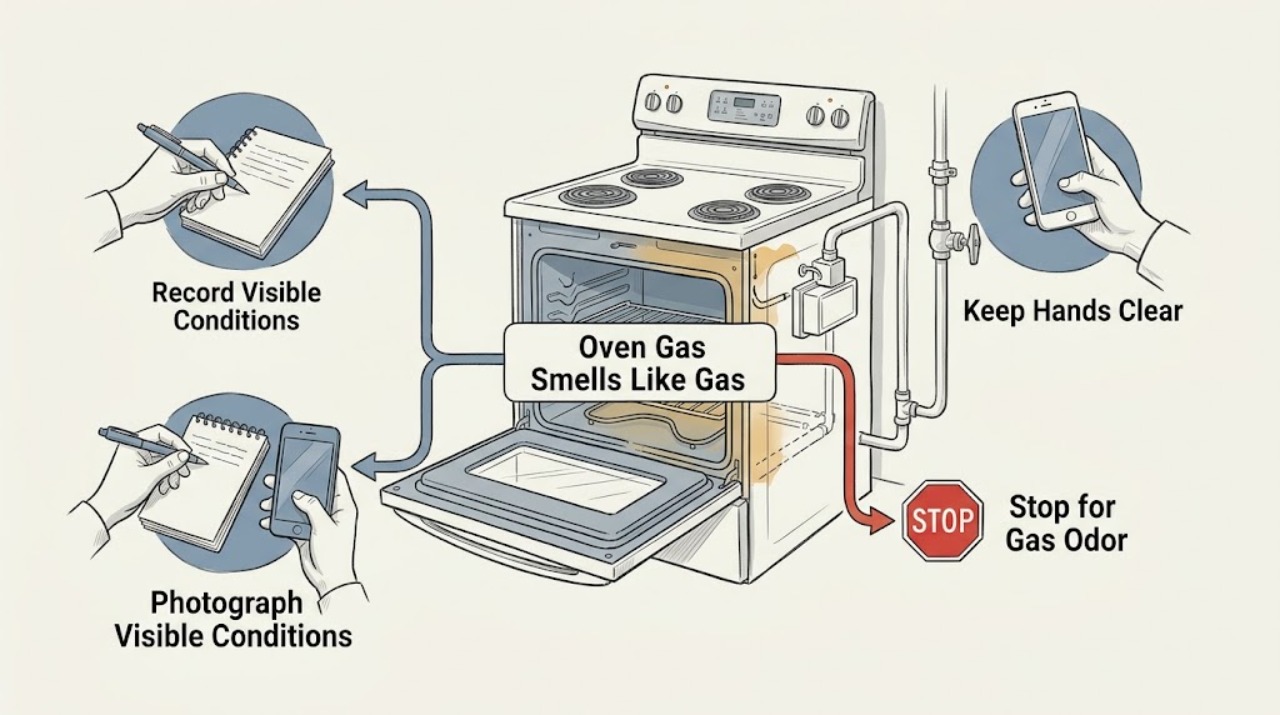
Work through in order
Diagnostic checks
Use only checks that match the exact appliance or system and its official guide.
-
Check 1
If you smell gas now, stop the oven and all ignition attempts. Do not light an appliance, touch an electrical switch, use a phone inside, or operate a vent or light. Leave the building or area and call the gas supplier from outside or from a neighbor's phone; follow its instructions.
Expected result: The odor is strong, persistent, present while the oven is off, accompanied by hissing, or noticeable beyond the immediate oven area.
Next step: Stay outside and wait for the gas supplier, fire department, or qualified responder. Do not return to inspect knobs, valves, burner flames, or wiring until they say it is safe.
Why this matters
Why: These observations are consistent with an active gas-safety concern and cannot be safely distinguished from a harmless oven odor indoors.
-
Check 2
After the gas supplier or emergency responder has cleared the area, record when the odor was noticed without relighting the oven: before any use, during ignition, during baking, after shutoff, or only after a recent installation or gas reconnection.
Expected result: The odor was present while the oven was off, began at ignition, continued during operation, returned after shutoff, or began after installation or reconnection.
Next step: Give the timing, duration, odor location, and whether any hissing or abnormal flame was previously seen to the gas supplier or service technician. Do not repeat a start-up test to reproduce it.
Why this matters
Why: Timing helps the qualified responder distinguish a possible supply or ignition issue from a new-oven or cooking-residue odor, but timing alone does not prove that gas is safe.
-
Check 3
Identify the exact Amana model and whether it is a freestanding range, slide-in range, or wall oven using the label, paperwork, or a photograph taken from a safe location. Locate the matching owner manual and installation instructions without opening the appliance.
Expected result: The model and fuel type are clear, the appliance was recently installed or reconnected, or the model and fuel arrangement cannot be confirmed.
Next step: Give the model and installation history to the gas supplier, installer, or qualified service technician. Do not apply a procedure from a different Amana range or wall oven.
Why this matters
Why: Amana's gas guidance and ignition, regulator, air-mixture, and shutoff arrangements are model- and installation-dependent; an unknown model makes a guessed repair unsafe.
-
Check 4
Only after the gas concern has been cleared and the appliance is cool, inspect the oven cavity for remaining shipping materials, foil or liners, heavy food soil, or spilled cooking residue. Do not cover the oven bottom or block the oven vent, and do not start a cleaning cycle to mask a gas odor.
Expected result: The smell began with a new installation and packaging or coatings were present, or the oven is heavily soiled or lined with foil; alternatively, the cavity is clean and the odor was unmistakably gas-like.
Next step: Remove only loose packaging or a removable cool rack as the manual permits. For persistent odor, any suspected combustion issue, or uncertainty, leave the oven off and arrange qualified service.
Why this matters
Why: Amana identifies new materials and heavy soil as possible non-gas odor sources, and warns that lining the oven bottom can trap debris and impair combustion in gas stoves. A clean cavity does not rule out a gas fault.
-
Check 5
If the range was recently installed or reconnected, do not attempt to purge air from the gas line or adjust the regulator. Record whether the fuel is natural gas or LP and whether a conversion or supply change occurred, then have the installer or gas-qualified technician check the installation.
Expected result: The odor began after installation, reconnection, fuel conversion, or work on the supply line, or there is no such history.
Next step: Keep the appliance off and request qualified installation or gas service. Do not light surface burners to purge air, move the range, or loosen a gas connection.
Why this matters
Why: Amana notes that air can be trapped after reconnection and that fuel type, regulator installation, supply pressure, and air-to-gas mixture affect operation. These are not ordinary user adjustments when gas odor is involved.
-
Check 6
Report any previously observed flame or ignition abnormality without recreating it: delayed ignition, repeated clicking without flame, yellow or noisy flame, soot, a whoosh or pop that is stronger than the model describes, or an oven that fails to heat.
Expected result: The odor was paired with an abnormal flame, repeated ignition attempts, soot, unusual noise, or no oven heat, or the oven had normal operation before the odor.
Next step: Give the complete symptom sequence to the service technician. Do not inspect the burner ports, ignite a match, bypass an igniter, or remove the oven bottom.
Why this matters
Why: Amana links ignition, gas supply, air-to-gas mixture, and burner condition to qualified service when operation is abnormal. A normal prior cycle does not clear a new gas odor.
-
Check 7
Check only the outside of the appliance after the area is cleared: note whether the control knob was left on, whether the power cord or outlet is damaged, and whether the visible gas connector or shutoff area shows impact or corrosion. Do not operate a switch or valve to test a suspected leak.
Expected result: A control was inadvertently on, a cord or outlet is damaged, a connector or shutoff looks damaged, or no visible issue is found.
Next step: For any damage or uncertainty, leave the appliance off and arrange gas-qualified service. Do not reset power, relight the oven, or tighten a gas fitting as a home repair.
Why this matters
Why: An accidentally open burner can explain some odors, but a damaged supply or electrical connection requires professional assessment. No visible issue does not rule out a concealed leak or ignition fault.
-
Check 8
If the gas supplier confirms no household leak and the odor persists or returns at the Amana oven, stop using the oven and schedule qualified appliance service. Provide the model, fuel type, odor timing, installation history, prior flame or ignition symptoms, and any visible cavity residue.
Expected result: The household supply is cleared but the oven still smells like gas, the odor returns on use, or the oven cannot ignite or heat normally.
Next step: Keep the oven off until a qualified technician inspects it. Do not keep running empty cycles, self-cleaning, or ignition tests to see whether the odor disappears.
Why this matters
Why: A valve, regulator, igniter, burner, air mixture, venting, control, or internal connection may need model-specific diagnosis; these parts are not safely confirmed by an external smell test.
Use your observations
Decision map
Find the observation that best matches what you see, then follow the next safe action.
-
PATH 01Next step
What you see
Gas is smelled while the oven is off, the odor is strong or persistent, or hissing or an unexplained return is present.
Do this next
Leave immediately, avoid switches and flames, and call the gas supplier from outside or a neighbor's phone. Do not return to troubleshoot or relight the oven until cleared.
Why this path and its safety boundary
Why it matters: An active gas leak or unsafe supply condition cannot be ruled out indoors.
-
PATH 02Next step
What you see
The odor occurred only during the first use of a new Amana oven, packaging or protective materials were present, and the gas supplier has cleared the fuel system.
Do this next
Follow the exact Amana first-use procedure only after the area is cleared, keep birds away from fumes, and stop and request service if the odor is gas-like or persists beyond the initial-use guidance.
Why this path and its safety boundary
Why it matters: A manufacturing, insulation, coating, or shipping-material odor is possible, but it is not the same as declaring a gas smell safe.
-
PATH 03Next step
What you see
The cavity has heavy soil or an oven-bottom liner, the odor is associated with cooking, and there is no current gas odor after professional clearance.
Do this next
With the oven cool, remove only the prohibited liner or loose residue as the exact manual allows. Do not use the oven if odor returns or combustion appears abnormal; arrange service.
Why this path and its safety boundary
Why it matters: Food residue or restricted oven airflow may be contributing to odor, and Amana warns that a liner can trap debris and impair combustion in a gas stove.
-
PATH 04Next step
What you see
The smell began after installation, reconnection, fuel conversion, or supply-line work.
Do this next
Keep the appliance off and call the installer, gas supplier, or qualified gas appliance technician. Do not purge the line, adjust the regulator, or loosen a fitting.
Why this path and its safety boundary
Why it matters: A connection, regulator, fuel conversion, trapped air, or air-to-gas setup issue is possible and needs qualified verification.
-
PATH 05Next step
What you see
The gas supplier clears the household supply, but the Amana oven still smells like gas during operation or has delayed ignition, no ignition, yellow or noisy flame, soot, or no heat.
Do this next
Leave the oven off and arrange qualified appliance service. Do not recreate the symptom or open the burner or control area.
Why this path and its safety boundary
Why it matters: An internal ignition, burner, valve, regulator, air-mixture, control, or venting fault remains possible.
-
PATH 06Next step
What you see
The odor is accompanied by smoke, fire, a hot or damaged cord, sparking, a damaged connector, or a strong chemical smell.
Do this next
Leave the area, call emergency help as appropriate, and do not operate switches, flames, or the appliance. Wait for qualified responders to clear it.
Why this path and its safety boundary
Why it matters: This is an immediate fire, electrical, gas, or combustion safety event rather than an ordinary odor check.
Helpful context
Understand the symptom
Safety comes before diagnosis
A gas smell is not something to diagnose by repeatedly starting the oven. Amana's gas safety instructions prohibit lighting appliances, touching electrical switches, or using a phone inside when gas is smelled. Leave first and contact the gas supplier from outside or a neighbor's phone. Only after the supplier or emergency responder has cleared the situation should you consider whether the odor was a new-oven manufacturing smell, food soil, or a serviceable appliance fault.
A new-oven smell is a separate, limited case
Amana says a small amount of smoke or odor can occur during the first uses of a new range or oven from packaging materials, insulation, protective coatings, or new parts. That explanation does not make an unexplained gas smell safe. Do not cook, run another cycle, or move birds into the fumes until the gas concern is resolved and the exact Amana instructions support a controlled first-use process.
Do not turn a supply problem into a repair experiment
A gas oven also needs electrical power for its ignition system, and its gas supply, regulator, conversion, and burner arrangement vary by model. Amana's troubleshooting directs uncertain power, gas, air-to-gas mixture, and ignition issues to a qualified electrician, installer, or service technician. Do not remove the oven bottom, burner cover, regulator, or control panel to look for a leak.
Safety boundary
Stop conditions
- For any gas odor, do not light an appliance, touch an electrical switch, or use a phone inside the building. Leave and call the gas supplier from outside or a neighbor's phone.
- Do not relight the oven to reproduce the smell, purge a gas line, adjust a regulator, loosen a fitting, inspect a burner with a flame, or remove oven panels.
- Keep the Amana oven off for persistent or returning odor, delayed ignition, no ignition, abnormal flame, soot, hissing, or an odor after installation or reconnection until qualified help clears it.
- Treat smoke, fire, sparking, a hot or damaged cord, damaged gas connector, or uncontrolled odor as an emergency and do not re-enter or restart until responders say it is safe.
Only after diagnosis
Potential parts
- oven igniter or ignition assembly
Consider this only after a qualified technician confirms the household gas supply is safe but the exact Amana oven has failed ignition or delayed ignition due to an ignition component.
Ignition parts are model-specific and involve gas and electrical hazards. Confirm the exact model and professional diagnosis before selecting a part. - oven burner or gas valve component
Consider this only when qualified testing identifies a burner, valve, or regulator fault after ruling out an unsafe supply, fuel conversion, and installation condition.
Gas components vary by model and fuel configuration and require qualified installation. Do not choose or install one by appearance. - oven thermostat, sensor, or control component
Consider this only when a qualified technician confirms that the gas and ignition path are safe but temperature control or an electronic control is causing abnormal cycling or no heat.
Control and sensing components are model-specific. Do not bypass a safety control or select a replacement without the exact model and diagnosis.
When checks do not resolve it
Need a professional?
Contact the gas supplier or emergency service immediately for a current, strong, persistent, or unexplained gas odor, hissing, smoke, fire, or a damaged gas connection. Arrange qualified Amana appliance service when the household supply is cleared but odor returns, ignition is delayed or absent, flames are yellow or noisy, soot appears, the oven will not heat, or the appliance was recently installed or reconnected. Use a qualified electrician for an unsafe outlet or power connection.
Safety scope: Keep the oven off for any gas odor, hissing, smoke, fire, damaged connector, abnormal flame, repeated ignition, or water or electrical damage. Do not relight, purge, adjust, bypass, or open the gas appliance.
Common questions
FAQ
What should I do first if my Amana oven smells like gas?
Stop using it and do not relight anything. Do not touch switches or use a phone inside. Leave the area and call the gas supplier from outside or a neighbor's phone, following its instructions.
Can a new Amana oven have an odor without a gas leak?
Amana says a small amount of odor or smoke during initial use can come from new parts, insulation, protective coatings, or shipping materials. That explanation does not clear an odor that is clearly gas-like, strong, persistent, or present while the oven is off.
Can I light a surface burner to purge air after Amana range installation?
Do not do that while gas odor is present or without qualified clearance. Amana notes that air can be trapped after reconnection, but gas-supply, regulator, conversion, and ignition work should be handled through the installer, gas supplier, or qualified technician.
Could foil or food soil cause an odor in an Amana gas oven?
Food soil and new-oven materials can cause non-gas odors, while Amana warns that lining the oven bottom can trap debris and affect combustion in a gas stove. Only inspect or clean a cool cavity after the gas concern has been cleared, and stop if the odor returns.
When does an Amana oven gas smell require appliance service?
Arrange qualified service when the gas supplier clears the household supply but the odor returns at the oven, or when ignition is delayed or absent, flames are abnormal, soot appears, or the oven will not heat. Do not recreate the symptom or open gas components.
Read the exact guide
Official sources
- Odors and Smells of Newly Installed Range or OvenAmana Product Help · Amana new-range and oven odor article; it addresses manufacturing odors and does not clear a gas-like odor or a fuel-system fault.
- Whoosh or Poof Noise in Oven - RangeAmana Product Help · Amana range article describing a normal ignition sound; an accompanying gas smell, delayed ignition, or abnormal event still requires service and safety triage.
- Odors and Smoke in OvenAmana Product Help · Amana oven odor support page across listed oven and range families; gas odor still requires the gas-safety procedure.
- GAS RANGE Use & Care GuideAmana · The specified Amana gas-range manual; exact range model and fuel configuration must be confirmed before applying operating or service instructions.
- RANGES TROUBLESHOOTING: CLEANING, MAINTENANCE AND ODORSAmana · Amana consumer range article; it provides general brand guidance and does not replace the exact model manual or gas-safety response.
- Oven Not Working - GasAmana Product Help · Amana gas range troubleshooting page; exact model installation instructions control any supply or service work.
- Odors or SmellsAmana Product Help · Amana gas-cooktop support page; its gas-odor emergency instructions are applicable to a gas range, while burner details remain model-specific.
Community feedback
Share a repair observation
Share a plain-text repair observation. Accepted observations are published automatically; this page may take a moment to update.