
On this page
Start here
Quick answer
Treat a sulfur or rotten-egg smell, a persistent gas smell, hissing, delayed ignition, or an odor that returns after the oven is off as unburned gas. Do not keep testing the Bosch oven. If you can do so without moving through a strong odor or operating a switch that could spark, turn the oven off; otherwise leave immediately. Do not light flames, use a phone or electrical switch in the odor area, start a vehicle, search for the leak, or adjust a valve. Leave the building and contact emergency services or the gas supplier from well away from the suspected leak. Bosch says a brief unusual odor during first ignition can come from gas combustion, but it says unburned-gas odor in the kitchen is not normal. Only after the area has been cleared by the appropriate gas professional should you arrange Bosch appliance service and provide the model, timing, and symptoms; do not relight the oven yourself.
Before you begin
Safety first
- This article supports stopping use, evacuating, calling from a safe location, and recording information without re-entry. A qualified gas professional must assess suspected leaks and combustion hazards; a qualified appliance technician must handle ignition, burner, valve, regulator, control, wiring, panels, and any return-to-use decision.
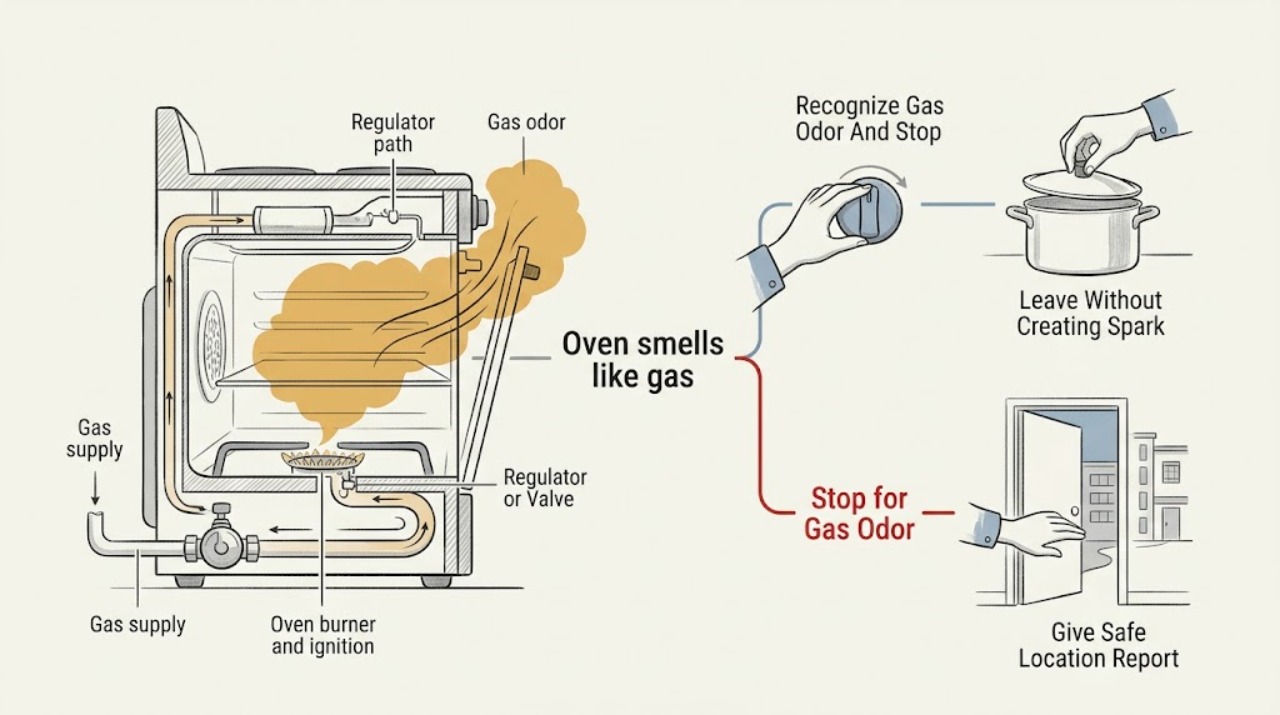
Work through in order
Diagnostic checks
Use only checks that match the exact appliance or system and its official guide.
-
Check 1
Stop the Bosch oven and any other gas appliance use as soon as a sulfur, rotten-egg, persistent gas, hissing, or delayed-ignition smell is suspected. Do not restart the oven to reproduce the odor.
Expected result: From where you already are, note whether the odor is strong or persistent, whether it is present with the oven off, whether you hear hissing, and whether anyone has headache, dizziness, nausea, breathing difficulty, or other possible carbon-monoxide symptoms.
Next step: If there is a strong or persistent odor or any health symptom, leave the building immediately. Contact emergency services or the gas supplier from well away from the building and follow their instructions.
Stop if: Do not touch a lighter, match, electrical switch, thermostat, appliance control, doorbell, garage-door opener, or phone in the odor area; do not start a vehicle or search for the leak.
Why this matters
Why: An odor that persists, appears while the oven is off, or accompanies hissing or symptoms cannot safely be classified as normal startup combustion.
-
Check 2
Leave by the nearest safe route without operating anything that could create a spark. If the oven control is immediately reachable without entering a strong odor area and can be turned off without manipulating an electrical switch, do so; otherwise do not return for that step.
Expected result: Once outside or well away from the suspected leak, confirm that household members and pets are out and that no one is attempting to investigate, ignite, ventilate with a powered fan, or re-enter.
Next step: Call 911 or the local emergency number and the gas supplier from a neighbor's home or another safe location. Do not re-enter until the responsible professionals say it is safe.
Stop if: Do not use a cell phone inside, turn lights or fans on or off, open or close powered equipment, smoke, strike a match, or drive through a vapor cloud.
Why this matters
Why: The priority is preventing ignition and exposure, not preserving the oven or completing a shutdown sequence. PHMSA specifically warns against phones, engines, flames, and electrical switches near suspected gas.
-
Check 3
From a safe location, tell the emergency dispatcher or gas supplier that a Bosch oven or nearby area smells like gas. Report the address, whether the odor is strong or persistent, any hissing, flames, smoke, symptoms, and whether the oven was operating.
Expected result: Record only what was noticed before evacuation: startup, preheat, bake, broil, flame-out, power restoration, recent movement or installation, or odor with the oven off. Do not go back inside to inspect the model plate or collect a photo.
Next step: Follow the gas professional's instructions. Keep people away from the building or suspected leak and do not operate the appliance again until it has been cleared.
Stop if: Do not guess at a leak location, report an unverified valve position, instruct others to enter, or ask someone to relight the oven while waiting.
Why this matters
Why: Timing and severity help the gas professional triage the event, while an odor with the oven off broadens the possible source beyond the oven burner.
-
Check 4
Only after the gas professional has cleared the area, review the context with a qualified appliance professional. Do not perform a new ignition test yourself merely because the smell was brief.
Expected result: Describe whether the odor occurred only at first startup, lasted briefly, returned on later starts, occurred after a flame went out, appeared with a failed ignition, or remained after the oven was off. Include whether the appliance is new or was recently serviced or moved.
Next step: Have qualified Bosch appliance service determine whether the oven is operating and igniting correctly before reuse. If the odor returns at any point, stop and repeat the gas-emergency response.
Stop if: Do not repeat ignition, hold a gas control open, adjust a regulator, inspect burner ports with a flame, or remove panels after the area is cleared.
Why this matters
Why: Bosch distinguishes a brief first-start combustion odor from unburned gas, but the symptom history alone cannot prove the burner, igniter, valve, regulator, or supply is safe.
-
Check 5
After the site is declared safe and without opening the appliance, collect the Bosch model or E-Nr. and any service or installation information from a safe, accessible record such as the manual, receipt, or a previously saved photo.
Expected result: Record the exact oven type, model, whether it is a range or wall oven, installation or service date, gas type if already documented, and any error code or prior ignition concern.
Next step: Give this information to Bosch or qualified appliance service along with the odor timing, evacuation, gas-professional findings, and whether the smell returned. Keep the appliance off until service approves use.
Stop if: Do not crawl behind the range, move a built-in oven, open a junction or gas enclosure, or re-enter a restricted area to find the model label.
Why this matters
Why: Bosch support and manuals are model-specific, and the same gas-odor symptom can involve different appliance designs. The model record helps service identify the correct documentation without a risky inspection.
-
Check 6
Arrange qualified Bosch appliance service after the gas professional has made the area safe, and describe the complete event rather than asking for a symptom-based part replacement.
Expected result: Provide the model, exact odor description and timing, oven mode, whether the flame or ignition was observed before evacuation, gas-professional findings, any error display, and whether the smell was present with the oven off.
Next step: Keep the oven off until the qualified technician confirms safe operation. If gas odor, hissing, smoke, or abnormal flame returns, stop and evacuate again instead of continuing the service test.
Stop if: Do not accept a temporary odor-masking fix, bypass a safety device, install an unverified gas part, or resume use after only a reset.
Why this matters
Why: The odor does not establish a failed component. Professional diagnosis must distinguish supply or connection issues from ignition, burner, valve, regulator, control, or combustion problems.
Use your observations
Decision map
Find the observation that best matches what you see, then follow the next safe action.
-
PATH 01Safety boundary
What you see
The odor is strong or persistent, smells like sulfur or rotten eggs, occurs while the oven is off, or is accompanied by hissing, delayed ignition, flame, smoke, or possible carbon-monoxide symptoms.
Do this next
Leave immediately, warn others only if safe, and call emergency services or the gas supplier from well away from the building. Follow their instructions and do not re-enter until cleared.
Why this path and its safety boundary
Why it matters: Treat the situation as a possible unburned-gas or combustion emergency; the source may be the oven or another part of the gas system.
Safety stop: Do not light or extinguish a flame by re-entering, operate electrical switches or phones inside, start an engine, search for the leak, or relight the oven.
-
PATH 02Safety boundary
What you see
The odor was noticed at startup and seemed brief, but no gas professional has evaluated the appliance or the user is unsure whether it was sulfur-like, persistent, or associated with failed ignition.
Do this next
Do not run another test. Keep the oven off, obtain qualified gas or appliance guidance from a safe location, and provide the timing and exact odor description.
Why this path and its safety boundary
Why it matters: Bosch describes a brief combustion odor at first startup as possible, but uncertainty cannot safely rule out unburned gas.
Safety stop: Do not use the one- or two-minute description as permission to continue if the odor returns, lingers, or smells like sulfur or rotten eggs.
-
PATH 03Safety boundary
What you see
The gas professional previously cleared the area, but the odor returns during preheat, bake, broil, ignition, or while the oven is off.
Do this next
Stop use and evacuate again if gas is suspected. Contact the gas supplier or emergency services from outside, then arrange qualified Bosch appliance service only after the area is safe.
Why this path and its safety boundary
Why it matters: A recurrence is a new safety event, not confirmation that the first visit fixed the appliance; the source may be intermittent or external to the oven.
Safety stop: Do not repeat ignition, keep the burner running to see whether the smell fades, adjust gas hardware, or rely on ventilation to continue cooking.
-
PATH 04Safety boundary
What you see
After clearance, the oven has no gas odor but has failed ignition, a flame that goes out, unusual flame behavior, or an error during a prior attempt.
Do this next
Keep the oven off and arrange qualified Bosch appliance service. Provide the precise operating stage and any gas-professional findings rather than trying another start.
Why this path and its safety boundary
Why it matters: The event still needs model-specific gas-appliance diagnosis; the absence of odor at one moment does not prove the ignition, burner, valve, or control path is safe.
Safety stop: Do not hold a control open, repeatedly spark or ignite, inspect with an open flame, adjust a regulator, or remove panels.
-
PATH 05Safety boundary
What you see
The odor is present when the Bosch oven is off, is strongest elsewhere, or remains after the appliance is isolated by a gas professional.
Do this next
Follow the gas professional's site instructions and keep away from the suspected area. Do not return to Bosch oven troubleshooting until the gas system is declared safe.
Why this path and its safety boundary
Why it matters: The oven may not be the source; a household gas line, connection, neighboring appliance, or service-line issue remains possible.
Safety stop: Do not narrow the source by lighting appliances, closing or opening unverified valves, applying leak-detection methods, or entering a restricted area.
-
PATH 06Safety boundary
What you see
The model is unknown, the timing and odor type cannot be recalled, the oven was recently installed or serviced, or the available manual does not match the appliance.
Do this next
Keep the oven off and give qualified service the safest available model record and event history. If gas odor returns, use the emergency branch rather than gathering more information indoors.
Why this path and its safety boundary
Why it matters: There is insufficient evidence for a safe appliance diagnosis, and gas appliance procedures are model- and installation-specific.
Safety stop: Do not move the appliance, open a panel, relight it, or use another model's ignition or gas-valve instructions.
Helpful context
Understand the symptom
A gas smell is a safety event before it is an oven-repair question
Do not use the oven to decide whether the smell is real. Bosch describes a brief unusual smell during first ignition as combustion odor, but says the sulfur or rotten-egg smell of unburned gas is not normal. Persistent odor, hissing, delayed ignition, or an odor that remains with the oven off should be treated as a possible gas release. Leave first and make the call from a safe location.
Do not troubleshoot the gas path yourself
The smell does not identify whether the source is the household supply, a connection, a valve, an ignition failure, a burner, a regulator, or another appliance. Do not inspect fittings, apply a flame or spray to look for a leak, adjust a regulator, repeat ignition, remove panels, or order a gas part from the symptom. A gas utility or qualified gas professional must first determine that the area and appliance are safe.
Use the model manual only after the hazard is cleared
Once the gas professional has cleared the area, keep the Bosch oven off until qualified appliance service confirms safe operation. The model number, oven type, whether the odor occurred at startup or after the flame went out, and whether any error or ignition symptom appeared will help the technician. A manual or support page can explain model-specific operation, but it is not a substitute for a leak or combustion assessment.
Safety boundary
Stop conditions
- For sulfur or rotten-egg odor, persistent gas smell, hissing, delayed ignition, smoke, flame, or possible carbon-monoxide symptoms, leave immediately and call emergency or gas professionals from outside or another safe location.
- Do not use flames, electrical switches, phones, powered fans, vehicles, garage-door openers, or other possible ignition sources in the odor area.
- Do not search for a leak, test fittings, adjust a regulator or valve, hold a gas control open, relight the oven, remove panels, or bypass an appliance safety device.
- Keep the Bosch oven off until the gas professional and qualified appliance technician have cleared the area and confirmed safe operation.
Only after diagnosis
Potential parts
- oven igniter or ignition assembly
Consider this category only if qualified diagnosis after gas clearance confirms failed ignition or delayed ignition is caused by the igniter assembly for the exact model.
Confirm the full Bosch model and manufacturer's fit information before ordering; never replace or test a gas ignition part based on odor alone. - oven gas valve or regulator
Consider this category only when a qualified gas-appliance technician confirms a valve or regulator fault after the supply and appliance are made safe.
Gas components are model- and fuel-specific. Do not adjust, substitute, or install one without qualified service and exact fit confirmation. - oven burner or burner tube
Consider this category only if professional inspection links a recurrent ignition, flame, or combustion problem to the burner assembly after ruling out supply and controls.
Confirm the complete Bosch model and manufacturer's fit information; a burner appearance or odor cannot establish compatibility or failure. - gas connection or supply component
Consider this category only if the gas supplier or qualified gas professional identifies a supply-side connection or appliance connection issue and specifies the required component.
Do not source or change gas connections from a symptom or generic search; use qualified installation and exact appliance and fuel requirements.
When checks do not resolve it
Need a professional?
Call emergency services or the gas supplier immediately from a safe location for a sulfur or rotten-egg odor, persistent gas smell, hissing, smoke, abnormal flame, delayed ignition, or possible carbon-monoxide symptoms. After the gas area is cleared, arrange qualified Bosch appliance service for any recurrent odor, failed ignition, flame-out, error, or uncertain model-specific condition. Do not return the oven to use until qualified professionals confirm it is safe.
Safety scope: This article supports stopping use, evacuating, calling from a safe location, and recording information without re-entry. A qualified gas professional must assess suspected leaks and combustion hazards; a qualified appliance technician must handle ignition, burner, valve, regulator, control, wiring, panels, and any return-to-use decision.
Common questions
FAQ
Is it normal for a Bosch oven to smell like gas when it starts?
Bosch says a brief unusual odor during first ignition can come from gas combustion, but it says a sulfur or rotten-egg odor from unburned gas is not normal. If you are unsure, the smell persists, returns, or occurs with hissing or failed ignition, stop and follow the gas-emergency response instead of trying another start.
Should I open windows when my Bosch oven smells like gas?
Bosch mentions opening windows for an unburned-gas odor, but do not re-enter a strong odor area or operate an electrical switch to do it. PHMSA's safer priority is to leave, avoid ignition sources, and call from well away from the leak; follow the gas professional's instructions.
Can I relight the Bosch oven after the gas smell goes away?
No. A smell disappearing is not proof that the source or combustion system is safe. Keep the oven off until a gas professional has cleared the area and qualified appliance service has determined that the Bosch oven can be returned to use.
What should I tell Bosch appliance service?
Provide the model or E-Nr., exact odor description and timing, oven mode, whether the smell occurred with the oven off, hissing or ignition symptoms, any error display, recent installation or service, and the gas professional's clearance or findings. Do not go back inside to retrieve a model label during an active odor event.
Read the exact guide
Official sources
- Bosch Wall Ovens & RangesBosch Home Appliances · Bosch oven and range owner manuals, service assistant, safety notices, and authorized service resources
- 24-BOS-1810 - Gas Range Quick Start Guide.inddBosch Home Appliances · Bosch gas-range quick-start, model-manual, ventilation, and gas-operation support for the published guide
- Causes of Oven Smells and How to Get Rid of ThemBosch Home Appliances · Bosch oven odor guidance, including first-start combustion odor and unburned-gas warning
- Pipeline Safety UpdateU.S. Department of Transportation, Pipeline and Hazardous Materials Safety Administration · Recognizing and responding to odorized natural-gas leaks in a home or workplace
Community feedback
Share a repair observation
Share a plain-text repair observation. Accepted observations are published automatically; this page may take a moment to update.