
On this page
Start here
Quick answer
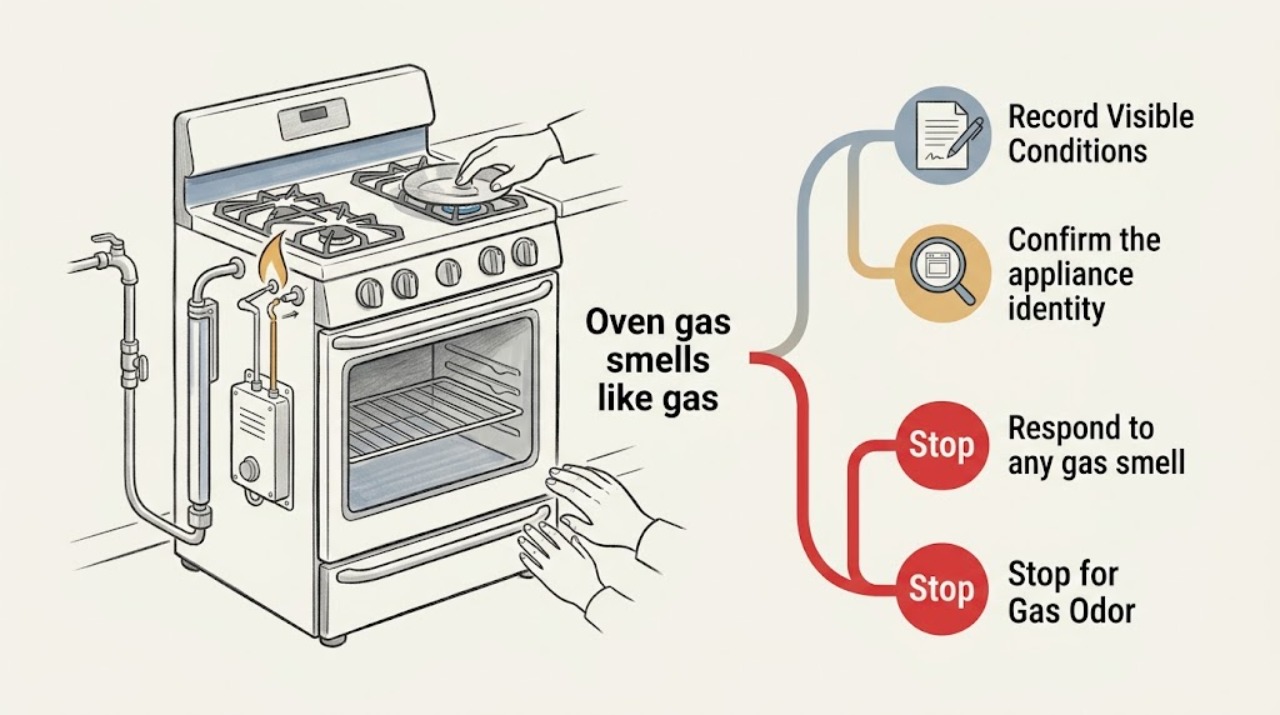
Treat a Maytag oven that smells like gas as a possible gas leak until the gas supplier or fire department says the area is safe. Do not light the oven or another appliance, touch an electrical switch, or use a phone inside the building. Leave, call the gas supplier from a neighbor's phone, and call the fire department if the supplier cannot be reached. Only after the gas concern has been cleared should you distinguish a new-oven coating odor, food residue, an installation or fuel-conversion issue, or an ignition fault. Do not relight the oven to reproduce the smell or adjust a regulator, valve, or burner yourself.
Work through in order
Diagnostic checks
Use only checks that match the exact appliance or system and its official guide.
-
Respond to any gas smell before checking the oven
If the gas-like odor is present now, stop using the Maytag oven and do not light any appliance, touch an electrical switch, or use a phone inside the building. Leave the building, then call the gas supplier from a neighbor's phone; if the supplier cannot be reached, call the fire department. Do not return to inspect the oven until the responsible authority gives instructions.
Expected result: The odor is strong, persistent, present while the oven is off, accompanied by a hiss, or still present after everyone is outside; or the gas supplier or fire department has cleared the area.
Next step: For any current or unexplained odor, remain out and follow the gas supplier or fire department instructions. Only proceed to the remaining checks after clearance; otherwise keep the oven off and arrange qualified appliance service.
Stop if: Never relight the oven to see whether the smell returns, operate switches to test it, or use a phone inside the building during the gas-smell response.
Why this matters
Why: A current, unexplained, or returning gas odor is a possible supply or appliance leak, not a normal oven-cleaning symptom. A professional clearance is the decision point for any later appliance diagnosis.
-
Record when the odor occurs without reproducing it
After the area has been cleared, write down whether the smell was noticed before the oven was used, during ignition, while baking, after shutoff, only near the oven, or elsewhere in the home. Do not turn the oven on or relight a burner solely to create another observation.
Expected result: The odor was limited to the first use of a new oven, occurred only around an ignition attempt, remained after shutoff, was present with the oven off, or was also detected at another gas appliance.
Next step: Give the timing and locations to the gas supplier and appliance technician. Keep the oven off for any pattern that is gas-like, persistent, or not limited to a cleared first-use odor.
Stop if: Do not perform a repeat ignition, smell test at a fitting, or any leak test that requires opening the appliance or disturbing a gas connection.
Why this matters
Why: First-use odor can fit Maytag's coating, insulation, or shipping-material explanation only after a gas concern has been cleared. An odor at ignition, after shutoff, while off, or at multiple appliances makes an installation, supply, valve, or ignition problem more concerning.
-
Confirm the appliance identity and fuel setup from the manual
With the oven off and the area safe, photograph or transcribe the full Maytag model number and identify whether the appliance is a range or wall oven. Retrieve its Maytag manual and compare the documented fuel type and installation information; do not remove a panel or adjust a regulator to confirm the setup.
Expected result: The documented fuel type matches the household supply and the installation history is unchanged; the appliance was recently installed, moved, reconnected, or converted; or the model documentation and installed setup do not agree.
Next step: For a recent installation, reconnection, or fuel mismatch, keep the oven off and have a qualified installer or gas appliance technician verify the installation. Do not purge the line or adjust the regulator yourself.
Stop if: Stop if confirming the setup would require moving the appliance, opening a gas connection, changing a regulator, or accessing wiring.
Why this matters
Why: A recent connection or fuel-conversion mismatch can make ignition and flame behavior unsafe. The model manual is needed because Maytag's instructions and allowable user checks vary by appliance.
-
Separate new-oven coating odor from cavity residue
Only after a gas professional has cleared the odor and the oven is cool, inspect the cavity from the opening for remaining packaging, visible food spills, heavy soil, foil, or a liner on the oven bottom. Remove only packaging or residue that the exact Maytag manual permits and never cover the oven bottom with foil or a liner.
Expected result: The oven is new and has packaging or a coating-type odor; visible residue or a liner is present; or the cavity is clean but the gas-like odor returns or persists.
Next step: For a cleared first-use or residue pattern, follow the exact Maytag first-use or cleaning instructions with ventilation and no food in the initial cycle. If the smell is gas-like, persistent, or returns after cleaning, keep the oven off and call service.
Stop if: Do not start a cleaning or self-clean cycle while a gas odor is unresolved, and do not scrape, disassemble, or clean around burners or gas fittings.
Why this matters
Why: New parts and shipping materials can cause a temporary first-use odor, while trapped spills or debris can cause ordinary oven smoke or odor. A clean cavity does not explain a returning gas-like odor and should not be used to dismiss it.
-
Document ignition and flame symptoms without re-igniting
Use only observations already made during normal operation before the odor was reported; do not start a new ignition test. Note whether there was repeated clicking, delayed or absent ignition, a flame that looked abnormal, soot, poor heating, or a smell that continued after the burner shut off. Maytag describes brief clicking while an igniter detects a flame as normal, but clicking with an abnormal result needs model-specific evaluation.
Expected result: The prior event included only brief clicking and normal heating; clicking continued with no heat; ignition was delayed or absent; flame appearance was abnormal; or soot and odor appeared together.
Next step: Keep the oven off and give the exact symptom sequence to a qualified gas-appliance technician. If an abnormal flame, soot, or current gas odor is present, return to the gas-smell emergency response rather than trying another cycle.
Stop if: Do not reach into the burner area, bypass ignition or safety controls, adjust flame or gas pressure, or repeatedly cycle the oven.
Why this matters
Why: Brief clicking alone can be part of the Maytag ignition sequence. Clicking with no heat, abnormal flame, soot, delayed ignition, or a continuing gas smell makes an igniter, burner, valve, regulator, fuel, or control problem more likely and cannot be safely narrowed by a homeowner test.
-
Check only safe external clues after clearance
From a safe, dry position and without moving the oven, note whether the smell is confined to the oven area, whether the control display has power, and whether there is visible damage, scorching, or a disturbed connector outside the appliance. Do not switch the appliance on, remove covers, or handle a gas line to test the clue.
Expected result: There is no visible damage and the odor was isolated to a cleared first-use event; there is visible damage or scorching; the control is dead; or the odor is present around the supply or another appliance too.
Next step: Photograph visible clues from a safe distance and keep the oven off. Have a qualified appliance technician inspect the appliance, and have the gas supplier address any odor beyond the oven or at the supply.
Stop if: Do not remove covers, move a connected range, touch gas fittings, or reset power as an experiment while an odor or damage concern remains.
Why this matters
Why: External damage or a dead control does not identify a safe repair and can involve gas, electrical, or installation work. An odor beyond the oven points back to the household gas-safety response rather than an oven-cavity cleaning issue.
-
Escalate any returning or unresolved odor
If the gas supplier has cleared the home but the Maytag oven odor returns, remains gas-like, or cannot be tied to a clearly documented first-use or residue pattern, leave the oven off and arrange qualified appliance service. Provide the model number, fuel type, odor timing, prior ignition symptoms, installation history, and the gas supplier's clearance information.
Expected result: The odor fully disappears after a cleared first-use or residue procedure and does not return; or it persists, returns, occurs with abnormal ignition, or cannot be confidently identified.
Next step: Keep the oven out of service and call a qualified gas-appliance technician for model-specific diagnosis. If the gas smell is present again, leave and repeat the gas supplier or fire department response before contacting appliance service.
Stop if: Do not keep running the oven to prove the fault, replace a gas component based only on symptoms, or resume use until the unresolved odor has been cleared and repaired.
Why this matters
Why: A resolved ordinary oven odor is different from a recurring gas-like odor. Persistence or recurrence means the cause remains unverified and may involve the burner, igniter, valve, regulator, supply, or installation.
Use your observations
Decision map
Find the observation that best matches what you see, then follow the next safe action.
-
PATH 01Safety boundary
What you see
The smell is present while the oven is off, is strong or persistent, returns after the home was cleared, is heard with a hiss, or is noticed at another gas appliance.
Do this next
Leave the building and follow the gas supplier or fire department gas-smell instructions. Keep the Maytag oven off and do not re-enter to test it.
Why this path and its safety boundary
Why it matters: This pattern is more consistent with an unresolved gas-safety or supply concern than with a new-oven coating or food residue.
Safety stop: Do not light appliances, touch switches, use a phone inside, or inspect gas fittings.
-
PATH 02Safety boundary
What you see
The gas supplier has cleared the area, the oven is new, the odor occurred only during initial use, and there was no abnormal ignition, persistent gas smell, or odor while the oven was off.
Do this next
Use the exact Maytag first-use instructions, remove packaging, ventilate as appropriate, keep birds away from fumes, and stop if the smell becomes gas-like or persists outside that pattern.
Why this path and its safety boundary
Why it matters: Maytag's documented new-part, insulation, coating, or shipping-material odor is plausible, but this remains a first-use pattern only after the gas concern has been cleared.
Safety stop: Do not cook during the prescribed empty first-use procedure or continue if the odor is not clearly an ordinary new-oven odor.
-
PATH 03Safety boundary
What you see
The area is cleared, the oven is cool, and visible spills, heavy soil, packaging, or a foil or liner on the oven bottom are present without a current gas smell.
Do this next
Follow the model manual for cool-oven cleaning and remove any prohibited liner. Do not start a cleaning cycle if a gas odor returns, and arrange service if the smell remains unexplained.
Why this path and its safety boundary
Why it matters: Trapped debris or ordinary residue can produce oven odor or smoke; it does not explain a gas-like odor when the appliance is off.
Safety stop: Do not clean burners, gas fittings, or the oven interior while hot or while a gas concern is unresolved.
-
PATH 04Safety boundary
What you see
The odor began after installation, moving, reconnection, or fuel conversion, or the model documentation does not match the installed fuel setup.
Do this next
Keep the oven off and have a qualified installer, gas supplier, or appliance technician verify the connection and fuel setup; do not purge or adjust anything yourself.
Why this path and its safety boundary
Why it matters: An installation, supply, regulator, or conversion issue is more likely than a harmless cavity odor and requires qualified gas-appliance work.
Safety stop: Do not move the appliance, open the gas connection, adjust a regulator, or attempt a conversion as a homeowner check.
-
PATH 05Safety boundary
What you see
Previously observed clicking was accompanied by absent or delayed heat, abnormal flame appearance, soot, or a gas odor that continued after shutoff, even after the gas supplier cleared the household.
Do this next
Keep the oven off and give the technician the exact sequence and model number. Do not attempt another ignition cycle or choose a replacement part from the symptom alone.
Why this path and its safety boundary
Why it matters: The pattern makes an ignition, burner, valve, regulator, control, or fuel issue more likely than normal brief igniter clicking.
Safety stop: Do not bypass safety controls, adjust the flame or gas pressure, or open the burner or valve area.
-
PATH 06Safety boundary
What you see
The gas supplier has cleared the home, but the odor persists or returns and cannot be confidently tied to first-use coating or visible residue.
Do this next
Keep the Maytag oven out of service and schedule qualified gas-appliance diagnosis. If the smell returns before the visit, leave and repeat the gas-smell response.
Why this path and its safety boundary
Why it matters: The source remains unverified; continued operation could obscure or worsen a gas or ignition fault.
Safety stop: Do not use the oven until the unresolved odor has been professionally evaluated and cleared.
Helpful context
Understand the symptom
Safety comes before diagnosis
The smell's timing does not make it safe to experiment. Maytag's gas safety directions apply when gas is smelled and also warn that a leak cannot always be detected by smell. Leave the area without operating switches or appliances and get instructions from the gas supplier or fire department. The rest of this article is for the time after that external safety check has cleared the home and the oven remains off or is available for a qualified inspection.
A new-oven odor is a separate pattern
Maytag says a small amount of smoke or odor during first use can come from new parts, insulation, manufacturing oil, or shipping tape and should diminish after the first few uses. That guidance does not clear a smell that is distinctly gas-like, present while the oven is off, strong, persistent, or accompanied by abnormal ignition. Do not run a first-use cycle until the gas concern has been cleared; keep birds in a separate, well-ventilated room around oven fumes.
Use the exact Maytag model documentation
Maytag gas ranges and wall ovens can differ in controls, fuel setup, ignition sequence, venting, and user-accessible parts. After the safety clearance, use the full model number to retrieve its manual. Use that manual to identify whether the appliance is set for natural gas or LP gas and what inspection or cleaning is permitted; do not transfer adjustment or disassembly instructions from another model.
Do not mask a gas odor with cleaning
Once the appliance is confirmed safe and cool, a visible spill or heavy soil may explain an oven odor or smoke, and Maytag advises routine cleaning without lining the oven bottom with foil or a liner. Cleaning cannot diagnose a fuel leak. Keep the oven off and call qualified service if the smell returns, remains gas-like, or appears with flame or ignition trouble.
Safety boundary
Stop conditions
- Do not light an appliance, operate an electrical switch, or use a phone inside the building during a current gas-smell response.
- Do not relight the oven to reproduce an odor, purge a gas line, adjust a regulator or valve, or open a gas connection.
- Keep the oven off for a persistent or returning gas-like odor, abnormal flame, soot, delayed ignition, smoke, visible damage, or any odor that cannot be confidently identified.
- Do not start a cleaning or self-clean cycle until a gas concern has been cleared; do not line the oven bottom with foil or a liner.
Only after diagnosis
Potential parts
- oven igniter or ignition assembly
Consider this category only if a qualified diagnosis finds delayed or absent ignition or repeated clicking with no normal flame; an odor alone does not identify an igniter fault.
Confirm the complete Maytag model and the technician's tested failure before selecting any ignition component. - gas burner or safety valve
Consider this category only when qualified testing links abnormal flame, delayed ignition, or gas flow behavior to the burner or valve.
Gas components require exact model and fuel compatibility; do not order or install one from the odor symptom alone. - gas regulator or control component
Consider this category only after qualified installation and fuel-supply checks point to a regulator or control fault.
A qualified installer or gas-appliance technician must confirm the part, fuel configuration, and model fit before replacement.
When checks do not resolve it
Need a professional?
Call the gas supplier or fire department immediately for a current, strong, persistent, or unexplained gas odor, or if the odor is present at more than one appliance. After the gas concern is cleared, call a qualified gas-appliance technician for a returning odor, installation or fuel mismatch, delayed or absent ignition, abnormal flame, soot, repeated clicking with no heat, or any diagnosis requiring a gas connection, burner, valve, regulator, igniter, control, wiring, or panel to be opened.
Have this ready
- Provide the full model number, range or wall-oven type, natural-gas or LP information if safely documented, when the odor occurred, whether the oven was on or off, any prior clicking or flame symptoms, recent installation or reconnection, visible residue, and the gas supplier's clearance or instructions.
Common questions
FAQ
Is a gas smell from a Maytag oven ever normal?
Do not assume a gas-like smell is normal. Maytag does describe a small first-use odor from new parts, insulation, protective coating, or shipping materials, but a smell while the oven is off, a strong or persistent odor, or an odor that returns requires the gas-smell safety response and professional clearance before any further use.
Should I turn the Maytag oven on to see whether the gas smell returns?
No. Do not relight the oven or another appliance to reproduce the smell. If the odor is present or unexplained, leave the building and follow the gas supplier or fire department instructions; after clearance, keep the oven off until a qualified technician evaluates a returning or unresolved odor.
Can an empty first-use cycle remove a new Maytag oven smell?
Maytag recommends an empty first-use cycle for an odor caused by new materials, after packaging is removed and only when the gas concern has been cleared. Follow the exact model guidance, ventilate as appropriate, keep birds away from fumes, and stop if the odor is gas-like or persists beyond the documented first-use pattern.
What information should I give the appliance technician?
Provide the full Maytag model number, range or wall-oven type, documented fuel type, when the smell occurred, whether the oven was on or off, any earlier clicking or flame symptoms, recent installation or reconnection, visible residue, and the gas supplier's clearance or instructions. Do not open the oven or gas connection to gather more details.
Read the exact guide
Official sources
- Cleaning and Maintenance of RangeMaytag · Maytag range cool-down cleaning preparation, oven residue and odor, foil or liner restriction, and venting guidance
- Owner's ManualMaytag · Maytag gas range safety, qualified installation and service, gas-smell response, and model-specific operating guidance
- Odors and Smoke in OvenMaytag · Maytag oven first-use odor, packaging, cavity residue, ventilation, and model-manual/service guidance
- Odors or SmellsMaytag · Maytag gas cooktop and household gas-odor safety response, fuel and flame observations, and service escalation
- Odors and Smells of Newly Installed Range or OvenMaytag · Maytag new range or oven first-use odor, packaging, ventilation, bird-safety, and residue guidance
- Clicking Noise in a Gas OvenMaytag · Maytag gas oven igniter clicking and flame-detection behavior
Community feedback
Share a repair observation
Share a plain-text repair observation. Accepted observations are published automatically; this page may take a moment to update.