
On this page
Start here
Quick answer
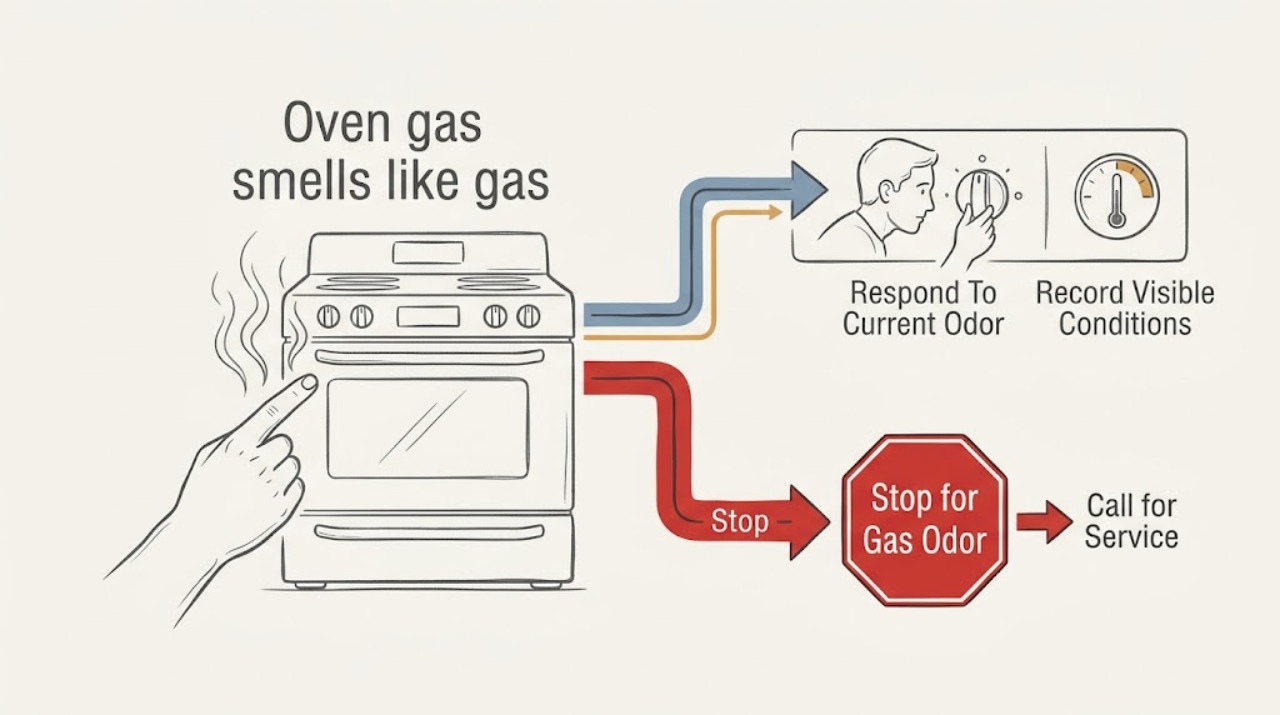
Treat a gas smell from a KitchenAid oven or range as a possible fuel leak until a qualified professional rules it out. If you smell gas now, leave the home and suspected area immediately; do not relight the oven or a burner, operate a light switch or appliance, use a phone inside, move the range, or try to find the leak. Contact local gas authorities or emergency services from outside. KitchenAid says a slight odor can occur during gas preheating and that new-oven materials can smell during the first few uses, but the odor should dissipate; an odor when the cooktop is off, a smell that persists or returns, or any odor with failed ignition or a flame-out is not a reason to keep testing. Do not run an empty burn-off cycle after an unexplained gas odor. Record the timing and visible flame history from a safe location, keep the appliance off, and arrange qualified gas-appliance service.
Before you begin
Safety first
- This article supports emergency recognition, safe documentation from outside the suspected area, visible-history reporting, and model identification. It does not authorize relighting, gas-valve operation, connector inspection by moving the range, panel removal, leak testing, fuel conversion, or gas-component adjustment.
Work through in order
Diagnostic checks
Use only checks that match the exact appliance or system and its official guide.
-
Check 1
If a fuel-like or rotten-egg odor is present now, or if the source is uncertain, stop using the KitchenAid oven and leave the home and suspected area immediately. Do not light a burner, press an ignition control, operate a light switch or appliance, use a phone inside, move the range, or search for the leak; contact local gas authorities or emergency services from a safe location.
Expected result: The odor is present now, intensifies, is accompanied by hissing, or is near the oven, range, connector, or wall; or it has cleared before this check.
Next step: For a current or worsening odor, remain outside and follow emergency guidance. If the odor has cleared, keep the appliance off and document the event for qualified service rather than recreating it.
Stop if: Do not re-enter to investigate, operate a gas valve, open a panel, or make a phone call until you are in a safe location.
Why this matters
Why: A current, strong, repeated, or unexplained fuel odor is a possible gas-leak emergency, not a normal owner troubleshooting opportunity. A cleared odor is not proof that the appliance is safe to restart.
-
Check 2
Only after reaching a safe location and when no odor is present, record when the smell occurred: before ignition, during preheating, after a burner or oven flame went out, during an active bake, after cleaning, during the first few uses, or after installation, service, or movement. Do not recreate the event.
Expected result: The odor was brief during preheating, occurred on first use, followed an ignition attempt or flame-out, persisted during operation, appeared while the cooktop was off, or cannot be tied to a known event.
Next step: Keep the appliance off unless qualified service and the exact manual establish that a non-gas new-oven odor is the cause. Report the timeline, model, and flame history to service; treat a returning odor as a new emergency.
Stop if: Do not turn the oven or cooktop on to see whether the smell returns, and do not use a match, detector, spray, or electrical device as a leak test.
Why this matters
Why: KitchenAid says slight preheat and first-use odors can occur and should dissipate, while an odor when the cooktop is not being used or one that persists calls for gas-leak precautions. Failed ignition, flame-out, or an unknown pattern needs professional evaluation rather than a relight test.
-
Check 3
When there is no current odor and you can stay in a safe area, look only at accessible front controls and surfaces without moving the KitchenAid range or opening a panel. Note whether a surface burner control appears out of its normal OFF position, packaging remains in a new oven, or obvious food residue is visible; do not operate controls or touch gas components.
Expected result: A control may be on, packaging or heavy soil is visible, or the accessible surfaces look normal and the odor remains unexplained.
Next step: Document the visible condition and leave the appliance off. Have qualified service determine whether the control, burner, packaging, soil, or gas path is involved; do not turn a control to test it.
Stop if: Do not touch a control that may admit gas, remove packaging near a burner, wipe a hot or gas-smelling surface, or continue if the odor returns.
Why this matters
Why: KitchenAid says to check for an accidentally turned-on surface burner when gas is smelled while the cooktop is not in use, and it identifies new materials or heavy soil as possible non-leak odor sources. These observations do not clear an appliance after an unexplained fuel odor.
-
Check 4
Ask what happened during the last safe use of the KitchenAid gas oven or cooktop: whether the flame lit, went out, was noisy or yellow, or needed repeated ignition. Do not relight the appliance or clean ports after a gas odor to confirm the report.
Expected result: There was no flame after gas was admitted, a flame went out, flames were noisy or yellow, ignition was repeatedly attempted, or no flame event is known.
Next step: Keep the appliance off and give the flame history to qualified gas-appliance service. If an odor returns, leave immediately and contact gas authorities from outside.
Stop if: Do not keep clicking ignition, hold a control open, probe ports, or use a match or lighter to test the oven or cooktop.
Why this matters
Why: A failed ignition or flame-out can leave unburned gas and needs service evaluation. KitchenAid identifies burner-head or cap position, clogged ports, LP-gas configuration, and supply or regulator details as possible flame-related causes, but the history does not identify a safe owner repair.
-
Check 5
Record whether the KitchenAid appliance was recently installed, converted between natural gas and LP, serviced, cleaned around, or moved, and whether the odor was noticed near the rear of the range or a connector. Do not pull the appliance forward to inspect behind it.
Expected result: The odor followed installation, movement, fuel conversion, service, or cleaning; the appliance has an unknown fuel setup or a suspected connector issue; or no installation change is known.
Next step: Leave the appliance in place and provide the history to a qualified gas-appliance professional. Do not attempt a conversion, regulator adjustment, or connector inspection yourself.
Stop if: Do not move the range, bend or touch the connector, remove a rear cover, or adjust any gas control.
Why this matters
Why: A changed installation or fuel configuration raises concern for a disturbed connector, regulator, shutoff, or conversion. KitchenAid's installation material requires model-specific gas setup, and CPSC warns that moving a gas appliance can cause an older connector to fail.
-
Check 6
Keep the KitchenAid oven and cooktop out of service and prepare the exact model information, fuel type if known, odor timing, flame history, and safe-distance photos of visible controls or surfaces for qualified service. Do not choose a replacement part or gas adjustment from the odor alone.
Expected result: The odor was persistent or repeated, the appliance failed to ignite or had a flame-out, the smell followed movement or installation, the model or fuel type is unknown, or a first-use odor did not dissipate.
Next step: Arrange qualified gas-appliance service before further use. If an odor returns, leave immediately and contact gas authorities or emergency services from outside the suspected area.
Stop if: Stop all troubleshooting for current odor, hissing, fire, suspected connector damage, carbon-monoxide symptoms, or water or electrical hazards and use emergency help.
Why this matters
Why: Each pattern warrants professional diagnosis because the appliance, connector, shutoff, gas setup, ignition, burner, regulator, combustion, or building piping may be involved. A cleared smell still does not establish safe operation.
Use your observations
Decision map
Find the observation that best matches what you see, then follow the next safe action.
-
PATH 01Next step
What you see
A fuel-like or rotten-egg odor is present now, is getting stronger, or has an uncertain source around the KitchenAid oven or range.
Do this next
Leave immediately, avoid ignition and electrical operations, and contact local gas authorities or emergency services from outside. Do not return until the situation is cleared.
Why this path and its safety boundary
Why it matters: This is a possible gas-leak emergency, not a normal troubleshooting opportunity. The appliance must not be relit or moved to locate the odor.
-
PATH 02Next step
What you see
The odor was mild, limited to gas preheating or the first few uses of a new oven, and fully dissipated without a failed ignition, flame-out, or odor while the cooktop was off.
Do this next
Follow the exact KitchenAid owner's manual for any first-use procedure only when there is no current or suspected gas leak. Stop and arrange service if the smell persists or returns.
Why this path and its safety boundary
Why it matters: KitchenAid describes slight preheat odor and new-oven odors from materials as patterns that can be normal when they dissipate. This branch does not apply to a strong, persistent, repeated, or unexplained fuel smell.
-
PATH 03Next step
What you see
The smell followed clicking, an attempted oven start, a burner that did not light, or a flame that went out.
Do this next
Keep the appliance off and arrange qualified service; report the sequence and any known flame color or sound. Use emergency gas-leak guidance if the odor returns.
Why this path and its safety boundary
Why it matters: Unburned gas or an ignition, burner, cap, moisture, control, or fuel-setup problem is possible. A flame symptom does not make relighting safe.
-
PATH 04Next step
What you see
The odor began after delivery, installation, fuel conversion, cleaning behind the appliance, service, or any movement of the range.
Do this next
Do not move it again or inspect behind it. Keep it out of service and arrange qualified professional inspection, providing the installation history.
Why this path and its safety boundary
Why it matters: A disturbed connector, shutoff, regulator, fuel setup, or installation connection is more concerning. Moving the appliance again can worsen a connector problem.
-
PATH 05Next step
What you see
The smell continues beyond the first few minutes of preheating, returns on later uses, occurs while the cooktop is not being used, or has no reliable non-gas explanation.
Do this next
Stop using the oven and cooktop and arrange qualified gas-appliance service before further testing. Treat a returning odor as an immediate possible leak.
Why this path and its safety boundary
Why it matters: A leak, failed ignition, gas-control, combustion, or installation problem cannot be excluded by an owner observation. KitchenAid's normal-odor guidance does not cover a persistent or unexplained pattern.
Helpful context
Understand the symptom
Safety comes before deciding whether an odor is normal
KitchenAid notes that a slight smell can occur while a gas oven preheats and that a new oven can give off odors from new materials for its first few uses. That does not make every gas-like odor harmless. A smell when the cooktop is off, an odor that continues or returns, or a smell accompanied by a failed ignition or flame-out must be treated as a possible leak or appliance fault.
Do not move the range or test the gas path
The Consumer Product Safety Commission warns that moving a gas appliance to inspect its connector can cause an older weakened connector to fail. Do not pull a KitchenAid range forward, remove a rear panel, operate a gas valve, use a flame, or apply a homemade leak test. Leave the appliance in place and give the installation history to qualified service.
Flame observations help a technician only when made safely
KitchenAid troubleshooting identifies burner-cap position, blocked ports, LP-gas setup, and regulator or supply details as possible causes of noisy or yellow flames. These are useful service clues, not instructions to relight a burner after a gas odor. Only record a previous flame symptom or a visible condition from a safe, odor-free location.
First-use odor has a different pattern
If the oven is new, KitchenAid says odor and smoke can come from insulating materials, new parts, protective oil, or shipping tape and should dissipate after the first few uses. Follow the exact owner's manual only when there is no suspected gas leak and no current fuel odor. If the smell is distinctly gas-like, persistent, repeated, or unexplained, skip any burn-off test and arrange service.
Safety boundary
Stop conditions
- If gas odor is present, worsening, or unexplained, leave immediately and do not light a burner, operate a switch or appliance, use a phone inside, move the range, or search for the leak; contact local gas authorities or emergency services from outside.
- Do not relight a failed oven or surface burner, keep clicking ignition, hold a gas control open, use a match or lighter, or recreate the odor as a test.
- Do not move the KitchenAid range, bend or touch its gas connector, remove rear panels, adjust a regulator or valve, convert fuel type, or disconnect a gas fitting.
- Do not clean burner ports, lift caps, wipe near a burner, or use spray, detector, soap solution, or another improvised leak test when a gas odor is present or the source is uncertain.
- Arrange qualified gas-appliance service before further use for a repeated or unexplained odor, failed ignition, flame-out, unusual flame, odor after installation or movement, suspected connector damage, or any condition requiring gas-path access.
Only after diagnosis
Potential parts
- KitchenAid oven igniter or burner assembly
Consider this category only after qualified diagnosis finds an ignition or burner condition and confirms that the exact model's gas and ignition parts are involved.
Confirm the exact KitchenAid model, fuel configuration, and manufacturer's fit information; do not replace or adjust gas components as an odor test. - KitchenAid gas valve or regulator component
Consider this category only when qualified gas-appliance service identifies a valve, regulator, or gas-control fault after isolating the appliance safely.
Gas-control parts and fuel settings are model-specific and professional work; confirm the exact model and approved procedure before any replacement. - Gas appliance connector or shutoff connection
Consider this category only when a qualified professional finds connector, shutoff, corrosion, or installation damage and determines replacement is required.
Do not move the appliance or handle the gas connection to identify a part; the professional must verify the fuel type, local requirements, and exact installation.
When checks do not resolve it
Need a professional?
Use emergency gas-leak help immediately if a fuel odor is present, worsening, or unexplained, especially with hissing, fire, or carbon-monoxide symptoms. Arrange qualified gas-appliance service before using the KitchenAid oven or cooktop again for any repeated odor, failed ignition, flame-out, unusual flame, odor after installation or movement, suspected connector or control problem, or diagnosis that requires opening the gas path.
Safety scope: This article supports emergency recognition, safe documentation from outside the suspected area, visible-history reporting, and model identification. It does not authorize relighting, gas-valve operation, connector inspection by moving the range, panel removal, leak testing, fuel conversion, or gas-component adjustment.
Common questions
FAQ
What should I do if my KitchenAid oven smells like gas right now?
Leave the home and suspected area immediately. Do not light the oven, relight a burner, operate a switch or appliance, use a phone inside, move the range, or search for the leak. From outside, contact local gas authorities or emergency services and do not return until the situation is cleared.
Is a brief gas smell when a KitchenAid oven preheats always normal?
KitchenAid says a slight smell can occur during gas preheating and that new-oven odors can occur during the first few uses, but they should dissipate. Do not assume a strong, persistent, repeated, or unexplained fuel odor is normal. Keep the appliance off and arrange professional evaluation instead of recreating the smell.
Can I relight my KitchenAid oven or clean its burner ports after smelling gas?
No. Do not relight, keep clicking ignition, hold a control open, or clean around the burner as a test after an unexplained gas odor. KitchenAid lists cap position, clogged ports, LP setup, and regulator or supply details as possible flame concerns, but a suspected leak or failed ignition needs qualified diagnosis.
Should I pull my KitchenAid range out to inspect the gas connector?
No. The Consumer Product Safety Commission warns that moving a gas appliance can cause an older weakened connector to fail. Leave the range in place and have a qualified professional inspect the connector, shutoff, installation, and appliance when the area is safe.
When does a KitchenAid oven gas odor require service?
Use emergency gas-leak help for any current, worsening, or unexplained fuel odor. Arrange qualified gas-appliance service before further use for a repeated brief odor, failed ignition, flame-out, unusual flame, odor after installation or movement, suspected connector problem, or any diagnosis requiring access to gas components.
Read the exact guide
Official sources
- Certain Older Gas Connectors May Be DangerousU.S. Consumer Product Safety Commission · Official CPSC safety alert; it is emergency and connector safety guidance, not a KitchenAid model repair manual.
- CPSC Warns of Generator, Carbon Monoxide and Fire Hazards Ahead of Hurricane SeasonU.S. Consumer Product Safety Commission · Official CPSC general gas-leak safety guidance; it does not diagnose a KitchenAid appliance or replace local emergency instructions.
- Noisy or Yellow flames - Gas Range - Product HelpKitchenAid · Official KitchenAid Product Help for gas ranges and cooktops; use only as a service clue after any gas odor has been resolved by appropriate professionals.
- How to Install a Gas or Electric RangeKitchenAid · Official KitchenAid installation article; gas connections, conversion, and service boundaries vary by model and jurisdiction.
- Owner's ManualKitchenAid · Official KitchenAid owner's manual for a specific gas-range family; use the exact manual for the appliance model before any normal operation or service.
- Odors or Smells - Commercial Range - Product HelpKitchenAid · Official KitchenAid Product Help for commercial ranges; its odor and safety distinctions are useful for KitchenAid gas appliances, while exact operating steps vary by model.
- 7 Reasons an Oven Smells Like GasKitchenAid · Official KitchenAid educational guidance for gas ovens; it is not a substitute for the exact model manual or emergency gas-authority instructions.
- 5 reasons why your gas oven isn’t heating upKitchenAid · Official KitchenAid educational article for gas-oven heating complaints; do not use it to justify relighting after a gas odor.
Community feedback
Share a repair observation
Share a plain-text repair observation. Accepted observations are published automatically; this page may take a moment to update.