
On this page
Start here
Quick answer
Do not judge the oven from one thermometer reading: KitchenAid says heating elements cycle and most thermometers do not accurately track that cycling. First allow a complete preheat, avoid opening the door, check rack position, pan material, pan clearance and airflow, and note whether the problem is uneven browning or a repeatable too-hot/too-cool result. For a repeatable baking complaint, use KitchenAid's official refrigerated-biscuit test: follow the package temperature and time, use the middle rack and the specified clearance, and judge whether the biscuits finish and brown evenly within the package time range. If the result supports calibration, use only the exact model manual's calibration procedure; calibration is select-model and the control sequence varies. If the oven will not preheat, a breaker trips, wiring/voltage is in question or the symptom persists after model-approved calibration, stop operating it and arrange qualified service.
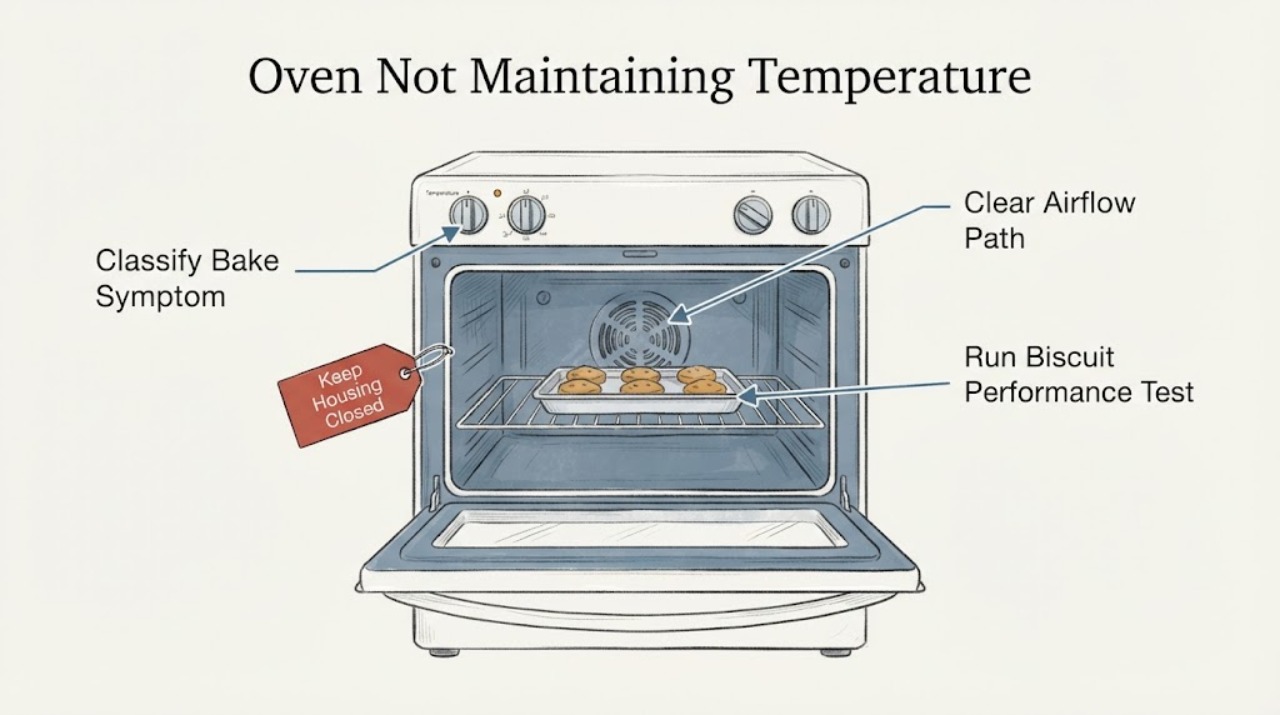
Work through in order
Diagnostic checks
Use only checks that match the exact appliance or system and its official guide.
-
Check 1
Record whether the complaint is slow preheating, repeatably too hot or too cool, uneven browning, or a result that changes when the door is opened; use one rack and note the rack position and pan type.
Expected result: The issue occurs only with door openings, a particular rack/pan arrangement or incomplete preheat, or it repeats after a complete preheat with a consistent setup.
Next step: Correct the setup first and repeat once with a complete preheat. If the result remains repeatably too hot or too cool, continue to the official bake-performance test.
Why this matters
Why: KitchenAid identifies preheat, door openings, rack position, bakeware and airflow as factors that can mimic temperature drift. A repeatable result under controlled setup is the appropriate point to evaluate calibration.
-
Check 2
Remove unused racks, allow the oven to finish its preheat indication, keep the door closed during the bake, use the recommended bakeware and rack position, and leave clearance around pans; do not cover the rack or oven floor with foil.
Expected result: The oven was under-preheated, the door was opened repeatedly, pans touched walls/each other, airflow was blocked or the setup already matched the guidance.
Next step: Correct the accessible setup and repeat the same recipe once. If the controlled result remains outside the expected time/browning range, run the biscuit test rather than changing hidden controls.
Why this matters
Why: These conditions can lengthen preheat or create hot spots and uneven results without showing that the temperature control is defective.
-
Check 3
Run KitchenAid's bake-performance test with refrigerated biscuits: use the package temperature, a shiny low-sided sheet when available, the middle rack, at least 2 inches of clearance from the oven walls, a complete preheat and the package's minimum-to-maximum bake time; do not use foil liners or a thermometer for this test.
Expected result: The biscuits are done and evenly browned within the package time range, or they are not done/evenly browned within that range.
Next step: If the test is within range, treat the original result as a setup/recipe issue and use the matching rack and pan guidance. If it is outside range, continue only with the exact model's calibration instructions.
Why this matters
Why: KitchenAid treats the first result as evidence the oven is calibrated for the test and the second as evidence that a calibration adjustment may be appropriate.
-
Check 4
If the bake test supports calibration, open the exact KitchenAid Owner's Manual and use the documented temperature-calibration control for that model; make only the manual's small adjustment and repeat the same bake test.
Expected result: The manual identifies a calibration feature, does not list one for the model, or the adjustment does not improve the repeatable bake result.
Next step: Save the model and test results for service if calibration is unavailable or ineffective. Do not try another model's hidden key sequence or alter wiring.
Why this matters
Why: KitchenAid says calibration is select-model and that control methods differ. A failed or unavailable calibration path does not identify which sensor, element or control component is defective.
-
Check 5
Stop user troubleshooting if the oven never reaches its preheat indication, a circuit breaker trips, wiring/voltage is uncertain, the door or heating area is damaged, or the repeatable temperature problem persists after model-approved calibration.
Expected result: A power/installation problem, persistent no-preheat condition or unresolved temperature result is present.
Next step: Stop operating the oven. Turn off the controlling breaker only from a safe location when instructed for an electrical issue, and arrange a licensed electrician or KitchenAid-authorized service. Do not remove covers or perform live tests.
Why this matters
Why: KitchenAid routes installation, circuit and persistent temperature problems to qualified electrical or appliance service; the symptom does not prove a particular internal part.
Use your observations
Decision map
Find the observation that best matches what you see, then follow the next safe action.
-
PATH 01Next step
What you see
The result changes with incomplete preheat, door openings, pan material, rack position or blocked clearance.
Do this next
Correct the setup, repeat the bake with a complete preheat and keep the door closed. Escalate only if the controlled result remains abnormal.
Why this path and its safety boundary
Why it matters: KitchenAid documents these as baking and airflow factors that can create uneven or slow results without a temperature-control failure.
-
PATH 02Next step
What you see
The biscuit test is not evenly browned or done within the package's time range after the specified setup.
Do this next
Use the exact model manual's calibration feature, if present, make only its documented small adjustment and repeat the same test. Arrange service if calibration is unavailable or ineffective.
Why this path and its safety boundary
Why it matters: KitchenAid says the oven may need calibration; this result does not identify a failed internal part.
-
PATH 03Next step
What you see
The oven never reaches preheat, the breaker trips, or installation voltage/wiring is uncertain.
Do this next
Stop operating the oven and arrange licensed electrical or KitchenAid service. Do not open the electrical compartment or perform energized checks.
Why this path and its safety boundary
Why it matters: KitchenAid identifies installation, circuit and voltage conditions as possible causes of a wall oven heating element not turning on; these are electrical service matters.
-
PATH 04Next step
What you see
The oven passes the setup checks but remains consistently too hot/cool or uneven after model-approved calibration.
Do this next
Leave the oven off if operation is unsafe and arrange KitchenAid-authorized service with the model number and the bake-test results.
Why this path and its safety boundary
Why it matters: The user-level guidance is exhausted; no model is supplied to support a sensor, thermostat, element or control diagnosis.
Helpful context
Understand the symptom
Temperature drift is not the same as uneven baking
A slow preheat, food that browns differently from an older oven, and one pan browning unevenly can come from preheat time, rack position, bakeware, pan placement, door openings or airflow. A repeatable result outside the package time range is a stronger reason to evaluate calibration. The symptom alone does not prove a failed sensor or heating element.
Use a bake test rather than a thermometer
KitchenAid's calibration test uses refrigerated biscuits, a suitable sheet, the middle rack, full preheat and the package's time range. If the biscuits are done and evenly browned in that range, the oven is calibrated for the test; if not, the oven may need a small calibration adjustment. This is a performance screen, not proof of a particular internal part failure.
Keep calibration and electrical work model-specific
KitchenAid lists different calibration methods for different controls and says to use the Owner's Manual. A wall oven that does not preheat because of installation, voltage or a circuit issue needs a qualified electrical installer or appliance service; do not remove covers or test wiring while energized.
When checks do not resolve it
Need a professional?
Arrange service when the oven will not preheat, a breaker trips, installation voltage/wiring is uncertain or calibration does not resolve a repeatable temperature problem., Stop operating the oven for damaged wiring, a damaged door or other unsafe electrical/heating condition., Do not use a thermometer as the deciding test, try another model's calibration sequence, remove covers or perform live electrical checks.
Have this ready
- complete oven model and serial information
- oven type and whether it reaches the preheat indication
- rack, pan, clearance and door-opening conditions
- biscuit test package time and browning result
- any breaker trip, installation or display observations
Common questions
FAQ
How can I tell whether my KitchenAid oven is really not maintaining temperature?
Control the setup first: fully preheat, use the recommended rack and pan with clearance, and keep the door closed. Then use KitchenAid's refrigerated-biscuit bake test and judge completion and browning against the package time range rather than relying on a thermometer.
Can I calibrate any KitchenAid oven with the same button sequence?
No. KitchenAid says calibration is select-model and lists different methods for different controls. Use the exact Owner's Manual and do not apply a hidden sequence from another model.
Should I use an oven thermometer to check the temperature?
KitchenAid's Product Help guidance says not to use a thermometer for this decision because heating elements cycle and common thermometers do not accurately track the changing temperature. Use the official bake-performance test instead.
Read the exact guide
Official sources
- How to Evaluate if Temperature Calibration is NeededKitchenAid · Official KitchenAid Product Help page opened directly. Supports the refrigerated-biscuit performance test, clearance, complete preheat, package time range and select-model calibration boundary.
- Oven Temperature Incorrect (Too Hot or Too Cold)KitchenAid · Official KitchenAid Product Help page opened directly. Supports cycling/thermometer boundary, preheat, rack/pan/airflow factors, model-specific calibration and service routing.
- How to Correct Uneven Baking or BrowningKitchenAid · Official KitchenAid Product Help page opened directly. Supports complete preheat, avoiding door openings, bakeware and rack-position checks.
- Oven Not Pre-Heating - Wall OvenKitchenAid · Official KitchenAid Product Help page opened directly. Supports installation/voltage/circuit caution and professional electrical/service escalation; it is not a user wiring procedure.
- How to Calibrate the Oven - Too Hot - Electric RangeKitchenAid · Official KitchenAid Product Help page opened directly. Used for model-specific calibration caution, thermometer warning and authorized service boundary; no method is generalized to an unidentified model.
Community feedback
Share a repair observation
Share a plain-text repair observation. Accepted observations are published automatically; this page may take a moment to update.