
On this page
Start here
Quick answer
A kettle that will not turn on should be checked for a working outlet, a firmly seated kettle on its base, the switch position, and enough water. If it was switched on empty or boiled dry, unplug it and let the element cool before one retest. Persistent no-power, damaged cord, or burning odor requires service or replacement.
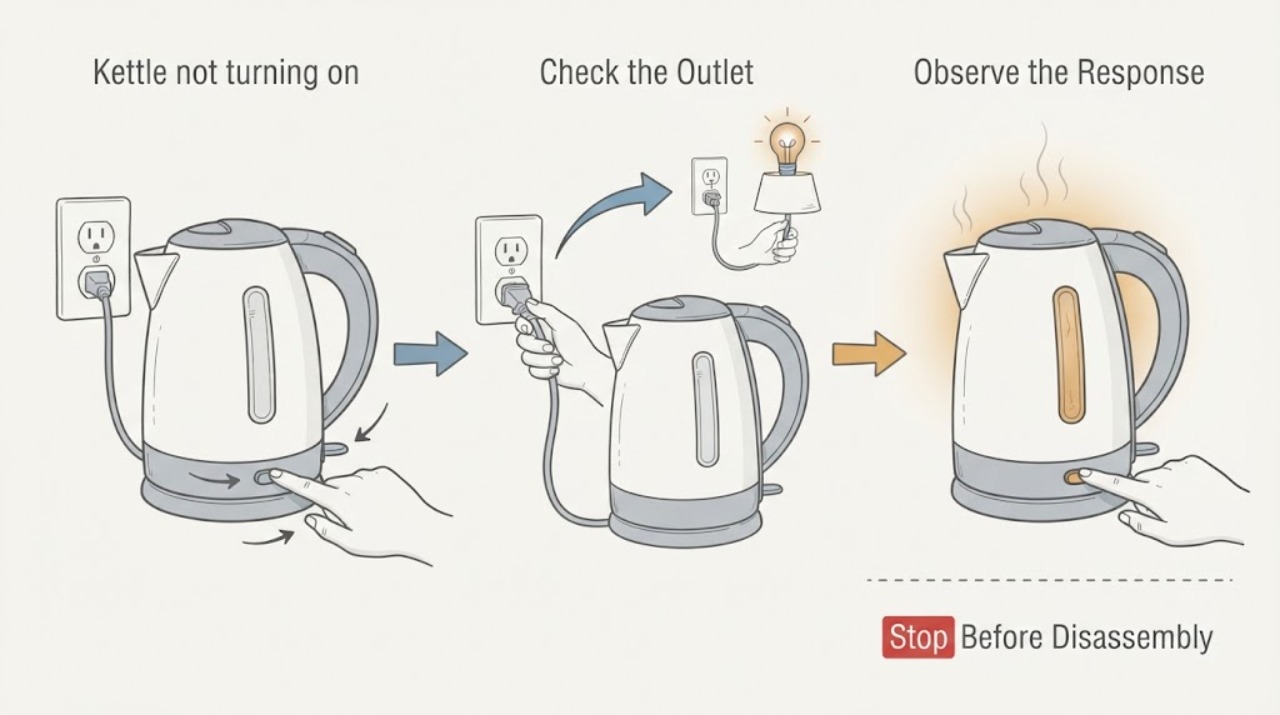
Work through in order
Diagnostic checks
Use only checks that match the exact appliance or system and its official guide.
-
Check 1
Check the outlet with another safe appliance and inspect the kettle cord/base for visible damage without opening it.
Expected result: Outlet is dead, cord/base is damaged, or supply appears normal.
Next step: Use a known-good outlet only if no damage is visible; stop for a hot/scorched plug or cord.
Why this matters
Why: Power or connection failure can prevent the kettle from starting; damaged electrical parts are not a DIY repair.
-
Check 2
Confirm the kettle body is seated squarely on its power base and the switch is in ON.
Expected result: Body is mis-seated, switch is OFF/stuck, or seating/control appear normal.
Next step: Reseat once on a dry base; do not force a sticking switch or bypass contacts.
Why this matters
Why: The base contacts and switch must engage before heating.
-
Check 3
Check the water level and whether the kettle recently boiled dry or was switched on empty.
Expected result: Water is below minimum, dry-boil event occurred, or water level is normal.
Next step: Turn off/unplug and wait about 15 minutes after a dry-boil event, then retest once.
Why this matters
Why: Hamilton Beach says dry-boil protection can shut the kettle off until the element cools.
-
Check 4
Run one supervised boil after the accessible checks, recording no lights, no heat, heat without boil, or automatic shutoff.
Expected result: Kettle works, heats slowly/does not boil, or remains dead.
Next step: Descale only as the exact manual allows; stop repeated testing for electrical symptoms.
Why this matters
Why: A successful retest supports an operating-state issue; heat without boil can indicate scale, while persistent dead operation needs service.
Use your observations
Decision map
Find the observation that best matches what you see, then follow the next safe action.
-
PATH 01Next step
What you see
Outlet, cord, seating, and switch are normal after dry-boil cool-down but kettle remains dead.
Do this next
Keep unplugged and arrange manufacturer/qualified service; do not open the base.
Why this path and its safety boundary
Why it matters: A base contact, thermal control, or internal electrical fault is possible.
-
PATH 02Next step
What you see
Kettle was empty or below minimum and works after cool-down/refill.
Do this next
Use at least the manual’s minimum water and never run empty.
Why this path and its safety boundary
Why it matters: Dry-boil protection likely interrupted operation.
-
PATH 03Next step
What you see
Kettle heats but does not boil.
Do this next
Follow the manual’s descaling procedure; arrange service if boiling remains abnormal.
Why this path and its safety boundary
Why it matters: Scale or a model-specific heating fault is more likely than no power.
-
PATH 04Next step
What you see
Cord/plug is hot, damaged, scorched, wet, or trips protection.
Do this next
Stop, unplug only if safe, and obtain qualified electrical/appliance help.
Why this path and its safety boundary
Why it matters: Immediate electrical safety boundary.
Helpful context
Understand the symptom
Electric kettles use a base/contact path and a dry-boil safety shutoff, so “not turning on” is different from “heats but does not boil.”
Keep the kettle empty of power and cool before inspecting the base or cleaning.
When checks do not resolve it
Need a professional?
Arrange service when the kettle remains dead after outlet, base seating, switch, and dry-boil checks or requires cord, thermostat, base, or heater diagnosis.
Common questions
FAQ
Why did the kettle stop turning on after boiling dry?
Dry-boil protection may shut it off. Switch off, unplug, wait about 15 minutes, refill, and try once as the manual states.
What if it heats but does not boil?
The manual says scale may be involved. Descale only by the model instructions; persistent failure needs service.
Can I repair the kettle base?
Do not open the base or bypass thermal/electrical controls. Use qualified service.
Read the exact guide
Official sources
- READ BEFORE USEHamilton Beach · electric kettle not-working, dry-boil shutoff, power and seating checks
Community feedback
Share a repair observation
Share a plain-text repair observation. Accepted observations are published automatically; this page may take a moment to update.