
On this page
Start here
Quick answer
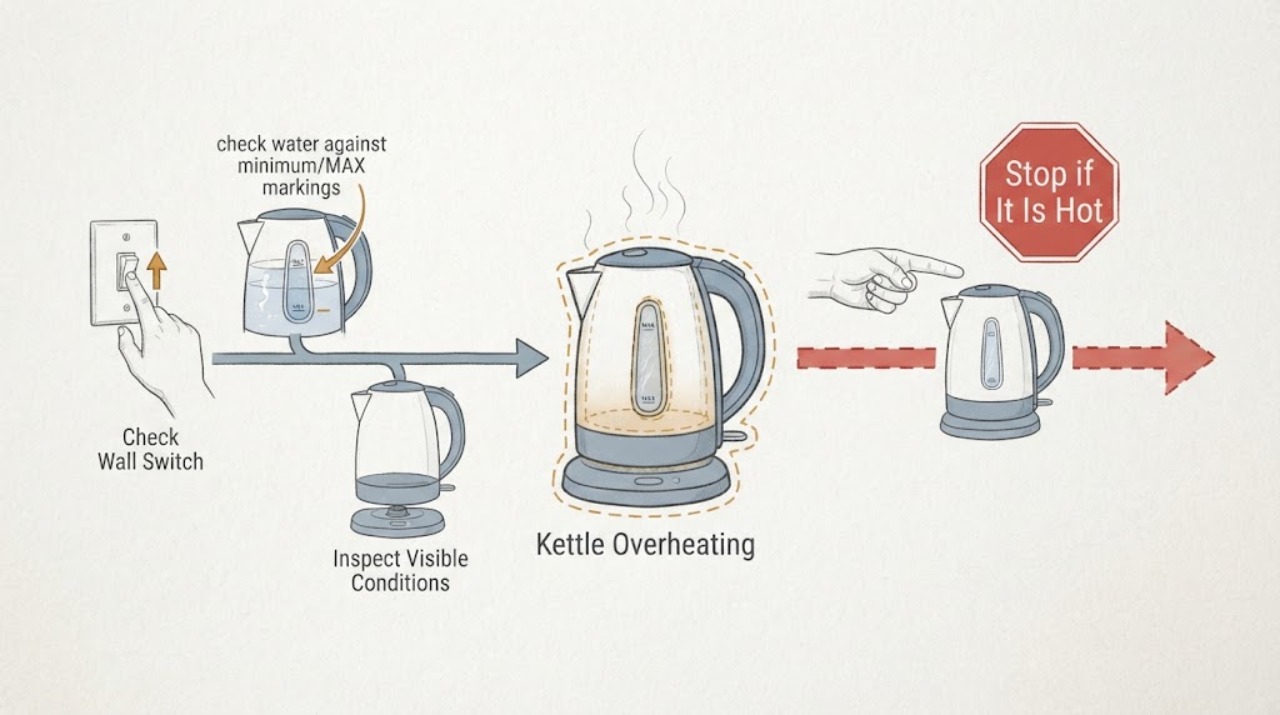
A kettle normally gets hot while boiling, but overheating means it stays on after boiling, boils dry, smells burnt, or the base becomes abnormally hot. Switch it off and unplug it, let it cool, then check water level, lid, seating, and scale only as the manual allows. Hamilton Beach says the kettle should shut off at boiling; a repeat failure needs service.
Work through in order
Diagnostic checks
Use only checks that match the exact appliance or system and its official guide.
-
Check 1
Switch off and unplug the kettle from a dry outlet; let the vessel and base cool.
Expected result: Smoke, burning odor, melted plastic, cord damage, boil-over, or dry heating occurred.
Next step: Keep it disconnected and arrange qualified service; use emergency help for fire or arcing.
Stop if: Stop if there is a safety hazard or internal access would be required.
Why this matters
Why: These signs exceed a routine scale check and create burn/electrical risk.
-
Check 2
After cooling, check water against minimum/MAX markings and confirm full seating on the base with lid closed.
Expected result: It was below minimum, overfilled, not seated, or lid was open.
Next step: Correct only the visible condition, then make one supervised boil test.
Stop if: Stop if there is a safety hazard or internal access would be required.
Why this matters
Why: Water level, base seating, and lid affect safe shutoff; overfilling can spit boiling water.
-
Check 3
During one supervised test with water present, observe whether the power light goes out at boiling.
Expected result: It shuts off normally or continues heating.
Next step: Unplug and discontinue use if it fails to shut off; arrange service.
Stop if: Stop if there is a safety hazard or internal access would be required.
Why this matters
Why: Normal shutoff suggests normal control; continued heating means the safety system cannot be trusted.
-
Check 4
With kettle unplugged and cool, inspect/clean only the removable scale filter and interior as directed.
Expected result: Scale is heavy, filter blocked, or it remains clean but overheats.
Next step: Do not open the base; arrange service.
Stop if: Stop if there is a safety hazard or internal access would be required.
Why this matters
Why: Scale may affect performance, but a clean kettle that overheats needs control/thermal diagnosis.
Use your observations
Decision map
Find the observation that best matches what you see, then follow the next safe action.
-
PATH 01Next step
What you see
Kettle shuts off at boiling with no abnormal signs
Do this next
Use it within the manual’s water and lid limits.
Why this path and its safety boundary
Why it matters: The heating cycle may be normal; an exterior gets hot while boiling.
-
PATH 02Next step
What you see
Kettle continues after boiling or boils dry
Do this next
Unplug and discontinue use; arrange service.
Why this path and its safety boundary
Why it matters: Automatic shutoff is not reliable.
-
PATH 03Next step
What you see
Overheating follows low water or empty start
Do this next
Let it cool; service it if behavior repeats.
Why this path and its safety boundary
Why it matters: Boil-dry protection may have activated, but damage cannot be assumed away.
Helpful context
Understand the symptom
How to read the result
A kettle normally gets hot while boiling, but overheating means it stays on after boiling, boils dry, smells burnt, or the base becomes abnormally hot. Switch it off and unplug it, let it cool, then check water level, lid, seating, and scale only as the manual allows. Hamilton Beach says the kettle should shut off at boiling; a repeat failure needs service.
When checks do not resolve it
Need a professional?
Arrange qualified kettle service for failure to shut off, recurring overheating, smoke, or cord/base damage. Seek emergency help for fire or active arcing.
Common questions
FAQ
Is a hot kettle exterior always a fault?
No. The manual notes the kettle surface gets hot. Staying on after boiling or repeated dry heating is different.
Can I open the base to replace a thermostat?
No. Arrange qualified service for recurring overheating.
Read the exact guide
Official sources
- Hamilton Beach 1.2L Stainless Steel Kettle (40852) - Use & CareHamilton Beach · electric kettle overheating
Community feedback
Share a repair observation
Share a plain-text repair observation. Accepted observations are published automatically; this page may take a moment to update.