
On this page
Start here
Quick answer
Unplug the kettle and check the outlet, switch, and—for cordless models—the kettle seating on its base. If it was switched on empty or boiled dry, leave it off and unplugged while it cools, then refill between the marked limits and retry once. If it heats but does not boil, scale may be restricting heat transfer. A damaged cord, plug, base, burning smell, or failure after these checks requires replacement or qualified service.
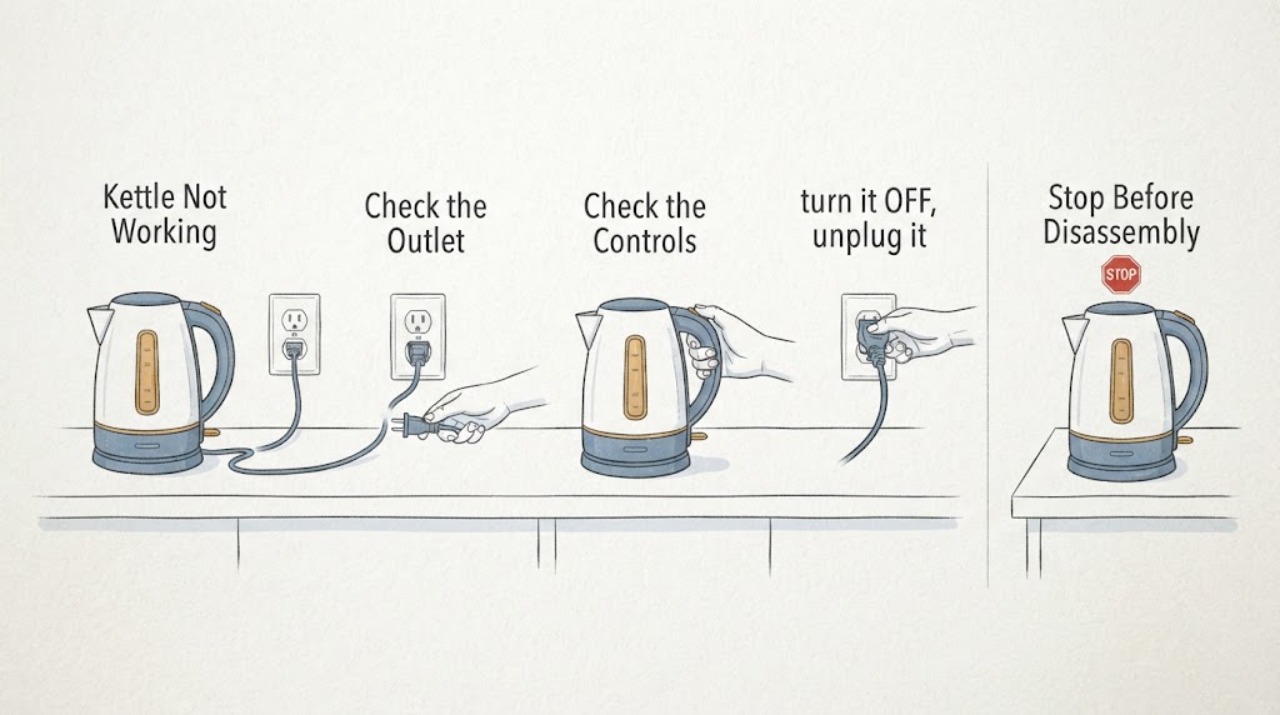
Work through in order
Diagnostic checks
Use only checks that match the exact appliance or system and its official guide.
-
Check 1
Unplug the kettle, inspect the plug and cord for cuts, heat damage, or looseness, and test the same outlet with a known-good appliance.
Expected result: The outlet is dead, the cord/plug is damaged, or the outlet works and the kettle appears intact.
Next step: Do not use a damaged cord, plug, or base. Restore power only through a sound outlet and intact appliance.
Why this matters
Why: A dead outlet is external; cord or plug damage is an electrical safety fault; an intact kettle on a working outlet needs the switch/base checks.
-
Check 2
For a cordless kettle, place it squarely on its power base; for any model, fill only with water between MIN and MAX, close the lid, and switch it ON.
Expected result: The indicator lights and heating begins, the switch will not stay on, or nothing changes.
Next step: If it still has no response, unplug it and stop testing. Do not bypass the switch or open the base.
Why this matters
Why: Firm base seating and an ON switch are required for normal heating; no indicator on a working outlet suggests a kettle/base fault.
-
Check 3
If the kettle was turned on empty or boiled dry, turn it OFF, unplug it, and allow the heating element to cool for about 15 minutes before refilling and retrying once.
Expected result: The kettle works after the cooldown, or remains inactive after a cooled retry.
Next step: Keep it out of service and arrange replacement or qualified service if it remains inactive.
Why this matters
Why: Boil-dry protection can shut the kettle off temporarily; failure after cooling points beyond a normal protection response.
-
Check 4
If the kettle warms but does not reach a boil, unplug it, let it cool, and follow the manual’s descaling method for the model.
Expected result: Boil time returns to normal, or heating remains weak/never boils after descaling.
Next step: Do not use abrasive cleaners or immerse the appliance. Escalate persistent weak heating.
Why this matters
Why: Scale can reduce heating performance; persistent failure can indicate a heating or control fault.
-
Check 5
After one supervised test, check for abnormal smell, sparking, excessive heat at the plug/base, leaks, or repeated shutdown.
Expected result: Any safety symptom appears, or the kettle completes a normal boil.
Next step: Stop immediately for a safety symptom. If normal, unplug after use and empty the kettle as directed.
Why this matters
Why: Safety symptoms indicate an electrical or mechanical hazard; a normal boil after the corrective check supports a resolved connection/protection issue.
Use your observations
Decision map
Find the observation that best matches what you see, then follow the next safe action.
-
PATH 01Next step
What you see
The outlet is dead but the kettle and cord look normal.
Do this next
Use a working outlet only if safe; have the dead outlet checked if it is not restored by its own switch/breaker.
Why this path and its safety boundary
Why it matters: The supply point is the observed fault.
-
PATH 02Next step
What you see
The kettle was dry and works after the documented cooldown.
Do this next
Use water within MIN/MAX and never switch it on empty.
Why this path and its safety boundary
Why it matters: Boil-dry protection likely operated as designed.
-
PATH 03Next step
What you see
The kettle heats but does not boil and has visible scale.
Do this next
Descale with the model’s instructions after unplugging and cooling.
Why this path and its safety boundary
Why it matters: Scale is a plausible restriction of heating performance.
-
PATH 04Next step
What you see
The outlet works, connections are firm, and the kettle still has no indicator or has a damaged/hot cord.
Do this next
Unplug it, do not open it, and replace or obtain qualified service.
Why this path and its safety boundary
Why it matters: The kettle or its electrical connection has a fault unsafe for further user testing.
Helpful context
Understand the symptom
A kettle not working may be a power connection, boil-dry safety shutdown, scale, or damaged appliance. Keep water below the MAX line and do not open the kettle or immerse its base or plug.
Separate no power from no boil
Observe whether the indicator lights, the switch stays on, the water warms, or the kettle shuts off. That observation determines whether to check power, cooldown, or scale.
When checks do not resolve it
Need a professional?
Stop using the kettle for a damaged cord/plug/base, sparking, burning smell, leaking water near electrical parts, or abnormal heat. Never immerse the kettle, base, or plug and do not open the electrical base.
Common questions
FAQ
Why did my kettle stop after boiling dry?
Hamilton Beach says boil-dry protection can switch the kettle off. Turn it off, unplug it, wait about 15 minutes for cooling, refill with water, and retry once.
What if the kettle heats but never boils?
The manual identifies scale as one possible cause. Unplug and cool the kettle, then use the model’s descaling procedure; persistent weak heating needs service or replacement.
Can I wash the kettle by immersing it?
No. Hamilton Beach warns not to immerse the kettle, power base, or plug in water or other liquid. Wipe the exterior only as directed.
Read the exact guide
Official sources
- READ BEFORE USEHamilton Beach · electric kettle safety and boil-dry troubleshooting
- 840081700 ENv02.qxdHamilton Beach · electric kettle not-working troubleshooting
Community feedback
Share a repair observation
Share a plain-text repair observation. Accepted observations are published automatically; this page may take a moment to update.