
On this page
Start here
Quick answer
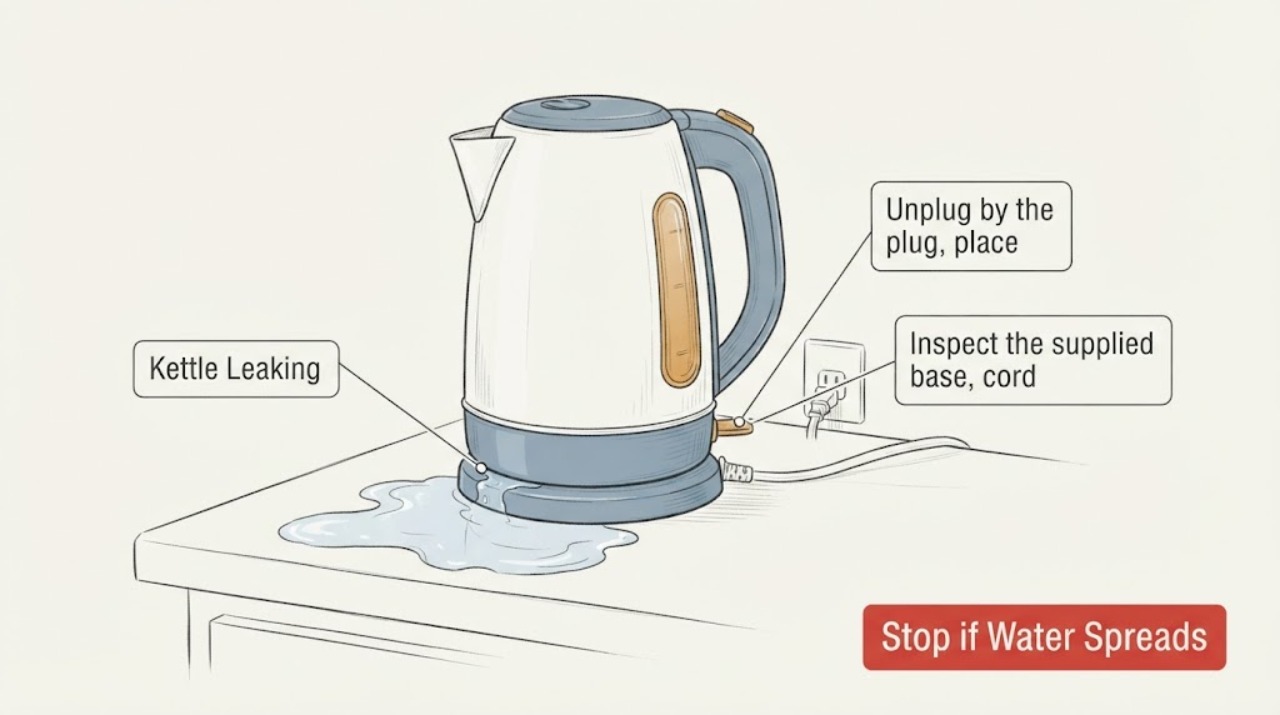
Unplug a leaking kettle, let it cool, and locate whether water escapes from the lid or spout, the body, or the base and connector. Do not use a kettle with a damaged cord, plug, base, housing, or water on its connector; overfilling can also spill boiling water.
Work through in order
Diagnostic checks
Use only checks that match the exact appliance or system and its official guide.
-
Check 1
Unplug by the plug, place the kettle on a heat-safe surface, and wait until water and body are cool; wipe the outside without immersing it.
Expected result: The leak stops when cool, continues from the body, or reached the base connector or socket.
Next step: Keep it disconnected; do not reconnect a wet connector and have the appliance and outlet checked.
Why this matters
Why: Hot water can burn, and water at the connector creates an electrical hazard.
-
Check 2
When cool, fill below the maximum mark and observe the lid hinge, seal, spout, and body seam without heating.
Expected result: Water escapes from the lid or spout, only above a level, or from a body seam.
Next step: Empty it and do not heat it while a body seam leaks; reducing level is not a housing repair.
Why this matters
Why: A lid or spout path can relate to seating or overfill; a body seam indicates housing damage.
-
Check 3
Inspect the supplied base, cord, plug, and visible contacts for cracks, melting, looseness, or water residue after drying.
Expected result: The base or cord is damaged, the plug or socket is hot or discolored, or all accessible parts look intact.
Next step: Retire it for any damage or heat mark; a lid-only drip still needs model-specific guidance.
Why this matters
Why: Philips says not to use a damaged appliance and warns about connector spills.
-
Check 4
Check filling and pouring only with cold water and the kettle unplugged; note whether the leak appears while filling, pouring, or only after heating.
Expected result: The leak appears during filling, pouring, or after heating.
Next step: Record the exact point and arrange service or replacement rather than running a leaking kettle.
Why this matters
Why: A post-heating leak increases burn risk and does not justify running the kettle to reproduce it.
Use your observations
Decision map
Find the observation that best matches what you see, then follow the next safe action.
-
PATH 01Next step
What you see
Water is on the body seam or under the base, or the connector became wet.
Do this next
Keep it unplugged and seek qualified appliance service.
Why this path and its safety boundary
Why it matters: The housing or connector may be compromised.
-
PATH 02Next step
What you see
The kettle was above the maximum mark and water escaped at the lid during heating.
Do this next
Cool it and retest only at the correct level when exterior and base are undamaged.
Why this path and its safety boundary
Why it matters: Overfill is plausible, but it does not clear a leak below the mark.
-
PATH 03Next step
What you see
The lid or spout leaks with a correct cold fill while body and base remain dry.
Do this next
Keep it unplugged until model instructions identify a safe adjustment; otherwise arrange service.
Why this path and its safety boundary
Why it matters: A lid, spout, or seal fit issue is more likely than a power fault.
Helpful context
Understand the symptom
This guide focuses on the exact leak point on a kettle. The symptom is a starting point, not a part diagnosis; use each observation to choose the next safe check.
Manufacturer guidance supports these symptom-level checks. Model-specific controls, parts, and service procedures must be confirmed in the appliance manual.
Only after diagnosis
Potential parts
- lid or spout seal
Relevant only when a cool, correctly filled kettle leaks at the lid or spout.
Confirm the exact appliance model and manufacturer instructions before ordering.
When checks do not resolve it
Need a professional?
Arrange qualified service or replace the kettle when the body, base, cord, plug, or connector leaks or is damaged.
Common questions
FAQ
Can I use a kettle if it leaks only a little?
No. A small leak can put hot water on the base connector or worktop.
Is reducing the water level enough to fix a leak?
It may explain ejection from an overfilled kettle, but it is not a repair for a leaking body, base, cord, or connector.
Read the exact guide
Official sources
- Important Safety InstructionsPhilips · kettle overfill, spill, damaged base, cord and connector safety
Community feedback
Share a repair observation
Share a plain-text repair observation. Accepted observations are published automatically; this page may take a moment to update.