
On this page
Start here
Quick answer
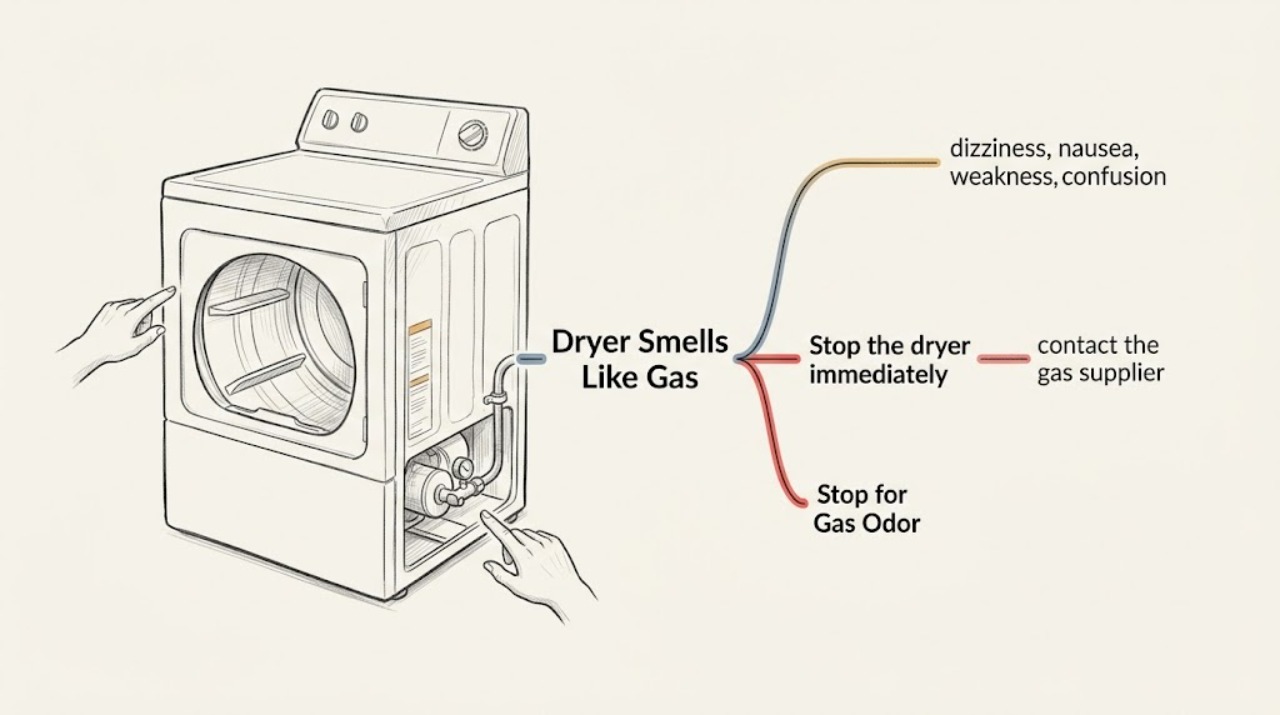
Treat a gas smell from or near a KitchenAid dryer as an active gas-leak warning: stop the dryer, do not light anything or touch electrical switches, clear everyone from the area, and contact the gas supplier or fire department from a safe location. Do not restart the dryer, disassemble its gas path, or perform a relight test until a qualified professional has checked it. KitchenAid also warns that gas leaks cannot always be detected by smell, so an odor that fades is not proof that the appliance is safe.
Work through in order
Diagnostic checks
Use only checks that match the exact appliance or system and its official guide.
-
Check 1
Stop the dryer immediately and do not start another cycle or try to light any appliance.
Expected result: You smell gas, hear hissing, see a flame or smoke, or notice the odor while the dryer is running or just after it stops.
Next step: Do not touch the dryer controls, light switches, plugs, phones, or other electrical equipment in the area. Leave the room or building with everyone and pets.
Why this matters
Why: Fuel may be escaping or not burning correctly; continuing to operate the dryer can add an ignition source and increase the hazard.
-
Check 2
From outside the building or another safe location, contact the gas supplier or fire department and follow their instructions.
Expected result: The gas odor is still present, returns after leaving, or the source cannot be identified from a safe location.
Next step: Do not re-enter to investigate or operate a shutoff, appliance, or electrical control unless emergency personnel or the gas supplier gives site-specific instructions and it is safe to do so.
Why this matters
Why: A fading or intermittent odor does not establish that the leak has stopped; KitchenAid warns that some gas leaks cannot be detected by smell.
-
Check 3
If a carbon-monoxide alarm sounds or anyone has headache, dizziness, nausea, weakness, confusion, or unusual sleepiness, move to fresh air immediately.
Expected result: The alarm continues, symptoms improve outdoors, or a person may have been exposed while the gas dryer was operating.
Next step: Call emergency services or the fire department from outside, seek medical advice for symptoms, and do not re-enter or use the appliance until responders and trained service personnel say it is safe.
Why this matters
Why: Carbon monoxide is an odorless poisoning hazard; staying inside to find the source can cause loss of consciousness or death.
-
Check 4
After the gas supplier or emergency responders clear the area, record the dryer model information and exactly when and where the odor was noticed without opening the cabinet or touching gas fittings.
Expected result: The odor was strongest at the dryer, behind it, near the exhaust outlet, or only during a particular cycle; or the location remains uncertain.
Next step: Give the observations to the gas supplier or qualified appliance service agency and keep the dryer out of service pending inspection.
Why this matters
Why: Timing and location help a qualified technician distinguish a supply-connection problem from a burner, combustion, or exhaust issue, but they do not make a user repair safe.
-
Check 5
Have a qualified installer, service agency, or gas supplier inspect the complete installation before any restart, including the approved gas connection, shutoff arrangement, burner operation, and exhaust path.
Expected result: The professional finds a leak, damaged connection, incorrect gas type, combustion fault, blocked or crushed vent, or no confirmed fault yet.
Next step: Follow the professional's repair and clearance instructions. Do not reconnect, relight, or run the dryer yourself as a diagnostic test.
Why this matters
Why: The KitchenAid manual assigns gas installation and service to qualified personnel; lint or restricted exhaust can also cause heat buildup and fires even when the odor source is unclear.
-
Check 6
Once a qualified professional has cleared the gas issue, have the lint screen and exhaust route checked and maintained before returning the dryer to normal use.
Expected result: The lint screen is damaged or blocked, the outside hood has little or no airflow, or the vent is crushed, kinked, or visibly obstructed.
Next step: Keep the dryer off and have the vent or appliance interior cleaned or repaired by a qualified person. Resume use only after the complete installation is confirmed safe.
Why this matters
Why: Restricted airflow can trap heat and raise fire risk; CPSC and KitchenAid identify lint and blocked exhaust as hazards requiring correction.
Use your observations
Decision map
Find the observation that best matches what you see, then follow the next safe action.
-
PATH 01Next step
What you see
Gas odor, hissing, smoke, or flame is present now
Do this next
Leave immediately, avoid switches and flames, and contact the gas supplier or fire department from outside; do not return to test the dryer.
-
PATH 02Next step
What you see
The odor has faded but there was a credible gas smell
Do this next
Keep the dryer out of service and report it for professional inspection; the absence of odor does not prove that no leak exists.
-
PATH 03Next step
What you see
A carbon-monoxide alarm sounds or anyone has possible CO symptoms
Do this next
Move outdoors, call emergency services or the fire department, and do not re-enter or operate the dryer until cleared by responders and trained personnel.
-
PATH 04Next step
What you see
Emergency personnel determine there is no active gas hazard, but the dryer still has an unexplained odor or poor exhaust
Do this next
Arrange qualified appliance and vent service; do not mask the smell, run repeated cycles, or open the gas or burner system.
-
PATH 05Next step
What you see
A professional confirms the gas and combustion system is safe
Do this next
Follow that professional's restart instructions and the exact KitchenAid model manual; stop again and escalate if the gas odor returns.
Helpful context
Understand the symptom
Why this is an emergency
A gas odor is not a normal dryer-performance symptom to troubleshoot by trial and error. The odorant can indicate unburned fuel, while a combustion or venting problem can add fire or carbon-monoxide risk. KitchenAid's own gas-dryer safety warning says to leave the area and use a phone only from outside the building or from a neighbor's location.
What not to test
Do not run another cycle, try to relight the burner, move the dryer to reach a connection, spray a leak test product, or remove a panel. Once the immediate hazard is cleared, a qualified installer, service agency, or gas supplier can inspect the supply connection, shutoff arrangement, burner, and exhaust installation against the model's instructions and local requirements.
When checks do not resolve it
Need a professional?
Call the gas supplier or fire department immediately from outside for a suspected gas leak. After the area is safe, use a qualified appliance service agency or gas supplier for any inspection, repair, or restart clearance.
Common questions
FAQ
Is a gas smell from a KitchenAid dryer safe to check by running another cycle?
No. Stop using it and follow the gas-emergency procedure from a safe location. Do not run a confirmation cycle or attempt to relight the burner.
What if the gas smell disappears before help arrives?
Keep the dryer off and report the suspected leak. KitchenAid warns that gas leaks cannot always be detected by smell, so a temporary absence of odor is not a safety clearance.
What should I do if the carbon-monoxide alarm sounds near the dryer?
Leave for fresh air immediately, call emergency services or the fire department from outside, and do not re-enter or use the dryer until responders and trained personnel say it is safe.
Read the exact guide
Official sources
- GAS DRYER OWNER'S MANUALKitchenAid · KitchenAid gas dryer safety, installation, service, and venting
- Carbon-Monoxide-Questions-and-AnswersU.S. Consumer Product Safety Commission · Carbon-monoxide alarm, exposure symptoms, fresh-air, emergency, and re-entry guidance
- Overheated Clothes Dryers Can Cause FiresU.S. Consumer Product Safety Commission · Clothes-dryer lint, airflow, exhaust blockage, and fire-prevention guidance
Community feedback
Share a repair observation
Share a plain-text repair observation. Accepted observations are published automatically; this page may take a moment to update.