
On this page
Start here
Quick answer
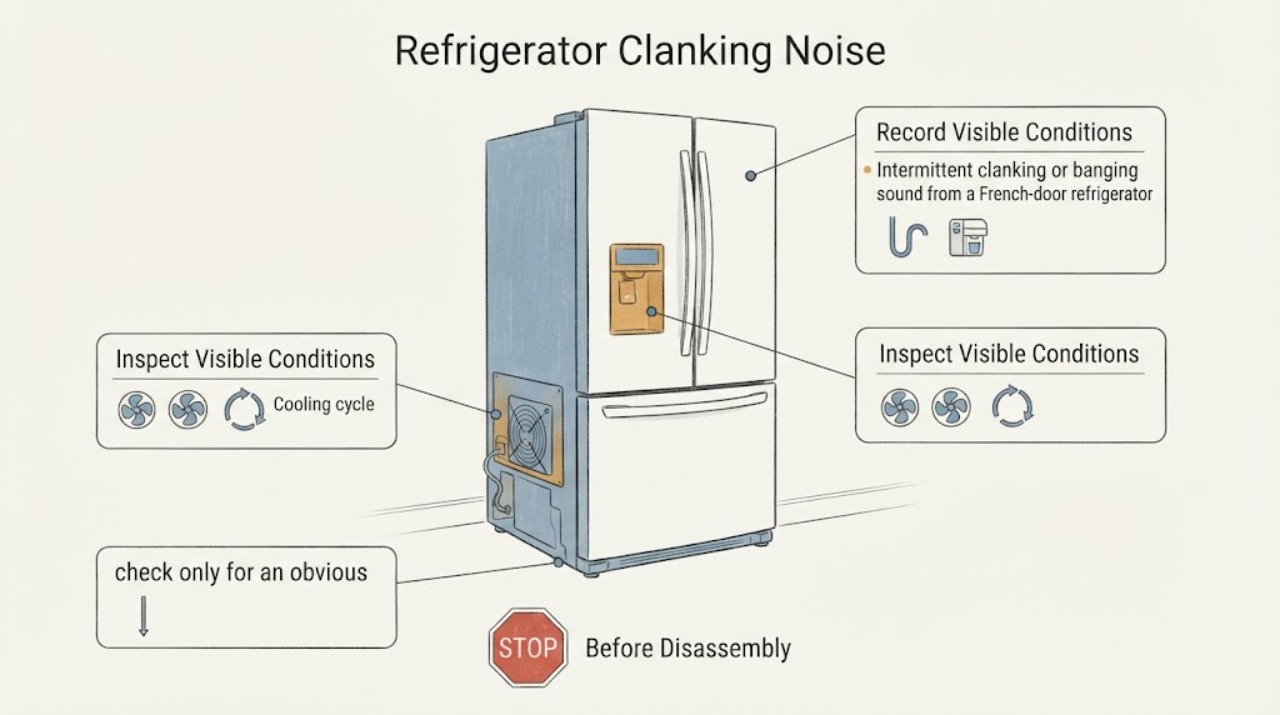
An intermittent clanking sound from a KitchenAid KRFC300ESS00 refrigerator can be part of a water-line fill or ice-maker event, refrigerant or cooling movement, cabinet expansion, or an external vibration. First note where the sound comes from and whether it occurs during ice making, water dispensing, door opening, or a cooling/defrost cycle. Remove items resting on the cabinet, check only accessible tubing for contact, and confirm the refrigerator is stable and level as the model instructions permit. A sound that becomes much louder, runs continuously, is accompanied by water leakage, loss of cooling, burning odor, or electrical symptoms needs qualified service; the sound alone does not identify a fan, valve, compressor, or other replacement part.
Work through in order
Diagnostic checks
Use only checks that match the exact appliance or system and its official guide.
-
Check 1
From outside the refrigerator, record when the clanking starts and stops. Note whether it occurs while the ice maker fills or ejects ice, while water is dispensed, immediately after a door opening or cooling change, during defrost, or with no visible cycle. Listen from the front and sides without reaching into the ice maker, fan area, or rear compartment.
Expected result: The sound is brief and linked to ice/water; it follows cooling or defrost; it occurs when the cabinet vibrates; or it is continuous or unrelated to an observable cycle.
Next step: Continue with the safe external vibration checks only if there is no leak, odor, heat, or electrical symptom. If the noise is continuous, rapidly worsening, or the refrigerator is not cooling normally, arrange qualified service instead of trying to identify a part by sound.
Why this matters
Why: A brief cycle-linked sound is consistent with KitchenAid's documented water-line, ice-maker, refrigerant, expansion, fan, or compressor noises. A continuous or newly unrelated sound is less clearly a normal operating event and needs further external checks or service.
-
Check 2
Remove bottles, magnets, or other items resting on top of the refrigerator and make sure the cabinet is on a solid, stable floor. Without moving the refrigerator or opening a panel, look for accessible water tubing behind it that is touching the cabinet or wall and could amplify vibration; do not pull on the tubing.
Expected result: The sound changes when an item is removed or accessible tubing is no longer touching; the cabinet rocks or is visibly unstable; or the external setup is stable and the sound remains.
Next step: Keep only safe, accessible adjustments and follow the complete KRFC300ESS00 manual before changing leveling feet. If the cabinet cannot be stabilized without moving or disassembling it, stop and use qualified service.
Why this matters
Why: KitchenAid lists objects on top, tubing contact, and an unlevel floor or refrigerator as possible rattling/vibration sources. A change after an external adjustment supports an amplification issue but does not prove the internal sound source; no change leaves the operating-cycle and service branches open.
-
Check 3
If the sound seems tied to the ice maker or water dispenser, check only for an obvious external leak, kink, or tubing contact while keeping hands away from moving or powered parts. Note whether the ice maker is connected to water and whether the sound happens at fill or dispense; do not disconnect a water line or remove an ice-maker cover as a test.
Expected result: A brief clank occurs during fill/dispense with no leak; the refrigerator is not connected to water but a valve-like sound occurs; water leaks or the sound persists between cycles; or the sound is not water-related.
Next step: For a brief, leak-free cycle-linked sound, monitor it and compare with the exact manual. For a leak, persistent clank, or unknown water configuration, keep the area dry and arrange qualified refrigerator service; do not alter the water connection yourself.
Why this matters
Why: KitchenAid describes water-valve, water-line, and ice-maker sounds as possible normal events, including fill-cycle thumping. A leak, persistent noise, or a sound unrelated to the water event requires model-specific assessment rather than a guessed valve or ice-maker part.
-
Check 4
Compare the current sound with the refrigerator's cooling and temperature behavior, and record whether it became louder or longer-lasting than before. Check only normal user-visible controls and the cabinet exterior; do not remove covers, clean hidden coils, or test a fan, compressor, relay, or valve by hand.
Expected result: Cooling remains normal and the sound is brief and unchanged; the sound is significantly louder or longer-lasting; temperatures rise; water leaks; or there is a burning odor, heat, smoke, or electrical symptom.
Next step: For a changed sound or any accompanying symptom, keep the refrigerator in its normal safe state, protect perishable food as needed, and arrange qualified service with the complete KRFC300ESS00 model and timing record. Stop using it and isolate power only if safe for smoke, burning odor, sparking, or dangerous heat.
Why this matters
Why: KitchenAid treats many brief operating sounds as normal but recommends professional assessment when a sound becomes significantly louder or lasts longer. Cooling loss, a leak, or an electrical/heat symptom raises the service urgency and cannot be diagnosed from the noise alone.
Use your observations
Decision map
Find the observation that best matches what you see, then follow the next safe action.
-
PATH 01Next step
What you see
The clank is brief, repeats during ice-maker filling or water dispensing, and there is no leak or change in cooling.
Do this next
Monitor the cycle and keep accessible tubing from contacting the cabinet. Use the exact KRFC300ESS00 manual if the sound changes; do not replace a valve or ice-maker from the sound alone.
Why this path and its safety boundary
Why it matters: This pattern is consistent with KitchenAid's documented water-line, valve, or ice-maker operating sounds.
-
PATH 02Next step
What you see
The sound follows cooling or defrost, is brief, and the refrigerator remains level, stable, and cooling normally.
Do this next
Continue normal observation and remove only external vibration sources. Schedule service if the noise becomes significantly louder, lasts longer, or is joined by a cooling, leak, or electrical symptom.
Why this path and its safety boundary
Why it matters: Refrigerant flow, defrost water, expansion/contraction, fan, or compressor operation can create normal refrigerator sounds; the noise description alone does not distinguish them.
-
PATH 03Next step
What you see
The cabinet rocks, an item or accessible tube vibrates against it, or the noise changes after that external source is removed.
Do this next
Leave the refrigerator stable and follow the complete model manual for any leveling adjustment. Use qualified service if leveling would require moving the appliance, disconnecting water, or opening a panel.
Why this path and its safety boundary
Why it matters: The cabinet or external contact is likely amplifying the sound, but it does not prove that all internal operation is normal.
-
PATH 04Next step
What you see
The clanking is newly much louder, continuous, unrelated to a cycle, or accompanied by cooling loss, water leakage, burning odor, smoke, heat, or an electrical symptom.
Do this next
Arrange qualified KitchenAid refrigerator service and provide the complete KRFC300ESS00 model, sound timing/location, and accompanying symptoms. Isolate power only when safe for smoke, burning odor, sparking, or dangerous heat; do not open the sealed system or guess a part.
Why this path and its safety boundary
Why it matters: This is outside the normal-sound decision path and requires model-specific professional diagnosis.
Helpful context
Understand the symptom
The useful first distinction is timing, not the word “clanking.” A short sound during ice-maker filling or water dispensing points toward the water path; a sound that follows cooling, defrost, or fan operation may be a normal operating noise. A vibration from items on top, loose accessible tubing, or an unlevel cabinet can amplify otherwise ordinary sounds. None of those observations proves that an internal component has failed.
The opened KitchenAid product page identifies the KRFC300ESS base refrigerator family and routes owners to model support, while the assigned label includes the complete KRFC300ESS00 suffix. Use the complete model in the owner documentation and service request; do not transfer a part or internal diagnosis from a different KRFC300ESS variant.
When checks do not resolve it
Need a professional?
Arrange qualified KitchenAid refrigerator service when the KRFC300ESS00 clanking is significantly louder or longer-lasting than before, continuous or unrelated to a normal cycle, or accompanied by cooling loss, a water leak, abnormal heat, burning odor, smoke, or an electrical symptom. Provide the complete model suffix, sound location and timing, and the results of the external vibration checks. Do not order a fan, compressor, valve, ice-maker, damper, or other part from the noise alone.
Common questions
FAQ
Can an intermittent clanking sound be normal on a KitchenAid KRFC300ESS00 refrigerator?
It can be, depending on timing. KitchenAid lists water-line and ice-maker fill/dispense sounds, refrigerant movement, expansion, fans, and other operating sounds as possible sources. A sound that becomes much louder, lasts longer, or comes with a leak or cooling problem needs professional assessment.
What can I check without opening the refrigerator?
Record when the sound occurs, remove items resting on top, check that the cabinet is stable, and look only for accessible tubing contact or an obvious leak. Follow the exact KRFC300ESS00 manual before changing leveling or water connections, and do not reach into fans or the ice maker.
Should I replace the fan, water valve, or compressor because of the clanking?
No. KitchenAid's sound guidance lists several normal and abnormal possibilities, and the noise alone does not identify a failed part. Use the complete model and sound history when arranging service rather than ordering a component by appearance or sound.
Read the exact guide
Official sources
- Refrigerator Noise - Thumping or HammeringKitchenAid Product Help · KitchenAid full-size refrigerator fill-cycle thumping/hammering sound guidance.
- Refrigerator Noise - Rattling or VibratingKitchenAid Product Help · KitchenAid full-size refrigerator rattling/vibration causes: refrigerant, water line, items on top, and leveling.
- Troubleshoot Your Refrigerator’s Possible ProblemsKitchenAid · KitchenAid refrigerator first checks, model-specific manual use, leveling/noise relationship, and professional-service routing.
- Why Is My Refrigerator Making Noise?KitchenAid · KitchenAid refrigerator sound categories, common causes, external adjustments, and professional-service boundary.
- Refrigerator Normal Sounds and NoisesKitchenAid Product Help · KitchenAid refrigerator operating-sound interpretation and external vibration/leveling checks.
- KRFC300ESS | KitchenAidKitchenAid · KitchenAid KRFC300ESS base product-family identity and model-support routing for the assigned complete model KRFC300ESS00; confirm the full suffix before applying model-specific documentation.
Community feedback
Share a repair observation
Share a plain-text repair observation. Accepted observations are published automatically; this page may take a moment to update.