
On this page
Start here
Quick answer
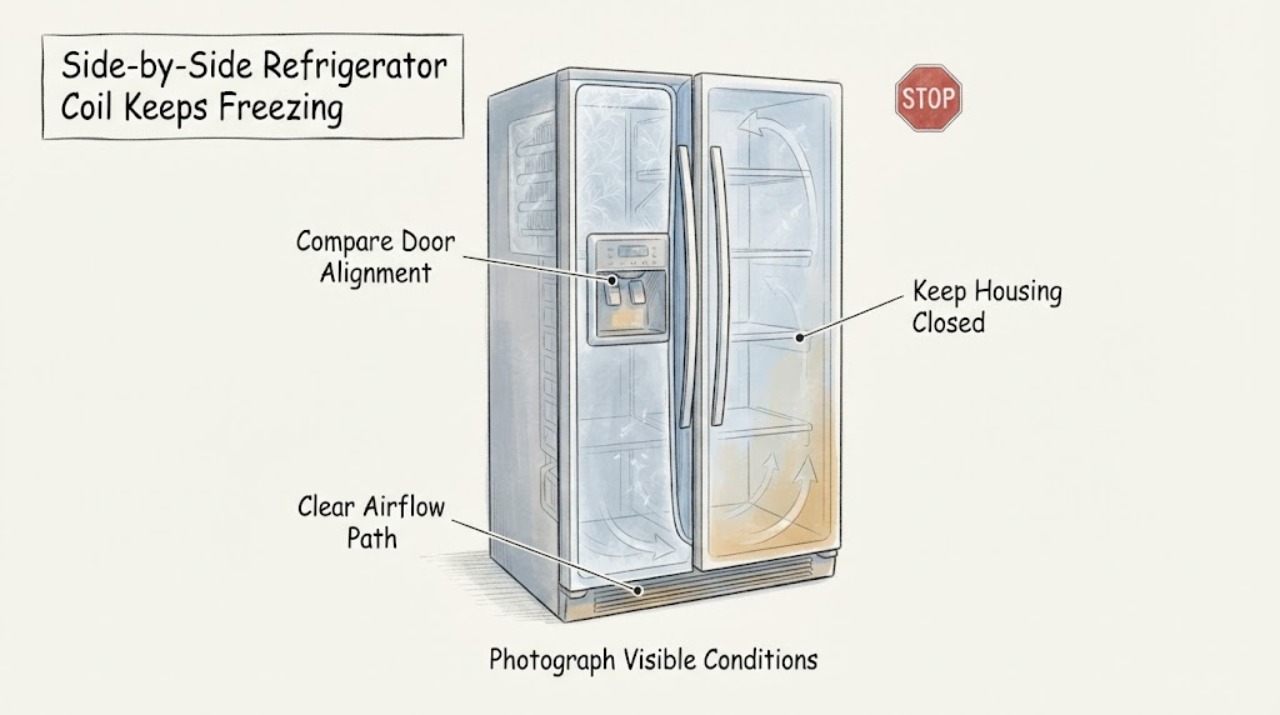
A KitchenAid side-by-side refrigerator that repeatedly develops heavy ice around its cooling coil needs the frost location, door seal and airflow checked before anyone names a defrost part. KitchenAid says that a door left open, frequent openings, an incomplete gasket seal, blocked vents or high humidity can produce frost, and that vent locations and moisture-control settings vary by model. Record whether the refrigerator is still holding its expected temperature, confirm both doors close fully, inspect only accessible gaskets and obstructions, and keep the freezer-to-refrigerator vents clear. If thick frost returns after the model's documented defrost or the refrigerator becomes warm, stop at those external checks and arrange KitchenAid or qualified refrigerator service; the missing model means a heater, sensor, timer, fan or control board cannot be identified safely from this symptom alone.
Work through in order
Diagnostic checks
Use only checks that match the exact appliance or system and its official guide.
-
Check 1
Before changing settings or removing anything, photograph the frost and record where it appears: freezer wall or vent area, the reported coil area, gasket, packages or another surface. Record the refrigerator and freezer temperatures from the display or an appliance thermometer and note whether food is warming.
Expected result: The frost is light and limited to surfaces after humid door openings with stable temperatures, or it is thick/recurrent and a compartment is warmer than its setting.
Next step: If temperatures are stable, continue with the external seal and airflow checks. If a compartment is warm or food safety is in doubt, minimize door openings and arrange service rather than opening the cooling compartment.
Why this matters
Why: KitchenAid describes some frost as a humidity and door-use effect, while heavy frost with poor cooling is a persistent operating problem that cannot be explained by a missing model-specific diagnosis.
-
Check 2
Inspect the accessible freezer and refrigerator door edges, gaskets, shelves and bins. Remove only a visible package or container that prevents full closure, and check that the gasket contacts the cabinet around the door. Do not remove the door, adjust hidden hinges or use a sharp object on ice.
Expected result: A package, bin, dirty or damaged gasket, or door position prevents a complete seal, or both doors close and the gasket contact looks continuous.
Next step: Correct only the visible obstruction and follow the model manual for gasket care. If the door still will not seal or the gasket is damaged, stop relying on the appliance and request installation or refrigerator service.
Why this matters
Why: KitchenAid says a door left open or a poor gasket seal lets humid room air enter and can build frost; a sound visible seal makes the vent and humidity checks more relevant but does not prove the internal system is healthy.
-
Check 3
Check the air vents that are accessible without removing panels. Keep the freezer-to-refrigerator air path clear and rearrange food only enough to leave the openings unobstructed; do not probe an opening, chip ice, or dismantle an evaporator cover.
Expected result: A vent or air path was blocked by food or ice, or the visible vents were already clear while the frost still returns.
Next step: After the safe loading correction, monitor temperatures and frost without forcing ice removal. If airflow remains blocked by internal ice or cooling is poor, use the model's documented defrost instructions or arrange service; do not improvise heat or internal disassembly.
Why this matters
Why: KitchenAid says blocked vents can cause moisture build-up or excessive frost and that vent locations vary by model. Clear external loading can be corrected by the user, but recurrent ice after the path is clear is not proof of a particular failed part.
-
Check 4
Check the refrigerator's installation condition from the outside: confirm it is level according to the model's Owner's Manual and that the doors are not being held open by the cabinet, floor, shelves or containers. Do not shim, remove doors or change hinge hardware without model-specific instructions.
Expected result: The cabinet or doors are visibly out of level or unable to close, or the unit is level and both doors close normally.
Next step: Follow the model-specific installation instructions or request installation correction if the unit is not level or a door will not close. If installation is sound, do not infer a defrost component from the frost alone.
Why this matters
Why: KitchenAid says proper leveling supports overall operation and directs model-specific leveling information to the Owner's Manual. An installation issue can keep a gasket from sealing, while a level, closed unit points back to humidity, airflow or an unresolved internal fault.
-
Check 5
If moisture or frost is concentrated on the vertical hinged seal or center rail, identify the refrigerator model and read its Owner's Manual for an Energy Saver or Humidity Control feature. Do not copy a button sequence or assume the feature exists on an unspecified KitchenAid model.
Expected result: The exact model documents a moisture-control feature, or no such feature is documented and the frost is on an interior cooling surface or keeps returning.
Next step: Use the feature only as the model manual directs. For recurring heavy frost, a warm compartment, a failed seal or any need to access internal parts, arrange KitchenAid or qualified refrigerator service.
Why this matters
Why: KitchenAid says some refrigerators use a heater in the vertical hinged seal and that control operation varies by model. That feature addresses a model-specific exterior moisture condition; it does not diagnose recurring interior coil ice.
Use your observations
Decision map
Find the observation that best matches what you see, then follow the next safe action.
-
PATH 01Next step
What you see
Frost is light, temperatures are stable, doors seal and it appears after humid conditions or repeated door openings.
Do this next
Keep doors closed as much as practical, keep vents clear and continue monitoring the frost location and temperatures. Escalate if the frost becomes heavy, returns quickly or cooling worsens.
Why this path and its safety boundary
Why it matters: The observed pattern is consistent with humidity entering during normal use and does not identify a failed refrigerator component.
-
PATH 02Next step
What you see
A package, shelf, gasket, door position or level problem prevents complete door closure.
Do this next
Remove only the visible obstruction or follow the model installation instructions. Request installation or service support for a damaged gasket, misalignment or a door that still will not seal.
Why this path and its safety boundary
Why it matters: The door can admit humid room air continuously, which KitchenAid identifies as a frost-producing condition.
-
PATH 03Next step
What you see
Doors seal, vents are clear and the cabinet is level, but thick frost returns or a compartment becomes warm.
Do this next
Protect perishable food and arrange KitchenAid or qualified refrigerator service. Do not remove panels, use a heat source, pierce tubing, add refrigerant or order a heater, sensor, fan or board from this symptom alone.
Why this path and its safety boundary
Why it matters: The documented external causes did not resolve the problem; the no-model evidence does not distinguish a defrost, airflow, control or sealed-system cause.
-
PATH 04Next step
What you see
The reported moisture is only on a center rail or vertical hinged seal and the exact model documents Energy Saver or Humidity Control.
Do this next
Use the model manual for the setting and observe the surface. If frost is inside the freezer, cooling is poor or the moisture persists, request service instead of assuming the control fixes an internal fault.
Why this path and its safety boundary
Why it matters: KitchenAid treats this as a model-dependent moisture-control feature, separate from a diagnosis of internal coil ice.
Helpful context
Understand the symptom
First separate frost location from the word coil
The opened lead uses the word coil, but no model number or internal view is supplied. Before opening a cover, note whether ice is on an accessible freezer wall or vent area, around the reported cooling coil, on the door gasket, or only as light frost on packages. Also record whether both compartments are still at their normal settings and whether food is warming. A visible frost pattern can guide the next safe check; it does not identify a heater, sensor, fan or control board.
Humidity enters through the door and the air path
KitchenAid says frost is likely when a freezer door remains open, and that frequent openings, a gasket that does not seal and blocked vents can increase humidity or excessive frost. Check only the accessible door edges, gasket contact, shelves and bins, then leave room around the model's vents. Do not pry at ice or remove an evaporator cover to make this check.
Use the model manual for controls and stop at service
KitchenAid's side-by-side pages repeatedly send model-specific vent locations, leveling information and moisture-control operation to the Owner's Manual. A no-model article can therefore support external observations and a service decision, but not a component diagnosis or an internal defrost test. If heavy frost returns or a compartment is warm after the visible door and airflow checks, preserve the model number, frost location and temperature history for service.
When checks do not resolve it
Need a professional?
Stop relying on the refrigerator for perishable storage and arrange service if a compartment is warm, thick frost blocks airflow, the gasket or door will not seal, ice returns after the documented defrost process, water is pooling, or any next step would require removing an internal panel or testing live refrigerator wiring.
Common questions
FAQ
Does recurring frost prove that the KitchenAid defrost heater is bad?
No. With no model number, the opened KitchenAid guidance supports checking humid-air entry, the door gasket, vents and leveling, but it does not identify a heater or any other internal part. A recurring heavy frost pattern with poor cooling needs model-specific service diagnosis.
Can I scrape the ice off the coil or thaw it with a hair dryer?
Do not chip at an internal coil or improvise a heat source. If the model manual provides a safe defrost procedure, follow that exact procedure; otherwise stop at the accessible door and vent checks and arrange service when ice returns or blocks cooling.
Why should I check the door seal when the problem is described as a frozen coil?
KitchenAid says that an open door or an improper gasket seal lets humid room air enter and can build frost. A seal check is an external way to test that documented cause, but a good seal does not rule in a particular internal component.
What should I record before calling for KitchenAid refrigerator service?
Record the exact model number, where the frost appears, refrigerator and freezer temperatures, whether each door closes fully, whether the vents are blocked, how quickly frost returns and whether food is warming. This lets service use the correct manual and avoids ordering an unverified part from a symptom alone.
Read the exact guide
Official sources
- Condensation in the Refrigerator Section - Side by Side RefrigeratorKitchenAid Product Help · Exact KitchenAid side-by-side family support page. Used for blocked vents, humid door openings, gasket sealing and level checks; model-specific details remain in the Owner's Manual.
- Condensation on the Mullion or Center Rail - Side by Side RefrigeratorKitchenAid Product Help · Exact KitchenAid side-by-side family support page. Used only for the conditional vertical-seal/center-rail moisture feature and the model-manual caveat, not for an internal coil diagnosis.
- Frosting in the Freezer Section - Side by Side RefrigeratorKitchenAid Product Help · Exact KitchenAid side-by-side family support page. Used for humid-air entry, prolonged/frequent door openings, gasket obstruction, blocked vents, model-dependent vent locations and the service boundary. It does not identify an internal part for an unspecified model.
- Kitchenaid side by side refrigerator coil keeps freezingReddit r/appliancerepair · Opened the exact Reddit permalink supplied as the research lead. Used only to confirm the assigned KitchenAid side-by-side coil-freezing wording; community speculation is not used for diagnosis or repair instructions.
Community feedback
Share a repair observation
Share a plain-text repair observation. Accepted observations are published automatically; this page may take a moment to update.