
On this page
Start here
Quick answer
Do not diagnose the compressor from run time alone. For a KitchenAid KBRS19KTMS1 that seems to run continuously while food is extra cold during colder, drier weather, first measure the actual refrigerator and freezer temperatures and note the room temperature. KitchenAid says many models are intended for indoor conditions of about 55°F to 110°F, that a refrigerator setting below about 35°F can freeze food near vents, and that a freezer set far below 0°F can push excessive cold into the fresh-food section. Check the controls as the KBRS19KTMS1 manual shows, clear vents, confirm both doors seal, and make only a small warmer adjustment if the measured temperatures are too low; wait 24 hours before judging the change. If food remains too cold, the compressor never cycles after the appliance has stabilized, temperatures swing, frost builds, or you hear abnormal scraping, clicking, or electrical noise, arrange KitchenAid or qualified refrigerator service rather than replacing the compressor by assumption.
Before you begin
Safety first
- Do not open the compressor compartment, probe live terminals, bypass a thermostat or control, add a portable heater near the refrigerator, use a heat gun to change temperatures, or select a compressor, sensor, or control from run time alone. Keep the appliance closed and protect food when temperatures are unsafe.
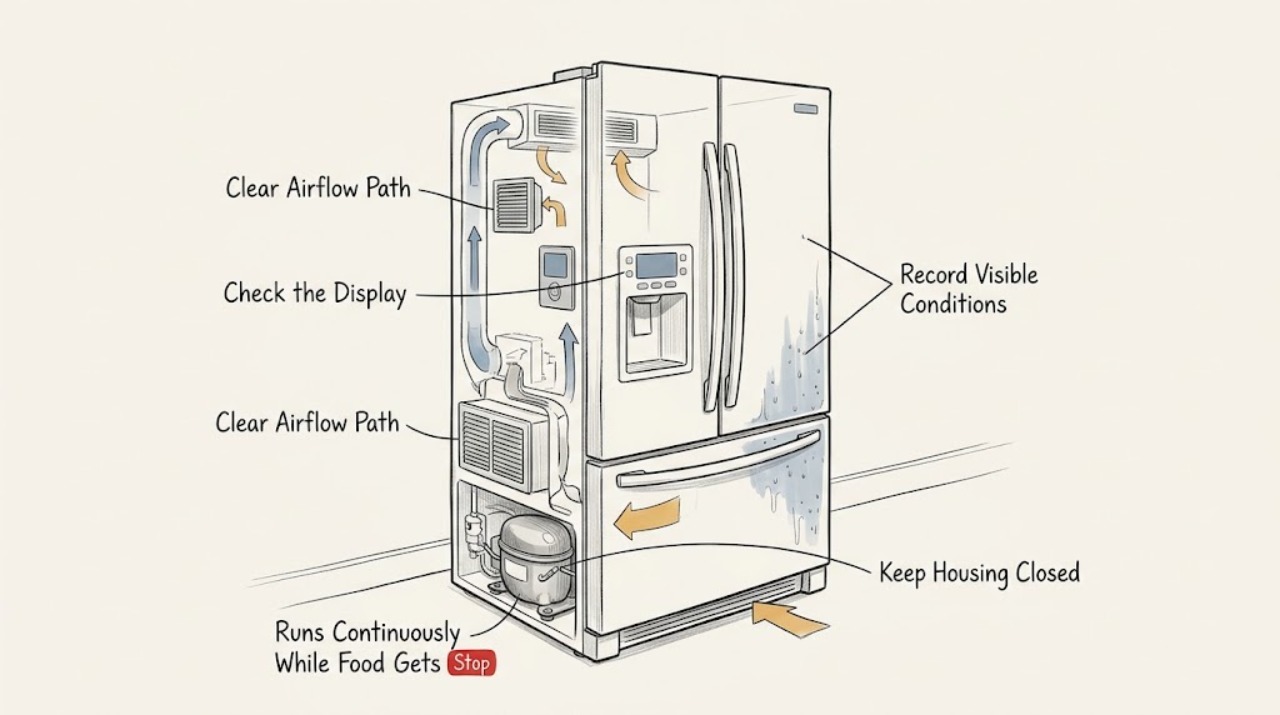
Work through in order
Diagnostic checks
Use only checks that match the exact appliance or system and its official guide.
-
Check 1
Record the complete model as KBRS19KTMS1, the room temperature, the refrigerator and freezer control positions, and actual temperatures from reliable thermometers placed in the food compartments. Note whether the compressor sound is truly continuous or whether it stops while fans or normal refrigerant sounds continue.
Expected result: The refrigerator section is below about 35°F, near 37°F-40°F, or warmer; the freezer is far below 0°F, near 0°F, or warmer; the room is below about 55°F; or the compressor cycles at least occasionally.
Next step: If food is freezing or measured temperatures are too low, make one small warmer adjustment using the exact manual and wait a full 24 hours. If temperatures are warm despite long running, or the compressor never cycles after stabilization, continue external checks and plan service.
Stop if: Stop and protect food if perishable food is above a safe temperature, the freezer is thawing, the thermometer shows a severe swing, or the sound includes burning, sparking, or repeated hard clicking.
Why this matters
Why: Temperature and sound separate overcooling or a cold-room control response from a compressor that is running to recover poor cooling. KitchenAid's published ranges are general guidance, not a substitute for the KBRS19KTMS1 manual or a calibrated service measurement.
-
Check 2
Check the visible temperature controls and any cold-weather or temporary setting only as the KBRS19KTMS1 owner information describes. Do not turn the control to an extreme position. If the refrigerator is measurably too cold, change one step warmer and mark the time so the result can be checked after 24 hours.
Expected result: A control is set colder than intended, a temporary mode is active, the setting is at the normal documented position, or the control does not respond consistently.
Next step: Leave the new setting unchanged for a full stabilization period. If temperatures remain too cold or the control has no predictable effect, provide the temperature log and model identity to service instead of repeatedly adjusting it.
Stop if: Stop if the control is loose, cracked, wet, hot, or requires removing a panel; do not enter a service mode or bridge a thermostat/control.
Why this matters
Why: KitchenAid says settings that are too cold can lengthen run time and can freeze food near vents. A control that does not respond to a documented small adjustment is a control-system clue, not proof of a failed compressor.
-
Check 3
With the appliance closed and powered normally, inspect the refrigerator and freezer doors, gaskets, cabinet level, and accessible base-grille area. Confirm that no package holds a door open, the gaskets contact the cabinet all around, and accessible air paths are not blocked by food or dust; do not remove panels or force a gasket.
Expected result: A door has a gap, gasket contact is uneven, the cabinet rocks or is badly out of level, a vent or base grille is blocked, or the doors and accessible airflow are normal.
Next step: Clear only accessible obstructions, close the doors, and monitor the same thermometers for one full day. Have service correct a damaged gasket, leveling problem, inaccessible airflow restriction, or persistent temperature mismatch.
Stop if: Stop if a gasket is torn, the door cannot close, the cabinet is unstable, the base grille is damaged, or cleaning would expose wiring or require moving the refrigerator unsafely.
Why this matters
Why: Warm air leakage and restricted heat rejection can make a compressor run longer, while blocked internal vents can create cold spots that make food seem overcooled. Correcting a visible condition is different from proving a refrigeration-system fault.
-
Check 4
Review the cold-weather environment without adding a heat source: note whether the refrigerator is in an unheated garage, porch, basement, or against a cold exterior wall, and whether the room is within KitchenAid's general indoor range. Check that the appliance is not beside a heat source and has its model-required ventilation clearance.
Expected result: The room is below the published minimum, the unit is in a drafty or unheated area, clearances are blocked, or the room is within range with normal clearances.
Next step: Move or protect the appliance only through a safe, code-compliant installation change in a climate-controlled space; do not place a portable heater against it. If the environment is normal and the temperature problem persists, use the temperature log for service diagnosis.
Stop if: Stop if the refrigerator is exposed to freezing conditions, condensation, water, a damaged power cord, or an installation change would require moving it while connected to plumbing or power.
Why this matters
Why: KitchenAid says low ambient temperatures can alter compressor cycling and cause freezer fluctuations or partial thawing, while blocked ventilation can affect performance. A cold Northeast season can therefore change cycling without identifying a compressor defect.
-
Check 5
After the control, door, airflow, and room checks have had a full stabilization period, observe the compressor and cabinet only from outside. Record whether both compartments hold their temperatures, whether the compressor cycles, and whether the sound is a normal hum or an abnormal scrape, repeated click, rattle, or electrical buzz; do not touch the compressor or remove the rear cover.
Expected result: Temperatures are stable and the compressor cycles; temperatures are too cold but stable; temperatures are warm or swinging while the compressor runs; or abnormal sound, frost, odor, or breaker trips appear.
Next step: For stable but overcold food, return to the documented control and airflow path. For persistent poor cooling, abnormal sound, frost, odor, or repeated trips, keep doors closed, protect food, and arrange KitchenAid or qualified refrigerator service.
Stop if: Stop using the appliance if there is smoke, burning odor, sparking, a hot or damaged cord, repeated breaker trips, refrigerant-oil evidence, or food-safety temperature loss.
Why this matters
Why: Stable temperatures with occasional cycling can be normal even when a run sound is noticeable. Persistent warm or swinging temperatures, or safety/noise symptoms, require diagnosis of fans, sensors, controls, compressor starting, or the sealed system; no outside symptom selects one of those parts.
Use your observations
Decision map
Find the observation that best matches what you see, then follow the next safe action.
-
PATH 01Next step
What you see
The room is unusually cold, the refrigerator is below about 35°F or the freezer is far below 0°F, food is extra cold, and doors, vents, and temperatures are otherwise stable.
Do this next
Use the exact KBRS19KTMS1 instructions to make one small warmer adjustment or restore a suitable indoor environment, then wait 24 hours and remeasure before escalating.
Why this path and its safety boundary
Why it matters: A setting or ambient-condition response is more likely than a proven compressor failure; the sound may reflect control behavior or normal cooling demand.
-
PATH 02Next step
What you see
The room is within the recommended range, settings are documented and reasonable, doors seal, vents are clear, but the refrigerator remains too cold and the compressor never cycles after a full stabilization period.
Do this next
Arrange KitchenAid or qualified refrigerator service with the temperature log, control positions, room temperature, and run/sound observations. Do not replace the compressor based only on run time.
Why this path and its safety boundary
Why it matters: The environmental and user-setting explanations are less likely, but a thermostat, sensor, control, airflow, or refrigeration-system diagnosis is still needed; continuous sound does not prove the compressor itself failed.
-
PATH 03Next step
What you see
The compressor runs for long periods while one or both compartments are warm, temperatures swing, frost builds, or doors cannot maintain a seal.
Do this next
Keep the doors closed, protect perishable food, and request qualified service; do not open the cabinet, defrost with a heat gun, or touch the compressor circuit.
Why this path and its safety boundary
Why it matters: This is not explained by food being extra cold alone. Cooling demand, door leakage, frost, fan, control, compressor-start, or sealed-system problems remain possible and cannot be separated safely from the outside.
-
PATH 04Next step
What you see
Burning odor, smoke, sparking, a hot or damaged cord, repeated breaker trips, scraping at the compressor, or unsafe food temperature accompanies the run complaint.
Do this next
From a dry safe position, disconnect power if it can be done without touching a wet or damaged cord, keep the appliance closed, protect food, and obtain qualified appliance/electrical service before reuse.
Why this path and its safety boundary
Why it matters: The symptom has crossed an electrical, mechanical, or food-safety boundary; continued cycling to reproduce it can increase damage or risk.
Helpful context
Understand the symptom
Cold outdoor weather is a useful condition to record, not proof of a compressor fault. A refrigerator can sound busy while recovering from a load or an open door, but extra-cold food changes the first question: is the cabinet actually below the intended refrigerator temperature, or is the compressor merely being heard more often? KitchenAid's public guidance identifies room temperature, controls, blocked vents, door sealing, and loading as operating factors and advises checking the exact model manual for control details.
The KBRS19KTMS1 is an older, exact-model appliance identity, so do not copy a modern electronic-button sequence or assume an inverter compressor. Use only visible controls and external observations. Never open the compressor compartment, probe live terminals, add a heater near the refrigerator, or change settings repeatedly before a full stabilization period.
When checks do not resolve it
Need a professional?
Arrange KitchenAid or qualified refrigerator service when the KBRS19KTMS1 remains too cold after one documented warmer adjustment and a full stabilization period, never cycles in a normal indoor environment, has warm or swinging temperatures despite long running, develops heavy frost or abnormal sounds, or shows a control/door/airflow condition that cannot be corrected externally. Use electrical service before reuse for smoke, sparking, a hot/damaged cord, or repeated breaker trips.
Safety scope: Do not open the compressor compartment, probe live terminals, bypass a thermostat or control, add a portable heater near the refrigerator, use a heat gun to change temperatures, or select a compressor, sensor, or control from run time alone. Keep the appliance closed and protect food when temperatures are unsafe.
Have this ready
- Provide the exact KBRS19KTMS1 model, room temperature and location, refrigerator/freezer measured temperatures over 24 hours, control positions, door and gasket observations, vent/clearance observations, compressor cycle pattern, and any frost, odor, noise, or breaker history.
Common questions
FAQ
Can colder Northeast weather make a KitchenAid refrigerator run continuously?
It can alter cycling, especially if the appliance is in a room below KitchenAid's general indoor minimum or in another unsuitable location, but weather alone does not prove a compressor fault. Measure the room and compartment temperatures and check the exact model's settings and installation conditions.
Why is food extra cold if the compressor keeps running?
A refrigerator control set too cold, a freezer set far below 0°F, blocked vents that create a cold spot, a cold room, or a sensor/control issue can all produce that combination. Actual temperatures and a 24-hour response to one small documented adjustment are more useful than sound alone.
Should I turn the control colder to make the compressor shut off?
No. A colder setting can lengthen run time and worsen overcooling. If measured temperatures are too low, use the KBRS19KTMS1 manual for one small warmer adjustment and wait 24 hours before judging it.
Does a humming sound mean the compressor is failing?
No. A normal hum can occur while cooling, and fans or other normal refrigerator sounds can be mistaken for a compressor. Persistent warm temperatures, abnormal scraping or clicking, odor, frost, or electrical symptoms require service diagnosis rather than a guessed compressor replacement.
Can I put a heater next to the refrigerator in cold weather?
Do not add a portable heater or otherwise heat the cabinet. KitchenAid's guidance is to use an appropriate indoor environment and the model's installation requirements; a heater can create fire and control risks. Have an unsuitable room or persistent cycling evaluated safely.
Read the exact guide
Official sources
- What to Check if the Refrigerator Section is Too ColdKitchenAid Product Help · The page is tagged for multiple KitchenAid refrigerator types including top-freezer models and is used for general temperature/airflow/environment guidance, not an exact KBRS19KTMS1 control sequence.
- Kitchen Appliance ManualsKitchenAid · KitchenAid directs owners to enter the complete appliance model to locate the correct manual; this source is used to preserve the KBRS19KTMS1 manual boundary rather than infer a control sequence.
- Motor or Compressor Runs Too Much - Built-In RefrigeratorKitchenAid Product Help · This is KitchenAid's published run-time guidance for refrigerator operation; it is used for general decision logic about settings, doors, load, room conditions, and clearance, not as proof of the KBRS19KTMS1's compressor type or fault.
- What is the Proper Location and Environment for a RefrigeratorKitchenAid Product Help · KitchenAid's general environment guidance includes top-freezer refrigerators and says exact model installation requirements control; it supports the cold-weather and clearance branch without identifying an internal component.
Community feedback
Share a repair observation
Share a plain-text repair observation. Accepted observations are published automatically; this page may take a moment to update.