
On this page
Start here
Quick answer
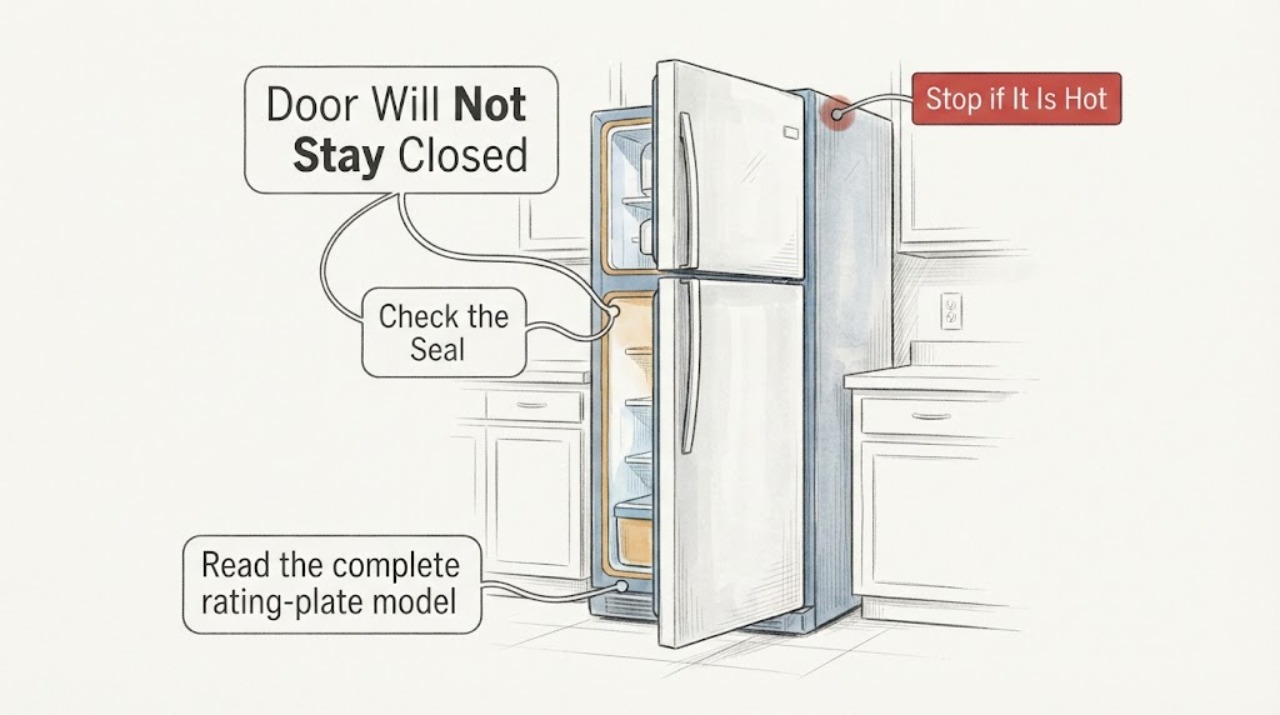
After replacing a door gasket on the KitchenAid KRFC302ESS00, do not force the French doors shut, heat-form the seal, or remove a hinge. First confirm the full model suffix and note which door was serviced. Move bins, bottles, shelves, drawers, and packages out of the closing path; inspect the new gasket for a fold, twist, gap, loose edge, or debris; and check whether the center hinged seal is in the position shown by the exact manual. KitchenAid says a refrigerator that is not level, has a dirty or warped gasket, has an obstruction, or has a door installed or aligned incorrectly may not close or seal. If one door opens when the other closes, that can be an air-pressure effect, but a door that will not stay closed or leaves a gap after the gasket replacement needs model-specific service and temperature/food-safety attention.
Work through in order
Diagnostic checks
Use only checks that match the exact appliance or system and its official guide.
-
Check 1
Check the refrigerator temperature display and visible seal from a safe position; if the door cannot remain closed, move perishable food to safe cold storage and do not keep running the refrigerator with a persistent gap.
Expected result: The door leaves a visible gap, the interior light stays on, frost or condensation is increasing, or the door closes and seals normally.
Next step: If the seal is not reliable, protect the food and arrange service after the external checks below. Do not slam or hold the door shut to compensate.
Why this matters
Why: KitchenAid warns that a door that does not seal can cause temperature fluctuation, frost buildup, and food spoilage. A door that appears closed but leaves a gap is not cleared by the latch or magnet alone.
-
Check 2
Read the complete rating-plate model and serial information, confirm the KRFC302ESS00 suffix, and retrieve the matching KitchenAid owner and installation documents before changing any adjustment.
Expected result: The plate confirms KRFC302ESS00 and the manual matches, or only the base KRFC302ESS name/another identifier is available.
Next step: If the suffix or manual cannot be matched, stop at external observations and have KitchenAid or a qualified technician identify the appliance. Do not order another gasket or adjust a hinge from the base name alone.
Why this matters
Why: The opened KitchenAid owner page identifies the KRFC302ESS base as a French-door model but does not expose the task's 00 suffix. KitchenAid directs owners to use the model number for product manuals and troubleshooting resources, so the repair timing cannot establish fitment across suffixes.
-
Check 3
Open both refrigerator doors and inspect every bin, bottle, shelf, drawer, ice container, and package at the closing edges; also remove any remaining shipping material without pulling the refrigerator or forcing a door.
Expected result: A container, shelf, drawer, ice bin, package, or packaging material projects into the door path, or the path is clear.
Next step: Reposition only the visible obstruction and close the door gently. If it still rebounds or will not stay closed, stop forcing it and continue to the gasket and alignment service branch.
Why this matters
Why: KitchenAid lists overfilled bins, tall containers, mis-seated drawers, an out-of-place ice bin, and packaging as causes of incomplete closure. A clear path makes the replacement gasket, alignment, or hinge/seal interaction more important, but does not identify a failed part.
-
Check 4
Inspect the newly replaced gasket around the entire door perimeter and the center vertical seal, looking for a fold, twist, pinched corner, loose section, dirt, crack, deformation, or a gap against the cabinet; wipe only accessible residue with a soft cloth and do not heat or reshape it.
Expected result: The gasket is folded or displaced, the center seal is outward when the doors are open, the gasket is dirty or damaged, or it appears evenly seated with continuous contact.
Next step: If the exact manual shows a safe hand-positioning step, return only the accessible seal to that position. For a damaged gasket, persistent gap, or uncertain seal design, keep the door from being forced and arrange service.
Why this matters
Why: KitchenAid says dirt, brittleness, cracking, warping, or an incorrectly positioned French-door hinged seal can prevent proper closure or sealing. A visibly displaced section after replacement is an installation/seal-path clue, not permission to use heat or force.
-
Check 5
Observe the cabinet and doors for rocking, unequal gaps, a door sitting high or low, or a door that closes only when lifted; do not turn hinge hardware, remove a hinge, or move the refrigerator as an experiment.
Expected result: The cabinet is visibly unlevel or unstable, the door alignment changed after the gasket work, or the cabinet and gaps look stable.
Next step: Use the exact installation instructions or a qualified appliance technician for leveling and alignment. Do not loosen hinges or support a door yourself.
Why this matters
Why: KitchenAid says leveling affects door swing and sealing, and that doors should be aligned only after the refrigerator is properly level. A changed gap after service raises an installation/alignment question but does not prove a hinge fault.
-
Check 6
With both doors otherwise clear, note whether closing one door briefly pushes the other open, whether the issue occurs only after a forceful close, and whether either door remains open or leaves a seal gap; do not repeat slams or deliberate pressure tests.
Expected result: The opposite door briefly pops open and then seals, or one door rebounds, stays open, or never contacts the cabinet.
Next step: Treat a brief pressure effect gently and avoid slamming. For persistent opening, a gap, rising temperature, or a post-replacement alignment change, keep the refrigerator protected and arrange model-specific service.
Why this matters
Why: KitchenAid describes brief door popping as possible air movement between compartments, especially after forceful closing. Persistent rebound or incomplete contact is not the same normal pressure effect and points back to obstruction, gasket, level, or alignment.
Use your observations
Decision map
Find the observation that best matches what you see, then follow the next safe action.
-
PATH 01Next step
What you see
A bin, bottle, shelf, drawer, ice bin, package, or shipping material touches the door or prevents full closure.
Do this next
Reposition only the accessible item and close gently. If the door still will not stay closed, stop and arrange service rather than forcing it.
Why this path and its safety boundary
Why it matters: The visible obstruction is more likely than a gasket or hinge fault, and KitchenAid lists these items as common closure blockers.
-
PATH 02Next step
What you see
The door gasket was just replaced and has a fold, loose edge, displaced center seal, dirt, crack, warp, or a continuous gap.
Do this next
Use only the exact manual's accessible positioning or cleaning instruction; otherwise have the replacement and seal contact checked by a qualified technician. Do not heat, stretch, glue, or lubricate the gasket.
Why this path and its safety boundary
Why it matters: The seal path or installation is implicated, but the observation does not identify the correct gasket or justify heat-forming it.
-
PATH 03Next step
What you see
The path and gasket look clear, but the cabinet rocks, the door gap changed after the replacement, or a door closes only when lifted.
Do this next
Keep the door from being forced and arrange qualified installation/appliance service using the exact model documentation.
Why this path and its safety boundary
Why it matters: Leveling or door alignment needs model-specific attention. KitchenAid says leveling should precede door adjustment, so this is not a reason to remove or loosen a hinge blindly.
-
PATH 04Next step
What you see
One door briefly pops the other open after the other door is closed, but both then sit flush and the gasket seals.
Do this next
Close doors gently and monitor without deliberate repetition. If either door remains open, the gap persists, or temperatures rise, use the service branch.
Why this path and its safety boundary
Why it matters: KitchenAid describes this as a possible air-pressure effect between compartments, especially when a door is slammed; it is different from a persistent gap or rebound.
-
PATH 05Next step
What you see
The full model is confirmed, the closing path is clear, and the door still will not stay closed or seal after the gasket replacement.
Do this next
Move vulnerable food to safe cold storage and arrange KitchenAid or qualified appliance service. Provide the old/new gasket information and photos; do not force the door or remove hinges.
Why this path and its safety boundary
Why it matters: A gasket fit, hinge/alignment, cabinet level, or installation interaction remains unresolved; KitchenAid's general guidance cannot select a replacement part from the symptom alone.
Helpful context
Understand the symptom
A post-replacement closure problem starts with the seal path
The timing after a gasket replacement is important, but it does not prove that the replacement is wrong or that a hinge needs adjustment. KitchenAid's guidance starts with obstructions, gasket condition, level, alignment, and the center seal on French-door models. Inspect those interfaces with the doors supported by their normal position; do not heat, stretch, force, or detach the gasket.
Separate a single-door fit problem from normal door-to-door pressure
If a door closes when the other door is already shut but briefly pops the other door open, KitchenAid says air moving between compartments can cause that effect, especially after a forceful close. That is different from a gasket gap, a door that rebounds and remains open, or a door that cannot reach the cabinet. The latter patterns require alignment and seal verification.
When checks do not resolve it
Need a professional?
Arrange qualified KitchenAid service if the new gasket remains displaced or damaged, a door gap persists, the refrigerator cannot hold temperature, the door changed alignment after replacement, or the unit must be leveled or a hinge adjusted. Escalate food protection immediately if the door cannot seal.
Have this ready
- Provide the complete KRFC302ESS00 rating plate, serial number, market, date and method of gasket replacement, old and new seal information, photos of folds or gaps, which door is affected, cabinet level observations, contents blocking checks, and whether the opposite door pops open or temperatures changed.
Common questions
FAQ
Why did the KitchenAid door stop staying closed after the gasket was replaced?
The replacement may be folded, displaced, damaged, or not contacting evenly, but a bin, shelf, package, center seal, level, or alignment can create the same symptom. Check only the visible seal path and contents; do not heat or force the gasket. Persistent gaps need model-specific service.
Is it normal for one French-door refrigerator door to pop open when the other closes?
A brief opposite-door pop can be an air-pressure effect, particularly after a forceful close, according to KitchenAid. It is not a normal explanation for a door that rebounds, remains open, or leaves a seal gap.
Can I use a hair dryer to reshape the new gasket?
Do not heat-form or stretch it here. The exact KRFC302ESS00 instructions and the fit of the replacement must be verified first; use a qualified technician for a persistent fold, gap, or alignment problem rather than risking gasket damage or a poor seal.
Read the exact guide
Official sources
- Doors Not Closing ProperlyKitchenAid Product Help · KitchenAid full-size refrigerator general guidance; exact KRFC302ESS00 manual and qualified service govern adjustments.
- Door Pops Opens when Refrigerator Doors CloseKitchenAid Product Help · KitchenAid full-size French-door guidance; applies only to a brief pop with otherwise normal closure, not a persistent gap.
- KRFC302ESS | KitchenAidKitchenAid · KitchenAid US owner page for the KRFC302ESS French-door refrigerator family; confirm the complete KRFC302ESS00 rating plate before model-specific service or parts decisions.
- Doors Not Sealing - French Door RefrigeratorKitchenAid Product Help · KitchenAid French-door bottom-freezer refrigerator guidance; do not infer exact hinge or gasket fit for the 00 suffix.
Community feedback
Share a repair observation
Share a plain-text repair observation. Accepted observations are published automatically; this page may take a moment to update.