
On this page
Start here
Quick answer
A single pop from the KitchenAid KRFF577KPS left refrigerator door at the same opening angle is different from KitchenAid's normal cabinet popping during cooling or defrost. First record whether the sound is tied to door movement, whether the door is sagging or rubbing, and whether the noise changes when you support the door without forcing it. KitchenAid's model parts list includes a left refrigerator door and door coupler, while an exact-model report described a service cam/bushing repair that stopped a repeatable mid-swing pop; that report is a service clue, not proof that a particular part is bad. Do not remove the door, adjust the hinge, or order a part from the sound alone. Arrange model-matched service if the pop repeats at a fixed angle, the door shifts, the seal is affected, or the noise is accompanied by damage or water leakage.
Before you begin
Safety first
- Do not remove the refrigerator door, disconnect its water tube or wiring, turn hinge hardware, add washers, defeat the door stop, or probe behind covers to chase a popping noise. Stop testing and arrange service for a loose or sagging door, damaged seal, water leak, exposed wiring, repeated rubbing, worsening noise, or any temperature change. Keep food at safe temperatures and disconnect power only when it is safe, especially if water reaches electrical parts.
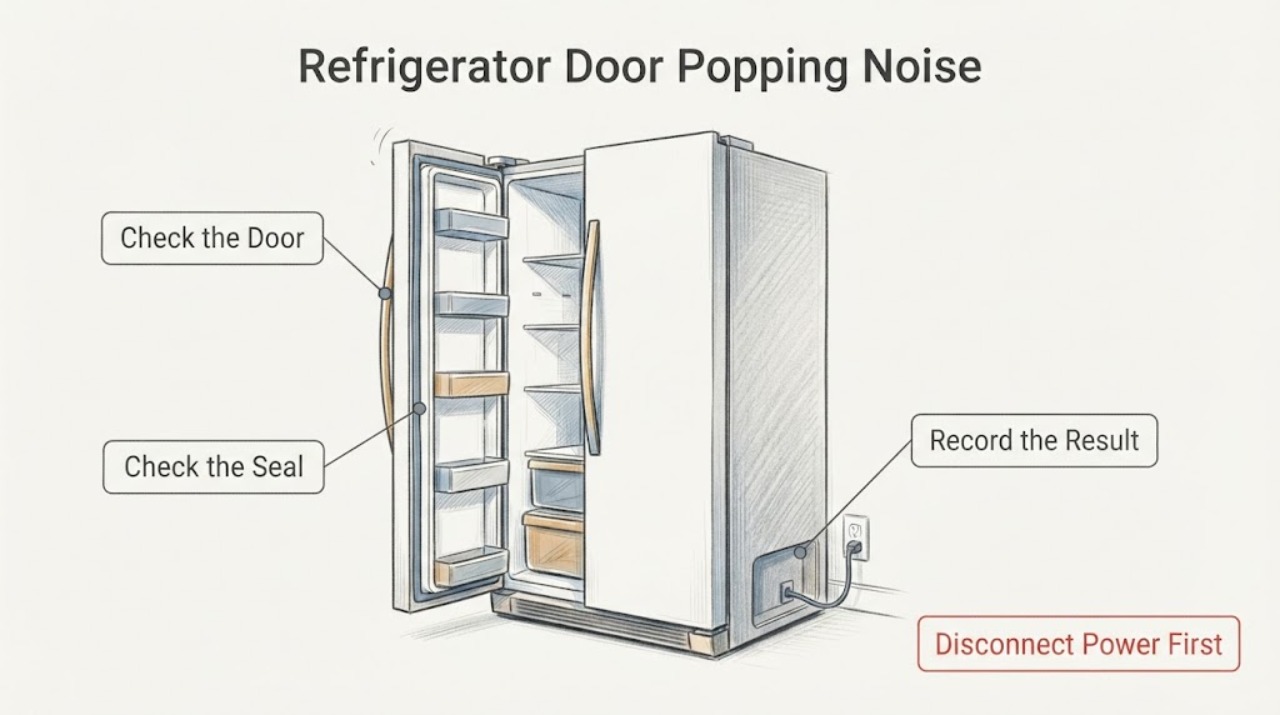
Work through in order
Diagnostic checks
Use only checks that match the exact appliance or system and its official guide.
-
Check 1
From the front, open the left refrigerator door slowly only through its ordinary travel and note the exact point, sound, and whether the pop happens on opening, closing, or both. Compare the right door without slamming either door. Do not force past a stop or repeatedly operate a door that is loose or rubbing.
Expected result: The pop happens at nearly the same angle on the left door, only during door movement, or it occurs only when another door is closed; alternatively, it is not tied to door movement.
Next step: Continue to the matching branch and record the model, door, direction, angle, and timing for service. Do not create a test by slamming doors or operating a damaged door.
Why this matters
Why: A fixed-angle, left-only event makes door-support or hinge-area hardware more relevant than a general cooling-cycle noise. A sound caused by another door closing may be air movement, while a sound independent of door movement fits KitchenAid's normal cooling/defrost noise description better.
-
Check 2
Check the left door from outside for visible sag, a changing gap, rubbing against the cabinet, a loose handle, a mullion that does not move normally, gasket separation, or a door that no longer closes and seals. Wipe accessible gasket contact surfaces with a soft damp cloth if visibly dirty, then dry them.
Expected result: The door is visibly low or shifted, rubs, fails to seal, or the gasket has a persistent gap; or the door looks aligned and seals normally.
Next step: If alignment or sealing is abnormal, keep the door closed as much as practical, protect food if temperatures rise, and arrange service. If the seal is normal, continue with the timing distinction rather than adjusting hardware.
Why this matters
Why: A changed door position or seal can indicate alignment, hinge, coupler, or gasket trouble and raises the priority of service. A clean, continuous seal does not rule out a hinge-area pop, but it makes a door-closure failure less likely.
-
Check 3
Without removing covers or the door, check whether the cabinet is stable and level enough that the refrigerator does not rock when the left door is opened. Note whether the pop changes when the door is gently supported upward without lifting, twisting, or forcing it.
Expected result: The cabinet rocks, the door appears to carry abnormal load, or the sound changes when the door is lightly supported; or leveling and support do not change the repeatable pop.
Next step: Use the exact KRFF577KPS installation guidance or request a qualified technician to inspect the support hardware. Do not turn hinge hardware, remove the door, or insert shims or washers based on this observation alone.
Why this matters
Why: KitchenAid says leveling affects door alignment and operation. A change with gentle support is a useful clue for a loaded hinge/coupler area, but it is not a safe way to confirm a worn part or justify adding washers.
-
Check 4
Check whether the sound occurs during cooling or defrost even when neither refrigerator door is moving, and whether it is a broad cabinet pop rather than a click or knock at the left door. Also note any water leak, damaged door tubing, exposed wiring, or unusual temperature change.
Expected result: The sound occurs independently of door motion during cooling or defrost with no door damage, or it is accompanied by a door/seal problem, water leak, exposed wiring, or loss of cooling.
Next step: Monitor a clearly normal cooling-cycle sound. For a door-linked sound with damage, leakage, exposed wiring, or cooling impact, stop unnecessary door testing, protect food, disconnect power only if safe when water reaches electrics, and arrange qualified service.
Why this matters
Why: A cooling-cycle pop is consistent with KitchenAid's normal contraction/expansion explanation. A door-linked noise with damage, leakage, or cooling impact is not safely dismissed as normal and may involve door or service components.
Use your observations
Decision map
Find the observation that best matches what you see, then follow the next safe action.
-
PATH 01Next step
What you see
The left KRFF577KPS door pops or knocks at nearly the same point in its swing, the right door does not, and the sound changes with gentle upward support or accompanies sag/rubbing.
Do this next
Arrange KitchenAid or qualified appliance service and ask for inspection of the left door support, lower hinge area, coupler, pin, and alignment. Do not remove the door, add washers, or lubricate an inaccessible hinge yourself.
Why this path and its safety boundary
Why it matters: This pattern points toward door-support, coupler, hinge, or related hardware loading rather than the normal cabinet contraction described by KitchenAid. An exact-model community report had a similar pattern and reported improvement after technician-installed cam/bushing work, but that does not identify the failed part in this refrigerator.
-
PATH 02Next step
What you see
The refrigerator door moves normally, the pop occurs only when the other door is forcefully closed, and the door does not remain open or lose its seal.
Do this next
Close doors gently and confirm that both doors remain aligned and sealed. Request service if the behavior becomes independent of door closing, the door stays open, or the seal changes.
Why this path and its safety boundary
Why it matters: KitchenAid says a door that pops open when another door closes can be caused by air moving quickly between sections and may be normal, especially after a forceful closure.
-
PATH 03Next step
What you see
The popping or cracking sound happens during initial cooling or defrost even when the left door is stationary, without a fixed door angle, sag, rubbing, or seal problem.
Do this next
Monitor it as an operating sound. If it becomes a door-motion click, grows sharply louder, or is joined by a closure, temperature, water, or electrical problem, reassess and arrange service.
Why this path and its safety boundary
Why it matters: KitchenAid identifies contraction and expansion of the refrigerator's inside walls as a normal source of this type of popping or cracking sound.
-
PATH 04Next step
What you see
The left door is visibly misaligned, does not seal, has damaged tubing or wiring, leaks water, or the refrigerator is warming after the door problem.
Do this next
Limit use, protect perishable food, keep clear of water near electrics, and request qualified service. Do not open the door assembly or probe wiring; use the exact model information when booking service.
Why this path and its safety boundary
Why it matters: The symptom has crossed from an isolated noise into a door-seal, water, or electrical/cooling service issue. Continuing to exercise the door can worsen damage or food-temperature risk.
Helpful context
Understand the symptom
Separate a door-motion pop from a normal refrigerator pop
KitchenAid uses popping or cracking to describe contraction and expansion of the inside walls, especially during initial cooling or defrost. That normal sound is related to the cooling cycle rather than one door reaching one repeatable angle. A click or knock that occurs only while the left door is moving, at nearly the same point each time, deserves a separate door-hardware check.
Why KRFF577KPS identity matters
The KRFF577KPS is a French-door refrigerator with exterior ice and water. KitchenAid's parts list for this model family shows separate left and right refrigerator doors, door pins, latches, a water tube, and a door coupler. Those parts make a door-removal or hinge diagnosis model-specific; the noise alone does not establish which item needs replacement.
What the exact-model report does and does not prove
A Reddit owner with a KRFF577KPS reported a repeatable left-door pop around mid-swing and later reported that a repair person replaced a cam/bushing and applied lubricant. That supports asking a technician to inspect the lower door support, coupler, hinge, and related hardware when the same pattern is present. It does not prove that every KRFF577KPS has the same failure, that the reported part fits every revision, or that the door should be removed at home.
Only after diagnosis
Potential parts
- model-matched left refrigerator-door coupler, hinge, pin, or related door-support hardware
KitchenAid's exact-model parts list identifies a door coupler and separate left-door hardware, while the exact-model community report describes a service cam/bushing repair. Neither source proves which component causes every popping noise, so a part should be selected only after inspection and model/revision confirmation.
Do not order by a generic closing-cam name or by sound alone. Match the complete KRFF577KPS model and revision and have the service provider confirm the door-side component before replacement.
When checks do not resolve it
Need a professional?
Arrange KitchenAid or qualified appliance service when a left-door pop repeats at a fixed angle, changes with support, appears with sag or rubbing, affects the gasket, or persists after confirming that the sound is not a normal cooling-cycle pop. Request prompt service for leaks, damaged tubing or wiring, a door that will not seal, or loss of cooling.
Safety scope: Do not remove the refrigerator door, disconnect its water tube or wiring, turn hinge hardware, add washers, defeat the door stop, or probe behind covers to chase a popping noise. Stop testing and arrange service for a loose or sagging door, damaged seal, water leak, exposed wiring, repeated rubbing, worsening noise, or any temperature change. Keep food at safe temperatures and disconnect power only when it is safe, especially if water reaches electrical parts.
Have this ready
- Provide the complete KRFF577KPS model and revision, serial number if available, which door and direction produce the sound, the approximate opening angle, whether it occurs on opening or closing, whether gentle support changes it, a short recording if safe, and any seal, leak, alignment, or temperature symptoms.
Common questions
FAQ
Is a popping sound from a KitchenAid refrigerator always a problem?
No. KitchenAid says popping or cracking from contraction and expansion of the inside walls during cooling or defrost can be normal. A repeatable click or knock tied to one door's movement is a different pattern and should be checked separately.
Why does the KRFF577KPS left door pop at the same angle?
A fixed-angle, left-only pop makes door-support or hinge-area loading more relevant than a general cooling-cycle noise. An exact-model owner reported a cam/bushing service repair, but the sound alone cannot identify the failed component.
Can I remove the KitchenAid refrigerator door or add a washer to stop the pop?
Do not do that based on the sound alone. The KRFF577KPS door assembly includes model-specific hardware and a water path, and door removal or hinge adjustment can affect alignment, sealing, and connections. Have a qualified provider inspect it using the exact model documentation.
Read the exact guide
Official sources
- KitchenAid Refrigerator Door Popping NoiseReddit r/appliancerepair · Exact KRFF577KPS community post matching the left-door, fixed-angle popping symptom; used as a cautious symptom and service clue, not as proof of universal cause or part fit.
- 26.8 Cu. Ft. Standard-Depth French Door Refrigerator with Exterior Ice and Water Dispenser KRFF577KPSKitchenAid · Exact model page opened to verify the appliance is a French-door refrigerator with exterior ice and water; it does not diagnose the noise.
- Door Pops Opens when Refrigerator Doors CloseKitchenAid Product Help · Official door-behavior guidance opened to distinguish a door being pushed open by air movement from a click or knock generated by door hardware.
- KitchenAid KRFF577KPS03 Refrigerator Repair Parts ListKitchenAid / Whirlpool · Exact model-family parts list opened to verify door-side components and the model-specific service boundary; it does not say which part causes a pop.
- Refrigerator Noise - Popping or CrackingKitchenAid Product Help · Official refrigerator noise guidance opened to distinguish cooling/defrost cabinet popping from a door-motion event.
Community feedback
Share a repair observation
Share a plain-text repair observation. Accepted observations are published automatically; this page may take a moment to update.