
On this page
Start here
Quick answer
For the KitchenAid KRMF706ESS01 multi-door refrigerator family, heavy frost and a freezer that is no longer freezing point to an airflow, door-seal, power/setting, or defrost-related service decision; frost alone does not identify a failed fan, heater, thermistor, or control. First protect temperature-sensitive food, record the freezer temperature, and inspect only the closed-door seal, visible vents, loading, settings, and installation conditions. KitchenAid says frequent or prolonged door opening, a poor seal, blocked vents, warm surroundings, power loss, showroom mode, and incorrect settings can affect frost or freezer temperature. Do not use a heat gun, remove the inner freezer panel, touch a heater, or run the refrigerator without the installed back plate; if frost returns after the external checks or the freezer remains warm, arrange KitchenAid service.
Before you begin
Safety first
- Do not use a heat gun or sharp tool, remove the freezer inner panel, touch a heater, bypass protection, take live measurements, or run the refrigerator with the installed back plate missing. Leave defrost-system, fan, electrical and sealed-system work to qualified service.
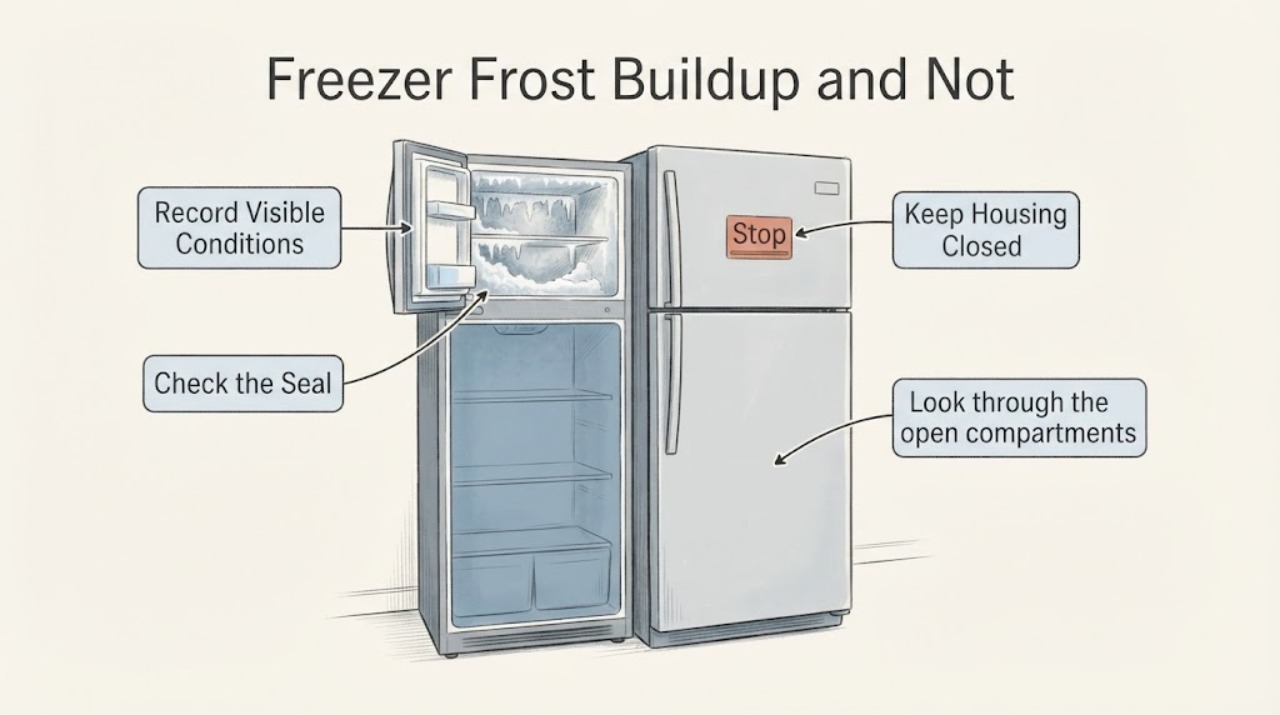
Work through in order
Diagnostic checks
Use only checks that match the exact appliance or system and its official guide.
-
Check 1
Protect temperature-sensitive food and record the freezer temperature with an appliance thermometer without removing panels or repeatedly opening the drawer. Note whether the freezer is warm, whether the refrigerator section also warms, and where frost is visible.
Expected result: The freezer is warming or food is thawing, the refrigerator section is also affected, or frost is limited to a visible surface or gasket area.
Next step: Keep doors closed and continue only with the external checks below. If the appliance has smoke, burning odor, damaged cord, or water around electrical parts, disconnect power only if safe and arrange urgent qualified service.
Why this matters
Why: A warming freezer is a performance fault requiring a decision about food and service; frost location helps distinguish an external moisture/seal or airflow observation from an unresolved internal cooling problem, but does not name a part.
-
Check 2
Inspect the freezer drawer and refrigerator doors from the outside for an obstruction, package, ice, or debris preventing full closure. Check the accessible gasket perimeter for a visible gap or damage; do not pry the gasket or remove drawer panels.
Expected result: A door or drawer cannot close fully, the gasket is obstructed or visibly damaged, or the doors seal with no visible gap.
Next step: Remove only the visible obstruction and close the door/drawer. If the gasket is damaged, the drawer remains misaligned, or the temperature does not recover, request model-specific service instead of reshaping or replacing the seal by guess.
Why this matters
Why: KitchenAid says open doors and improper gasket sealing allow humid air into the freezer and can produce frost or condensation.
-
Check 3
Look through the open compartments for food or containers pressed against visible air vents or the back/side walls. Rearrange only accessible items to leave the vents clear and maintain the spacing described in the exact owner manual.
Expected result: A vent or return path is blocked by loading, or all visible vents are clear while the freezer remains warm and frosted.
Next step: Clear the visible obstruction and close the appliance. If airflow or temperature remains abnormal with clear vents, stop external troubleshooting and arrange service; do not remove the evaporator cover or fan guard.
Why this matters
Why: KitchenAid explains that blocked vents and crowded loading can restrict air circulation and produce warm spots or frost; clear vents do not prove a fan or defrost component has failed.
-
Check 4
Check the accessible control display for a power-outage indication, cooling-off/showroom indication, and the current temperature setting. Note whether the refrigerator was recently moved, installed, powered off, or exposed to a room outside the recommended indoor range.
Expected result: A power event, cooling-off/showroom state, changed setting, recent installation, or unsuitable room condition is present; alternatively, controls and location appear normal.
Next step: Use only the exact owner manual to change a documented setting or exit a documented mode, then allow the model's stabilization period. If no external cause is found or the freezer remains warm, request service rather than resetting repeatedly.
Why this matters
Why: KitchenAid says power loss, showroom mode, incorrect controls, recent installation, warm surroundings, and large additions can delay or prevent proper freezer temperature; the control panel sequence varies by model.
-
Check 5
Observe whether the frost returns after the visible seal, loading, control, and room checks, without using a heat gun, sharp tool, improvised heater, or removed inner panel to accelerate defrosting.
Expected result: Frost does not return and the freezer recovers, or frost rapidly returns/the freezer remains warm despite the external checks.
Next step: For recurrent frost or persistent warmth, keep the appliance closed and arrange KitchenAid service with the exact model and history. Do not run it with the back plate missing or test an energized heater.
Why this matters
Why: Recovery after an external correction supports that correction as a possible contributor; recurrent frost or persistent warmth means the public user checks have not resolved the condition and do not identify an internal part.
Use your observations
Decision map
Find the observation that best matches what you see, then follow the next safe action.
-
PATH 01Next step
What you see
Frost is concentrated around a door or drawer that was not sealing, and the freezer starts recovering after the visible obstruction is removed.
Do this next
Keep the door/drawer closing fully and monitor the temperature. Request service if the gasket remains damaged, the drawer cannot align, or frost returns quickly.
Why this path and its safety boundary
Why it matters: The pattern is consistent with humid room air entering through the seal, which KitchenAid identifies as a frost contributor.
-
PATH 02Next step
What you see
Food or containers blocked visible vents or were pressed against the back/side walls, and the temperature improves after the load is rearranged.
Do this next
Keep vents clear and follow the exact owner manual for loading. If the freezer remains warm or frost returns, use the service branch.
Why this path and its safety boundary
Why it matters: Restricted airflow may have contributed to the warm or frosted condition, but improvement does not prove an internal fan or defrost part is healthy.
-
PATH 03Next step
What you see
The freezer is warm after a power event, recent installation, showroom/cooling-off state, or a changed setting, and no safety warning is present.
Do this next
Apply only the matching manual's documented control correction and allow the stated stabilization period. If temperature does not recover, schedule service.
Why this path and its safety boundary
Why it matters: KitchenAid documents these as possible reasons for delayed or improper freezer temperature; the correct control sequence remains model-specific.
-
PATH 04Next step
What you see
Frost quickly returns, the freezer remains warm or food is thawing after the external checks, or the owner is considering removing the back panel or touching the heater.
Do this next
Stop improvised defrosting and internal testing, keep the refrigerator closed, protect food, and arrange KitchenAid or qualified appliance service with the exact model and symptom history.
Why this path and its safety boundary
Why it matters: The condition has exceeded the safe user-level checks. The opened public sources do not support naming a fan, heater, thermistor, control, or sealed-system cause.
Helpful context
Understand the symptom
Frost and warmth are related observations, not a confirmed part diagnosis
The exact Reddit lead describes a KitchenAid KRMF706ESS01 five-drawer refrigerator with frost behind the freezer interior panel and a later period in which the freezer stopped freezing. The post is useful for confirming the symptom identity, but it does not establish a verified repair result. KitchenAid's official guidance says humidity entering through open doors, an imperfect gasket seal, blocked vents, or operating conditions can create frost or temperature problems. Those external checks should be completed before anyone names a fan, heater, thermistor or control as the cause.
Use the model-specific service boundary
KitchenAid's owner page identifies KRMF706ESS as a 25.8-cubic-foot, 36-inch multi-door refrigerator and directs owners to Product Help, manuals and service. The opened service manual is marked for technician use and contains energized defrost-system information, so it is not a user test. Do not remove the freezer back panel, apply improvised heat, touch the heater, bypass protection, or run the refrigerator with an installed panel missing.
Escalate when frost returns or food is warming
If the freezer remains warm, food is thawing, the frost quickly returns after an external obstruction or seal issue is corrected, or the appliance has an electrical or burning warning, keep the refrigerator closed as much as possible and arrange KitchenAid service. Provide the exact model, temperature readings, frost location, door/seal observations, and whether the problem followed a power event or a prior repair.
When checks do not resolve it
Need a professional?
Call KitchenAid or qualified appliance service when frost rapidly returns, the freezer remains warm, food is thawing, a door/gasket cannot seal, or the issue persists after external checks. Do not infer a fan, heater, thermistor, control-board or sealed-system failure from the frost pattern alone.
Safety scope: Do not use a heat gun or sharp tool, remove the freezer inner panel, touch a heater, bypass protection, take live measurements, or run the refrigerator with the installed back plate missing. Leave defrost-system, fan, electrical and sealed-system work to qualified service.
Have this ready
- Provide model KRMF706ESS01, temperature readings and times, frost location and recurrence, door/gasket and vent observations, power or installation history, control/display state, and any prior service or repair.
Common questions
FAQ
Can frost buildup by itself prove that the freezer fan or heater failed?
No. KitchenAid's official guidance also identifies humid air from open doors, poor gasket sealing, blocked vents, loading, power events, settings and room conditions as contributors. Frost that returns or a freezer that remains warm needs service; the frost pattern alone does not select an internal part.
Is it safe to use a heat gun or run the refrigerator without the freezer back panel?
Do not do that. The opened KitchenAid service material is marked for technician use and contains energized defrost-system information. Keep the installed panel and factory protection in place, and use qualified service for internal frost, heater or fan work.
What should I check first on a KRMF706ESS01 with frost and poor freezing?
Record the freezer temperature, check door and drawer sealing, clear visible vents, review loading, and check for a recent power event, showroom/cooling-off state, changed setting, recent installation or unsuitable room conditions. Use the exact owner manual for controls and request service if the freezer stays warm.
Should I keep running the freezer with the frost panel removed if it gets cold again?
No. Temporary cooling with a panel removed does not establish a safe repair and can expose moving, hot or energized parts and alter designed airflow. Reinstall the appliance as designed and arrange model-specific service for recurrent frost or poor freezing.
Read the exact guide
Official sources
- Not Cooling - Freezer Section - RefrigeratorKitchenAid · Opened KitchenAid's official product-help page. It covers room range, loading and vents, power outage, condenser/pet-traffic conditions, cooling settings, showroom mode, recent installation, door openings and service. Control sequences remain model-specific.
- KRMF706ESS | KitchenAidKitchenAid · Opened the KitchenAid owner page at the exact task model URL. It identifies the KRMF706ESS family as a 25.8 cu. ft. 36-inch multi-door freestanding refrigerator and links product help, manuals and service. It does not authorize user access to technician diagnostics.
- Frosting in the Freezer Section - Quad DoorKitchenAid · Opened KitchenAid's official product-help page. It covers frequent/prolonged door opening, gasket sealing, blocked vents, leveling and service for multi-door frost conditions. It supports family-level external checks and does not diagnose the exact internal cause on KRMF706ESS01.
- Service Manual - French-Door Bottom Mount RefrigeratorKitchenAid · Opened the KitchenAid-hosted service manual and used it only to confirm that defrost-system information is technician-facing and that internal defrost components are part of a service scope. No service-mode, energized test, voltage, heater, sensor, or board procedure is exposed in the article.
Community feedback
Share a repair observation
Share a plain-text repair observation. Accepted observations are published automatically; this page may take a moment to update.