
On this page
Start here
Quick answer
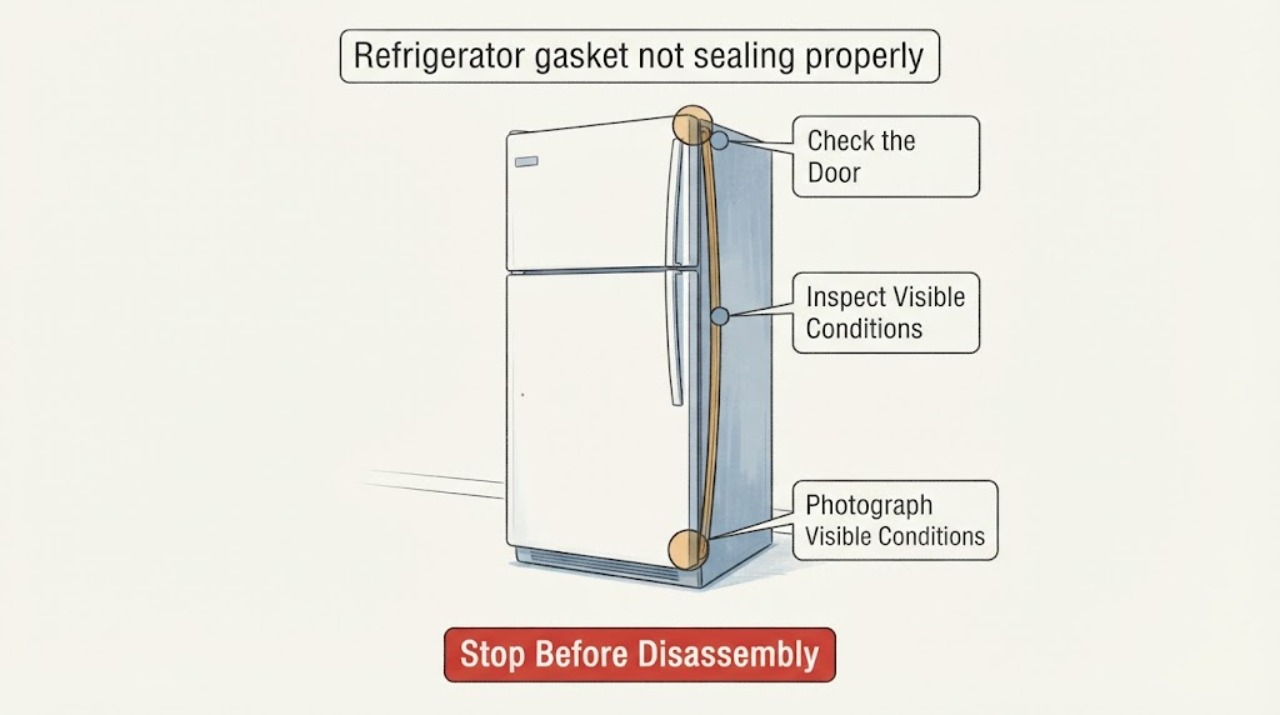
The opened KitchenAid owner-manual PDF groups KSRS22Q and KSRB22Q in the same no-frost refrigerator manual, but the task does not establish which exact model suffix or door variant you have. Do not order a gasket or follow a model-specific removal procedure from that ambiguity. With the refrigerator stable and the door empty enough to inspect, check that food, bins, shelves or packaging are not holding the door open; clean the visible gasket and mating surface with a soft damp cloth; and check for a dirty, cracked, brittle, warped or folded seal and an uneven door gap. If the gasket still will not sit in its existing channel, the door remains ajar, or the gasket is damaged, stop forcing it and use the exact model manual or qualified service. Do not heat, glue, stretch, cut, remove the gasket, adjust hinges, or move the refrigerator based on a guessed KSRS22Q/KSRB22Q part fit.
Work through in order
Diagnostic checks
Use only checks that match the exact appliance or system and its official guide.
-
Check 1
Read the complete model label inside the refrigerator and photograph it before selecting a manual or part. Compare the full label with KSRS22Q and KSRB22Q, including any suffix characters; do not choose between the two family names from appearance alone.
Expected result: The label confirms KSRS22Q, confirms KSRB22Q, shows another model, or cannot be read.
Next step: Use the exact confirmed label for any later manual or service request. If it remains unreadable or does not match either model, stop model-specific work and request identification from KitchenAid or a qualified technician.
Why this matters
Why: The official KitchenAid manual covers both model families, but the assigned identity leaves the exact variant unresolved. A full label is needed to select the correct door layout, manual instructions and gasket fit.
-
Check 2
With the door open and the refrigerator stable, inspect the installed gasket all the way around without pulling it out. Look for dirt, food residue, a folded edge, cracks, brittleness, warping, a section outside its channel or a continuous gap against the cabinet; clean only visible contact surfaces with a soft damp cloth and dry them.
Expected result: The gasket is dirty but intact, folded or partly outside its existing channel, visibly cracked/warped, or appears seated but still leaves a gap.
Next step: If the exact model manual explicitly shows a simple user-level seating correction, follow that manual only; otherwise leave the gasket installed and arrange model-matched service. Do not heat, glue, cut, stretch or remove it.
Stop if: Stop if the seal is torn, hard, bonded, trapped behind a trim piece, or would require force or a tool to reposition.
Why this matters
Why: KitchenAid identifies a dirty, brittle, cracked or warped gasket as a possible cause of resistance or improper sealing. A visible defect or a gap after cleaning does not identify which replacement gasket fits the two possible model families.
-
Check 3
Check the closure path from the front without moving the appliance: remove only packages, bins, shelves or shipping material that visibly prevent the door from closing, and confirm the door is not contacting an overfilled shelf or drawer.
Expected result: A package, bin, shelf, ice container or packaging material blocks the door, or nothing visible prevents closure.
Next step: Rearrange or remove the visible obstruction and close the door once to observe the seal. If it still will not close, continue to the gap and alignment check rather than forcing the door.
Why this matters
Why: KitchenAid lists interior and exterior obstructions as common reasons a door will not close or seal. Clearing an obstruction can restore contact without changing the gasket, while no obstruction leaves the gasket, alignment or level unresolved.
-
Check 4
Observe the closed door from the front and sides for an uneven gap, a corner that springs back open, or contact that is missing along one section. Do not loosen hinges, alter leveling feet or pull the refrigerator forward while the model variant and installation details are unresolved.
Expected result: The gap is even and the door stays closed, one corner remains open, the door sits visibly low/high, or the cabinet appears unstable or unlevel.
Next step: If the door does not stay closed or the unit is unlevel, use the exact installation instructions or qualified service. Do not compensate with a guessed gasket or hinge adjustment.
Stop if: Stop if the door is heavy, loose, damaged, or requires moving the refrigerator or removing panels to inspect.
Why this matters
Why: KitchenAid says an unlevel unit or incorrect door alignment can keep the door from sitting flush. A one-corner gap may be an alignment or gasket issue, but the observation cannot distinguish them or determine the correct adjustment procedure for the exact model.
-
Check 5
If the complete model label is confirmed but the gasket remains detached, damaged or unable to seal after the external checks, give KitchenAid or a qualified appliance technician the label, door side, photos of the gasket and gap, and the obstruction/alignment observations.
Expected result: The exact model is known but the seal still fails, the model remains ambiguous, or the door requires gasket removal, hinge adjustment or another tool-based repair.
Next step: Keep the refrigerator closed and avoid prolonged use if temperature is not holding; arrange model-matched service. Do not order a gasket, apply adhesive/heat or disassemble the door from the title alone.
Why this matters
Why: The official support pages support model lookup and service escalation, but the opened family manual and generic door guide do not establish a KSRS22Q-versus-KSRB22Q part number or a safe removal procedure for this case.
Use your observations
Decision map
Find the observation that best matches what you see, then follow the next safe action.
-
PATH 01Next step
What you see
The label confirms one exact model family, KSRS22Q or KSRB22Q, and the visible gasket is intact but partly folded or outside its existing channel.
Do this next
Use that exact model's KitchenAid manual for any documented seating step; if the manual does not clearly cover it, request model-matched service instead of forcing the seal.
Why this path and its safety boundary
Why it matters: The model identity is narrower, but the opened evidence still does not establish a universal seating or removal procedure for every suffix or door variant.
-
PATH 02Next step
What you see
A package, bin, shelf or shipping material prevents the door from closing, and the gasket itself is clean and undamaged.
Do this next
Clear or rearrange the visible obstruction and make one normal closure check. If a gap remains, stop and evaluate alignment or service rather than forcing the door.
Why this path and its safety boundary
Why it matters: An external obstruction is a supported explanation for the failure to seal and does not require a gasket or hinge diagnosis.
-
PATH 03Next step
What you see
The gasket is dirty, but it becomes continuous and the door closes after the visible contact surfaces are cleaned.
Do this next
Monitor for recurring gaps, frost or temperature fluctuation and use the exact model manual or service path if the problem returns.
Why this path and its safety boundary
Why it matters: Residue was a plausible closure resistance, while the result does not prove the seal will remain reliable under temperature changes.
-
PATH 04Next step
What you see
The gasket is cracked, brittle, warped or detached, or the door still springs open after obstructions and cleaning are addressed.
Do this next
Keep the door closed as safely as possible and arrange KitchenAid or qualified service with the complete model label. Do not order or install a gasket based on KSRS22Q/KSRB22Q family names alone.
Why this path and its safety boundary
Why it matters: A damaged seal or alignment problem is more likely than a simple dirty surface, but the correct part and repair method remain model- and suffix-dependent.
-
PATH 05Next step
What you see
The seal repair would require heat, adhesive, cutting, removing the gasket, loosening hinges, leveling the cabinet or moving the refrigerator.
Do this next
Stop the DIY repair and use the exact manual or qualified appliance service. Preserve the original gasket and photograph the gap for the technician.
Why this path and its safety boundary
Why it matters: The repair has crossed beyond a safe, model-neutral external inspection and could damage the gasket, door, cabinet or connected services.
Helpful context
Understand the symptom
Resolve the model ambiguity before choosing a gasket
The task names KitchenAid KSRS22Q or KSRB22Q rather than one confirmed model label. KitchenAid's official owner-manual PDF groups those model families in one no-frost manual, which confirms that both names belong to the document family but does not establish the exact suffix, door side, finish or gasket fit for this refrigerator. Read the model label inside the refrigerator and keep both possibilities visible until it is confirmed. A parts listing or a similar-looking seal is not evidence of compatibility.
Start with the door and seal, not removal
KitchenAid identifies ordinary closure causes before service: a dirty or damaged gasket, food packages or bins blocking the door, packaging material, incorrect leveling and door alignment. Those checks support cleaning and observation of the installed seal. They do not authorize removing the gasket, stretching it, applying heat or adhesive, or adjusting hinges on a refrigerator whose exact variant is still uncertain.
A persistent gap is a service decision
A door that remains open can cause temperature fluctuation, frost and food spoilage. If the gasket is visibly torn, warped or detached, if the door is not level, or if the seal cannot be restored by clearing an obstruction and cleaning the visible contact surfaces, keep the door closed as far as it can safely go and arrange model-matched service. Do not compensate by selecting a KSRS22Q or KSRB22Q gasket from the symptom alone.
When checks do not resolve it
Need a professional?
Arrange KitchenAid or qualified appliance service when the gasket is cracked, brittle, warped or detached; the door remains open after clearing obstructions and cleaning; the unit is unlevel or the door is misaligned; the exact model cannot be confirmed; or repair would require heat, adhesive, removal, hinge adjustment or moving the refrigerator.
Common questions
FAQ
Are KSRS22Q and KSRB22Q the same refrigerator model?
The opened KitchenAid owner manual groups both names in one no-frost refrigerator document, but the task does not establish the exact suffix, door variant or full model label. Treat them as unresolved until the appliance label is read; do not assume the same gasket or repair procedure.
What should I check before replacing a KitchenAid refrigerator gasket?
Check for packages, bins, shelves or shipping material blocking closure; inspect the visible gasket for dirt, folds, cracks, brittleness or warping; clean the visible contact surfaces; and observe whether the door is level and closes evenly. These checks do not select a replacement part.
Can I use heat to reshape the gasket so it seals?
Do not use heat, glue, cutting or stretching as a generic fix. The official pages support cleaning, obstruction checks and exact-manual/service guidance, but they do not authorize a heat-based restoration for these two unresolved model possibilities.
Does a visible gap mean I need a new gasket?
Not necessarily. KitchenAid lists obstructions, an unlevel unit, door alignment and a dirty or damaged gasket as separate causes. A visible gap should be documented, but it does not identify whether the gasket, hinge, level or another part needs service.
What if the door still will not seal after cleaning?
Keep the door closed as safely as possible, protect food if temperature is not holding, and arrange model-matched service with the complete label and photos. Do not keep forcing the gasket or order a part from the family name alone.
Read the exact guide
Official sources
- Troubleshoot Your Refrigerator’s Possible ProblemsKitchenAid · Official KitchenAid overview used for the limited points that packages or shelves can obstruct sealing, gaskets should be kept clean, and model-specific installation/manual information controls further work. It is not a full repair manual for either unresolved model.
- Doors Not Closing ProperlyKitchenAid Product Help · KitchenAid's general full-size refrigerator guidance for dirty/damaged gaskets, obstructions, packaging, level and alignment. It supports external checks but does not establish a KSRS22Q-versus-KSRB22Q part or removal procedure.
- Owner's ManualKitchenAid · The official PDF cover identifies the KSRS22Q and KSRB22Q model families in one no-frost manual. It confirms the family relationship but not the exact suffix, door variant or a universal gasket part for this task.
Community feedback
Share a repair observation
Share a plain-text repair observation. Accepted observations are published automatically; this page may take a moment to update.