
On this page
Start here
Quick answer
A sheet of ice under a KitchenAid drawer freezer usually means moisture is entering or defrost water is not leaving; it does not identify one failed part. First confirm that the drawer closes fully, the gasket contacts the cabinet, food is not blocking the seal or vents, and the ice is not simply a one-time result of a door left open. If the ice is thick, turn the refrigerator off only according to its manual, protect the food, allow a safe manual defrost, and use only a plastic scraper or warm water—never a knife, pick, open flame or uncontrolled heat. If the sheet returns, leaks, or the model and serial match the KitchenAid service pointer’s listed French-door range, arrange qualified service rather than removing freezer panels or forcing a drain clear.
Before you begin
Safety first
- Do not use knives, picks, open flames, heat guns or uncontrolled heat; do not remove the evaporator cover, drain pan, rear drain tube or electrical panels, and do not install a service kit based on a similar KitchenAid model.
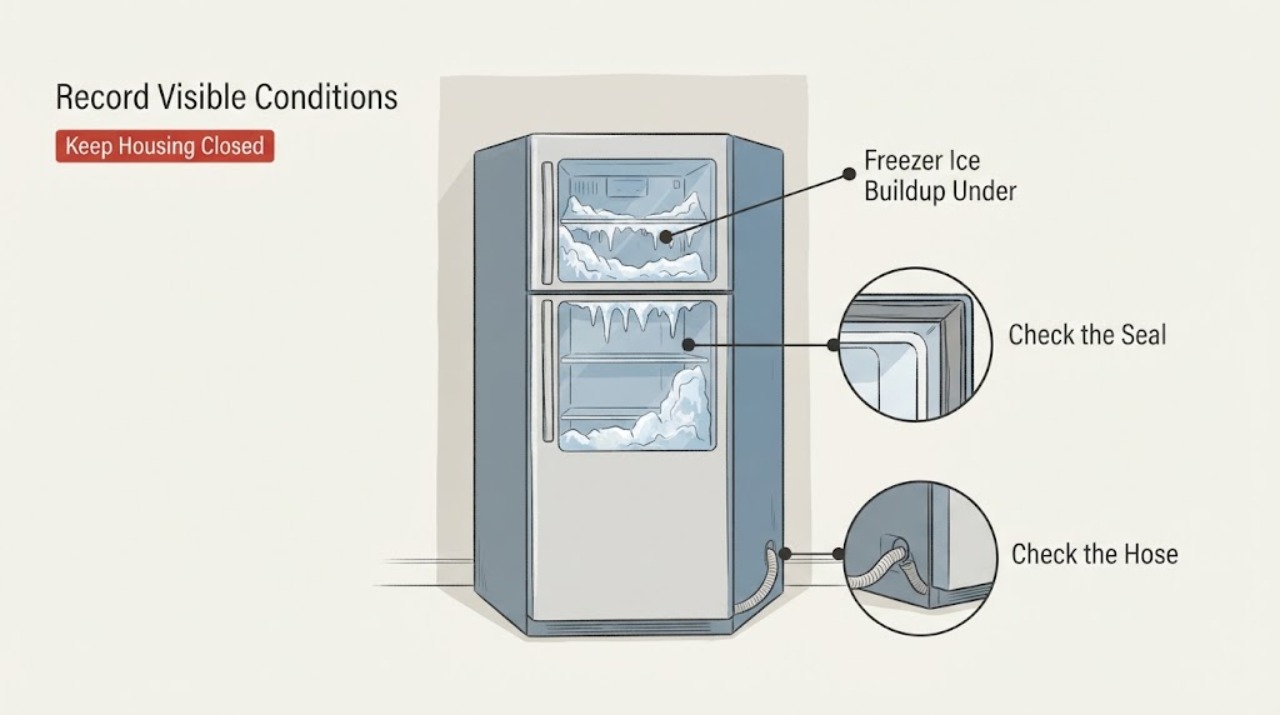
Work through in order
Diagnostic checks
Use only checks that match the exact appliance or system and its official guide.
-
Check 1
With the freezer drawer closed, inspect the entire gasket contact area and drawer track from the outside. Remove only packages that visibly prevent closure, wipe dirt from the gasket with a soft damp cloth, and check whether the drawer sits flush without forcing it. Do not pry the drawer or remove inner panels.
Expected result: The drawer was ajar, a package blocked the gasket, the gasket is dirty or torn, or the drawer closes evenly with full gasket contact.
Next step: Correct only the visible obstruction or clean the gasket. If the gasket is damaged, the drawer remains misaligned, or ice returns, arrange model-matched service.
Why this matters
Why: KitchenAid says an open drawer or poor door seal lets humid air enter and can create frost. A complete seal makes that cause less likely but does not prove a drain or defrost system fault.
-
Check 2
Check the freezer interior without dismantling it. Keep food from blocking vents, note whether the ice is on the floor under the drawer, on the rear wall, around the gasket, or accompanied by water outside the cabinet, and record whether the drawer is hard to close.
Expected result: Ice is limited to a light surface frost after a door-opening event, or a thick sheet repeatedly forms at the bottom and may leak when it melts.
Next step: For a one-time light frost, correct the seal/vent issue and monitor. For a recurring thick sheet or leak, stop improvised disassembly and arrange qualified service with the model and serial.
Why this matters
Why: Light frost can follow humid-air entry; a recurring bottom sheet is consistent with a drainage or defrost-water pattern described in KitchenAid’s service pointer, but the location alone cannot identify the failed part.
-
Check 3
If the ice is hard or blocking the drawer, protect the food in a cooler, turn the appliance off or unplug it only as the owner manual permits, place towels or the applicable drain hose to catch meltwater, and allow the ice to melt. Use a bowl of warm water or a plastic scraper only; never stab, chip, heat with an open flame or use a sharp tool.
Expected result: The ice clears without damage, or water remains trapped, the cabinet is wet near electrical parts, or the ice cannot be safely removed.
Next step: Dry the freezer completely before reconnecting power. If water reaches electrical components, damage is visible, or safe defrost is not possible, leave power off and call service.
Why this matters
Why: KitchenAid’s defrost guidance treats manual defrost as removal of accumulated ice, not a repair. Trapped water, inaccessible ice or wet electrical areas raise the service boundary.
-
Check 4
Read the complete rating-label model and serial before considering any drain or service-pointer claim. Compare it with KitchenAid’s published service pointer only through a qualified service provider; do not assume an unidentified KitchenAid shares the listed drain-tube design or service kit.
Expected result: The model/serial matches a listed French-door family and serial range, or it is missing, different or outside the published range.
Next step: Provide the model/serial, ice location, recurrence interval and leak history to KitchenAid or qualified refrigeration service. Do not remove the evaporator cover, drain pan or rear tubing based on the pointer alone.
Why this matters
Why: The pointer is explicitly limited to listed models/serials and says it is for service departments. A match permits a technician to consider that bulletin; a non-match does not rule out another cause and does not authorize a user repair.
Use your observations
Decision map
Find the observation that best matches what you see, then follow the next safe action.
-
PATH 01Next step
What you see
The drawer was left open, a package blocked the gasket, or ice is light and follows frequent openings or a humid period.
Do this next
Restore full gasket contact, keep openings brief and keep vents clear; monitor after the freezer returns to normal temperature.
Why this path and its safety boundary
Why it matters: KitchenAid’s user guidance makes humid-air entry and poor gasket contact more likely than a confirmed internal failure.
-
PATH 02Next step
What you see
A thick sheet repeatedly forms under the drawer, returns after a full safe defrost, or melts into a leak.
Do this next
Arrange qualified service and provide the rating-label identity; do not remove panels, force a drain open or install a service kit from a generic description.
Why this path and its safety boundary
Why it matters: This pattern is compatible with the service pointer’s bottom-freezer defrost-water concern, but the assigned unit has no model/serial proof for that bulletin.
-
PATH 03Next step
What you see
The ice blocks the drawer, water reaches electrical areas, the cabinet is damaged, or the ice cannot be removed without force.
Do this next
Keep power off when safe, protect food, contain meltwater without touching wet electrical parts, and call qualified service.
Why this path and its safety boundary
Why it matters: The issue has crossed the safe manual-defrost boundary; sharp tools, heat and panel removal can damage the appliance or expose hazards.
-
PATH 04Next step
What you see
The model or serial is missing, does not match the service pointer, or the refrigerator is not a listed French-door configuration.
Do this next
Use the owner manual for the exact appliance and arrange model-matched diagnosis if recurrence continues; do not transfer a model-specific drain procedure.
Why this path and its safety boundary
Why it matters: The KitchenAid bulletin cannot be assumed to apply, and the ice location alone cannot distinguish a seal, drain, pan, defrost or airflow problem.
Helpful context
Understand the symptom
A sheet of ice is a pattern, not a component diagnosis
KitchenAid identifies warm humid air from an open drawer or poor gasket contact and blocked vents as common contributors to frost. Its service pointer separately describes ice at the bottom of certain French-door freezers when defrost water cannot drain, with possible causes including a clogged drain tube, drain-pan damage, a defrost-circuit issue or fan malfunction. Because the assigned refrigerator has no model or serial, treat that pointer as a service-scope check rather than proof that any one drain, heater, pan or fan has failed.
Defrost without damaging the freezer
KitchenAid’s public defrost guidance supports unplugging for hard ice, moving frozen food to a cooler, catching meltwater, using warm water and a plastic scraper, and avoiding knives or sharp objects. It also says to dry the freezer fully before reconnecting power. These steps remove accumulated ice; they do not repair a recurring drain or defrost fault.
Recurrence needs model-matched service
If the ice sheet returns after the drawer closes correctly and the freezer is defrosted, the cause may be beyond user-level checks. KitchenAid’s service pointer is marked for service departments and includes a precise model and serial range; do not copy its service-kit or drain-tube procedure onto an unidentified unit. Give service the complete rating-label identity, recurrence interval, leak location and photos taken without removing panels.
When checks do not resolve it
Need a professional?
Arrange KitchenAid or qualified refrigeration service for a recurring thick bottom ice sheet, a leak after defrost, damaged gasket or drawer alignment, wet electrical areas, or any ice that requires panel removal or force. Ask the technician to verify the complete model and serial against any service bulletin before selecting a drain or defrost repair.
Safety scope: Do not use knives, picks, open flames, heat guns or uncontrolled heat; do not remove the evaporator cover, drain pan, rear drain tube or electrical panels, and do not install a service kit based on a similar KitchenAid model.
Have this ready
- Provide the full model and serial, freezer layout, ice location and thickness, recurrence interval, whether the drawer was left open, gasket/vent observations, any water on the floor, and photos taken without removing panels.
Common questions
FAQ
Does a sheet of ice under a KitchenAid freezer drawer prove the drain is clogged?
No. KitchenAid’s service pointer lists clogged drain tubing among several possible causes, but it applies only to listed models and serials and is directed to service departments. A seal, open drawer, airflow or another defrost issue can create a similar pattern.
Can I chip the ice out with a knife or screwdriver?
No. KitchenAid says to use a plastic scraper and never knives or other sharp objects. Unplug or turn the appliance off only as the owner manual permits, protect the food, catch meltwater and let the ice melt safely.
Should I install the service-pointer drain kit on my KitchenAid?
Only a qualified service provider should decide that after confirming the complete model and serial. The opened KitchenAid pointer lists specific models and serials and is marked for service departments; it is not a universal repair instruction.
Read the exact guide
Official sources
- How to Manually Defrost a FreezerKitchenAid · Supports food protection, unplugging/turning off for hard ice, meltwater containment, warm water, plastic scraper and no sharp tools; it does not diagnose a recurring fault.
- Frost or Condensation in Freezer - Built-In Refrigerator - Product Help | KitchenAidKitchenAid · Supports family-level external checks for humidity entry, door/gasket closure and blocked vents; model-specific locations may differ.
- 9 Possible Freezer Troubleshooting Fixes & TipsKitchenAid · Supports gasket, temperature, airflow/frost checks and professional escalation when frost persists; it does not identify a component for an unknown model.
- Appliance Manuals and LiteratureKitchenAid · Supports retrieving the assigned refrigerator’s complete model-specific instructions before any defrost or service-pointer procedure; the lookup page is not evidence for an unseen repair step.
- Service Pointer - W11397260A - Ice Build-up in Bottom of FreezerKitchenAid · Official service-department bulletin for bottom-freezer ice caused by possible defrost-water drainage issues; applicability is conditional on the complete model and serial list.
Community feedback
Share a repair observation
Share a plain-text repair observation. Accepted observations are published automatically; this page may take a moment to update.