
On this page
Start here
Quick answer
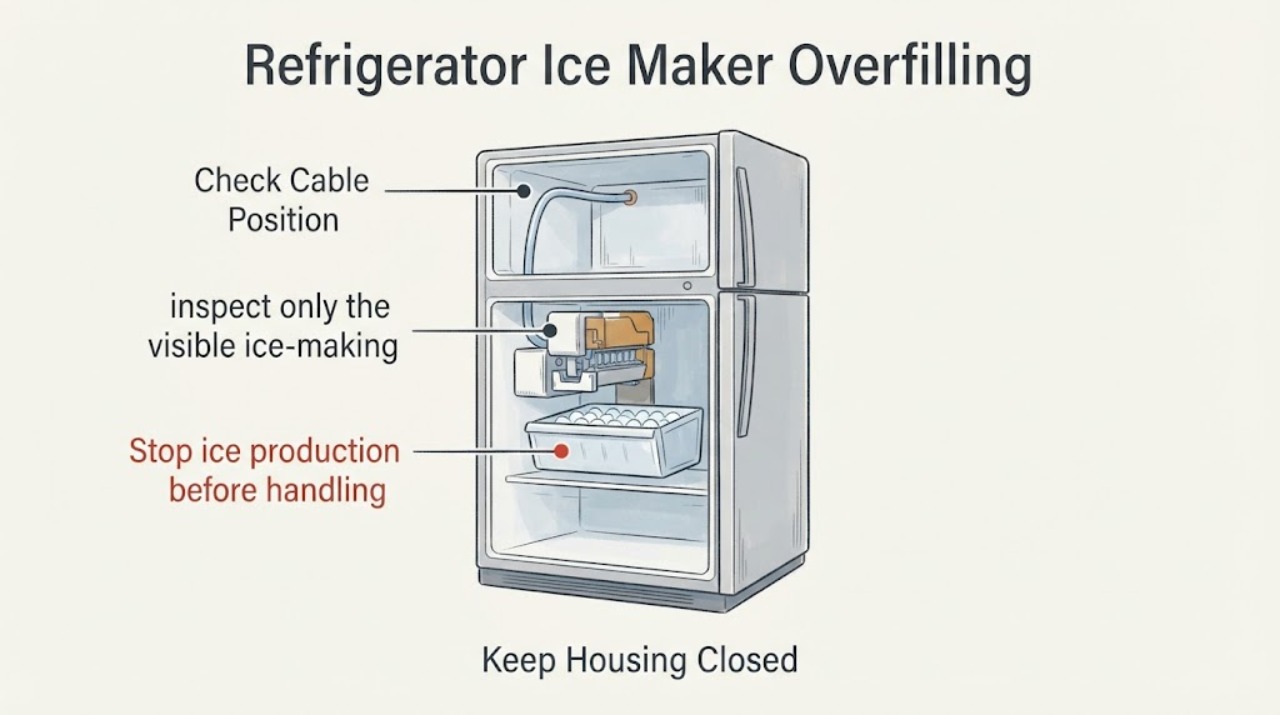
First separate a bin that is making too many cubes from water that is actively overflowing or leaking. Stop the ice maker before removing the bin. On KitchenAid refrigerator models with a freezer wire shutoff arm, raise the arm gently to OFF and do not force it; other refrigerator ice makers use model-specific controls and an automatic sensor. Check from the outside that the bin is positioned below the ice maker, the shelf or spacing has not moved, and no bagged or other non-produced ice is interfering with the shutoff mechanism. If water continues to enter, appears under the refrigerator, at a hinge, or at a rear connection, leave the ice maker off and arrange service rather than guessing at an inlet valve or sensor.
Before you begin
Safety first
- Keep the ice maker off during active leaking or unexplained repeated overfill. Do not force or bypass a shutoff arm, remove panels, reach into wet electrical areas, perform live measurements, or replace a water valve, sensor, fill tube, or control board based only on the symptom.
Work through in order
Diagnostic checks
Use only checks that match the exact appliance or system and its official guide.
-
Check 1
Stop ice production before handling the ice bin. If water is actively running or pooling, leave the ice maker off, keep clear of wet electrical areas, and use an accessible water shutoff only if its location and operation are already known to you and it can be closed safely.
Expected result: The problem is only excess cubes in the bin, or water is still entering, spilling outside the mold, or pooling under/around the refrigerator.
Next step: For active water, stop using the ice maker and arrange qualified appliance service; do not open panels, reach into wet areas, or diagnose an inlet valve or sensor yourself.
Why this matters
Why: Excess cubes points to a shutoff, bin-position, or sensing decision; active water is a leak or water-control hazard and is not a safe reset experiment.
-
Check 2
With the appliance stopped, inspect only the visible ice-making area and classify the result as a full bin of formed cubes, water or slush outside the mold, or both.
Expected result: Cubes are formed and the bin is overfull; water is outside the mold or leaking; or the result cannot be seen safely.
Next step: Follow the matching branch below and keep the ice maker off until the condition is understood.
Why this matters
Why: A full cube bin calls for a shutoff and spacing check. Water outside the mold requires the leak branch. An unseen or obstructed area needs a model-specific service assessment rather than a guessed cause.
-
Check 3
Identify whether the ice maker is in the freezer with a visible wire shutoff arm or in a refrigerator compartment with a different control and sensor arrangement. If it is the freezer wire-arm design, lift the arm gently to the OFF position and listen for the documented click; do not force it or remove the bin while the maker is on.
Expected result: The arm moves normally to OFF, will not move without force, or there is no wire arm because the refrigerator uses another design.
Next step: Use the exact KitchenAid owner manual for the model, or arrange service if the control cannot be operated without force. Do not bend, bypass, or remove the mechanism.
Why this matters
Why: A normal arm movement provides a safe stop command only for that design. Resistance, a missing arm, or a different compartment design means the exact model procedure is unresolved; it does not prove a failed part.
-
Check 4
Check from the outside that the ice bin is directly below the ice maker, the shelf or support that sets its spacing is in place, and no bagged or other non-produced ice is being stored in the bin or obstructing the shutoff area.
Expected result: The bin is displaced, the shelf or spacing is missing, the shutoff/sensing area is blocked, or the arrangement is correct and the bin still overfills.
Next step: Correct only the visible bin or shelf placement and monitor with the ice maker stopped between checks; if overfill returns, record the model and call service rather than trying to alter the arm or sensor.
Why this matters
Why: KitchenAid identifies bin alignment and non-produced ice as conditions that can stop the shutoff mechanism from working correctly. A correct visible arrangement with repeated overfill is not enough to identify an internal component.
-
Check 5
After stopping ice production, look without removing panels for water at the bottom of the refrigerator compartment, around the hinge area, and at the household water connection behind the refrigerator; if a filter was recently replaced, verify only that it is visibly seated according to the matching model instructions.
Expected result: Water is visible at one of those locations, a filter is visibly mis-seated, or no external water source is found.
Next step: Keep the ice maker off and arrange service for persistent water or unexplained overfill. Do not pull the refrigerator, remove covers, or perform live electrical or water-system tests to locate an internal leak.
Why this matters
Why: These observations can identify a connection or installation issue for service follow-up. No visible water does not prove that an internal valve, fill tube, sensor, or control is sound or failed.
Use your observations
Decision map
Find the observation that best matches what you see, then follow the next safe action.
-
PATH 01Next step
What you see
Water continues to enter, spills outside the ice mold, or is visible under the refrigerator, at a hinge, or at a rear connection.
Do this next
Leave the ice maker off, avoid wet electrical areas, use only a safely accessible known water shutoff if needed, and arrange qualified service. Do not open panels or keep testing.
Why this path and its safety boundary
Why it matters: This is an active leak or water-control symptom, not merely a full storage bin; the exact source cannot be assigned from a no-model topic.
-
PATH 02Next step
What you see
The freezer wire arm lifts gently to OFF and the bin is directly below the ice maker, but overproduction returns after the maker is placed back in service.
Do this next
Keep the maker off, record the full model number, and use the matching manual or qualified service. Do not force the arm or order a valve, sensor, or control board from this symptom alone.
Why this path and its safety boundary
Why it matters: The visible shutoff command and spacing are not resolving the condition; KitchenAid guidance does not establish which internal part is responsible.
-
PATH 03Next step
What you see
The refrigerator-compartment ice maker has no visible wire arm, or its control/sensor arrangement differs from the freezer guidance.
Do this next
Identify the model from the refrigerator tag and follow only the matching owner manual or product-help page; use service if the model-specific control cannot be confirmed.
Why this path and its safety boundary
Why it matters: KitchenAid documents model variation and a separate automatic-sensor design for some refrigerator ice makers, so a freezer-arm procedure cannot be transferred.
-
PATH 04Next step
What you see
The bin, shelf or spacing, and visible shutoff/sensing area are correct, there is no active leak, and the ice maker still repeatedly overfills.
Do this next
Keep ice production off and schedule qualified KitchenAid appliance service with the full model and serial information and a description of when the overfill occurs.
Why this path and its safety boundary
Why it matters: The remaining cause is unresolved at safe external-check scope; the official pages do not support a definitive internal valve, sensor, or control diagnosis without the exact model and service evaluation.
Helpful context
Understand the symptom
Identify whether the excess is ice or water
An overfilled bin with normally formed cubes is a shutoff or positioning question. Water outside the mold, a puddle, or continued filling after the ice maker is stopped is a leak or water-control symptom. Treat active water as the urgent branch: keep the ice maker off, avoid wet electrical areas, and arrange service. Do not call a water valve or sensor defective from the symptom alone.
KitchenAid controls vary by refrigerator design
KitchenAid publishes separate guidance for an ice maker in the refrigerator compartment and one in the freezer. The freezer guidance uses a wire shutoff arm that should be lifted gently to OFF; the refrigerator-compartment guidance describes automatic sensing and notes that model variations exist. Without a model number, use the visible control described in the matching owner manual rather than forcing an arm, removing covers, or repeating a reset.
Keep the check external and model-bounded
Check the bin position, shelf or spacing, and visible shutoff or sensing area with the ice maker stopped. KitchenAid warns that storing bagged or other non-produced ice can damage internal shutoff mechanisms and lead to overproduction. If the visible arrangement is correct but the ice maker still overfills, record the full model number and use the matching manual or service path; do not infer an internal valve, sensor, or control-board failure.
When checks do not resolve it
Need a professional?
Call qualified appliance service when water continues to enter, the bin repeatedly overfills after visible positioning and the model-specific stop control are correct, the shutoff arm will not move normally, or the exact refrigerator model cannot be matched to the control procedure. Use the manufacturer manual or service path rather than selecting an inlet valve, sensor, or control board from the symptom alone.
Safety scope: Keep the ice maker off during active leaking or unexplained repeated overfill. Do not force or bypass a shutoff arm, remove panels, reach into wet electrical areas, perform live measurements, or replace a water valve, sensor, fill tube, or control board based only on the symptom.
Have this ready
- Provide the complete refrigerator model and serial information, whether the ice maker is in the refrigerator compartment or freezer, whether the excess is cubes or water, the bin and shutoff-arm/sensor position, any recent filter or plumbing work, and where water was observed.
Common questions
FAQ
Should I keep running the KitchenAid refrigerator to see whether the ice maker stops?
No. Stop ice production first. If the bin is already full, water is spilling, or the maker continues filling, leave it off and use the matching model guidance or qualified service. Repeatedly running it can turn an unresolved overfill into a leak.
Can I lift the ice-maker wire arm to stop overfilling?
Only when your KitchenAid model visibly uses that freezer wire-arm design. KitchenAid says to lift the arm gently to OFF and not force it; a refrigerator-compartment maker may use a different control and automatic sensor. If the arm is absent or resists, stop and confirm the model procedure.
Could a misplaced ice bin cause overproduction?
Yes, KitchenAid says the bin should be directly below the freezer ice maker and that missing shelf or spacing can keep the shutoff arm from working. The manufacturer also warns that bagged or other non-produced ice can damage the shutoff mechanism. Correct only visible placement; do not alter the mechanism.
Where should I look for water before calling service?
With the ice maker off, look from outside for water at the bottom of the refrigerator compartment, around a hinge, or at the household water connection behind the refrigerator. These locations help service narrow the report, but they do not prove which internal part is at fault.
Why do I need the KitchenAid model number?
KitchenAid documents more than one refrigerator ice-maker arrangement and directs owners to use the model number for manuals and product help. Read the tag from an accessible refrigerator location and do not use a freezer-arm procedure on a different design.
Read the exact guide
Official sources
- Ice Maker Not Working - TroubleshootingKitchenAid Product Help · Opened KitchenAid refrigerator ice-maker troubleshooting guidance; used only for externally checking the water line, accessible valve/filter seating and refrigerator placement without inferring an internal failure.
- Owners Center | KitchenAidKitchenAid · Opened KitchenAid Owner Center; it says model and serial information is required for support, provides refrigerator model-tag locations and links to manuals, troubleshooting and service.
- Making too Much Ice - Ice Maker is in Freezer - RefrigeratorKitchenAid Product Help · Opened KitchenAid guidance specifically for the freezer ice-maker arrangement; it is used only for the gentle OFF-arm, bin position and non-produced-ice checks and is not transferred to other designs.
- Leaking from the Ice Maker - Bottom Freezer RefrigeratorKitchenAid Product Help · Opened KitchenAid leak guidance for bottom-freezer refrigerators; used to name external observation points and the service boundary, not to claim that every KitchenAid refrigerator has the same leak path.
- Product LookupKitchenAid Product Help · Opened KitchenAid Product Lookup; it directs owners to use the model number to locate manuals and documents for installation, use and troubleshooting.
- Making too Much Ice - Ice Maker in Refrigerator - RefrigeratorKitchenAid Product Help · Opened KitchenAid guidance for an ice maker in the refrigerator compartment; the page explicitly notes model variations and describes automatic shutoff sensing when the bin is full, the door is open, or the bin is removed.
Community feedback
Share a repair observation
Share a plain-text repair observation. Accepted observations are published automatically; this page may take a moment to update.