
On this page
Start here
Quick answer
If the KitchenAid KRFC604FSS01 in-door ice maker is putting too much water into the tray, stop trying repeated harvest cycles and first separate a water-fill problem from ordinary overproduction. The KitchenAid/Whirlpool service manual for the KRFC604FSS family describes a timed in-door fill of about 3.2 oz (100 ml) and says the valves are de-energized when the fill cycle ends; water continuing after the fill, a puddle, or a tray that spills points to a service issue rather than a user-adjustable water amount. If the tray fill is normal but the bin keeps overproducing, check that the ice bucket is fully seated, the automatic shutoff path is clear, and nothing except ice is stored in the bin. Keep the ice maker off according to the KRFC604FSS01 Owner's Manual, isolate the water supply from a safe location if water is actively escaping, and arrange KitchenAid or qualified appliance service before opening panels, measuring voltage, bypassing the shutoff, or replacing a valve or ice-maker assembly.
Before you begin
Safety first
- Do not run repeated harvest cycles, throttle the household water valve as a repair, enter service mode, probe live connectors, remove the door liner or water-valve compartment, bypass the automatic shutoff, or order a valve, sensor, fill tube, or ice-maker assembly from the symptom alone. If water is actively escaping, disable ice production and use the accessible household water shutoff from a dry safe position; do not touch wet electrical parts. The official service manual is for in-home service professionals.
Work through in order
Diagnostic checks
Use only checks that match the exact appliance or system and its official guide.
-
Check 1
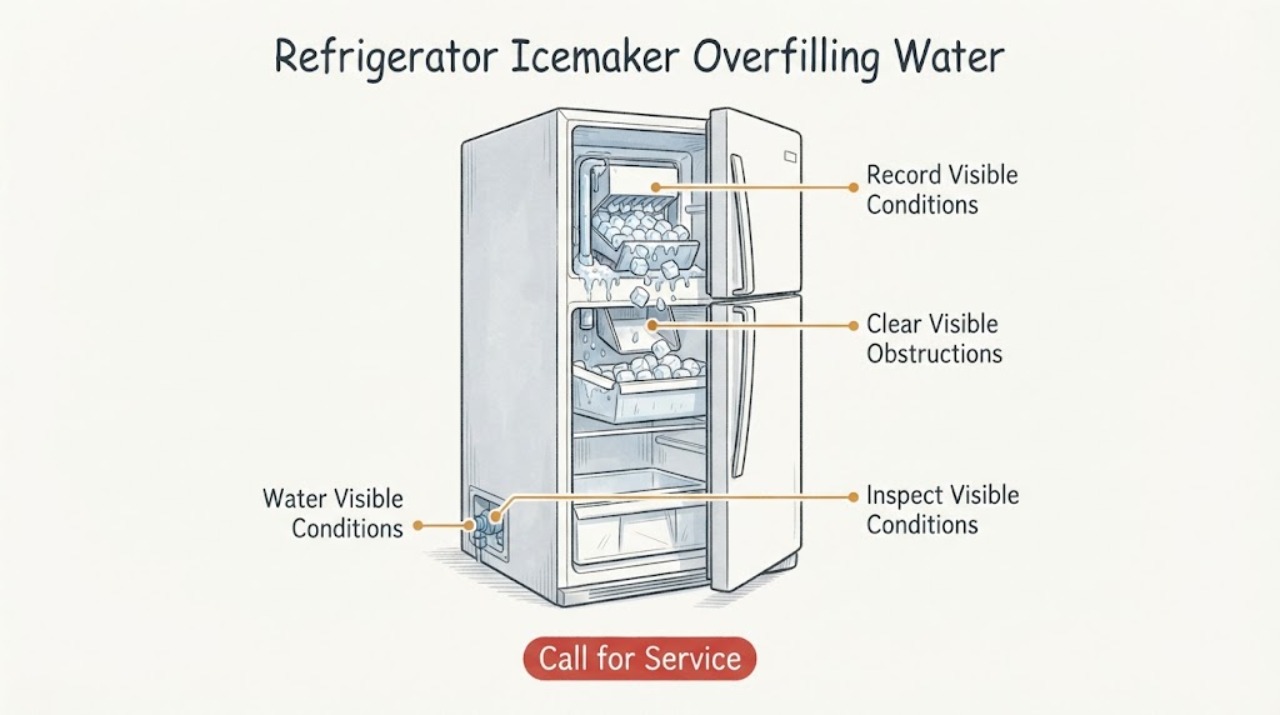
Stop repeated ice-maker cycles and record whether the excess water is visibly spilling during the fill, dripping after the fill, or only producing a fused block after the ice has frozen. Disable the ice maker with the KRFC604FSS01 Owner's Manual control; if water is actively escaping, close the refrigerator's accessible household water shutoff from a dry, safe position.
Expected result: Water is still entering after the tray appears full or after the normal fill ends; water is only present as a later fused mass; or the bucket is simply becoming full of separate cubes.
Next step: Keep the ice maker and water supply off when water is escaping, photograph the tray and bucket without dismantling the door, and arrange qualified service. Continue with the external bin and shutoff checks only when there is no active leak.
Why this matters
Why: Continued water or a puddle is a water-control or leak symptom that cannot be corrected by changing an unverified fill setting. A fused block can result from excess fill or a harvest/tray problem, while a bin that simply fills with separate cubes is an automatic-shutoff/overproduction branch.
-
Check 2
With power and ice production stopped, inspect the in-door bucket and ice-maker opening for a fully visible obstruction, bagged ice, or another stored object; reseat the bucket only as the Owner's Manual allows and do not force the shutoff mechanism.
Expected result: The bucket is not seated, the door or bin is open, or something other than ice is pressing on or occupying the bin; alternatively, the bucket is seated and the space contains only ice.
Next step: Remove only a fully visible non-ice object, seat the empty bucket as directed for the model, and leave the ice maker off if the tray has spilled or the module is frozen together. Request service if overproduction returns or the shutoff path does not behave normally; do not bypass it.
Why this matters
Why: KitchenAid says the automatic shutoff uses the bin/door condition and warns that storing bagged ice or other objects can damage the ice-maker module and lead to overproduction. A correctly seated, unobstructed bin makes that external explanation less likely; it does not prove a valve or sensor failure.
-
Check 3
Compare the symptom with the official KRFC604FSS-family fill description without opening the appliance: the service manual describes about 100 ml (3.2 oz) delivered during the timed in-door fill, then the valves are de-energized. Observe only from outside during a single normal cycle if there is no active leak and the manual permits operation; do not repeat cycles to measure it.
Expected result: The fill stops normally and the amount is roughly consistent, or the stream continues, drips after the cycle, or visibly exceeds the tray capacity.
Next step: For continued flow, spilling, or a recurring frozen block, stop the ice maker and water supply and give the technician the model, photos, and whether the dispenser itself leaks. Do not buy a valve or ice-maker assembly solely from this observation.
Why this matters
Why: A normal timed fill shifts attention toward harvest, tray, bin or shutoff conditions. Continued flow or excessive water is outside a safe user adjustment and makes a water valve/control or ice-maker service diagnosis necessary; the manual's technician tests must not be performed as a homeowner voltage test.
-
Check 4
Check the model identity and use-and-care instructions before any maintenance: confirm the rating-label model is KRFC604FSS01 and use the KitchenAid Owner's Center/Owner's Manual for the exact ice-maker disable and bucket instructions. Do not enter service mode, probe connectors, remove the door liner, or open the water-valve compartment.
Expected result: The rating label and assigned model match, and the documented user controls resolve the issue; or the exact model instructions are unavailable, the water still overfills, or the symptom requires an internal test.
Next step: Keep the ice maker disabled and schedule KitchenAid or qualified appliance service, supplying the exact suffix, serial information if requested, fill behavior, and photos. Resume use only after the leak/overfill cause is inspected.
Why this matters
Why: KitchenAid's Owner's Center identifies the KRFC604FSS as a 23.8 cu. ft. French-door refrigerator and routes model-specific manuals and service. The service manual explicitly targets in-home professionals, so missing documentation or an unresolved internal symptom is a service boundary rather than permission to generalize from another KitchenAid model.
Use your observations
Decision map
Find the observation that best matches what you see, then follow the next safe action.
-
PATH 01Next step
What you see
Water spills from the in-door tray, continues after the fill appears complete, or leaves a puddle around the ice maker.
Do this next
Leave ice production off, close the accessible household water shutoff if water is still escaping, protect the floor, and arrange qualified service. Do not open panels or test the valve with live voltage.
Why this path and its safety boundary
Why it matters: This is a water-fill or leak symptom, not merely a full ice bin. The service manual describes a timed fill and valve shutoff, but it does not provide a safe homeowner adjustment for excess water.
-
PATH 02Next step
What you see
The tray fill appears normal, but cubes freeze into one connected block or repeatedly jam the bucket after harvest.
Do this next
Keep the ice maker off, remove only loose accessible ice, document the tray and bucket, and have a technician inspect the model-specific ice-maker system. Do not substitute a valve, sensor, or assembly based on the block alone.
Why this path and its safety boundary
Why it matters: The visible result is consistent with the reported symptom, but it does not identify whether excess water, tray position, harvest, or another ice-maker mechanism is responsible. The Reddit report is a user description, not a verified repair outcome.
-
PATH 03Next step
What you see
The bucket is not seated, the door or bin is open, or bagged ice/another object occupies the storage area, and the issue is overproduction rather than water spilling from the tray.
Do this next
Remove only the visible non-ice object, seat the empty bucket according to the exact manual, and monitor without forcing the shutoff. If the bin still overproduces, leave the ice maker off and request service.
Why this path and its safety boundary
Why it matters: KitchenAid says the automatic shutoff responds to bin/door conditions and that storing anything other than produced ice can damage the module and cause overproduction.
-
PATH 04Next step
What you see
There is an active leak, the water will not stop, the ice-maker cavity is heavily frozen, wiring or a connector is visible, or the refrigerator has been exposed to standing water.
Do this next
Keep the refrigerator and ice maker in a safe stopped state, use the household water shutoff from a dry location when necessary, and contact KitchenAid or qualified appliance service. Do not touch wet electrical parts, remove panels, or restore ice production to test it.
Why this path and its safety boundary
Why it matters: The ordinary user checks have ended and continued operation can cause water damage or electrical risk. The official service manual's diagnostic and component procedures are for in-home service professionals.
Helpful context
Understand the symptom
Confirm what is actually overfilling
A tray that receives water until it spills is a different symptom from a bin that gradually becomes too full of otherwise normal cubes. The official service manual covers the KRFC604FSS French-door family and describes the in-door fill as a timed cycle of about 100 ml. KitchenAid's consumer page discusses automatic shutoff and overproduction, but it also warns that ice-maker types vary and that the model Owner's Manual controls the exact shutoff operation. Use the model-specific identity and the visible water pattern before naming a component.
Keep the check external and safe
With the appliance stopped and the ice maker disabled using the exact Owner's Manual instructions, remove only loose ice that is fully accessible and check that the bucket is seated and the in-door area is not packed with bagged ice or another object. Do not force the bail or shutoff mechanism, reach behind the door liner, open a panel, run electrical tests, or throttle the home's water valve to compensate for an unknown fault. If water is actively leaking, use the refrigerator's accessible household shutoff from a dry, safe position and protect the floor before arranging service.
Why the model-specific boundary matters
The KRFC604FSS01 is listed in KitchenAid's service documentation, but the public service manual is written for in-home service professionals and includes electrical, valve, control and service-test procedures. Those procedures are not a safe remote adjustment for a homeowner. A tray that fills beyond the normal cycle, continues dripping after the cycle, or repeatedly makes a connected frozen block needs a qualified inspection of the water-control and ice-maker system; the public evidence does not justify choosing a valve, sensor, or complete assembly from the symptom alone.
When checks do not resolve it
Need a professional?
Arrange KitchenAid or qualified appliance service if the tray spills, water continues after the fill, a puddle forms, cubes repeatedly freeze into a large block, the bucket/shutoff path is clear but overproduction continues, or the ice maker needs an internal test.
Safety scope: Do not run repeated harvest cycles, throttle the household water valve as a repair, enter service mode, probe live connectors, remove the door liner or water-valve compartment, bypass the automatic shutoff, or order a valve, sensor, fill tube, or ice-maker assembly from the symptom alone. If water is actively escaping, disable ice production and use the accessible household water shutoff from a dry safe position; do not touch wet electrical parts. The official service manual is for in-home service professionals.
Common questions
FAQ
Is the KitchenAid KRFC604FSS01 supposed to fill the ice tray with a measured amount of water?
The official French-door service manual that lists the KRFC604FSS family describes the in-door fill as a timed cycle of about 3.2 oz (100 ml), followed by valve shutoff. That is a service reference, not a homeowner calibration instruction. If water continues, spills, or creates a recurring block, stop ice production and arrange service.
Could a full ice bin make it look like the ice maker is overfilling?
Yes. A bin that gradually fills with separate cubes is different from water spilling from the tray. KitchenAid says the automatic shutoff should respond to the bin, door, and bucket conditions, and warns that bagged ice or other objects in the bin can damage the module and cause overproduction.
Should I replace the water inlet valve first?
No. A valve or another ice-maker component may require professional diagnosis, but the public evidence does not identify a replacement part from the overfill symptom alone. Keep the ice maker off, document whether water continues after the fill, and give the exact KRFC604FSS01 model to the technician.
Can I run a diagnostic test to measure the fill time?
The service manual contains technician diagnostic tests and electrical checks, but it is written for in-home service professionals. Do not enter service mode, probe live connectors, or repeat fill cycles as a homeowner. Use only the exact Owner's Manual's user controls and request service for an unresolved overfill.
Read the exact guide
Official sources
- Service Manual - W11366204 - French-Door Bottom Mount RefrigeratorKitchenAid / Whirlpool Corporation · The opened PDF lists KRFC604FSS in its model family. It describes the in-door ice maker's timed fill as about 3.2 oz (100 ml) and states that the valves are de-energized when the fill cycle ends. Its diagnostic and electrical procedures are for in-home service professionals and are not presented as homeowner instructions.
- KRFC604FSS | KitchenAidKitchenAid · The opened KitchenAid Owner's Center identifies KRFC604FSS as a 23.8 cu. ft. 36-inch counter-depth French-door refrigerator and provides the model-specific manuals and service/support route. It is used to keep the exact model family and documentation boundary explicit, not to infer an overfill cause.
- Making too Much Ice - Ice Maker in Refrigerator - RefrigeratorKitchenAid Product Help · The opened KitchenAid support page says ice-maker types vary and directs readers to the Owner's Manual for model-specific instructions. It supports the automatic shutoff conditions and the warning that storing bagged ice or other objects can damage the module and cause overproduction; it is not used as proof of a KRFC604FSS01 valve fault.
- KitchenAid Refrigerator Icemaker over filling water -Reddit r/appliancerepair · The opened exact Reddit post names KitchenAid KRFC604FSS01 and reports excess water, connected cubes, and a large frozen block. It contains no confirmed repair outcome, so it is used only to preserve the reported symptom and not as a parts or adjustment authority.
Community feedback
Share a repair observation
Share a plain-text repair observation. Accepted observations are published automatically; this page may take a moment to update.