
On this page
Start here
Quick answer
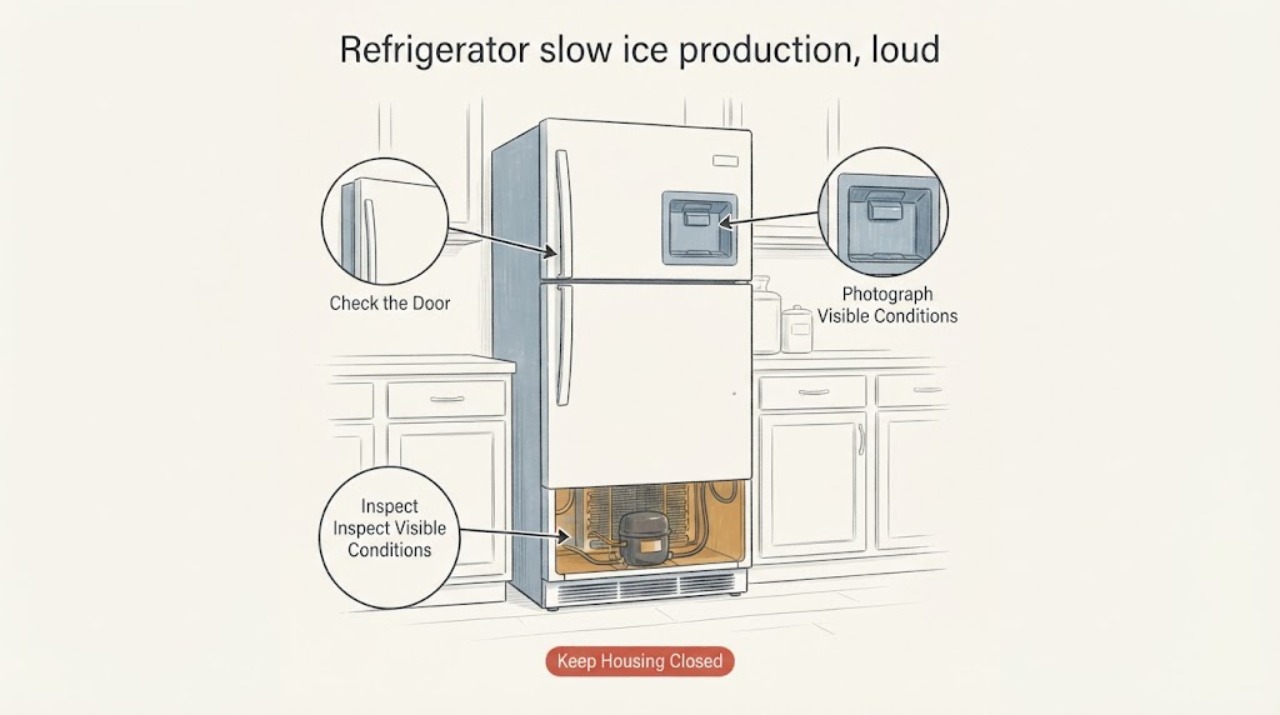
Do not treat E0 as a universal KitchenAid refrigerator fault. In the opened KitchenAid technician sheet, E0 is the ‘No Errors’ result for a particular ice-maker error-code test, but the refrigerator model and the screen or test that produced E0 are missing here. First record the complete rating-label model and where E0 appears, then separate ice production from the sound: note whether the bin has cubes, whether the freezer is cold, whether one normal water dispense is strong, and whether the noise occurs during fill, cooling, defrost, or continuously. KitchenAid says a brief valve buzz, low hum, fan whoosh, or defrost gurgle can be normal, while slow ice with normal water flow and a new loud or persistent sound needs model-specific service rather than a guessed fan, pump, valve, or ice-maker replacement.
Work through in order
Diagnostic checks
Use only checks that match the exact appliance or system and its official guide.
-
Check 1
Photograph the complete KitchenAid rating-label model and record exactly where E0 appeared: the normal user display, an ice-maker status screen, or a diagnostic/test screen. Note any adjacent letters, numbers, icons, or other codes and whether E0 remains after leaving the screen normally. Do not enter a hidden diagnostic sequence just to reproduce it.
Expected result: E0 is clearly shown as an ice-maker diagnostic result, appears on the ordinary control display, appears with another code, or cannot be tied to a screen because the model and context are missing.
Next step: Use the exact model manual or support page to interpret the recorded screen. If the model cannot be recovered, keep the result scoped as an unidentified E0 indication and continue only with the safe symptom checks below; do not use a generic E0 parts list.
Stop if: Stop if identifying E0 would require opening the cabinet, probing wiring, or entering a service procedure.
Why this matters
Why: The opened KitchenAid technician sheet defines E0 as No Errors only for that sheet's ice-maker error-code test. Without the model and display context, E0 could be a normal status result rather than the cause of slow ice, and it must not be mapped to a component across KitchenAid platforms.
-
Check 2
Separate making ice from dispensing it. Without reaching into the mechanism, look at the accessible ice bin or mold area for existing cubes, an empty mold, cubes stuck in the mold, or a full/clumped bin. If an external water dispenser is present, make one brief normal water dispense observation; do not repeatedly press a jammed ice paddle.
Expected result: The bin has cubes but dispensing is poor, the mold is empty, cubes are frozen in the mold, the bin is clumped or full, or both water and ice are weak or absent.
Next step: Follow the exact model manual for accessible bin seating or chute care. Record the production-versus-dispensing result and arrange service for a dry mold, a jam that requires force, overfilling, or a mechanism that binds.
Stop if: Do not pry cubes, insert tools, or touch an operating mechanism.
Why this matters
Why: Cubes in the bin shift attention toward dispensing or bin seating rather than production. An empty mold keeps water delivery and the ice-maker call in consideration; cubes that remain in the mold keep harvest or sensing in consideration. Weak water and weak ice point toward a shared supply or filter path, not a proven ice-maker part.
-
Check 3
Check the freezer temperature indication if available, the condition of other frozen food, and the visible closure of the freezer and refrigerator doors or drawers. Note a recent installation, reconnection, large warm load, or frequent door opening. Do not force the coldest setting or remove an interior panel.
Expected result: The freezer is around the model's normal target, is warm or unstable, a door or drawer is not sealing, or the appliance was recently installed or heavily loaded.
Next step: Restore only a visible obstruction or closure problem and use the exact manual's normal temperature and startup guidance. Keep perishable food in a known-safe cold location if temperatures are uncertain, and request service if cooling stays abnormal or the freezer is not maintaining the model target.
Stop if: Do not chip frost, heat a frozen line, or open an access panel to investigate airflow.
Why this matters
Why: KitchenAid says freezer temperature and door/operating conditions affect ice production, and a newly installed refrigerator can take time to reach full production. A warm compartment or poor seal can slow ice without proving an ice-maker assembly failure; normal cold conditions make the water and ice-making sequence more important.
-
Check 4
From the front or another dry, safe position, inspect only the visible water-line area and filter status. Look for a kinked or crushed line, a visibly closed accessible shutoff, a wet connection, or a filter that is not seated according to the exact manual. Compare one normal water dispense with the ice symptom; do not loosen a pressurized fitting or pull the refrigerator out by its tubing.
Expected result: Water flow is normal, weak, absent, briefly sputters after a filter change, or there is visible water at the filter housing, line, floor, or nearby plumbing.
Next step: Correct only a clearly visible kink or model-documented filter seating issue. For a leak, shut off the refrigerator water supply from a dry accessible location and arrange qualified appliance or plumbing service; do not bypass the filter or perform a pressure test.
Stop if: Stop immediately if water is near an outlet, cord, wiring, or an inaccessible electrical area.
Why this matters
Why: Normal dispenser flow makes a shared external restriction less likely but does not identify the ice-maker valve, fill path, or harvest mechanism. Weak flow in both functions supports a supply or filter restriction. A wet connection is a leak decision, not proof of a particular valve or pump failure.
-
Check 5
Characterize the sound from outside the cabinet and keep a timeline separate from ice production. Note whether it is a brief buzz or click during water fill, a low hum or whoosh during cooling, a gurgle during defrost, a vibration/rattle against the cabinet, or a new scraping, grinding, knocking, or continuously loud sound. Record whether it changes when the freezer drawer or door is opened, without touching a fan or removing a cover.
Expected result: The sound is brief and tied to fill or cooling, follows defrost or a door/load event, is loudest near the freezer, or is continuous/irregular and accompanied by slow ice, warming, leak, odor, or vibration.
Next step: If the sound is brief and temperatures are safe, monitor without repeated tests. If it is continuous or irregular, or if it tracks with warming or worsening ice production, keep the ice maker off when the manual permits and arrange model-specific service with the sound timeline; do not label the fan, pump, or ice-maker motor from sound alone.
Stop if: Stop for scraping with burning odor, smoke, arcing, a hot cord, uncontrolled water, or a sound that indicates the cabinet or mechanism is being damaged.
Why this matters
Why: KitchenAid lists valve buzz, fan/compressor hum or whoosh, refrigerant/defrost gurgle, and some rattles as possible normal operating sounds, but a sound that becomes significantly louder or persists abnormally needs attention. The exact Reddit report has the same distinctive combination of slow ice, E0 shown as no ice-maker errors, and a loud freezer-area fan/pump-like sound; it records a symptom pattern, not a confirmed part diagnosis.
-
Check 6
Make a food-and-leak safety decision before any follow-up. Check the refrigerator and freezer temperatures with an appliance thermometer if available, keep doors closed, and note whether water is actively accumulating. Do not taste questionable food or restart the refrigerator merely to recreate a noise.
Expected result: Food temperatures are unknown or above the model's safe target, water is recurring or near electrics, cooling is failing, or the appliance remains dry and safely cold.
Next step: Move or discard food according to measured temperature and known time, isolate water from a dry safe location for an active leak, and arrange qualified service for persistent warming, recurring water, or electrical symptoms. Preserve the model, E0 context, ice result, water-flow result, and sound timeline.
Stop if: Do not touch wet electrical areas, remove panels, measure live voltage, enter service mode, or continue operation after smoke, burning odor, arcing, or uncontrolled leakage.
Why this matters
Why: Slow ice is secondary to safe food storage and water/electrical control. A recurring leak or failed cooling changes this from an observation-only ice-maker concern to a service and safety event, while safe temperatures and no water allow a documented service handoff without guessing a part.
Use your observations
Decision map
Find the observation that best matches what you see, then follow the next safe action.
-
PATH 01Next step
What you see
E0 appears only in an ice-maker error-code/status screen, the exact model is still unknown, and no other code is shown.
Do this next
Record the exact model and screen context, use the model's owner manual, and diagnose the slow-ice symptom through temperature, bin, water, and timing observations rather than trying to clear E0.
Why this path and its safety boundary
Why it matters: On the opened KitchenAid technician sheet, this context means No Errors, so E0 is not evidence of a failed part. Because the model is missing, the meaning cannot be generalized to the ordinary refrigerator display.
-
PATH 02Next step
What you see
Ice is slow and the water dispenser is also weak or absent, or the visible line/filter area is kinked, wet, disconnected, or apparently shut off.
Do this next
Correct only a visible safe kink or exact-manual filter seating issue. Shut off water for a leak and arrange qualified service for the line, filter housing, pressure, or hidden supply path.
Why this path and its safety boundary
Why it matters: A shared supply or filter restriction is more consistent with both functions being affected than an isolated ice-maker harvest problem. The observation still does not select an inlet valve, pump, or fill tube.
-
PATH 03Next step
What you see
The freezer is maintaining normal cold operation, the dispenser has normal flow, the maker is enabled, and the mold stays dry or cubes remain unharvested while the loud sound persists.
Do this next
Stop using any maker function that buzzes continuously, jams, or overfills and give qualified service the exact model, E0 screen context, mold/bin observation, dispenser result, freezer temperature, and sound timeline.
Why this path and its safety boundary
Why it matters: The evidence narrows the problem to the ice-making sequence and the sound's source, but it does not prove a valve, fill tube, fan, pump, sensor, motor, or control failure. The E0 result does not remove the need for model-specific diagnosis.
-
PATH 04Next step
What you see
The noise is a brief fill buzz, low cooling hum/whoosh, or defrost gurgle, it settles, the freezer remains cold, and no water or food-safety problem is present.
Do this next
Monitor one normal production interval using the exact model guidance and keep a record. Request service if the sound becomes louder or continuous, temperatures rise, or slow ice persists despite normal water and freezer conditions.
Why this path and its safety boundary
Why it matters: KitchenAid documents these as possible normal operating sounds. A normal sound does not explain slow ice by itself; the ice-maker state, temperature, water flow, filter, and startup timing remain separate checks.
-
PATH 05Next step
What you see
The sound is continuous, scraping, grinding, or irregular, or it accompanies warming, recurring water, burning odor, smoke, arcing, or food temperatures outside a safe range.
Do this next
Stop the ice maker and refrigerator if safe, keep clear of wet electrical areas, shut off water for an active leak from a dry accessible point, move or discard food based on temperature and time, and obtain qualified appliance service. Do not restart to reproduce the symptom.
Why this path and its safety boundary
Why it matters: This is a safety and service boundary, not a cue to run the ice maker again or choose a part. KitchenAid's guidance distinguishes abnormal persistent noise and water/cooling concerns from normal operating sounds.
Helpful context
Understand the symptom
The identity gap matters. KitchenAid uses E0 in at least one ice-maker diagnostic context as a normal ‘no errors’ result, but that does not establish what an E0 on an unidentified refrigerator's front display means. Save a clear photo of the display and the full model/rating label before looking for a code-specific repair. Treat the slow ice and the loud sound as two observations until their timing actually connects them.
Keep all checks external and low risk. Do not enter a service mode, reach toward a moving fan or ice-maker mechanism, remove panels, bypass a control, or order a part from the sound. If water reaches electrical areas, food is no longer safely cold, the appliance smells burned, or the sound is scraping or continuously abnormal, stop testing and arrange qualified service.
When checks do not resolve it
Need a professional?
Arrange qualified KitchenAid refrigerator service when the exact model cannot be matched to the E0 screen, slow production persists with a cold freezer and normal dispenser flow, the maker stays dry or fails to harvest, the sound is continuous or irregular, or a leak, overfill, jam, abnormal cooling, burning odor, smoke, arcing, or wet electrical area appears. Shut off water for an active leak from a dry accessible location and protect food before service. Do not open panels, enter service mode, touch fans or the ice-maker mechanism, perform live electrical tests, bypass controls, or order a fan, pump, valve, sensor, motor, or ice-maker assembly from these symptoms alone.
Common questions
FAQ
Does E0 mean my KitchenAid refrigerator has no problem?
Not universally. The opened KitchenAid technician sheet uses E0 for No Errors in one ice-maker error-code test. Because the refrigerator model and display context are missing, first identify whether E0 came from a status/test screen or the ordinary display; do not treat E0 as a universal refrigerator diagnosis.
Can a normal refrigerator buzz while ice production is slow?
Yes, a brief valve buzz during an ice fill or a low cooling hum can be normal, but slow ice still needs separate checks for freezer temperature, maker state, water flow, filter seating, and startup timing. A new continuous or irregular sound, especially with warming or a leak, needs service.
What does slow ice with normal dispenser flow suggest?
Normal dispenser flow makes a shared external restriction less likely, but it does not prove which ice-making component is at fault. Check the exact model's on state, freezer temperature, bin or mold result, and sound timing, then arrange model-specific service if production remains slow.
Should I keep running the refrigerator to reproduce the loud sound?
No. Record the sound from outside the cabinet and its timing. Stop for scraping, grinding, burning odor, smoke, arcing, uncontrolled water, or unsafe food temperatures; do not remove panels, touch a fan, enter service mode, or perform live testing.
Read the exact guide
Official sources
- Tech Sheet W11501234BKitchenAid · Opened official KitchenAid service sheet. Its E0 meaning is limited to Service Test 56 on the covered refrigerator platform and must not be generalized to an unidentified KitchenAid model or ordinary display.
- Ice Maker Not Working - TroubleshootingKitchenAid · Opened official KitchenAid product-help guide. It is symptom-level guidance across refrigerator platforms; exact settings and reset behavior remain model-specific.
- Refrigerator Normal Sounds and NoisesKitchenAid · Opened official KitchenAid refrigerator noise guide covering multiple refrigerator forms. Sound type and timing remain model- and installation-dependent; it does not identify a failed part for this topic.
- Kitchenaid ice maker, and loud fan/pump soundReddit r/appliancerepair · Exact Reddit report for a KitchenAid five-door refrigerator with slow ice, E0 shown as no ice-maker errors, and a freezer-area fan/pump-like sound. It is community evidence for timing and symptom separation only, not a repair instruction or model-wide E0 definition.
- Troubleshoot Your Refrigerator's Possible ProblemsKitchenAid · Opened official KitchenAid refrigerator troubleshooting guide. It provides general owner-level checks and directs exact model manual use; it does not support identifying a component from sound or E0 alone.
- Refrigerator Ice Maker TroubleshootingKitchenAid · Opened official KitchenAid refrigerator ice-maker guide. It discusses slow or absent production across models and repeatedly directs owners to the exact owner's manual for model-dependent controls.
Community feedback
Share a repair observation
Share a plain-text repair observation. Accepted observations are published automatically; this page may take a moment to update.