
On this page
Start here
Quick answer
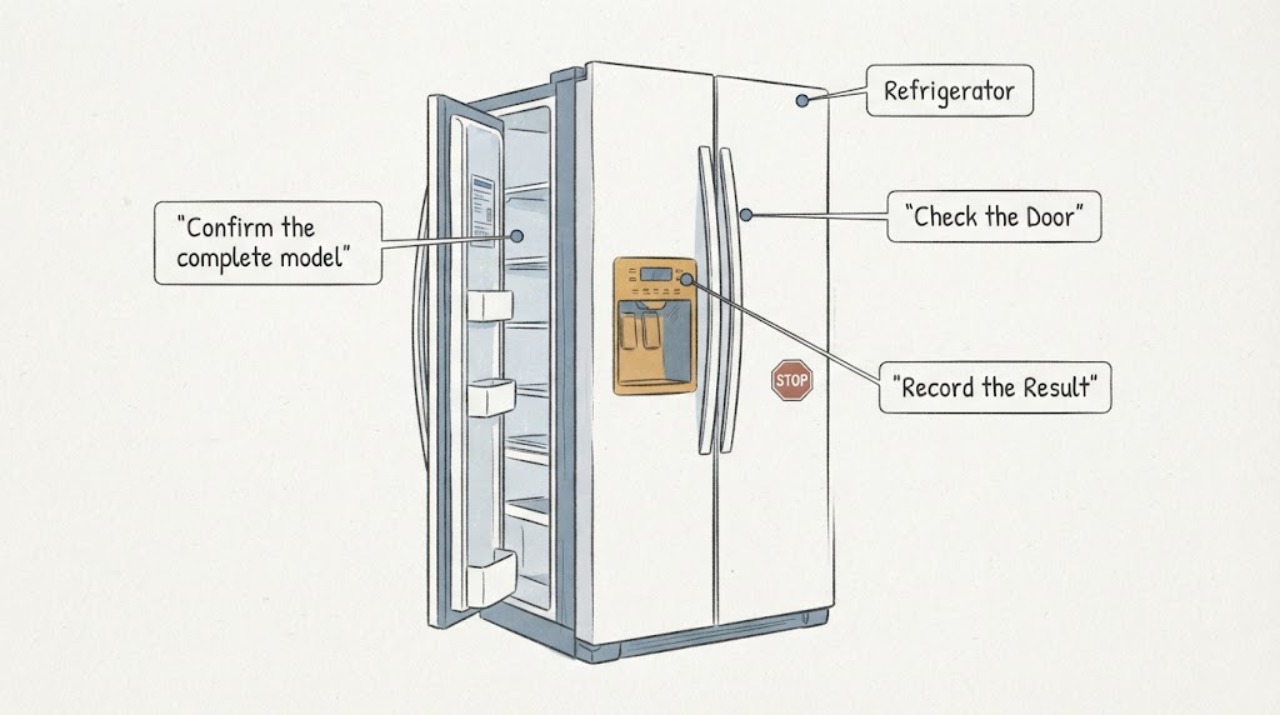
For a KitchenAid KFIS25XVMS00 refrigerator that intermittently loses both ice and water at the outside door, first separate ice production from delivery. Confirm the complete model suffix on the rating label, then check for a dispenser/control lock, a fully closed door, a recently changed or poorly seated filter, and a visible kink or wet connection in the supply line. Look in the bin to see whether ice is being made, and make only one brief normal water and ice request. If the freezer is cold, ice is present, water flow and filter seating look normal, and both outside functions still drop out, the evidence points to the shared dispenser interface or internal supply/control path—not a proven bad ice maker or a specific replacement part. KitchenAid's official model page shows the KFIS25XVMS base family but no available documents, so do not apply another model's button sequence or part fit; provide the full suffix and the observed sequence to qualified service.
Work through in order
Diagnostic checks
Use only checks that match the exact appliance or system and its official guide.
-
Confirm the complete model and the dispenser state
Read the refrigerator rating label and record the full model, including the final suffix. From the front, note whether a lock symbol, a Sabbath indication, or an inactive dispenser selection is visible. Do not try a button combination copied from another KitchenAid model.
Expected result: The label confirms KFIS25XVMS00 and the dispenser is unlocked, or the suffix is different/unclear or a lock-style indication is present.
Next step: If a visible lock or documented mode is present, use only the exact model's instructions to clear it. If the suffix cannot be confirmed, stop model-specific troubleshooting and give the label information to service.
Stop if: Stop if the display is abnormal, the model label is inaccessible without moving the refrigerator, or any reset would require an undocumented sequence.
Why this matters
Why: KitchenAid says the control lock disables the dispenser controls and pad without shutting off refrigerator power, the ice maker, or the dispenser light. The exact model page displays KFIS25XVMS but no documents, so a missing suffix prevents model-specific control instructions.
-
Separate ice production from outside-door delivery
Look through the accessible ice bin or maker area without reaching into moving parts. Note whether cubes are already in the bin, whether the mold is dry, and whether cubes remain stuck in the mold. Make one normal ice request only; do not force the auger, use a sharp object, or press an unidentified test button.
Expected result: The bin has usable cubes, the mold is dry, cubes remain in the mold, or no ice is available.
Next step: If cubes are present, follow only the exact model's accessible bin/chute guidance. If the mold is dry or the maker repeatedly buzzes, continue with the shared water checks and arrange service if the condition persists.
Stop if: Stop if the bin binds, the mechanism jams, the maker buzzes continuously, or a cube would require force to remove.
Why this matters
Why: Cubes in the bin make an outside delivery or bin/chute issue more plausible than a failure to make ice. A dry mold keeps water delivery and the ice-maker call for water in consideration; cubes stuck in the mold keep a harvest or sensing issue in consideration. These observations do not identify a failed part.
-
Check freezer condition and door closure
Check the freezer display and the condition of other frozen food. Confirm that the refrigerator doors and freezer drawer close fully and that no recent loading, installation, or reconnection left a door ajar. Do not force an extreme temperature setting or open an access panel.
Expected result: The freezer is stable and cold with doors closing normally, or it is warm/unstable, a door remains ajar, or the refrigerator was recently installed or reconnected.
Next step: Correct only the visible door, drawer, or loading issue and follow the exact model's normal temperature and startup guidance. Arrange service if cooling remains poor or a fault returns.
Stop if: Stop and protect food if the freezer cannot maintain safe cold conditions, if frost blocks closure, or if abnormal heat or odor is present.
Why this matters
Why: KitchenAid identifies freezer temperature, water supply, the ice-maker on state, and filter problems as common ice-maker factors. A warm compartment or poor door seal can reduce production without proving a dispenser or ice-maker component failure.
-
Inspect only the visible supply line and filter condition
From the front, inspect the visible refrigerator water line and any accessible shutoff indication. Look for a kink, crushing against the cabinet, a wet connection, or a recently changed filter that is not visibly locked and sealed. Do not pull the refrigerator by its tubing or loosen a pressurized fitting.
Expected result: The line is visibly kinked/crushed or wet, the shutoff appears closed, the filter was recently changed or is not seated, or the visible line is clear and dry.
Next step: Ease only a visible kink that can be corrected without moving the appliance. Reseat or replace the filter only using instructions that match the full model, and stop before any hose work if a leak, disconnection, or pressure question exists.
Stop if: Shut off water from a safe accessible point and obtain qualified service for a leak, wet electrical area, disconnected tubing, filter-housing damage, or any work behind the refrigerator.
Why this matters
Why: KitchenAid states that a restricted or closed cold-water supply, kinked line, clogged filter, or improperly seated filter can reduce or stop dispenser flow and reduce ice production. A clear, dry line lowers the likelihood of an external restriction but does not rule out an internal valve, tube, or control issue.
-
Compare one water request with one ice request
Select water and press a sturdy glass against the dispenser paddle for one brief normal request, then release it. After the area stops, select ice and make one brief request. Note whether the dispenser light responds, whether water is normal/slow/absent, whether the motor is heard, and whether opening or closing a door changes the response. Do not repeatedly cycle a sticking paddle or keep a cup against it.
Expected result: Both outputs are absent together, water is weak but ice exists, water is normal while ice is intermittent, or the light/control responds without delivery.
Next step: Record the exact pattern and the full model for service. Do not bypass a switch, open the door panel, disconnect the water line, or order a valve, harness, or control based only on this test.
Stop if: Stop immediately for a leak, water near electrical areas, burning odor, sparking, a jammed motor, or an abnormal noise that continues after the request is released.
Why this matters
Why: KitchenAid advises that the paddle must be fully engaged and that low water pressure or filter restriction can slow water and ice production. If both outside outputs fail while the freezer and bin are normal, a shared delivery interface, door-side switch/wiring, or internal supply/control path remains possible; the observation cannot distinguish those parts.
-
Use only an exact-model reset or escalate
If the exact owner material for KFIS25XVMS00 is available, follow its single documented dispenser/ice-maker reset once after the safe observations. The official KitchenAid page currently shows no documents for the KFIS25XVMS base page, so do not invent a reset from a neighboring model. If the symptom returns, stop testing and prepare the model label plus the ice-bin, water-flow, filter, lock, and door observations for service.
Expected result: The exact manual provides a reset and the dispenser recovers, or no exact reset is available or the intermittent failure returns.
Next step: Keep the maker/dispenser off if it leaks, overfills, buzzes continuously, or reaches wet electrical areas. Otherwise arrange qualified KitchenAid refrigerator service and provide the recorded pattern.
Stop if: Do not remove panels, test internal wiring, enter a diagnostic mode, thaw a tube with heat, or continue cycling the dispenser to reproduce the symptom.
Why this matters
Why: A one-time documented reset can clear a temporary control state, but recovery does not prove a part is healthy. A repeat failure after visible checks requires model-specific diagnosis of the shared delivery path and ice-making path rather than guesswork.
Use your observations
Decision map
Find the observation that best matches what you see, then follow the next safe action.
-
PATH 01Next step
What you see
Cubes are present in the bin, the freezer is cold, and one outside-door water and ice request is intermittent or unresponsive.
Do this next
Check only the accessible bin/chute and lock indication using exact-model guidance, then arrange service if both outside outputs continue to fail.
Why this path and its safety boundary
Why it matters: The refrigerator is making ice, so the immediate decision shifts from ice production to the shared dispenser interface, bin/chute seating, door-side sensing, or internal delivery path. No individual component is proven.
-
PATH 02Next step
What you see
Water is slow or absent and ice production is also low, especially after a filter change or when a visible line is kinked.
Do this next
Correct only a visible kink or exact-model filter seating issue. Stop for leaks, disconnected tubing, or any need to move the refrigerator or work on a pressurized connection.
Why this path and its safety boundary
Why it matters: A shared supply restriction, filter seating/condition, shutoff, or pressure problem is more plausible than an isolated harvest failure.
-
PATH 03Next step
What you see
Water flow is normal, cubes exist, but ice delivery is intermittent while the lock is off and the bin is seated.
Do this next
Follow the exact model's accessible cleaning and bin instructions without force; service the refrigerator if the mechanism binds or the symptom returns.
Why this path and its safety boundary
Why it matters: The evidence favors an ice-bin/chute/auger delivery issue or a door-side dispenser control issue rather than a water-supply restriction, but a motor or control cannot be identified from sound or a single request.
-
PATH 04Next step
What you see
The full suffix is unclear, the outside functions remain intermittent after visible checks, or water reaches electrical areas, the maker overfills, or burning odor appears.
Do this next
Stop the maker and dispenser; shut off water if safe and accessible, keep clear of wet electrical areas, preserve the model label and symptom record, and obtain qualified appliance service. Do not restart merely to reproduce it.
Why this path and its safety boundary
Why it matters: The issue is outside safe model-agnostic observation. The official base-model page has no documents, and continued testing could add water, electrical, or food-safety risk.
Helpful context
Understand the symptom
Ice production and outside-door delivery are different decisions. Cubes in the bin with a nonresponsive dispenser shifts attention toward the delivery path; weak water flow together with low ice keeps the filter and supply path in play. A single observation of each function is more useful than repeatedly holding a paddle or forcing a jammed mechanism.
The official KitchenAid owners page identifies the KFIS25XVMS family, but it currently lists no documents. Confirm the complete KFIS25XVMS00 label before using any control sequence, installation detail, or replacement-part listing.
When checks do not resolve it
Need a professional?
Call for service if the intermittent outside-door failure returns after exact-model visible checks, if the full suffix cannot be confirmed, or immediately for leaks, water near electrical parts, overfill, continuous buzzing, burning odor, abnormal cooling, or food-safety concerns.
Have this ready
- Provide the complete KFIS25XVMS00 rating-label model, whether cubes were in the bin, water-flow result, filter-change history, lock/door observations, and whether both functions failed together.
Common questions
FAQ
If the ice maker still makes cubes, is the ice maker bad?
Not necessarily. Cubes in the bin show that production is occurring; the next decision is the outside dispenser, bin/chute seating, lock, paddle, door-side sensing, or shared delivery path. A part should not be selected without model-specific diagnosis.
Can I use another KitchenAid refrigerator's reset sequence?
No. The official KFIS25XVMS owners page currently shows no available documents, and KitchenAid says control-lock instructions vary by model. Confirm the full suffix and use only matching documentation or qualified service.
Why can the dispenser light work while ice and water do not dispense?
KitchenAid explains that the control lock can disable the dispenser controls and pad without shutting off refrigerator power, the ice maker, or the dispenser light. A responsive light therefore does not prove that the paddle, valve, tubing, or internal control path is working.
Read the exact guide
Official sources
- Not Dispensing Ice or Water - Refrigerator - Product Help | KitchenAidKitchenAid Product Help · Manufacturer guidance covering dispenser lock, filter seating, cold-water supply, kinked lines, flushing after filter installation, and service; it supports the shared-path decision but does not establish exact KFIS25XVMS00 controls.
- Not Dispensing Water - Refrigerator - Product Help | KitchenAidKitchenAid Product Help · Manufacturer guidance for control lock/Sabbath mode, filter, cold-water supply, line kinks, pressure, and fully engaging the dispenser paddle; exact settings vary by model.
- Ice Maker Not Working - Troubleshooting - Product Help | KitchenAidKitchenAid Product Help · Manufacturer guidance for restricted water supply, freezer temperature, ice-maker on state, and filter problems; use it to separate production from dispenser delivery, not to identify an exact component on KFIS25XVMS00.
- KFIS25XVMS | KitchenAidKitchenAid · The official owners page displays the KFIS25XVMS base family and identifies the appliance as a 25 Cu. Ft. Architect Series II refrigerator; it lists no available documents, so the 00 suffix must be confirmed from the rating label before model-specific instructions or parts are used.
- Not Dispensing Ice or Water - Refrigerator - Product Help | KitchenAidKitchenAid Product Help · Manufacturer guidance for refrigerator dispenser lock, filter seating, cold-water connection, visible supply-line kinks, and service escalation; use as brand-level guidance, not as proof of a KFIS25XVMS00-specific part.
- Using the Control Lock Feature - Product Help | KitchenAidKitchenAid Product Help · Manufacturer explanation that control lock disables dispenser controls/pad but not refrigerator power, ice maker, or dispenser light; the unlock gesture varies by model.
Community feedback
Share a repair observation
Share a plain-text repair observation. Accepted observations are published automatically; this page may take a moment to update.