
On this page
Start here
Quick answer
A repetitive click from a new KitchenAid KRFF507HPS is not, by itself, proof of a failed part. First correlate the sound with an ice-maker fill attempt, a cooling transition, or compressor/control switching, and note whether cooling, water dispensing, and ice production remain normal. KitchenAid documents clicking from a water valve when an ice maker is enabled without a water supply, and says repetitive clicking can be normal on models whose cooling valve switches compartments. If the sound is continuous or comes with worsening temperatures, a leak, burning odor, or failure to start cooling, stop trying to reproduce it and arrange qualified service.
Before you begin
Safety first
- The user-facing checks stop at controls, visible connections, cabinet stability, temperature observation, and sound correlation. Internal electrical, sealed-system, refrigerant, compressor, control-board, valve, and ice-maker mechanism work belongs to qualified appliance service.
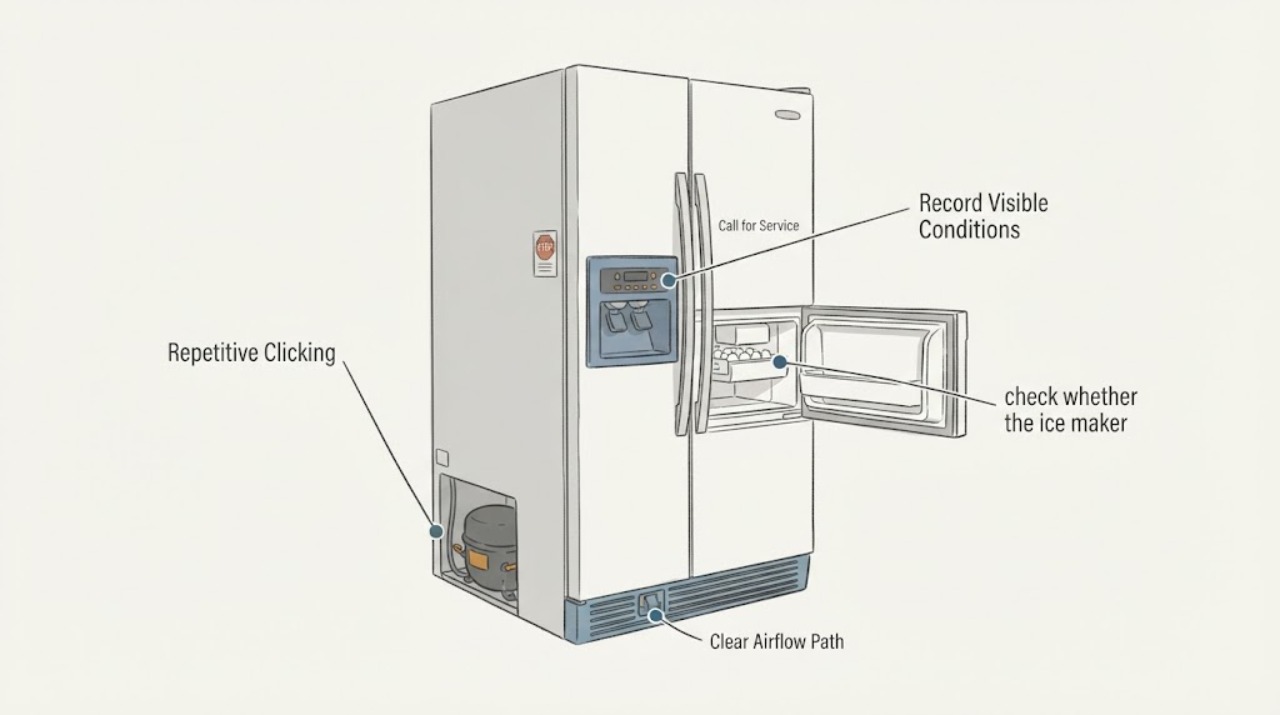
Work through in order
Diagnostic checks
Use only checks that match the exact appliance or system and its official guide.
-
Check 1
Write down the exact KRFF507HPS model from the product label, then make one short recording from the front and note where the click is loudest, whether it comes in a burst or remains continuous, and whether the doors, dispenser, cooling, or ice output changed.
Expected result: The click is brief and tied to a recognizable event, or it repeats without an event; cooling and water/ice functions are either stable or degraded.
Next step: Keep the recording and symptom timeline for the next branch. Do not move the refrigerator or open an access panel to locate the sound; arrange service if performance is degrading or the noise is accompanied by an electrical or water-safety symptom.
Why this matters
Why: Timing and location separate a normal control, compressor, or water-valve event from a sound that is occurring while the refrigerator is failing to perform. The exact model identity matters because KitchenAid's published noise guidance is broader than a model-specific diagnosis.
-
Check 2
From the normal controls, check whether the ice maker is enabled and whether the refrigerator is actually connected to its household water supply. Look only for a visible dry or disconnected supply condition; do not loosen a pressurized fitting or reach into the maker.
Expected result: The ice maker is enabled with no water connection, a water line is visibly wet or disconnected, or the line is connected and the click is heard during an ice fill or water dispense.
Next step: If there is no water connection, turn the ice maker off using the model's documented control and have the water connection completed safely. For a leak, wet connection, or any tubing work, shut off water from a safe accessible point and use qualified service.
Why this matters
Why: KitchenAid says an unconnected ice maker can make the water valve buzz or click while it tries to fill, and its quick guide says to turn the ice maker off when there is no water line. A click during a normal fill can therefore be a valve operation rather than a proven valve failure.
-
Check 3
Compare one click burst with the refrigerator's normal cooling behavior without changing settings repeatedly: note whether the sound occurs as the compressor starts or stops, as airflow changes, or as the appliance switches cooling between compartments. Check temperatures and food condition rather than judging the noise by loudness alone.
Expected result: Cooling remains stable and the click is brief or tied to a cooling transition, or the click is persistent and the refrigerator is not maintaining temperature.
Next step: With stable cooling and no hazard sign, monitor and preserve the recording instead of naming a failed component. If cooling is worsening, the compressor repeatedly attempts to start, or the sound is continuous and abnormal, stop repeated tests and request model-specific diagnosis.
Why this matters
Why: KitchenAid describes relay and control-board clicks, a compressor start/stop click, and other cooling sounds as normal possibilities. Its French-door clicking guidance also describes rapid repetitive clicking as normal for models whose dual-evaporator valve switches between compartments; that statement does not establish that every KRFF507HPS configuration has that valve.
-
Check 4
For a recent installation or reconnection, confirm only that the refrigerator is stable on a solid, level floor, no loose object is touching the cabinet, and the internal air vents are not blocked. Follow the exact owner's manual for startup and temperature settings; do not force extreme settings to silence the click.
Expected result: The unit is unstable or contacting an object, an air path is blocked, the appliance is still in its initial cooldown, or the installation is stable and cooling has already settled.
Next step: Correct only the visible stability or loading issue and follow the model manual's startup guidance. If the refrigerator cannot reach or hold safe temperatures, or the click persists with other symptoms after normal startup, use the warranty or qualified appliance service route.
Why this matters
Why: Leveling and loose objects can transmit or amplify vibration, while a new refrigerator may produce unfamiliar normal sounds during initial operation. The quick reference also says to allow the refrigerator to cool completely before storing food and to allow time after setting changes; neither point proves a defect from sound alone.
-
Check 5
Before contacting service, record the model, installation date, click frequency and location, freezer and refrigerator temperature readings, ice-maker and dispenser behavior, and any visible water or odor. Keep the appliance closed as much as practical if cooling is failing.
Expected result: The noise is the only symptom with stable operation, or it is paired with cooling loss, repeated failed starts, a water leak, burning odor, smoke, or water near electrical areas.
Next step: For stable operation, provide the recording and timeline to KitchenAid support if the noise remains unacceptable. For cooling loss, smoke, burning odor, or water near electrical parts, stop using the affected function, disconnect power only if safe, shut off water before hose work, and obtain qualified appliance service; do not restart merely to reproduce the click.
Why this matters
Why: A sound-only report can be triaged by context, but a performance or hazard symptom moves the question from normal-noise identification to a service diagnosis. The public KitchenAid guidance does not identify a KRFF507HPS replacement part from a sound recording.
Use your observations
Decision map
Find the observation that best matches what you see, then follow the next safe action.
-
PATH 01Next step
What you see
The click occurs in a short burst when the ice maker would fill, and the ice maker is enabled without a connected water line.
Do this next
Turn the ice maker off using the normal model control until water is connected, and use qualified service for a leak, damaged connection, or any pressurized tubing work.
Why this path and its safety boundary
Why it matters: The documented pattern is consistent with the water valve attempting an ice fill; it does not prove that the valve itself has failed.
-
PATH 02Next step
What you see
The click is brief or occurs with a cooling transition while both compartments maintain temperature and there is no leak, odor, or repeated failed start.
Do this next
Keep the recording and monitor operation; do not order a control board, compressor, or valve solely from the sound. Request service if the pattern changes or performance falls off.
Why this path and its safety boundary
Why it matters: This pattern fits KitchenAid's documented normal relay, compressor, water-valve, or model-dependent cooling-valve sounds better than a confirmed component failure.
-
PATH 03Next step
What you see
The click is continuous or increasingly frequent and the refrigerator is warming, repeatedly failing to start cooling, leaking, smoking, or producing a burning odor.
Do this next
Stop repeated testing and arrange qualified KitchenAid appliance service. Keep clear of wet electrical areas, shut off water before safe hose service, and protect perishable food according to an appropriate food-safety plan.
Why this path and its safety boundary
Why it matters: The sound is now coupled to a cooling, water, or electrical warning and should not be treated as a normal-noise question.
-
PATH 04Next step
What you see
The refrigerator was just installed or reconnected, but the sound cannot be correlated with ice filling, cooling, or compressor operation and the exact product documentation is not available.
Do this next
Locate the exact KRFF507HPS owner's literature or use the warranty/service channel with the recording and symptom timeline. Do not guess a part, bypass a control, or open the sealed or electrical areas.
Why this path and its safety boundary
Why it matters: The available KitchenAid noise pages describe sound classes, not a KRFF507HPS-specific fault code or part diagnosis. Identity and startup context remain unresolved.
Helpful context
Understand the symptom
Why a new refrigerator can sound unfamiliar
The KRFF507HPS product page identifies this exact model as a French Door refrigerator with exterior ice and water and an In-Door-Ice system. KitchenAid says new refrigerators can sound different from an older appliance because quieter compressor operation makes normal operating sounds more noticeable. A sound is useful evidence only when its timing, location, and accompanying performance are recorded together.
Safety boundary
Keep this investigation external and observation-only. Do not remove a rear cover, reach into the ice maker, probe wiring, bypass a control, or order a valve, board, compressor, or other part from the sound alone. Keep food safety and any water near electrical areas ahead of reproducing the noise.
When checks do not resolve it
Need a professional?
Call qualified service when clicking is paired with loss of cooling, repeated failed starts, a leak, smoke, burning odor, water near electrical areas, an overfilling or jammed ice maker, or a sound that remains unacceptable after the documented external checks.
Safety scope: The user-facing checks stop at controls, visible connections, cabinet stability, temperature observation, and sound correlation. Internal electrical, sealed-system, refrigerant, compressor, control-board, valve, and ice-maker mechanism work belongs to qualified appliance service.
Have this ready
- Provide KRFF507HPS, installation or reconnection date, sound recording, click timing and location, temperature readings, and whether water dispensing and ice production are normal.
Common questions
FAQ
Does repetitive clicking prove that the KRFF507HPS needs a new part?
No. KitchenAid documents several normal clicking sources, so the sound must be correlated with cooling, ice-making, water, and safety symptoms before a component is considered.
Why can a new KitchenAid refrigerator sound different from an older one?
KitchenAid says a new refrigerator's quieter compressor can make unfamiliar but normal operating sounds more noticeable, especially during cooling, defrost, airflow, and ice-maker operation.
Should I replace the water valve or control board because the click is repetitive?
Not from the sound alone. First identify whether it coincides with an unconnected ice-maker fill attempt or a normal cooling/control event; use qualified service for a performance or safety symptom rather than ordering an unverified part.
Read the exact guide
Official sources
- Refrigerator Normal Sounds and Noises - Product Help | KitchenAidKitchenAid Product Help · KitchenAid full-size refrigerator normal-sound classification and external noise-reduction guidance
- 26.8 cu. ft. 36-Inch Width Standard Depth French Door Refrigerator with Exterior Ice and Water and PrintShield® finish Stainless Steel with PrintShield™ Finish KRFF507HPS | KitchenAidKitchenAid · KitchenAid KRFF507HPS product identity and published product features
- Quick Reference ManualKitchenAid · KitchenAid refrigerator quick-reference cooling, noise, ice-maker, and startup guidance
- Clicking Noise - Refrigerator - Product Help | KitchenAidKitchenAid Product Help · KitchenAid full-size French Door Bottom Freezer refrigerator clicking-noise guidance; applicable to the documented sound patterns, not a model-specific part diagnosis
Community feedback
Share a repair observation
Share a plain-text repair observation. Accepted observations are published automatically; this page may take a moment to update.