
On this page
Start here
Quick answer
R600a is flammable, but a leak does not automatically explode: the serious risk is that released gas reaches an ignition source or is handled incorrectly. A KitchenAid owner manual for a specific built-in refrigerator states that its circuit contains R600a, warns of fire or explosion if refrigerant tubing is punctured, and directs refrigerant service to qualified personnel. The opened Whirlpool Corporation R600a service manual likewise requires trained service conditions and says R600 and R600a are different refrigerants that are not interchangeable. The sources opened here do not prove that newer KitchenAid refrigerators have larger tubing or are inherently more durable. First confirm the exact model, refrigerant listed on its rating tag, and whether a leak was actually confirmed. Do not puncture tubing, use improvised heat, add refrigerant, or open the sealed system. If a leak or damaged circuit is suspected, keep ignition sources away, leave the area if gas release is suspected, and arrange qualified KitchenAid or refrigeration service; use emergency help for an active fire.
Before you begin
Safety first
- Do not puncture tubing, open or access the sealed system, use open flame or spark-producing tools, add or substitute refrigerant, bypass electrical protection, perform live tests, or use a generic tube or part. R600a work requires qualified service conditions. Stop immediately for suspected gas release, smoke, flame, strong heat, damaged wiring or cord, water near electrical parts, or repeated protection trips.
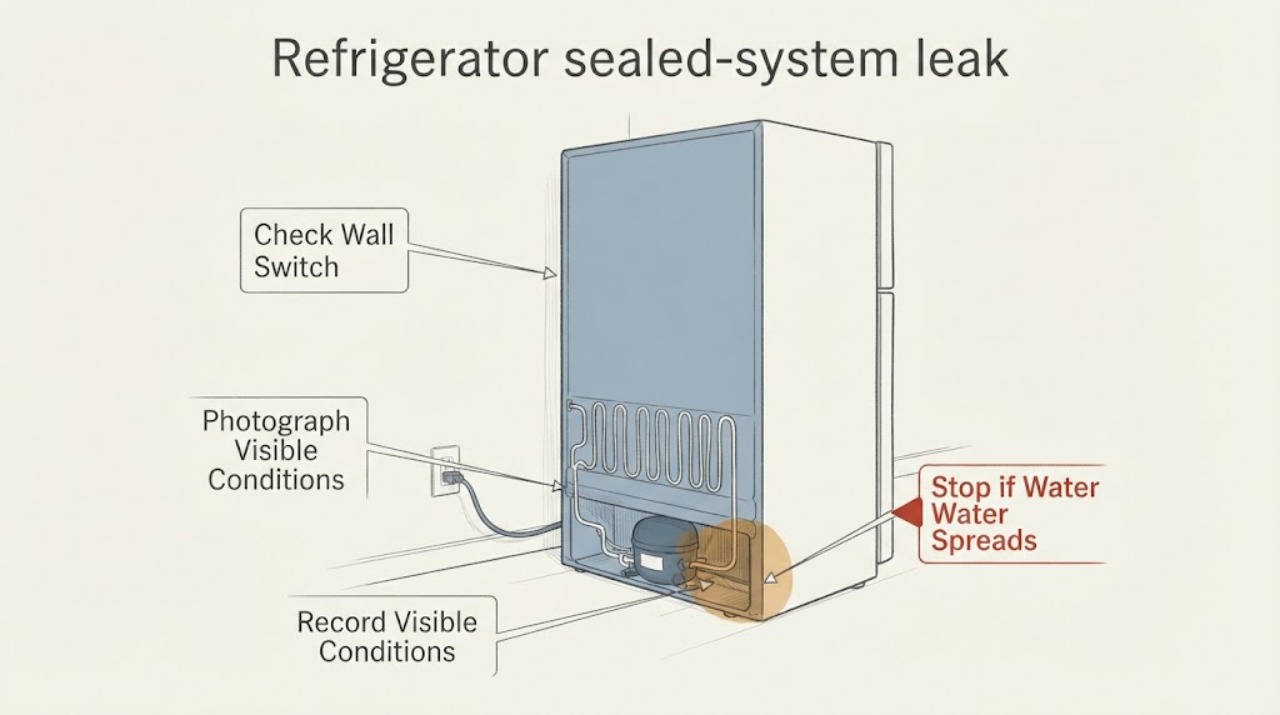
Work through in order
Diagnostic checks
Use only checks that match the exact appliance or system and its official guide.
-
Check 1
Without moving the refrigerator or removing a panel, photograph the rating tag and record the full model, serial information if available, market, and refrigerant designation. Record whether a technician actually confirmed a sealed-system leak or whether the report is based only on weak cooling, frost, or another symptom.
Expected result: The tag identifies R600a and a leak has been confirmed, R600a is listed but no leak has been confirmed, another refrigerant is listed, or the model and refrigerant are unknown.
Next step: For a confirmed R600a case, keep the circuit untouched and arrange qualified service. For an unconfirmed or different-identity case, use the exact KitchenAid manual and have the technician establish the cause before discussing tubing or refrigerant.
Stop if: Do not pull out a built-in unit, remove a machine-compartment cover, or puncture tubing to look for a leak.
Why this matters
Why: The safety and service path depends on the exact appliance and whether a circuit breach is established. A cooling symptom alone cannot prove a leak, and the R600a guidance cannot be applied to an unidentified model or another refrigerant.
-
Check 2
If a leak or tubing breach is suspected, keep the area free of flames, smoking, sparks, and heat-producing tools. Do not operate switches or electrical equipment near a suspected gas release; leave the area and seek qualified help if gas release, fire, or an unsafe concentration is suspected.
Expected result: There is no evidence of a release and the appliance is electrically intact, a technician has confirmed a leak, or there is smoke, flame, strong heat, visible tubing damage, or another immediate hazard.
Next step: For a confirmed or suspected release, keep people away, avoid ignition sources, leave the area when necessary, and arrange qualified refrigeration service. For an active fire, leave immediately and contact emergency services.
Stop if: Do not use a flame, spark-producing tool, household fan, improvised leak detector, or electrical test to locate or clear the release.
Why this matters
Why: R600a is flammable, so a confirmed or suspected release changes this from ordinary cooling troubleshooting to a fire-safety boundary. The technical service procedure is not a homeowner leak-repair procedure.
-
Check 3
From a safe position, record the refrigerator and freezer cooling condition, visible frost or water, compressor run behavior if it is audible, and whether food may have warmed. Keep doors closed as much as practical and do not remove interior or rear covers.
Expected result: Cooling is normal, cooling is weak or absent, frost or water is visible, the compressor behavior is abnormal, or food safety cannot be established.
Next step: Protect or move perishable food according to local food-safety guidance and arrange prompt qualified service when cooling is impaired, frost recurs, or food temperature is uncertain. Keep the appliance untouched if a circuit breach is suspected.
Stop if: Do not scrape ice, use a hair dryer or heater, add refrigerant, or continue operating a damaged appliance to reproduce the symptom.
Why this matters
Why: These observations help a technician determine urgency but do not identify a leak location, tubing size, refrigerant charge, or failed component. A water leak can also be unrelated to the sealed circuit.
-
Check 4
Prepare the service question about durability with the exact model and serial information, the refrigerant and charge listed on the rating tag, the confirmed leak location if a technician has already found it, and any repair estimate or tubing specification provided by the manufacturer or qualified provider.
Expected result: The provider can identify the exact tubing and system design, or the answer is being inferred only from the fact that the appliance uses R600a or is newer.
Next step: Ask qualified service to verify the leak source, tubing or joint condition, approved repair method, correct refrigerant, and post-repair leak test for the exact model. Do not authorize a substitute refrigerant or an unapproved tube based on a general comparison.
Stop if: Do not select tubing, charge, compressor, drier, or sealant from a generic parts list or from another KitchenAid model.
Why this matters
Why: The opened sources establish flammability and system-design differences between R600 and R600a, not a universal tubing diameter or durability ranking for newer KitchenAid models. Refrigerant choice alone is not evidence that a repair will last longer or that a tube is larger.
Use your observations
Decision map
Find the observation that best matches what you see, then follow the next safe action.
-
PATH 01Next step
What you see
The exact KitchenAid tag lists R600a and a qualified provider has confirmed a sealed-system leak or damaged refrigerant tubing.
Do this next
Keep flames, smoking, sparks, and heat-producing tools away, leave the area if release or fire is suspected, and arrange qualified KitchenAid or refrigeration service. Do not operate the circuit or attempt a repair.
Why this path and its safety boundary
Why it matters: This is a flammable-refrigerant service condition. It does not mean an explosion is inevitable, but it does mean a release and ignition source must be controlled by trained service procedures.
-
PATH 02Next step
What you see
R600a is listed but no leak has been confirmed; the refrigerator only has weak cooling, frost, long run time, or another symptom.
Do this next
Keep the unit accessible and untouched, protect food if temperatures are unsafe, and arrange qualified service to verify the fault before discussing a leak repair or replacement tubing.
Why this path and its safety boundary
Why it matters: A sealed-system leak is only one possible explanation. The symptom does not establish tubing failure, refrigerant loss, or an ignition hazard by itself, but it still warrants model-specific diagnosis if cooling is impaired.
-
PATH 03Next step
What you see
The model uses a refrigerant other than R600a, or the model and refrigerant cannot be confirmed from the rating tag.
Do this next
Use the exact KitchenAid manual and have qualified service identify the refrigerant, leak status, and approved repair method. Do not substitute R600, R600a, or another refrigerant.
Why this path and its safety boundary
Why it matters: The R600a-specific flammability and service procedure cannot be assumed. Refrigerants and system designs are not interchangeable, and a missing identity blocks a safe tubing comparison.
-
PATH 04Next step
What you see
The owner is asking whether newer units have larger or more durable tubing, but no exact model, tubing specification, or manufacturer comparison is available.
Do this next
Ask the qualified provider or KitchenAid documentation to compare the exact model's approved tubing and repair method. Do not make a purchase or repair decision from age or refrigerant name alone.
Why this path and its safety boundary
Why it matters: The opened sources do not support a universal durability claim. R600a changes the design and safety requirements, but the refrigerant name alone does not establish tubing diameter, wall strength, leak history, or repair life.
-
PATH 05Next step
What you see
A suspected leak is accompanied by smoke, flame, strong heat, damaged wiring or cord, water near electrical parts, or another immediate fire or shock hazard.
Do this next
Leave the area and use emergency help for an active fire. Otherwise isolate the appliance only if safe from a dry location and arrange qualified appliance, refrigeration, or electrical service. Do not return to reproduce the leak.
Why this path and its safety boundary
Why it matters: This is an emergency safety boundary in addition to the refrigerator fault; continued diagnosis can add ignition, shock, or water damage risk.
Helpful context
Understand the symptom
Does an R600a leak automatically explode?
No. R600a is refrigerant-grade isobutane and is flammable, so a release creates a fire or explosion hazard if enough gas accumulates and meets an ignition source. That is different from saying every leak explodes. The KitchenAid manual uses an explicit puncture warning, and the Whirlpool Corporation service manual requires ventilation, removal of ignition sources, and trained procedures when working on an R600a system. Treat a suspected circuit breach as a stop-work and service condition, not as a reason to test the system with a flame, improvised detector, or electrical tool.
Are newer refrigerators using larger or more durable tubing?
The sources opened for this topic do not establish a year-over-year tubing diameter or durability improvement for KitchenAid refrigerators. The Whirlpool Corporation technical manual emphasizes that R600 and R600a have different pressures, boiling points, and system-design requirements, and that the refrigerants are not interchangeable; it does not turn the refrigerant name into a tubing specification. Use the exact KitchenAid model, rating tag, service documentation, and technician findings to answer a tubing or repairability question.
Do not confuse a cooling problem with a confirmed leak
Loss of cooling, a long-running compressor, frost, or a water leak may prompt a sealed-system investigation, but none of those observations alone identifies a puncture or proves that R600a escaped. The safe consumer decision is to document the model and symptoms, keep the circuit and tubing untouched, and let qualified service verify the leak and the repair path.
When checks do not resolve it
Need a professional?
Arrange qualified KitchenAid or refrigeration service when a sealed-system leak has been confirmed, cooling is weak or absent and a leak is suspected, frost or food-temperature problems persist, the model or refrigerant cannot be identified, or a tubing durability or replacement question requires an exact specification. Use emergency help for an active fire and qualified electrical help for power damage.
Safety scope: Do not puncture tubing, open or access the sealed system, use open flame or spark-producing tools, add or substitute refrigerant, bypass electrical protection, perform live tests, or use a generic tube or part. R600a work requires qualified service conditions. Stop immediately for suspected gas release, smoke, flame, strong heat, damaged wiring or cord, water near electrical parts, or repeated protection trips.
Have this ready
- Provide the exact model and serial information, market, refrigerant designation and charge from the rating tag, whether the leak was confirmed and how, leak location if already documented by a technician, cooling and food observations, visible frost or water, and any smoke, heat, cord, wiring, or breaker observations.
Common questions
FAQ
Will an R600a leak make my KitchenAid refrigerator explode?
Not automatically. R600a is flammable, so a release can create a fire or explosion hazard if gas accumulates and reaches an ignition source. Treat a confirmed or suspected circuit breach as a stop-work condition, keep ignition sources away, leave the area if necessary, and arrange qualified service.
Are newer KitchenAid refrigerators made with larger or more durable tubing?
The sources opened here do not establish that generalization. Tubing diameter, material, joints, charge, and repairability are exact-model specifications. R600a changes system-design and safety requirements, but its name alone does not prove a stronger or larger tube.
Can I add R600a or repair the leak myself?
No. The KitchenAid manual warns against puncturing the tubing and directs the work to qualified personnel; the Whirlpool Corporation R600a service manual requires specialized safety controls and says R600 and R600a are not interchangeable. Have a qualified provider verify the model, leak, refrigerant, and approved repair method.
Read the exact guide
Official sources
- R600a Refrigerant Sealed System Technical ManualWhirlpool Corporation · Supports general corporate safety and system-design principles for R600a service, including flammability controls, technician certification, and non-interchangeability of R600 and R600a. It does not prove a particular KitchenAid model's tubing size or repair history.
- Bottom-Mount Built-In Refrigerator | KitchenAid Use and Care GuideKitchenAid · Directly supports the scoped model's R600a identification, flammability and puncture warning, model-tag route, and qualified-service boundary. It is not a universal specification for every KitchenAid refrigerator.
Community feedback
Share a repair observation
Share a plain-text repair observation. Accepted observations are published automatically; this page may take a moment to update.