
On this page
Start here
Quick answer
For the KitchenAid KBFN402EPA01, a door left slightly open can let warm air in and make the compressor and fans run more often until the compartments recover. First identify whether the sound is brief and linked to cooling, defrosting, ice, or water operation; then confirm the doors close, the gasket is intact, vents are clear, and the built-in cabinet is stable. Allow the refrigerator to stabilize before judging the noise. Persistent grinding, harsh vibration, abnormal frost, poor cooling, or a noise that does not change as cooling demand settles needs qualified service; a sound alone does not identify a fan or compressor part.
Before you begin
Safety first
- Do not remove the cabinet, interior or rear panels, built-in doors, or sealed-system components; do not probe live wiring, bridge controls, run an exposed fan, or use heat to clear hidden frost. Stop for smoke, burning or electrical odor, a hot or damaged cord or plug, repeated breaker operation, water near electrics, severe vibration, or unsafe temperatures.
Work through in order
Diagnostic checks
Use only checks that match the exact appliance or system and its official guide.
-
Check 1
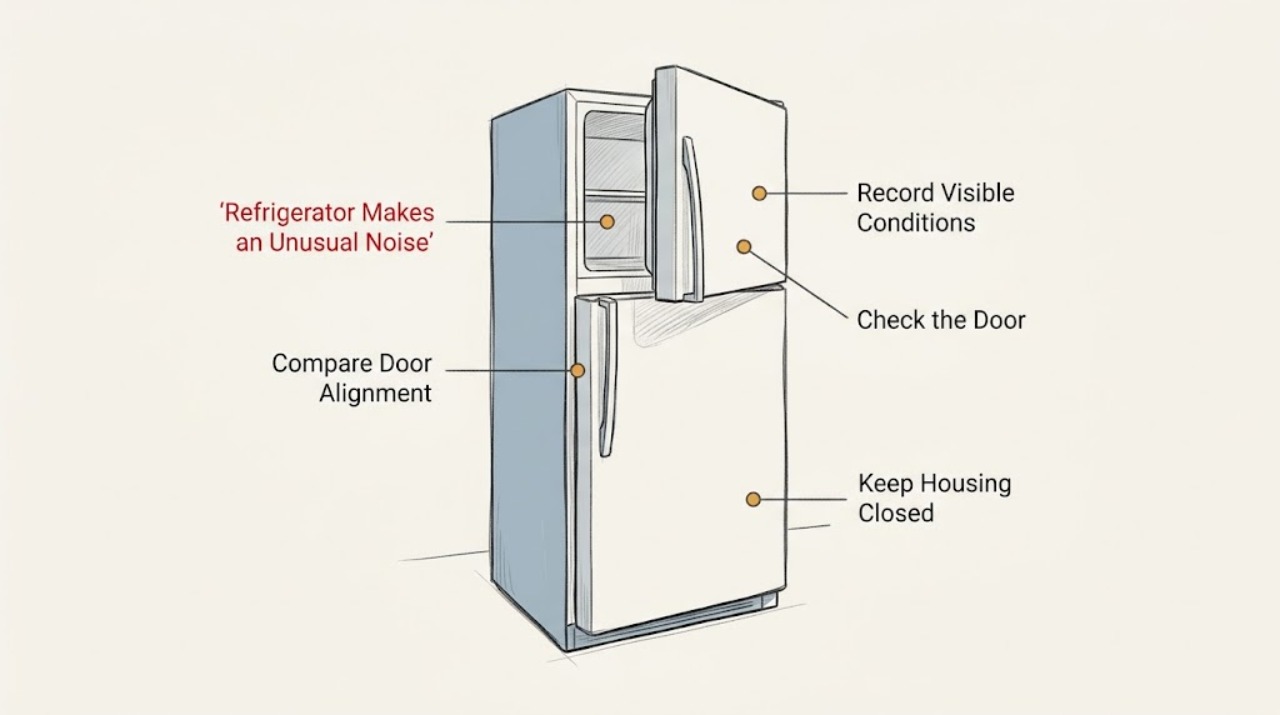
Record the exact sound and its timing without opening the cabinet: note whether it is a hum, airflow, gurgle, hiss, click, pop, buzz, rubbing, grinding, or harsh vibration; whether it starts after a door closes, during defrost, or during ice/water operation; and whether it comes from the upper cabinet, lower rear area, or inside a compartment.
Expected result: The sound is brief and tied to a cooling, defrost, ice, or water event, or it is continuous, harsh, rubbing, or independent of those events.
Next step: Continue with the recovery and closure checks for a brief cycle-linked sound. If the noise is severe, continuous, or accompanied by cooling loss, stop repeated testing and arrange qualified service.
Why this matters
Why: Brief cycle-linked sounds can match KitchenAid's listed normal fan, compressor, refrigerant, defrost, valve, or ice-operation sounds. Continuous grinding or harsh vibration is not explained by a normal sound label and needs a different path.
-
Check 2
Close every door and the freezer drawer fully, keep the temperature settings at their normal documented positions, limit door openings, and allow the refrigerator to recover before making a final noise comparison. Do not use food that has been held at an unsafe temperature.
Expected result: Cooling and the sound improve as the compartments recover, or the refrigerator continues to run loudly with no cooling improvement after the recovery period.
Next step: If it is improving, monitor without repeatedly cycling power. If it is not improving or temperatures are unsafe, protect food and arrange service; do not select a compressor or fan solely from the sound.
Why this matters
Why: A reduction as temperatures stabilize supports extra cooling demand from the open-door event. Continued loud operation without recovery points away from a simple temporary workload and toward an airflow, frost, installation, control, or refrigeration problem that needs assessment.
-
Check 3
Inspect only the visible door and drawer closure path: remove a package or bin that prevents closure, look for a dirty, torn, or visibly folded gasket, and confirm the doors meet the cabinet evenly. Clean an accessible gasket with the care method in the matching manual; do not adjust built-in hinges or remove the doors yourself.
Expected result: A package blocks closure, the gasket is not contacting the cabinet, or the doors close normally with no visible seal defect.
Next step: Correct only the visible obstruction or clean the accessible gasket, close the appliance, and repeat the recovery observation. If the seal is damaged, doors are misaligned, or the noise and cooling problem persist, arrange service.
Why this matters
Why: Warm air from a door or gasket that is not sealing can keep the refrigerator running longer and can cause condensation or frost, so a closure defect is a higher-value first correction than naming an internal part. A normal visible seal does not rule out an internal airflow or cooling fault.
-
Check 4
With the refrigerator closed and powered normally, inspect the visible air outlets and nearby storage for blocked vents, unusual frost, or ice that could contact airflow. Do not remove panels, scrape hidden ice, use a heat gun, or force a fan to run.
Expected result: There is abnormal frost or ice near an air path, a blocked visible vent, or no visible frost and the airflow path is clear.
Next step: Move only an obvious load blocking a vent and observe whether the sound and cooling improve after recovery. If frost returns, contacts a fan, or cooling remains weak, stop and arrange qualified refrigeration service rather than dismantling the cabinet.
Why this matters
Why: A frost or airflow restriction can make a fan sound change and can reduce cooling after warm humid air entered; it does not prove that the fan motor is the failed part. A clear visible path with persistent rubbing or cooling loss leaves an internal service diagnosis.
-
Check 5
Check the exterior installation without moving the built-in unit: confirm the cabinet is stable, no accessible trim or item is touching it, and no water line is rattling against the cabinet. If the model's instructions permit user-accessible condenser cleaning, disconnect power before that limited cleaning; do not remove covers or touch electrical parts.
Expected result: The cabinet rocks or an external contact, loose item, or water-line vibration is visible, or the installation is stable and the sound remains internal.
Next step: Correct only the obvious external contact described by the manual and recheck after the refrigerator is stable. If the sound remains harsh or the unit cannot be safely leveled in its built-in opening, arrange service.
Why this matters
Why: KitchenAid identifies leveling and external contact as ways vibration can transfer into the cabinet or floor. A stable installation with persistent internal noise makes an external resonance less likely, but still does not identify a particular internal component.
-
Check 6
If the sound occurs only while ice is filling or water is dispensing, note whether the water supply is connected and whether the line is visibly kinked. If the ice maker is not connected to water, use the model instructions to confirm it is off; do not disconnect a line or test a valve electrically.
Expected result: The noise occurs only during a fill or dispense event, or it continues when ice and water functions are idle.
Next step: Correct only a plainly visible kink or documented ice-maker setting, then monitor. If the valve noise is harsh, leaks appear, or the sound continues independently, arrange service and keep hands away from the water and electrical connections.
Why this matters
Why: A valve, water line, or ice-ejection sound can be normal during the related operation. A noise that continues independently is not explained by that operation and should be evaluated as a mechanical, airflow, installation, or cooling symptom.
Use your observations
Decision map
Find the observation that best matches what you see, then follow the next safe action.
-
PATH 01Next step
What you see
After all doors are closed, the refrigerator cools normally and the sound is brief, soft, and linked to a cooling, defrost, ice, or water cycle; it becomes less frequent as the compartments recover.
Do this next
Monitor the appliance with normal door use and record any change. Do not replace a part based on the sound alone.
Why this path and its safety boundary
Why it matters: This pattern is consistent with normal operating sounds made more noticeable by the extra cooling demand after the door was ajar, rather than evidence that a fan or compressor has been identified as failed.
-
PATH 02Next step
What you see
Frost or ice is visible near an air path, the noise changes with door position or airflow, or cooling remains weak after the door and gasket are corrected.
Do this next
Do not remove panels or melt hidden ice with heat. Protect food and arrange qualified KitchenAid or refrigeration service, providing the exact model, the door-ajar duration, frost location, temperatures, and a recording if safe.
Why this path and its safety boundary
Why it matters: Warm humid air and restricted airflow make a frost or evaporator-airflow path more plausible, but this result still does not distinguish an ice obstruction, fan contact, sensor/control issue, or another cooling fault.
-
PATH 03Next step
What you see
The cabinet is stable and clear, ice and water functions are idle, but grinding, rubbing, harsh vibration, or a persistent high-pitched noise continues together with poor cooling, abnormal frost, or ice/water loss.
Do this next
Stop troubleshooting and arrange qualified service. Do not run the appliance with covers removed or order a fan or compressor from an audio diagnosis.
Why this path and its safety boundary
Why it matters: A persistent symptom cluster is not explained by a temporary post-ajar workload or an external resonance. It requires inspection of the applicable fan, compressor/inverter, airflow, controls, or sealed refrigeration system without assuming which part has failed.
-
PATH 04Next step
What you see
The noise appears only during ice filling, water dispensing, or ice ejection and cooling is otherwise normal.
Do this next
Check only the documented water-supply and ice-maker conditions. If the noise continues while those functions are idle, return to the persistent-noise service branch.
Why this path and its safety boundary
Why it matters: The timing makes a valve, water line, or ice-making event more likely than a continuously running compressor or evaporator fan; the exact sound may still need model-specific service if it is harsh or accompanied by a leak.
-
PATH 05Next step
What you see
There is smoke, a burning or electrical odor, a hot or damaged plug or cord, water near electrical parts, repeated breaker operation, severe cabinet movement, or unsafe food temperatures.
Do this next
Stop using the appliance if it can be done safely, keep clear of exposed or wet electrical areas, protect food as appropriate, and contact qualified service or local emergency help for an immediate hazard. Do not open the cabinet.
Why this path and its safety boundary
Why it matters: These signs exceed a user sound check and can involve electrical, water, installation, or food-safety risk.
Helpful context
Understand the symptom
Why the open-door event changes the first check
The KBFN402EPA01 is in KitchenAid's KBFN402EPA built-in French-door refrigerator family. When a door is left ajar, warm humid air enters and the refrigerator may run more frequently while it pulls the compartments back toward their set temperatures. KitchenAid's support guidance says increased sounds after frequent door openings or warm loads can settle as cooling demand drops. That makes a short, cycle-linked hum or airflow sound after the door is closed a recovery observation, not proof that a fan or compressor has failed.
Do not identify a part from the recording alone
KitchenAid's noise guidance includes normal pulsating or whirring from fans and a compressor adjusting, gurgling or hissing from refrigerant and defrost water, clicking from valves or ice making, and popping during material contraction and expansion. The same manual also distinguishes vibration, repetitive grinding, and cooling symptoms that warrant further assessment. Compare the sound with its timing, location, cooling result, visible frost, and cabinet stability before asking for a component; a recording by itself cannot separate a fan, compressor, tubing, valve, or an external vibration source.
Model and safety boundary
Use the complete KBFN402EPA01 model when locating documentation or arranging service. Do not remove doors, interior panels, the rear cover, or sealed-system parts; do not probe live wiring or deliberately run a fan with a cover removed. Keep perishable food safe while the refrigerator is warm. Stop and arrange qualified service for a burning smell, hot or damaged cord, smoke, water near electrical parts, repeated breaker operation, severe vibration, or loss of cooling.
Only after diagnosis
Potential parts
- evaporator or condenser fan assembly
Consider a fan assembly only after the exact model documentation and a qualified diagnosis connect the persistent sound, frost, or airflow symptom to that fan; a post-ajar recording alone cannot identify it.
Confirm KBFN402EPA01, the complete part number, and the applicable market before ordering. Do not access or test the fan with covers removed. - compressor or inverter-related assembly
A compressor or inverter is only a conditional service hypothesis when persistent noise is accompanied by cooling failure and external checks are normal; the manual's normal low-speed sounds do not identify a failed compressor.
Sealed-system and inverter work is for qualified service. Verify the full model and service documentation; do not select this part from sound alone. - door gasket or closure hardware
A gasket or closure part is relevant only when the exact model has a visible sealing or alignment defect that remains after removing an obstruction and cleaning the accessible gasket.
Confirm the exact model suffix and gasket orientation before ordering. Do not remove built-in doors or hinges as a user noise test.
When checks do not resolve it
Need a professional?
Arrange qualified KitchenAid or refrigeration service when grinding, rubbing, harsh vibration, or persistent high-pitched noise remains after the door is closed and the recovery period; when frost returns or cooling is weak; when a gasket or built-in closure cannot be corrected visibly; or when the exact source cannot be safely identified.
Safety scope: Do not remove the cabinet, interior or rear panels, built-in doors, or sealed-system components; do not probe live wiring, bridge controls, run an exposed fan, or use heat to clear hidden frost. Stop for smoke, burning or electrical odor, a hot or damaged cord or plug, repeated breaker operation, water near electrics, severe vibration, or unsafe temperatures.
Have this ready
- Provide KBFN402EPA01, country and installation type, how long the door was ajar, the sound recording and location, when it occurs in the cycle, refrigerator and freezer temperature observations, visible frost or gasket findings, and whether cooling, ice, or water operation is affected.
Common questions
FAQ
Can leaving the KitchenAid refrigerator door slightly open make it sound louder?
Yes. Warm air entering after a door is left ajar can increase cooling demand, so fans and the compressor may run more often until the compartments recover. A brief cycle-linked sound that becomes less frequent with normal cooling is different from persistent grinding or harsh vibration.
Does the sound prove that the fan or compressor is bad?
No. KitchenAid lists several normal fan, compressor, refrigerant, defrost, valve, and ice-operation sounds. Use timing, cooling performance, visible frost, door sealing, and cabinet stability to choose the next safe branch; do not order a part from a recording alone.
What should I check before calling service?
Confirm the doors and drawer close, remove visible obstructions, inspect the accessible gasket, keep vents clear, note visible frost, check for external vibration, and record whether the sound occurs during cooling, defrosting, ice, or water operation. Do not remove panels or built-in doors.
How long should I wait after closing the door?
KitchenAid advises allowing the refrigerator time to stabilize after warm-air entry or frequent openings; its support guidance allows up to 24 hours after warm loads. Use the matching KBFN402EPA01 documentation for the exact recovery expectation, and do not wait if cooling is failing, food is unsafe, or a hazard is present.
Read the exact guide
Official sources
- KBFN402EPA | KitchenAid Owner's CenterKitchenAid · Directly establishes the product family for the task's KBFN402EPA01 suffix; the page displays the family model KBFN402EPA and product type, so the exact suffix should remain on service documentation.
- Refrigerator Noise - High-Pitched or PulsatingKitchenAid Product Help · Supports the distinction between brief regular speed-change or pressure sounds and persistent abnormal noise; it does not identify a failed part for this exact model.
- Refrigerator Noise - BuzzingKitchenAid Product Help · KitchenAid refrigerator-family noise guidance applicable to the post-door-ajar comparison and visible checks; not a component diagnosis for KBFN402EPA01.
- KitchenAid Built-In Refrigerator Owner's Manual W10859993KitchenAid · Opened KitchenAid built-in refrigerator manual used for the family-level noise table and safe user boundaries; verify the full KBFN402EPA01 documentation for any exact revision difference.
- Door Alarm Light - RefrigeratorKitchenAid Product Help · Supports checking closure, bins, shelves, and packages after the reported door-ajar event; it does not explain the internal sound by itself.
- Refrigerator Noise - GurglingKitchenAid Product Help · Supports normal gurgling and post-door-opening recovery context; it is not evidence that any particular KBFN402EPA01 fan or compressor is defective.
- Built In Refrigerator - Product HelpKitchenAid Product Help · Confirms that built-in refrigerator troubleshooting is organized by model documentation, door/leveling/closure, frost/condensation, temperature, ice, water, and service; it does not define a fan or compressor fault for the exact topic.
Community feedback
Share a repair observation
Share a plain-text repair observation. Accepted observations are published automatically; this page may take a moment to update.