
On this page
Start here
Quick answer
A brief thump or hammer when the KitchenAid KFIS20XVBL fills or dispenses can be normal water-line movement, but a new or persistent bang should be separated from a restriction. First note whether it happens only while the dispenser is flowing, whether the flow is steady, and whether it began after a filter change or the refrigerator was moved. From a dry position, inspect the visible supply tubing for a kink, sharp bend, or contact that can vibrate; do not move the refrigerator or loosen a pressurized connection. Use the exact KFIS20XVBL documentation to confirm the filter installation and flush trapped air after filter service if the manual calls for it. If the line and filter are correct but flow is weak, the valve chatters, the noise continues after dispensing, or any connection leaks, stop using the water dispenser and arrange qualified service.
Before you begin
Safety first
- Do not disconnect pressurized tubing, force a shutoff, pull the refrigerator, open rear or door covers, test live circuits, or keep using a leaking water system. Keep the dispenser and affected ice-maker fill off and keep wet areas away from electrical equipment.
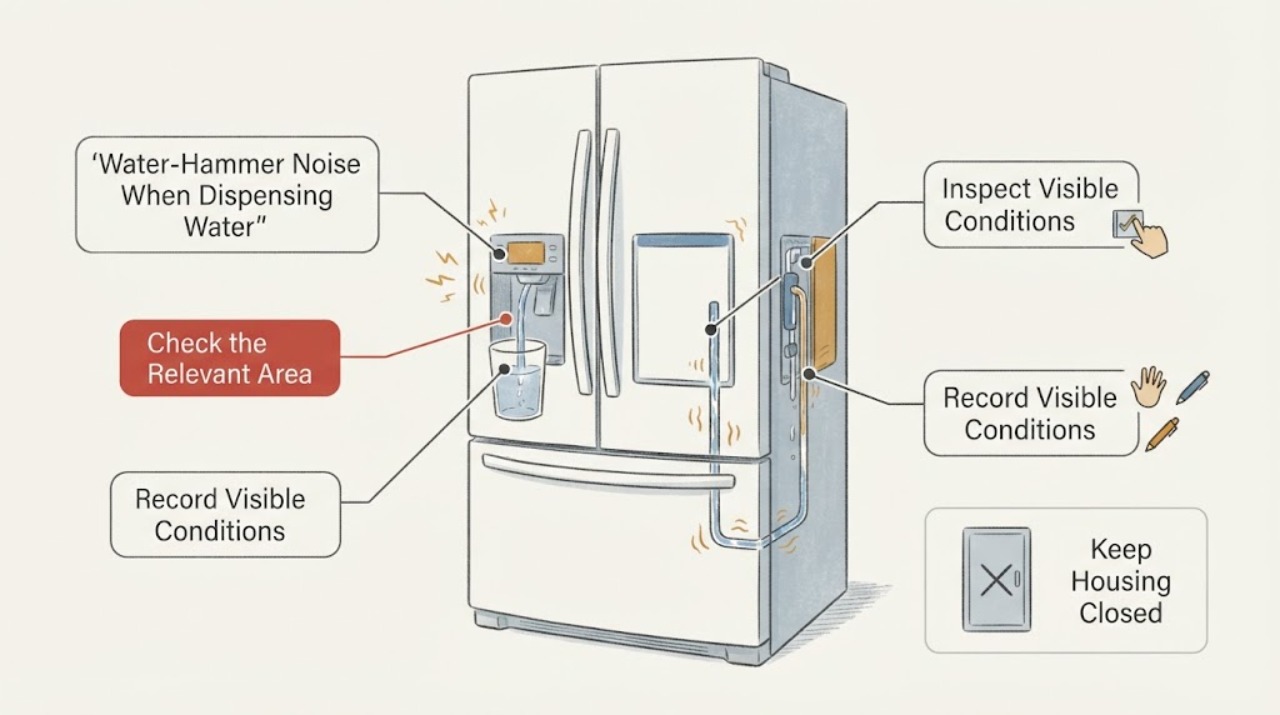
Work through in order
Diagnostic checks
Use only checks that match the exact appliance or system and its official guide.
-
Check 1
From a dry position, dispense water briefly into a sturdy container while watching the dispenser and listening from the front and rear-accessible side. Record whether the sound starts with the water flow, stops as soon as the lever is released, occurs after dispensing, or occurs during an ice-maker fill instead.
Expected result: The sound is a single brief thump only during flow, rapid chattering with weak or pulsing flow, a noise that continues after release, or a sound that comes from the rear connection or ice-maker fill.
Next step: Use the timing and flow pattern to choose the corresponding branch. Stop dispensing if water appears at the filter, door, rear connection, cabinet base, or electrical area.
Stop if: Do not repeat a noisy test when there is a leak, uncontrolled water, damaged tubing, burning odor, or wet electrical equipment.
Why this matters
Why: KitchenAid identifies a water-line hammer during a fill cycle as potentially normal, while chattering can result from pressure changes or flow restrictions that make the inlet valve open and close rapidly. Noise that continues after water stops or is accompanied by a leak is not established as normal operation.
-
Check 2
Confirm that the appliance label reads the full assigned model KFIS20XVBL, then use KitchenAid's model lookup or manuals page before applying any filter position, filter type, or water-system instruction. Keep the full suffix in the service record.
Expected result: The label matches KFIS20XVBL and a model-specific document is available, or the label is incomplete, different, or not found in the lookup.
Next step: Follow only the exact KFIS20XVBL document for filter or dispenser work. If the full label cannot be confirmed, limit the diagnosis to external timing and tubing observations and provide the label to a qualified technician.
Stop if: Do not substitute another refrigerator's filter, bypass arrangement, reset sequence, or component conclusion.
Why this matters
Why: KitchenAid directs owners to enter the model number to locate the applicable literature. Filter location, filter style, flushing instructions, and valve access vary across refrigerator families, so a similar model is not proof for this one.
-
Check 3
With the dispenser idle, inspect the visible household shutoff connection and exposed supply tubing without touching fittings. Look for a kink, sharp bend, crushed section, tubing touching the cabinet, a partially closed valve handle, or a joint that becomes wet when the system is used.
Expected result: The line is kinked or vibrating against a surface, the shutoff appears partly closed, the visible route is smooth, or a connection becomes wet.
Next step: Correct only a clearly visible line position if it can be done without moving the refrigerator or touching a fitting. If the valve is stiff, the line is behind the cabinet, or a joint leaks, stop the water dispenser and arrange service.
Stop if: Do not force a shutoff, disconnect pressurized tubing, overtighten a fitting, pull the refrigerator, or work near wet electrical parts.
Why this matters
Why: KitchenAid lists fluctuating pressure, a partially closed shutoff, kinked or sharply bent tubing, and vibrating tubing as contributors to dispensing chattering. A wet joint is a leak path, not a sound-only adjustment; a clear external route shifts attention to the filter, pressure, valve, or concealed tubing.
-
Check 4
If the noise began after a filter change or installation, inspect the accessible filter door and housing for a visibly cracked filter, displaced seal, or filter that is not seated as the exact model instructions show. Keep the water connection intact and do not force the cartridge.
Expected result: The filter was recently changed, the dispenser sputters or flow is reduced, the filter is visibly damaged or not seated, or the filter area remains dry and correctly installed.
Next step: Use the exact KFIS20XVBL instructions for any permitted filter correction. If the cartridge will not seat without force, the housing is cracked, or the area leaks, stop using the dispenser and arrange service.
Stop if: Do not force the filter, remove seals, use an unverified substitute, or open the filter housing while water is leaking.
Why this matters
Why: KitchenAid identifies trapped air after filter replacement, incorrect seating, damaged sealing surfaces, and a clogged or incompatible filter as causes of dispensing symptoms and valve vibration. A dry, correctly installed filter makes a supply-line or valve-pressure issue more likely, but does not prove a failed part.
-
Check 5
When the exact model document calls for flushing after filter service, use the dispenser and a sturdy container to perform only that documented flush. Observe whether the flow becomes steady as air clears, and stop immediately if the filter area, dispenser door, or floor becomes wet.
Expected result: The flow begins sputtering and then becomes steady, air continues to spurt, the noise disappears after the documented flush, or weak flow and noise remain.
Next step: If the sound and flow normalize, monitor the next few normal uses. If they do not, keep the dispenser off and provide the timing, flow result, filter history, and model to a qualified appliance technician.
Stop if: Do not continue flushing against a leak, use a non-model quantity or procedure, or keep dispensing to overcome a restriction.
Why this matters
Why: KitchenAid explains that flushing removes trapped air after filter replacement and that air can cause temporary dispensing symptoms. Improvement after the model-approved flush supports an air-in-line/filter-service condition; persistent weak flow or chattering needs the restriction and service branches rather than repeated dispensing.
-
Check 6
After one safe external correction or documented flush, make at most one brief normal dispensing observation from a dry position. Note whether flow is steady, weak, pulsing, or absent, and whether the sound stops when dispensing stops.
Expected result: The water flows steadily and the sound is brief, flow remains weak or pulsing with chattering, the valve or line is silent but no water flows, or the noise or leak persists after release.
Next step: Stop using the water system for weak, absent, or abnormal results. Arrange qualified service and report the exact model, sound timing, flow pattern, filter history, line observations, and any leak location.
Stop if: Do not measure live circuits, remove panels, disconnect tubing, bypass a valve, or repeat cycles when the noise or leak persists.
Why this matters
Why: Normal flow with a brief use-linked sound is consistent with KitchenAid's normal fill-cycle guidance. Weak or pulsing flow makes a restriction, pressure condition, kink, filter issue, or valve vibration more likely; no flow or persistent noise cannot be assigned to a specific part from an external check.
Use your observations
Decision map
Find the observation that best matches what you see, then follow the next safe action.
-
PATH 01Safety boundary
What you see
A brief thump occurs only while water is dispensing or a fill cycle is active, flow is steady, there is no leak, and the sound stops when flow stops.
Do this next
Monitor the sound during normal use. Recheck the visible line if the refrigerator was moved or the sound becomes louder, longer, or linked to weak flow.
Why this path and its safety boundary
Why it matters: KitchenAid says a water-line thump or hammer during a fill cycle can be part of normal operation.
Safety stop: Do not label a continuing noise, leak, or weak-flow event as normal solely because it resembles a brief thump.
-
PATH 02Safety boundary
What you see
The sound is rapid chattering with sputtering or weak flow, especially after a filter change, and the filter area is dry.
Do this next
Confirm the full KFIS20XVBL identity, follow its filter instructions, and perform its documented flush once if appropriate. Inspect only the visible line route and stop if the result remains abnormal.
Why this path and its safety boundary
Why it matters: Air after filter service, incorrect seating, a restricted filter, kinked line, pressure fluctuation, or valve vibration is more likely than an unexplained mechanical failure.
Safety stop: Do not force a cartridge, disconnect tubing, or keep dispensing against a leak or restriction.
-
PATH 03Safety boundary
What you see
The visible line is kinked, sharply bent, vibrating against the cabinet, or associated with a partly closed shutoff, and the sound changes with flow.
Do this next
Correct only an accessible line position without moving the refrigerator or touching fittings. If the valve is stiff or the route is concealed, stop the water system and arrange service.
Why this path and its safety boundary
Why it matters: A flow or pressure restriction and line vibration are the best-supported external leads.
Safety stop: Do not force a shutoff or disconnect a pressurized line.
-
PATH 04Safety boundary
What you see
The filter and visible line appear correct, but noise persists after dispensing stops, flow is absent or repeatedly weak, a connection leaks, or the sound source is behind a cover.
Do this next
Stop using the dispenser and ice-maker water fill if affected, keep the area dry, and arrange qualified KitchenAid or appliance service. Give the technician the exact model and all recorded observations.
Why this path and its safety boundary
Why it matters: A concealed valve, tubing, filter housing, pressure, or electrical issue remains possible and cannot be separated safely from external observation.
Safety stop: Do not open covers, test live wiring, pull the refrigerator, remove tubing, or order a valve or filter housing before diagnosis.
Helpful context
Understand the symptom
What the sound can mean
KitchenAid says a thumping or hammering sound from the water line during a fill cycle can be part of normal operation. Its dispensing-noise guidance also describes chattering as rapid valve opening and closing when pressure or flow is inconsistent. The sound alone does not identify a failed valve; its timing, flow pattern, and connection to filter or line changes matter.
Keep the water connection intact
The checks below are external and low risk. Do not disconnect tubing, force a shutoff, pull the refrigerator, open a rear cover, or test a valve with live electrical equipment. Water at a connection or cabinet base is a stop condition, not a reason to keep dispensing for comparison.
When checks do not resolve it
Need a professional?
Arrange qualified appliance service when a water-hammer or chattering noise persists after the exact model's safe filter and visible-line checks, flow is weak or absent, the noise continues after dispensing, the filter housing or supply connection leaks, or diagnosis requires moving the refrigerator, opening covers, disconnecting tubing, or testing a valve.
Safety scope: Do not disconnect pressurized tubing, force a shutoff, pull the refrigerator, open rear or door covers, test live circuits, or keep using a leaking water system. Keep the dispenser and affected ice-maker fill off and keep wet areas away from electrical equipment.
Common questions
FAQ
Is a brief hammer when dispensing water always a failed inlet valve?
No. KitchenAid says a water line may thump or hammer during a fill cycle as part of regular operation. A valve or other component should not be blamed unless the timing, flow, line, and filter checks support a service diagnosis.
Why did the noise start after I replaced the refrigerator filter?
KitchenAid identifies trapped air after filter replacement, incorrect seating, a restricted filter, and pressure or flow changes as possible contributors to dispensing noise. Use the exact KFIS20XVBL instructions to verify seating and perform its documented flush, without forcing or disconnecting the water connection.
When should I stop using the dispenser and call for service?
Stop when the noise continues after dispensing, flow is repeatedly weak or absent, a filter housing or line leaks, the visible route is concealed, or the valve or connection needs disassembly. Keep the water system off and arrange qualified service rather than testing live wiring or removing pressurized tubing.
Read the exact guide
Official sources
- Kitchen Appliance Manuals | KitchenAidKitchenAid · KitchenAid's manuals portal requires the appliance model number so the assigned KFIS20XVBL can be kept distinct from other refrigerator families.
- How to Flush the Water System in a RefrigeratorKitchenAid Product Help · KitchenAid's general flush guidance supports the air-in-line branch; the exact KFIS20XVBL document controls whether and how the procedure applies.
- Refrigerator Noise - Chattering Noise When DispensingKitchenAid Product Help · KitchenAid's dispensing-noise guidance applies to the assigned KitchenAid refrigerator symptom while reserving model-specific filter and valve instructions for KFIS20XVBL documentation.
- Product LookupKitchenAid Product Help · KitchenAid Product Lookup provides a model-number field and links to manuals and product help; it is an identity check, not proof of a specific valve or filter fit.
- Refrigerator Noise - Thumping or HammeringKitchenAid Product Help · KitchenAid's general full-size refrigerator noise guidance; the assigned KFIS20XVBL manual controls model-specific operation and service details.
- What to Do if the Water Filter is Damaged or DrippingKitchenAid Product Help · KitchenAid filter guidance supports visual filter and seal checks without establishing a KFIS20XVBL-specific replacement part.
Community feedback
Share a repair observation
Share a plain-text repair observation. Accepted observations are published automatically; this page may take a moment to update.