
On this page
Start here
Quick answer
Do not assume an LG dishwasher display reading as 1E is a confirmed code or that the earlier leaking solenoid caused it. LG's opened dishwasher guidance specifically asks the reader to distinguish IE from E1 and defines IE as a water-inlet error: the tub did not receive enough water in the expected period. Photograph the complete display and the rating-label model, then check for any current water, a wet base or connection, and water near electrical parts before doing anything else. If there is active or recent leakage, keep the dishwasher off, close its water supply, and isolate power only from a safe dry position. If the appliance is dry and safe, inspect only the accessible supply valve and hose for closure, kinks, crushing, or damage. Do not disconnect the inlet valve, repeat the test cycle, bypass leak protection, or conclude that the solenoid or control is defective from IE/1E alone.
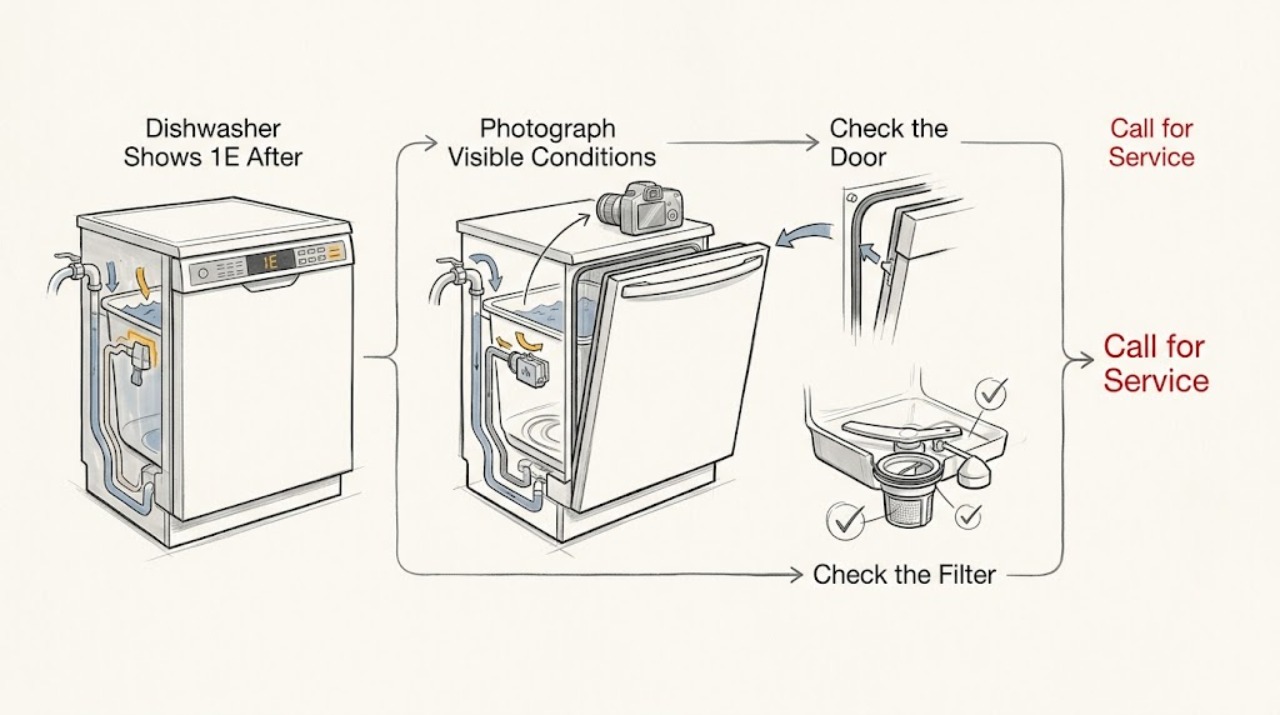
Work through in order
Diagnostic checks
Use only checks that match the exact appliance or system and its official guide.
-
Check 1
Photograph the entire display and rating label before clearing anything. Write the characters exactly as shown—IE, 1E, E1, or another message—and record whether it appeared during filling, washing, draining, or the service/test cycle.
Expected result: The photo clearly shows IE and the model is readable, the display only appears to show 1E/E1, or another code or flashing pattern is present.
Next step: For a clear IE, continue with the external water-supply and leak-safety checks. For 1E, E1, a partial display, or an unknown model, stop code-specific troubleshooting and provide the photo and model to LG support or a qualified technician.
Stop if: Do not repeat the test cycle merely to make the display recur.
Why this matters
Why: LG defines IE as a water-inlet/low-fill condition and explicitly distinguishes it from E1. A visually ambiguous 1E report cannot safely be assigned the IE path without the complete display and model.
-
Check 2
Before restoring or testing water, inspect from outside for current dripping, a wet floor, dampness around the visible inlet connection, water near the power connection, or signs that the earlier solenoid leak is still active. Keep the door and panels closed.
Expected result: There is active or recent water, moisture near electrics, a burning smell, smoke, or the area is dry and intact.
Next step: If wet or leaking, close the dishwasher water supply, stop using it, and isolate power only from a safe dry position before arranging service. If dry and intact, continue without opening the inlet system.
Stop if: Do not energize a wet appliance, bypass a leak sensor, pull out the built-in dishwasher, or perform a live test.
Why this matters
Why: A leak or wet electrical area overrides interpretation of IE/1E. A dry exterior does not prove that an internal valve or base is dry, but it allows only the limited external checks below when no other hazard exists.
-
Check 3
Only if there is no leak and the area is safe, check the accessible shutoff valve under the sink and the outside of the inlet hose for a closed valve, kink, crush, tear, or other visible restriction. Do not loosen the hose or touch the inlet valve or its filter.
Expected result: The valve is closed, the hose is visibly kinked or damaged, water is unavailable at nearby faucets, or the visible supply path is open and intact.
Next step: Open only an accessible closed shutoff valve normally, or correct a plainly visible hose position without moving the machine. For damage, low household supply, a leak, or a normal path with recurring IE, leave the appliance off and contact the installer or qualified service.
Stop if: Do not disconnect a pressurized hose, remove the inlet filter, or continue after the previous leak reappears.
Why this matters
Why: LG lists a shutoff supply, kinked or damaged hose, clogged inlet filter, and low water pressure as possible IE conditions. A normal visible supply moves the unresolved issue beyond a safe external check; it does not prove that the solenoid failed.
-
Check 4
Record what happened in the test cycle without starting another one: whether the tub received any water, whether it emptied repeatedly, whether the display appeared after 30 seconds to 10 minutes, and whether any water remained when the door was opened after the machine stopped.
Expected result: The machine did not fill adequately, water entered but later remained, the display recurs immediately, or the code and observed symptom do not agree.
Next step: Give LG or service the display photo, exact model, prior leak history, cycle stage, water observations, and visible supply findings. Do not force a drain, dismantle the pump, or keep testing to separate the possibilities.
Stop if: Stop immediately for standing water near electrics, a leak, smoke, burning odor, or a repeated breaker trip.
Why this matters
Why: LG associates IE with insufficient filling and OE with incomplete draining. A mismatch between the reported 1E/IE and the actual water path may indicate a misread display, a second symptom, or a model-specific condition—not a confirmed inlet-valve failure.
Use your observations
Decision map
Find the observation that best matches what you see, then follow the next safe action.
-
PATH 01Next step
What you see
The photo clearly shows IE, the appliance is dry, and the visible valve is closed or the inlet hose is kinked without any need to move the machine.
Do this next
Restore only the plainly visible valve or hose condition once. Do not repeat the test cycle if IE returns; arrange service with the exact model and photo.
Why this path and its safety boundary
Why it matters: The visible supply restriction is consistent with LG's IE water-inlet guidance and is a stronger first explanation than a proven failed solenoid.
-
PATH 02Next step
What you see
The display is actually IE, but the visible supply is normal and the code recurs after the earlier leak or service work.
Do this next
Leave the dishwasher off, close the water supply if appropriate, and request a model-specific diagnosis from LG, the installer, or qualified service. Tell them what leaked, when it was repaired, and whether the base or electrical area became wet.
Why this path and its safety boundary
Why it matters: LG's public guidance supports a filling-system problem but does not establish that the solenoid, inlet filter, wiring, or control is the failed part. The leak history raises the need for a service inspection rather than more user testing.
-
PATH 03Next step
What you see
The report remains 1E/E1, the model is missing, or the actual symptom is standing water or repeated emptying rather than inadequate filling.
Do this next
Stop code-specific DIY work and provide the complete display, model/serial label, cycle stage, and water-level history to qualified service. If water is present near electrics or the prior leak is active, keep the unit isolated.
Why this path and its safety boundary
Why it matters: The assigned code is not yet reliable enough for a component-level or platform-specific instruction. LG uses different labels for inlet and outlet conditions, so the mismatch may be a display-reading issue or a separate drain symptom.
-
PATH 04Next step
What you see
There is current leakage, wet electrical equipment, smoke, burning odor, exposed wiring, or a repeated breaker trip.
Do this next
Stop using the dishwasher, close the water supply, isolate power only from a safe dry position, and arrange qualified appliance or electrical service. Do not rerun the test cycle or bypass leak protection.
Why this path and its safety boundary
Why it matters: The safety event takes priority over whether the display is IE, 1E, or E1. Continued operation could worsen water or electrical damage.
Helpful context
Understand the symptom
The first decision is whether the display really says IE. LG's official page asks whether the message is ‘IE’ rather than ‘E1’ and describes IE as a low-fill or water-inlet condition. A report written as 1E therefore needs a photo and the complete model before it can be treated as a code. The test-cycle timing and the earlier solenoid leak do not establish a failed valve or a specific platform.
Treat the leak history as a reason to check safety before troubleshooting. LG's dishwasher material separates IE, which concerns insufficient filling, from OE, which concerns water not draining, and tells the reader to close the water valve before checking a drain hose. Because the model is not supplied and a leak has already occurred, keep the checks external and stop if water, a wet electrical area, smoke, or a repeated trip is present.
When checks do not resolve it
Need a professional?
Request service for recurring IE after the accessible supply check, any unresolved 1E/E1 display, any return of the solenoid leak, or any water/electrical hazard.
Have this ready
- Provide the exact display photo, rating-label model and serial, market, test-cycle stage, whether the tub filled or emptied, current water-level observations, visible hose/valve condition, and the prior leak and repair history.
Common questions
FAQ
Is LG dishwasher 1E the same as IE?
Do not assume that from a typed report. LG's official guidance asks the user to distinguish IE from E1 and defines IE as a water-inlet or low-fill condition. Photograph the display and confirm the model before applying the IE path.
Does the earlier leaking solenoid prove that it caused the new IE/1E display?
No. The leak is important service history and a reason to check for current moisture and keep the machine off if water is present, but it does not prove which component caused the current display. LG's public guidance supports external water-supply checks and professional escalation when the issue persists.
What can I check without opening the dishwasher?
Photograph the complete display, identify the model, look for current leakage, and—only when dry and safe—check the accessible shutoff valve and the outside of the inlet hose for a kink or damage. Do not disconnect the inlet valve, remove a pressurized filter, or move the built-in appliance.
Could water left in the tub be a different LG code path?
Yes. LG's dishwasher guidance describes IE as insufficient filling and OE as water not draining completely. If the actual observation is standing water or repeated emptying rather than low fill, report that symptom separately instead of treating IE/1E as proof of an inlet-valve failure.
Read the exact guide
Official sources
- Dishwasher Installation ManualLG Electronics · LG dishwasher installation safety, water/electrical isolation, and IE/OE final-check boundaries
- Dishwasher: No water – ‘IE’ error codeLG USA Support · LG U.S. dishwasher IE water-inlet guidance and clarification of a reported 1E/E1 display
- [LG Dios dishwasher] ‘OE’ appears on the displayLG USA Support · LG dishwasher OE water-outlet distinction, filter/hose observations, and water-valve safety boundary
Community feedback
Share a repair observation
Share a plain-text repair observation. Accepted observations are published automatically; this page may take a moment to update.