
On this page
Start here
Quick answer
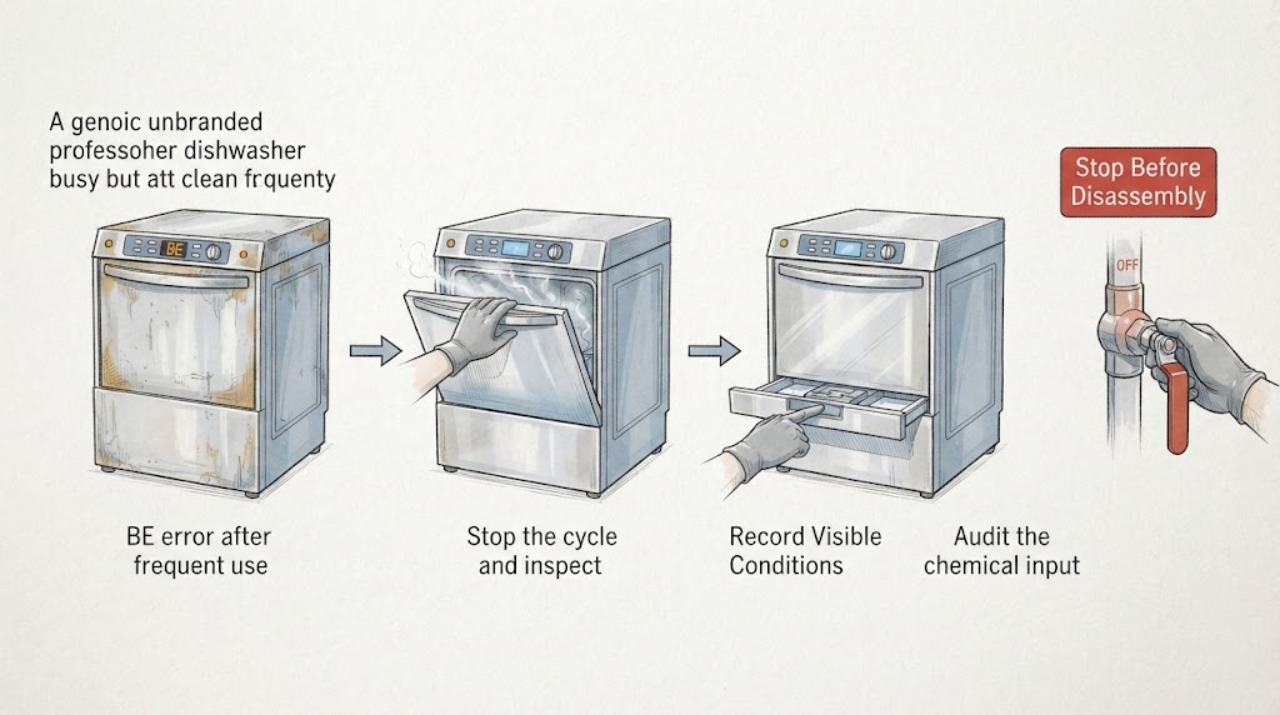
On an LG LDP6810SS, bE means a bubble error: LG says excessive suds can trigger it to help prevent leakage. Frequent use does not prove a failed pump or board; repeated cycles can simply expose detergent, rinse-aid, or pre-wash soap that leaves foam in the sump. Stop adding detergent, empty the dishwasher, set rinse aid to L0, and follow LG's model-appropriate suds-removal procedure only if the floor is dry and there is no uncontrolled leak. LG's current guidance uses a bowl containing 200–300 mL of milk on the upper rack and an empty Normal cycle with the listed options; if foam or bE returns after the documented cleanup, stop repeated cycles and request service. Do not buy a pump or control board from the code alone.
Work through in order
Diagnostic checks
Use only checks that match the exact appliance or system and its official guide.
-
Check 1
Stop the cycle and inspect from a safe position. Note whether there is visible foam, water or suds leaking onto the floor, a burning smell, smoke, a hot connection, or a breaker trip. Keep hands out of standing water and do not continue cycling a leaking machine.
Expected result: Foam is visible but contained, the tub has no obvious foam, or there is a leak, smoke, burning odor, hot connection, or repeated electrical trip.
Next step: For a leak, smoke, burning smell, hot connection, or repeated breaker trip, stop use, isolate power only from a safe dry location, and request qualified service. If the floor is dry, continue to identify the detergent and foam conditions.
Why this matters
Why: Visible foam supports LG's bubble-error path, while no visible foam after a prior detergent event can still leave residual suds. A leak or electrical symptom is a safety boundary rather than a detergent experiment.
-
Check 2
Write down the exact display as bE or BE, confirm the appliance is the LG LDP6810SS, and record when the code appears: early in the cycle, near the end, only after several daily cycles, or even when run empty. Use the LDP6810SS LG support page for the matching manual and support route.
Expected result: The exact model and bE display are confirmed, or the characters, model, or timing do not match.
Next step: If identity is confirmed, continue with the suds checks. If the code is different or the model cannot be confirmed, stop using this bE interpretation and retrieve the correct manual before taking action.
Why this matters
Why: LG's bE guidance is for dishwashers and the LDP6810SS has its own support/manual entry; a different display or model cannot safely inherit this code meaning or procedure.
-
Check 3
Audit the chemical input for the last several cycles: regular hand dish soap used for prewashing, an unmeasured liquid or oversized tablet, too much detergent, or rinse aid set above the model's documented setting. Do not add more detergent to test the machine; remove dishes and leave the dispenser empty for the cleanup check.
Expected result: Hand soap or excess detergent may have entered the machine, the rinse-aid setting is above L0, or only dishwasher detergent at a measured amount has been used.
Next step: Remove the source of extra suds, set rinse aid to L0 for the cleanup procedure, and follow LG's documented empty-machine routine. If the chemical history is normal and bE recurs, do not keep changing parts or detergent indefinitely; arrange service.
Why this matters
Why: LG specifically links regular kitchen detergent, liquid dishwashing soap, large detergent amounts, and residual suds to bE. A clean detergent history makes a persistent code more worthy of service, but still does not identify a failed part by itself.
-
Check 4
With the dishwasher empty and the detergent dispenser empty, follow LG's current bE cleanup instructions only if the floor and connections are dry: set rinse aid to L0, place 200–300 mL of milk in a bowl on the center of the upper rack, and run the specified empty Normal cycle with the listed options. Do not improvise a chemical mixture or dismantle the pump.
Expected result: Foam reduces and bE clears, foam remains and bE returns, or the machine leaks, stops abnormally, or shows another code.
Next step: If foam remains, repeat only as LG's page permits and stop if the floor becomes wet. If bE returns after the documented cleanup or another code appears, stop repeated cycles and request qualified service with the display, detergent history, and cleanup result.
Why this matters
Why: A clear result after LG's no-detergent cleanup is consistent with residual suds; LG notes that detergent and rinse-aid formulations vary and the steps may need repeating if foam remains. A returning bE after the documented cleanup is not proof of a pump or board failure, but it moves the issue to model-specific service diagnosis.
-
Check 5
After the machine is dry and the bE cleanup has been completed, use only the recommended dishwasher detergent at the measured amount and avoid prewashing with hand soap. Track the next few cycles, noting detergent type, rinse-aid setting, cycle, foam, leaks, and whether bE appears only after heavy daily use.
Expected result: bE stays cleared with corrected detergent practice, returns intermittently despite corrected inputs, or returns on an empty/no-detergent cycle.
Next step: Continue only with the corrected detergent routine if the dishwasher remains dry and normal. For recurrence, stop repeated operation and provide LG or a qualified technician the exact model, code timing, usage frequency, detergent/rinse-aid details, and whether the empty cleanup worked.
Why this matters
Why: A stable result after changing the chemical input supports a suds-related cause; an intermittent or no-detergent recurrence leaves a sensor, pump/motor, drain arrangement, or control diagnosis unresolved and cannot be assigned to a part from the code alone.
Use your observations
Decision map
Find the observation that best matches what you see, then follow the next safe action.
-
PATH 01Next step
What you see
bE appears with visible foam or after hand soap, excessive detergent, or an elevated rinse-aid setting, and the empty LG cleanup clears it.
Do this next
Keep the dispenser empty during the cleanup, then use only measured dishwasher detergent and the corrected rinse-aid setting. Monitor for recurrence without adding extra detergent.
Why this path and its safety boundary
Why it matters: The combined result is consistent with the documented bubble-error path; a component replacement is not justified by this result alone.
-
PATH 02Next step
What you see
bE returns after the documented no-detergent cleanup, appears on an empty/no-detergent cycle, or continues despite a corrected detergent routine.
Do this next
Stop repeated cycles and request qualified LG or appliance service. Supply the LDP6810SS model, code timing, daily-use frequency, detergent and rinse-aid history, foam observations, and cleanup result; do not order a pump or board solely from bE.
Why this path and its safety boundary
Why it matters: Residual suds are no longer a sufficient explanation by themselves. A persistent model-specific pump/motor, sensing, drain, or control diagnosis may need service, but the code still does not select a part.
-
PATH 03Next step
What you see
The dishwasher leaks, the floor is wet near electrical connections, a breaker trips, there is smoke or burning odor, or a different code appears.
Do this next
Stop using the dishwasher, isolate power only from a safe dry location, shut off water if safe, and obtain qualified appliance/electrical service. Do not run another cycle to test it.
Why this path and its safety boundary
Why it matters: This is a water/electrical or model-mismatch boundary, not a safe detergent troubleshooting branch.
-
PATH 04Next step
What you see
The code clears after detergent correction but reappears only after several daily cycles or after a particular detergent or prewash routine.
Do this next
Keep a short cycle log and maintain the corrected detergent practice. If bE returns with no plausible suds source, stop relying on resets and arrange model-specific service.
Why this path and its safety boundary
Why it matters: The timing makes repeated chemical input or residual foam more likely than a proven intermittent board failure, though recurrence still deserves documentation.
Helpful context
Understand the symptom
What bE means on this dishwasher
LG's dishwasher guidance defines bE as a bubble error. The protection is intended to prevent leakage when excessive foam is detected; it is not a model-independent statement that the wash pump, motor, or main board has failed. The LDP6810SS support page confirms the exact product identity and provides the model's manuals and support options, so do not substitute a code table from another appliance.
Why frequent use matters without proving a part failure
Running a dishwasher four or five times a day can make a marginal detergent or rinse-aid routine show up more often, especially if dishes were prewashed with regular hand soap or the detergent dose is too high. That usage pattern is a clue to audit the chemical input and residual foam first, not proof of a pump defect. An exact-model community report eventually considered motor/control behavior after a pump replacement, but the same report also describes the bE error returning, so the part change was not a reliable diagnosis.
When checks do not resolve it
Need a professional?
Request qualified service when bE returns after LG's documented empty-machine suds cleanup, appears with no detergent or after corrected detergent practice, or is accompanied by another code or abnormal operation. Stop immediately for leaking water, smoke, burning odor, a hot electrical connection, a repeated breaker trip, or water near electrical parts; isolate power only from a safe dry location and do not run another cycle. Do not open the pump or console, perform live electrical tests, or treat a community part replacement as a confirmed diagnosis.
Common questions
FAQ
Does bE prove the wash pump or control board is bad on an LG LDP6810SS?
No. LG defines bE as a bubble error caused by excessive suds. An exact-model community report says a pump replacement was followed by a temporary improvement and then recurrence, so parts should not be selected from bE alone.
Why can bE appear when the dishwasher is run empty?
LG says suds from an earlier detergent event may remain inside the dishwasher. Follow the official no-detergent cleanup instructions, including the model-appropriate rinse-aid setting, and request service if foam or bE persists.
Does using the dishwasher four or five times a day cause bE?
Frequent use can make a detergent, rinse-aid, or prewash-soap problem appear more often, but usage frequency alone does not establish the cause. Track the chemical inputs and the timing of bE, then escalate recurring errors after the documented cleanup.
Read the exact guide
Official sources
- LDP6810SS.ASSESNA | LG SupportLG USA · Exact LG LDP6810SS support page opened for model identity and documentation/support routing; it does not independently assign a bE component failure.
- Finally Fixed my LG Dishwasher "BE" Error - $50 USD and a relatively simple DIYReddit r/appliancerepair · Exact-model owner report and follow-up; useful for the frequent-use context and recurrence after a pump replacement, not an official LG diagnosis or part recommendation.
- LG Dishwasher - Troubleshooting bE Error CodeLG USA · Official LG dishwasher guidance opened for bE; it states the guide is for all models and warns that images or content may differ, so the exact LDP6810SS manual remains the final model-specific reference.
- If Your LG Dishwasher Stops with a bE Error CodeLG USA · Official LG dishwasher guidance opened for the assigned bE symptom; it notes the steps are based on standard models and settings may vary by model.
Community feedback
Share a repair observation
Share a plain-text repair observation. Accepted observations are published automatically; this page may take a moment to update.