
On this page
Start here
Quick answer
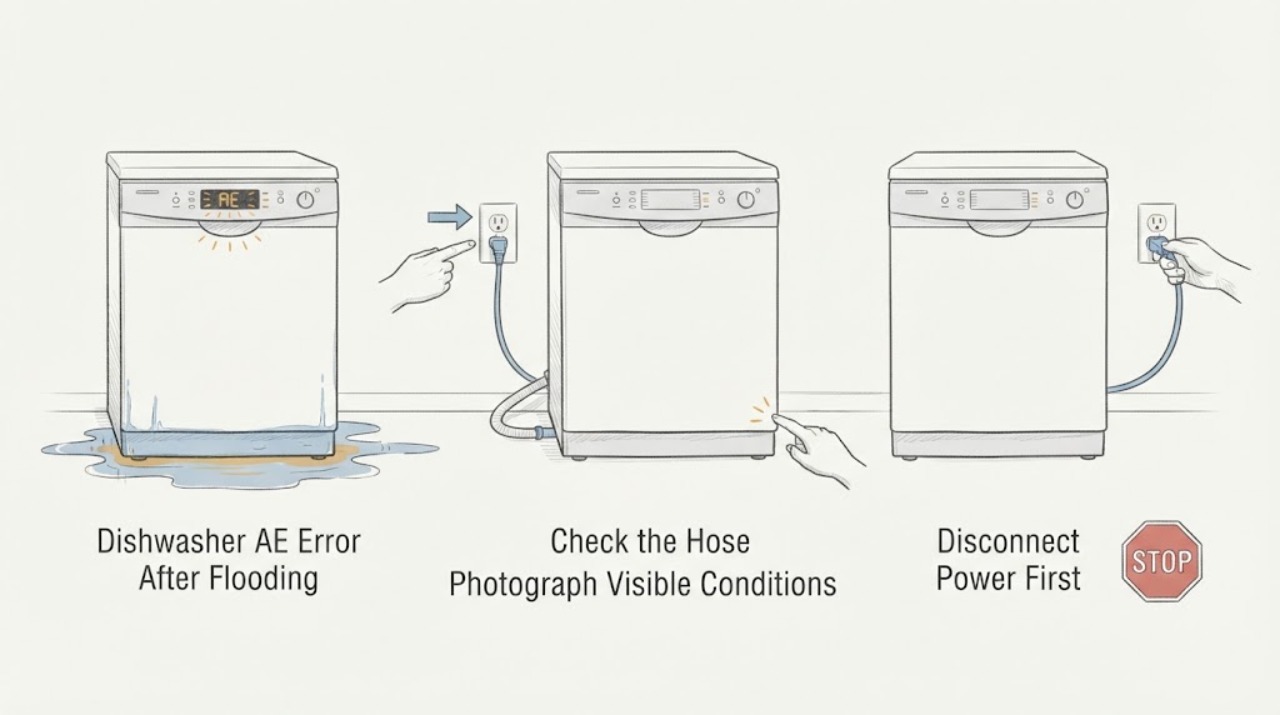
On the LG LDP6797BD, do not treat AE as an ordinary not-draining code or keep restarting the dishwasher. LG's LDP6797-family owner manual identifies AE as water leakage; OE is the drainage code, while FE is excessive water supplied. Turn off the dishwasher's water supply and isolate its power from a dry, safe location. If there is standing water, a wet electrical connection, smoke, a spark or a burning smell, stay clear and have the area made safe. Do not tilt or pull out the built-in unit, remove the lower cover or float, enter service mode, clear the code, or run another cycle. Record whether the water was on the floor or came from a sink or drain, the exact display and cycle stage, then request qualified LG dishwasher service.
Work through in order
Diagnostic checks
Use only checks that match the exact appliance or system and its official guide.
-
Check 1
Stop the dishwasher. From a dry, safe location, close the dishwasher water supply valve and switch off its power at an accessible dry disconnect or circuit control. If water is near the electrical connection, the floor is wet, or there is smoke, a spark, a burning smell or damaged wiring, do not touch the unit or wet connector; keep people away and have qualified electrical or appliance help make the area safe.
Expected result: The surrounding floor and electrical access are dry and intact, or there is standing water, a wet connection, smoke, a spark, an electrical odor or visible damage.
Next step: Leave the dishwasher isolated. For any water or electrical hazard, arrange qualified service and, if household wiring or plumbing is involved, the appropriate electrician or plumber.
Stop if: Do not reach behind the dishwasher, unplug it in a wet area, reset power, or restore the water supply to see whether the code clears.
Why this matters
Why: AE is a leakage/protection event, and the manual directs the owner to turn off the water supply and obtain service. A wet or damaged installation is a shock, fire or property-damage hazard rather than a drain-filter problem.
-
Check 2
Before anyone clears the display, photograph and transcribe the exact message and timing: AE versus OE, FE or another character, whether it was flashing or beeping, and whether it appeared during fill, wash, drain, drying or after the cycle ended. Record the full model from the rating label as LDP6797BD and the serial number without moving the built-in unit.
Expected result: The display is confirmed as AE, it is actually OE or FE, the code is unclear, or the message reappears after power is isolated.
Next step: Give the code photo, exact model/serial and cycle stage to LG service. If the message is not clearly AE, use only the exact manual for that confirmed code and do not borrow a generic button sequence.
Stop if: Do not enter service mode, clear stored faults, or reconnect the dishwasher just to obtain a cleaner code recording.
Why this matters
Why: LG's manual assigns different decisions to AE leakage, OE drainage and FE excess water. A code that is misread as not-draining can send the owner toward a filter or pump check while an internal leak remains active.
-
Check 3
With water and power isolated, inspect only what is visible without pulling the dishwasher: the floor in front of it, the lower door edge, adjacent cabinet, sink base, disposal or air-gap area, and the visible supply or drain connection if already exposed. Note the water's location, amount, color or detergent foam; do not remove panels, hoses, the float or the lower cover.
Expected result: Water is centered at the dishwasher door/base, appears under the sink or drain connection, is accompanied by detergent foam, or no source is visible and AE remains recorded.
Next step: Photograph the safe visible evidence and keep the appliance isolated. Ask service to inspect the installed leak path; ask a plumber to address a sink, disposal, air-gap or household drain source when that is where water is observed.
Stop if: Do not pull the built-in dishwasher forward, tilt it to drain the base, dismantle the door or float assembly, or run a test cycle.
Why this matters
Why: A door, hose, water valve, foam or external plumbing issue can produce water, but the location alone cannot prove a component failure. No visible floor water does not rule out an internal leak or a triggered protection system.
-
Check 4
Separate the flood event from the code history in writing: note whether the dishwasher had been operating normally before the event, whether water arrived during fill or drain, whether the sink or disposal was being used, whether excess suds or a leveling/door-alignment issue was present, and whether AE returned without another cycle. Do not try to reproduce any of these conditions.
Expected result: The flood followed filling, followed draining or sink use, occurred with visible suds, was present with the dishwasher off, or the trigger cannot be determined.
Next step: Provide the sequence and photographs to LG service and any plumber involved. Keep the water supply and power off until the leak source and installation are inspected.
Stop if: Do not substitute OE drainage instructions for AE, force the pump, add chemicals, or repeatedly cycle power and water.
Why this matters
Why: The sequence helps a technician distinguish an appliance leak, excessive-water/oversudsing condition, drain or external plumbing overflow, and a continuing inlet issue. It does not identify a valve, pump, seal, float or control board for replacement.
-
Check 5
Prepare the service handoff without opening the appliance: include the LDP6797BD model and serial, purchase and installation information, AE photo, water location, cycle stage, whether the breaker or GFCI operated, whether the sink or drain was in use, and whether anyone already reset or moved the unit. Keep the dishwasher out of service while waiting.
Expected result: The unit is still under the original installation or warranty arrangement, the installation identity is incomplete, or the event involved a breaker/GFCI trip or repeated AE.
Next step: Request qualified LG dishwasher service and give the electrician or plumber the same event record when their domain is implicated. Preserve the installation and avoid unauthorized repairs until the service decision is made.
Stop if: Do not authorize a pump, valve, float, seal or control replacement from AE alone, and do not continue operating while water or power safety is uncertain.
Why this matters
Why: The exact model, installation context and event history determine which service path owns the next inspection. A recurring AE or any electrical/water hazard needs professional diagnosis, not a consumer part decision.
Use your observations
Decision map
Find the observation that best matches what you see, then follow the next safe action.
-
PATH 01Next step
What you see
There is standing water near the dishwasher or its electrical connection, a wet connector, smoke, a spark, a burning smell, damaged wiring, or a breaker/GFCI trip.
Do this next
Stay clear, isolate water and power only from a safe dry location, and arrange qualified electrical/appliance help before any inspection or restart.
Why this path and its safety boundary
Why it matters: The flood/AE event has a shock, fire or property-damage risk and must not be treated as an ordinary drainage error.
-
PATH 02Next step
What you see
The display is confirmed as AE on the LDP6797BD, regardless of whether the floor is currently dry, and the unit has not yet been professionally inspected.
Do this next
Keep the water supply and power isolated, do not tilt or pull the built-in unit, and request qualified LG service with the code and visible evidence.
Why this path and its safety boundary
Why it matters: LG's matching owner manual treats AE as water leakage and describes intermittent draining or automatic return of power until the condition is resolved; a dry floor at one moment does not clear an internal leak.
-
PATH 03Next step
What you see
The message is actually OE, with no flooding or electrical hazard, rather than AE.
Do this next
Do not reuse this AE article as an OE repair procedure; consult the exact LDP6797BD manual and stop for standing water, leakage or a returning code.
Why this path and its safety boundary
Why it matters: OE is the LDP6797-family drainage branch, not the AE leakage branch. A visible, model-permitted filter or external drain-path check may be relevant only under the matching manual.
-
PATH 04Next step
What you see
Water is clearly coming from the sink, disposal, air gap or household drain area while the dishwasher's visible base and door area remain dry.
Do this next
Keep the dishwasher isolated until the external plumbing is corrected and LG or a qualified technician confirms that the dishwasher has no leak or residual water hazard.
Why this path and its safety boundary
Why it matters: An external plumbing overflow may explain the flood, but it does not prove that the dishwasher's AE protection signal is false or that the appliance can be restarted.
Helpful context
Understand the symptom
The exact LDP6797BD is a built-in LG top-control dishwasher. Its owner manual covers the LDP679# family and makes the key distinction for this report: AE is water leakage, while OE is the drainage problem code. A dishwasher may keep trying to drain when AE is active, but that protective behavior is not proof that the unit is safe to keep running or that the pump is the failed part.
Because the event included flooding, first separate an appliance leak from water supplied by the sink, disposal, air gap, drain connection or surrounding plumbing. Do only dry, visible observations. Do not slide the built-in dishwasher out, tilt it, remove its lower cover or float, or restore power to clear AE; those actions can spread water, damage the installation and destroy useful evidence for service.
When checks do not resolve it
Need a professional?
Request qualified LG dishwasher service for any AE display, recurring code, water inside or under the built-in unit, unexplained flooding, or a message that cannot be identified confidently. Use a qualified electrician when water reached electrical equipment or a breaker/GFCI tripped, and a plumber when the sink, disposal, air gap or household drain is the visible overflow source. Stop immediately for smoke, sparks, burning odor, damaged wiring or standing water near electricity. Do not tilt, pull out, open the lower cover, remove the float, enter service mode or keep restarting the dishwasher.
Common questions
FAQ
Is AE the same as an LG dishwasher not-draining code?
No. In the LDP6797-family owner manual, AE is water leakage and OE is the drainage problem. Treating AE as OE can lead to a filter or pump check while a leak-protection condition remains active.
Why does the dishwasher keep trying to drain after AE?
LG says the dishwasher can sound an alert and run the drain pump intermittently for AE, and that power may return automatically until the AE condition is resolved. That is protective behavior, not proof that the leak is repaired.
Can I tilt or pull out the built-in LDP6797BD to drain it?
Do not do that after a flooding event. Keep water and power isolated and request service; moving a built-in dishwasher can spread water, damage hoses or wiring, and remove evidence needed to identify the leak.
Read the exact guide
Official sources
- LG Dishwasher Owner's Manual (LDP679# family)LG Electronics · Opened official LG US owner manual whose model list explicitly includes LDP679#; the manual's troubleshooting table identifies AE as water leakage and OE as drainage trouble.
- LDP6797BD Product SpecificationLG Electronics Canada · Opened official LG Canada specification sheet for the exact LDP6797BD model; market-specific warranty terms are not generalized to other regions.
- Top Control Smart Dishwasher - LDP6797BDLG USA · Opened official LG USA product page for the exact LDP6797BD model.
Community feedback
Share a repair observation
Share a plain-text repair observation. Accepted observations are published automatically; this page may take a moment to update.