
On this page
Start here
Quick answer
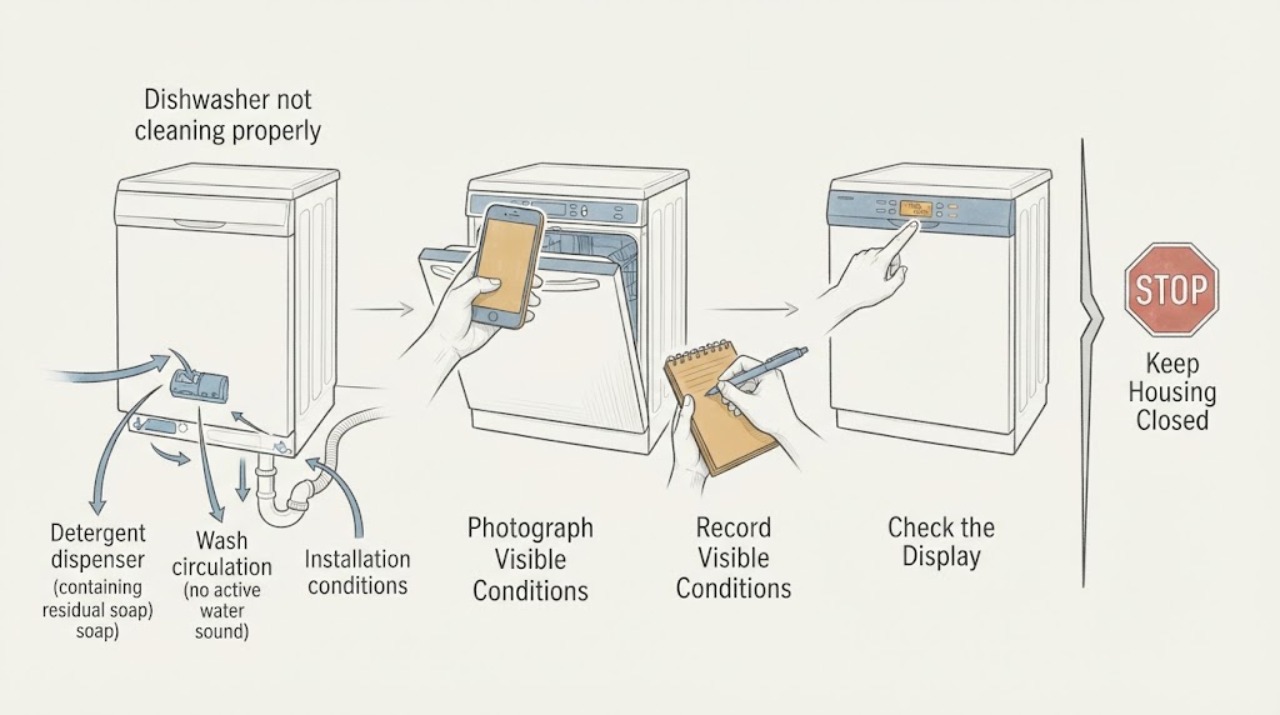
On an LG LDFN4542S, bE is an oversudsing or bubble-protection indication: LG says excessive suds can stop the dishwasher to help prevent leaks. On a new dishwasher that has never cleaned well, first document the exact display and check for regular hand dish soap, pre-wash soap residue, too much liquid detergent, or a detergent type that is producing foam; do not assume a pump or control part has failed. If suds are present, use LG's current bE procedure—remove dishes, empty the dispenser, set rinse aid to L0, place a bowl containing 200–300 mL of milk on the center of the upper rack, and run Normal with High Temp and Extra Rinse, while checking the LDFN4542S manual if the controls differ. After the foam is gone, separately check the filter, spray-arm movement, loading, detergent, and cycle. If bE returns with no foam, the machine leaks, the unit is visibly unstable or misaligned after installation, or cleaning has been poor from the first cycle, stop repeated testing and use the installer or LG warranty/service route for an exact-model diagnosis.
Before you begin
Safety first
- Do not open the dishwasher's electrical or pump compartments, probe live wiring, bypass the door latch, run through a leak, or choose a part from bE alone. Stop for smoke, burning odor, exposed wiring, water near electrical connections, or repeated breaker operation.
Work through in order
Diagnostic checks
Use only checks that match the exact appliance or system and its official guide.
-
Check 1
Stop the dishwasher before another cycle if there is active leaking, foam coming out of the door, a burning smell, smoke, repeated breaker operation, or water near electrical connections. From a dry position, note the exact display as bE, BE, 1E, IE, or another pattern, photograph it, and record whether it appeared during fill, wash, drain, or at the end of the cycle. Do not remove panels or run it with a leak.
Expected result: The display is clearly bE with visible suds or a leak, bE appears without visible foam, the display is a different code, or a safety hazard is present.
Next step: Keep the unit off for a hazard, follow only the exact-code branch for confirmed bE, and provide the photo and LDFN4542S model to the installer or qualified service if the identity is uncertain.
Stop if: Do not reset repeatedly, operate through a leak, bypass the door latch, or open the dishwasher's electrical or pump compartments.
Why this matters
Why: LG's bE procedure is relevant only when the display and dishwasher identity match. A different code, an uncertain segment, or a safety symptom must not be mapped to bE; visible leaking or electrical danger outranks cleaning troubleshooting.
-
Check 2
With the dishwasher off, inspect the dispenser and ask what was used before the bE display: hand dish soap used for pre-washing, soap left on dishes, more liquid detergent than the label calls for, or an unfamiliar eco or low-foam product. Empty any visible detergent from the dispenser and record the product and approximate amount; do not add another detergent to counteract the foam.
Expected result: Hand soap or residue is confirmed, liquid detergent was over-measured, a detergent type is producing foam, or the detergent history is normal and no residue is visible.
Next step: For confirmed soap or over-dosing, proceed to the single de-foaming procedure below and change to a recommended dishwasher detergent afterward. If history is normal or bE recurs, do not select a part from the code; use the service branch.
Stop if: Do not pour hand dish soap, chemicals, bleach, or extra detergent into the tub, and do not dismantle the dispenser or pump.
Why this matters
Why: LG identifies regular dish soap and excessive or unsuitable detergent as common bE triggers. Normal detergent history lowers the likelihood of a simple dosing mistake but does not prove a component fault, especially when the machine is new.
-
Check 3
If bE is confirmed and the unit is not leaking, use LG's current standard-model de-foaming sequence once: remove the dishes, make sure the dispenser is empty, set the rinse-aid level to L0, place a bowl containing 200–300 mL of milk in the center of the upper rack, and run Normal with High Temp and Extra Rinse. Confirm the LDFN4542S manual if its control layout or available options differ.
Expected result: The cycle completes and foam/bE clears, foam remains or bE returns, or the requested options are not available on this exact model.
Next step: If it clears, change detergent practice and do one controlled cleaning check. If it persists or the model controls differ, stop repeated cycles and request LG/installer service with the photo and procedure attempted.
Stop if: Do not keep running empty cycles, add more milk or chemicals, or enter a service mode to force the code away.
Why this matters
Why: A clear result supports residual or excessive suds as the immediate bE condition, not a proven failed part. Persistent bE after the documented user procedure, or an unavailable setting, leaves the exact-model cause unresolved.
-
Check 4
After bE and visible foam are gone, evaluate cleaning separately: remove and rinse the filter under running water, reinstall it without force, and with the racks empty of sharp items check that the spray arms are seated and turn freely and that their nozzle openings are not blocked. Do not reach into hot water or dismantle the pump.
Expected result: The filter is dirty or not seated, a spray arm is blocked or cannot rotate, or both are clean, seated, and free-moving.
Next step: Correct only a plainly visible filter or spray-arm condition, then retry one properly loaded cycle. If cleaning remains poor, document the result and escalate rather than ordering a wash-system part.
Stop if: Do not force the filter, run with the filter or spray arm removed, probe wiring, or remove internal panels.
Why this matters
Why: LG links dirty filters and blocked spray paths to poor cleaning, and says improper filter installation can lower performance. If these checks are normal, bE has not been shown to explain the continuing cleaning failure; water supply, cycle, heating, control, or installation diagnosis remains for service.
-
Check 5
For the controlled cleaning check, scrape large scraps, soak or pre-rinse baked-on food, keep plates upright and bowls facing down, avoid overlap, and place tall pans so they do not block the spray arms or detergent dispenser. Use a recommended dishwasher detergent and a cycle suited to the soil; record the load pattern, detergent type, selected options, and which dishes remain dirty.
Expected result: Only overloaded or blocked items remain dirty, the whole load is still poor, the dispenser cannot open, or the result improves after a correctly loaded cycle.
Next step: Keep the successful loading and detergent record. If a full, correctly loaded load is still dirty or the dispenser/spray path is not operating normally, stop repeated trials and ask service to diagnose the exact LDFN4542S.
Stop if: Do not increase detergent indefinitely, use hand dish soap, or keep cycling a machine that leaks, overheats, or displays bE again.
Why this matters
Why: LG's loading and cleaning guidance treats blocked spray paths, overlapping items, difficult soil, and detergent/cycle choice as separate wash-performance variables. Improvement after a controlled load lowers the likelihood of a hardware fault; whole-load failure on a new unit warrants installation/service review.
-
Check 6
Because the dishwasher has never performed properly, make a non-invasive installation record: photograph the rating label, note the installation date and installer, and observe only whether the closed door sits evenly, the unit visibly rocks, there is water at the base, or the accessible hoses are sharply pinched. Do not pull the built-in unit, loosen mounting hardware, or level it by guesswork.
Expected result: The unit rocks or the door is visibly misaligned, an accessible hose is pinched or a leak is present, installation looks normal, or the installation cannot be verified.
Next step: Ask the installer to correct and document any visible installation defect and verify one normal cycle. If the problem was present from first use, retain the installation evidence and request exact-model LG warranty/service assessment rather than opening the unit.
Stop if: Stop for any leak or electrical hazard. Do not continue testing a machine that rocks, has an uneven door seal, or repeatedly shows bE.
Why this matters
Why: A visible installation problem or an unverified first installation keeps the commissioning path open; it does not identify the cause of bE. A normal exterior does not rule out a supply, heating, circulation, sensor, or control problem.
Use your observations
Decision map
Find the observation that best matches what you see, then follow the next safe action.
-
PATH 01Next step
What you see
The LDFN4542S display is confirmed as bE and there are suds, hand-soap residue, or a recent detergent over-dose, with no active leak or electrical hazard.
Do this next
Perform the single LG de-foaming procedure, then change detergent practice and run one controlled load. Stop and request service if bE returns.
Why this path and its safety boundary
Why it matters: The observed pattern matches LG's bubble-protection explanation and makes an immediate oversudsing condition more likely than a specific replacement part.
-
PATH 02Next step
What you see
bE returns after the documented de-foaming sequence, or appears when the dispenser is empty and no foam is visible.
Do this next
Stop repeated cycles and request LG or qualified service with the exact model, display photo, detergent history, and steps already attempted. Ask for a model-specific diagnosis before approving a part.
Why this path and its safety boundary
Why it matters: Residual foam or a non-detergent condition is possible, but the opened LG guidance does not justify naming a pump, sensor, or control part for the exact LDFN4542S from bE alone.
-
PATH 03Next step
What you see
bE clears, but a properly loaded cycle still leaves most dishes dirty while the filter and spray arms are clean, seated, and unobstructed.
Do this next
Document the full-load result and have service assess the exact LDFN4542S installation and wash system under warranty or the applicable service route. Do not keep increasing detergent or blind-swap components.
Why this path and its safety boundary
Why it matters: The bE condition may have been corrected without explaining the cleaning failure. LG's cleaning guidance leaves detergent/cycle, water reach, and internal wash-performance paths to be evaluated; a part cannot be selected from the symptom alone.
-
PATH 04Safety boundary
What you see
The unit has never cleaned properly and also rocks, has an uneven door fit, a pinched accessible hose, a leak, or an installation date and commissioning record that cannot be verified.
Do this next
Keep the dishwasher off for a leak or electrical hazard; otherwise contact the installer and LG support for the exact LDFN4542S, provide the first-use history and display photo, and request a documented verification of operation.
Why this path and its safety boundary
Why it matters: This is an installer/warranty escalation pattern, not proof that bE identifies a failed component. Installation should be corrected and documented before a repair-versus-replace decision.
Safety stop: Do not pull out the built-in appliance, remove panels, or waive the warranty path in order to test a guessed part.
-
PATH 05Safety boundary
What you see
There is active water leakage, smoke, burning odor, repeated breaker operation, exposed wiring, or water near electrical connections.
Do this next
Stop using the dishwasher, keep clear of the hazard, and arrange qualified appliance/electrical service; disconnect power only if it can be done safely without contacting water or damaged equipment.
Why this path and its safety boundary
Why it matters: The immediate risk is safety, and LG's bE anti-leak context does not make continued operation safe.
Safety stop: No restart, door-latch bypass, panel removal, live test, or repeated breaker reset.
Helpful context
Understand the symptom
What bE changes on this exact new dishwasher
The assigned appliance is the LG LDFN4542S front-control dishwasher, not an unspecified LG appliance. LG's current dishwasher help page describes lowercase bE as a bubble or excessive-suds condition that can stop the unit to help prevent leaks. That is a different first decision from a generic dishwasher error answer: look for foam and detergent history before treating poor cleaning as evidence of a failed wash motor, pump, or control. LG also warns that the settings shown in a standard-model article can vary, so the LDFN4542S manual on its exact support page controls any model-specific button sequence.
Why a new unit needs an installation and warranty branch
If the dishwasher has never cleaned properly, record that from the first cycle. A visibly rocking unit, uneven door fit, or installation that was never verified is a reason to involve the installer; it is not proof that bE identifies a part. Keep the model and serial label, display photo, detergent details, installation date, and results of the safe checks. The LG U.S. LDFN4542S support page lists model manuals and a limited warranty with one-year labor and parts coverage for covered U.S. purchase and use, so do not forfeit that path by opening panels or repeatedly swapping components.
When checks do not resolve it
Need a professional?
Request installer or LG-qualified service when bE recurs after the documented procedure, when no-foam bE cannot be explained, or when the LDFN4542S has never cleaned properly from first use. For a U.S. purchase, use the exact model's LG support and warranty route shown on its support page; preserve the installation and first-use record.
Safety scope: Do not open the dishwasher's electrical or pump compartments, probe live wiring, bypass the door latch, run through a leak, or choose a part from bE alone. Stop for smoke, burning odor, exposed wiring, water near electrical connections, or repeated breaker operation.
Have this ready
- Provide LDFN4542S and the full rating-label identity, display photo, installation date and installer, detergent brand/type and amount, whether hand soap was used for pre-washing, visible foam or leakage, filter and spray-arm observations, load/cycle details, and the result of the one LG de-foaming procedure.
Common questions
FAQ
Does bE mean the wash motor or pump is bad on an LG LDFN4542S?
No. LG's bE guidance describes excessive suds and a bubble-protection stop; it does not identify a failed pump, motor, sensor, or control. Clear the documented detergent/foam branch once, then request an exact-model diagnosis if bE returns or cleaning remains poor.
Can hand dish soap used before loading cause bE?
Yes, LG says regular dish soap or soap left on pre-washed dishes can trigger bE. Empty the dispenser and follow the current LG de-foaming procedure; use a recommended dishwasher detergent afterward and measure it carefully.
What if bE goes away but the new dishwasher still does not clean?
Treat those as two linked but separate observations. Check the filter, spray-arm rotation and nozzle openings, loading, difficult soil, detergent, and cycle once. If a properly loaded full load is still dirty, keep the first-use record and use the installer or LG warranty/service path instead of choosing a part from bE.
Should I level or pull out the LG dishwasher myself?
Do not pull out a built-in unit or loosen mounting hardware just to investigate bE. Photograph any rocking, uneven door fit, pinched accessible hose, or leak and ask the installer to verify the installation. A visible installation issue is an escalation clue, not proof of a failed part.
Read the exact guide
Official sources
- LG Dishwasher - How To Clean The FilterLG USA · LG dishwasher filter-care article opened for a safe, external post-bE cleaning check; exact LDFN4542S filter access remains subject to its model manual.
- LG Dishwasher – How to Properly Load the DishwasherLG USA · LG dishwasher loading article opened for the controlled cleaning comparison; it does not define bE or prove an LDFN4542S hardware fault.
- Why Your LG Dishwasher Isn't Cleaning Dishes Well and How to Fix ItLG USA · LG dishwasher cleaning-performance guidance opened for the separate post-bE cleaning branch; it is not used to assign a hardware part to LDFN4542S.
- LG Dishwasher - Spray Arm MaintenanceLG USA · LG dishwasher spray-arm maintenance opened for a safe user-level check after foam is cleared; it is not evidence that a spray-arm part fits LDFN4542S.
- 24" QuadWash™ Front Control Dishwasher - LDFN4542SLG USA · Exact-model product page opened to confirm LDFN4542S is an LG dishwasher; product features are not used as a bE code definition.
- If Your LG Dishwasher Stops with a bE Error CodeLG USA · Directly applicable to the assigned LG dishwasher's displayed bE symptom at the LG dishwasher-family level; LG notes that standard-model settings can vary, so the exact LDFN4542S manual controls UI differences.
- LG LDFN4542S: Support, Manuals, Warranty & MoreLG USA · Exact-model LG U.S. support page opened for LDFN4542S; it supplies model-specific manuals and warranty scope but does not define bE by itself.
Community feedback
Share a repair observation
Share a plain-text repair observation. Accepted observations are published automatically; this page may take a moment to update.