
On this page
Start here
Quick answer
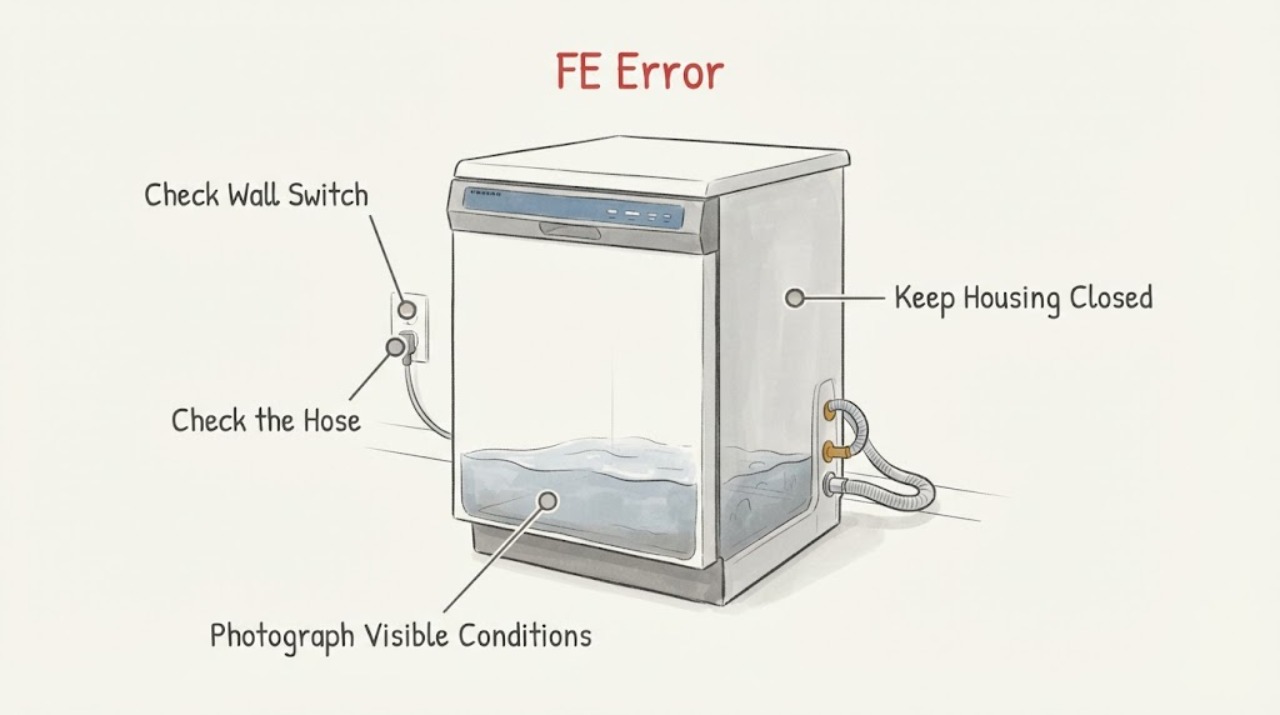
For the LG D1452WF, the opened owner manual lists FE as excessive water supplied above the normal level and says the drain pump operates automatically; it also lists an inlet-valve problem as a possible cause. FE is not the same as the manual's OE drain code. When FE appears with overfilling, continuous filling, or water on the floor, stop the cycle, close the water tap from a safe position, disconnect power safely, and arrange service. If the tub is safe and the separate symptom is slow draining, wait until it is cool, then inspect only the accessible filter and visible drain hose for a blockage or kink. A fault that disappears for days and returns weekly still needs the model and timing recorded; self-recovery does not prove the valve or level-sensing path is sound.
Before you begin
Safety first
- Do not open the base or control housing, remove the inlet valve or pump, disconnect a pressurized hose, probe live wiring, or order a water valve, level sensor, pump, or control board from FE alone.
Work through in order
Diagnostic checks
Use only checks that match the exact appliance or system and its official guide.
-
Check 1
Photograph the display and record the complete model as D1452WF, when FE appears (during fill, wash, drain, or at the end), whether the tub is above its normal water level, and whether the drain pump runs automatically. Note whether the display is FE rather than OE, EI, or another code.
Expected result: FE appears during or after filling with excess water and automatic draining, or the code/timing is unclear or is actually OE/EI.
Next step: Use the FE branch only when the display and timing match. If the code is not clearly FE, stop guessing and use the exact manual entry for the displayed code.
Stop if: Do not reset repeatedly or start another cycle while water is above the normal level, the code is unclear, or the pump is running continuously.
Why this matters
Why: The exact D1452WF manual ties FE to excessive water above the normal level and separates it from OE's water-not-pumped-away path and EI's leak path. A misread code would send the diagnosis to the wrong branch.
-
Check 2
If FE is accompanied by ongoing filling, water on the floor, a wet hose connection, or an overfilled tub, stop the dishwasher. From a dry, safe position close the dishwasher water tap and disconnect power using the accessible plug or switch; do not pull out a built-in unit or reach into the water.
Expected result: The water supply stops and no further water enters, or water continues, the tap is inaccessible, or a leak remains visible.
Next step: Keep the tap closed and the appliance isolated, then request qualified service. Report whether the pump continued to drain and where water was seen; do not reconnect the machine just to see whether FE returns.
Stop if: Do not remove the inlet valve, disconnect a pressurized hose, tilt the dishwasher, or open the base, pump, wiring, or control housing.
Why this matters
Why: LG's FE guidance treats excess water and leakage protection as a floor and appliance safety issue, and the D1452WF manual identifies the inlet valve as one possible FE cause. Stopping water and power limits further filling but does not prove the valve is the failed part.
-
Check 3
Only after the tub has cooled, the water tap is safely closed if needed, and there is no active leak, inspect the accessible filter and visible drain hose for food residue, a kink, or a crushed section. Do not remove the pump cover or reach into standing water.
Expected result: The filter is visibly clogged or the hose is kinked, or the accessible drain path looks clear while water remains or draining stays slow.
Next step: When safe and permitted by the manual, clear only the accessible filter or restore gentle hose routing, then stop. If water remains, the code returns, or the pump sounds abnormal, arrange service rather than treating the drain check as an FE repair.
Stop if: Do not work in hot water, dismantle the pump, use tools inside the drain opening, or run repeated tests with standing water.
Why this matters
Why: The D1452WF manual lists a clogged filter and kinked drain hose under OE, not as the definition of FE. A visible drain restriction can explain slow pump-out after an overfill, but a clear path shifts the problem toward a pump or control issue that needs service.
-
Check 4
For the weekly or self-recovering pattern, keep a short incident record: date, cycle, FE timing, water level, automatic-drain duration, slow-drain observation, detergent used, and whether the appliance was left isolated. Do not deliberately reproduce the event with a loaded cycle.
Expected result: FE returns under a similar fill condition, appears only with a particular detergent or load, or does not recur while the appliance remains isolated.
Next step: Give the record, model, serial number, display photo, and water/slow-drain observations to qualified service. Do not order an inlet valve or water-level component without model-specific testing.
Stop if: Stop immediately for smoke, burning odor, exposed wiring, repeated breaker operation, uncontrolled filling, water near electrical parts, or any need to open the appliance.
Why this matters
Why: Repeated FE under a fill condition supports a recurring water-control or inlet path problem; a detergent-related pattern may indicate oversudsing, which LG lists as one possible FE/AE trigger. A quiet interval while isolated does not establish that the valve, sensor, or control has recovered.
Use your observations
Decision map
Find the observation that best matches what you see, then follow the next safe action.
-
PATH 01Next step
What you see
D1452WF displays FE during or after filling, the water level is above normal, and the automatic drain pump runs.
Do this next
Stop operation, close the water tap and isolate power safely, then arrange qualified service with the display photo and timing record.
Why this path and its safety boundary
Why it matters: This matches the exact manual's FE overfill meaning. An inlet-valve problem is one possibility, but the code does not prove that part is defective.
-
PATH 02Next step
What you see
FE is followed by slow draining or standing water, while the filter or visible drain hose is clogged or kinked.
Do this next
After cooling and safe isolation, correct only the accessible filter or hose condition allowed by the manual. If water remains or FE returns, stop and request service.
Why this path and its safety boundary
Why it matters: The FE overfill event and an OE-like drain restriction may be coexisting. The visible restriction can explain slow pump-out, but it does not replace the FE water-control diagnosis.
-
PATH 03Next step
What you see
FE recurs about weekly, disappears after several days, or returns after a seemingly clear filter and hose.
Do this next
Keep an incident record and arrange model-specific service. Do not run repeated cycles to force the failure to reappear and do not substitute a part from another LG platform.
Why this path and its safety boundary
Why it matters: Intermittent recovery has not established a safe fix; a recurring inlet valve, water-level sensing, control, or oversudsing condition remains possible and cannot be separated by the code alone.
-
PATH 04Next step
What you see
There is active leakage, uncontrolled filling, water near electrical parts, smoke, burning odor, repeated breaker operation, or exposed wiring.
Do this next
Keep the water tap closed and power isolated only from a safe position, leave the dishwasher out of service, and obtain qualified appliance service.
Why this path and its safety boundary
Why it matters: The water and electrical hazard takes priority over any attempt to distinguish FE from a drain symptom.
Helpful context
Understand the symptom
FE and slow draining are related symptoms, not one interchangeable code
The D1452WF owner manual distinguishes FE from OE. FE is the overfill path: more water than the normal level is supplied, the dishwasher operates its drain pump automatically, and an inlet-valve problem is one listed possibility. OE is the separate drainage path, where the manual lists a kinked drain hose, clogged filter, or motor trouble. A slow pump-out after an FE event may be the protective drain response or a separate restriction; the display code alone cannot identify which internal part is responsible.
Why an intermittent return still matters
A weekly FE event that clears after several days is not safely classified as harmless or fixed. The exact D1452WF manual supports recording the code and requesting service when the user cannot resolve it, while LG's current dishwasher guidance says an FE/AE event can keep draining to protect the appliance and floor. Treat the recurrence as a water-control symptom and avoid repeated cycles that could recreate an overfill.
When checks do not resolve it
Need a professional?
Request qualified service for any D1452WF FE recurrence, an inlet valve or water-level diagnosis, an overfill that continues after the tap is closed, slow draining that remains after the accessible filter and hose check, or any leak, electrical symptom, or standing water that is unsafe to handle.
Safety scope: Do not open the base or control housing, remove the inlet valve or pump, disconnect a pressurized hose, probe live wiring, or order a water valve, level sensor, pump, or control board from FE alone.
Have this ready
- Provide the exact D1452WF model and serial number, display photo, cycle stage, water level, whether the automatic pump ran, slow-drain duration, filter and hose observations, detergent used, leak location, and the dates of recurring episodes.
Common questions
FAQ
Does FE on an LG D1452WF mean the drain pump is defective?
No. The D1452WF manual says the drain pump operates automatically to protect against the FE overfill condition. It lists excessive water and a possible inlet-valve problem; a separate OE entry covers water not being pumped away.
Why can FE disappear for a few days and then return?
An intermittent condition can stop temporarily without proving that the inlet valve, water-level sensing, control, drain path, or detergent condition is healthy. Record when FE appears and arrange model-specific service instead of repeatedly testing with full cycles.
Read the exact guide
Official sources
- DISHWASHER OWNER'S MANUAL — D1452W(L,M,T,B,C,D,A)F(B,U)LG Electronics · Opened official LG manual linked from the D1452WF support page. It includes D1452WF in the covered model family and gives the FE and OE troubleshooting entries; regional suffixes and installation conditions should still be confirmed from the appliance label.
- [LG Dishwasher] Guide to Error CodesLG Electronics · Opened current LG guidance for a broader dishwasher model set. It is used only for the safety boundary, oversudsing possibility, and instruction to isolate/request service; the older D1452WF manual remains authoritative for its exact FE/OE definitions.
- LG D1452WF Soporte de Producto: Soporte PosventaLG Electronics · Opened official LG product support page to verify the exact D1452WF identity and the linked English owner manual; the regional page is used for model/document routing, not for a market-independent service promise.
Community feedback
Share a repair observation
Share a plain-text repair observation. Accepted observations are published automatically; this page may take a moment to update.