
On this page
Start here
Quick answer
Stop using the LG LDF5545ST immediately. Smoke, zapping, or a breaker trip at the beginning of a cycle is an electrical or fire-safety symptom, not a normal detergent reaction to troubleshoot by running another cycle. If you can do so without touching water or damaged wiring, switch off the dishwasher's breaker; otherwise leave it off and get qualified help. Do not restart it, open the toe-kick or control area, or test live wiring. Cascade should not be blamed from timing alone: LG's detergent guidance says to use detergent intended for automatic dishwashers, while its wrong-detergent guidance concerns suds and leaks. Give the technician the exact model, detergent product form and amount, cycle, timing, smoke location, odor, sounds, and breaker behavior.
Before you begin
Safety first
- Do not restore power, run a detergent-only test, pull out the built-in dishwasher, remove panels, access the heater/pump/control area, bypass protection, or perform live voltage tests after shorting or smoke. LG's installation manual reserves electrical work and damaged supply replacement for qualified parties.
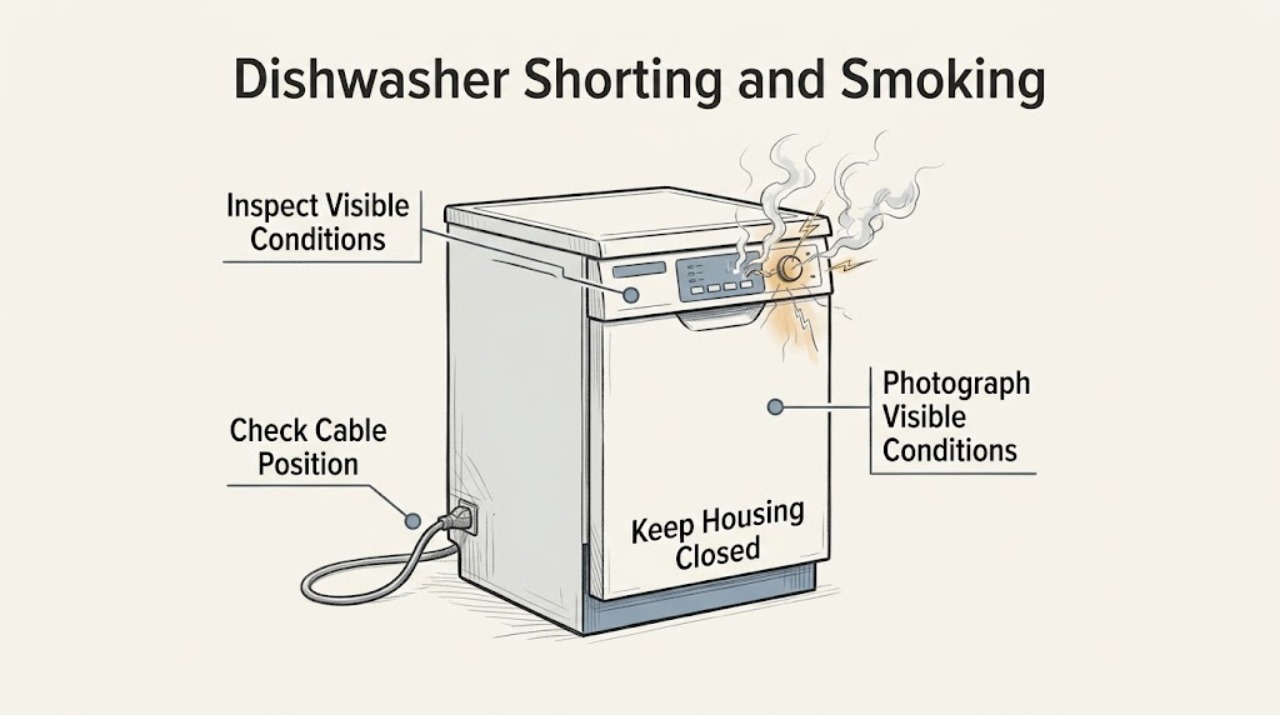
Work through in order
Diagnostic checks
Use only checks that match the exact appliance or system and its official guide.
-
Check 1
Stop the cycle immediately and keep the dishwasher off. From a dry position, note whether there was visible smoke, a flash, a zapping or crackling sound, an electrical or chemical odor, or a breaker/RCD trip. Do not open the lower access panel to look for the source.
Expected result: Smoke, sparks, an electrical burning smell, repeated tripping, or a sharp zapping sound occurred, or the report was only steam, detergent odor, or foam without an electrical symptom.
Next step: Treat any electrical symptom as a stop-use event and continue only with external isolation and documentation. Do not use another cycle to distinguish the branches.
Stop if: Do not reset the breaker to see whether the dishwasher runs, open panels, touch wet flooring or wiring, or use a phone light inside an energized cabinet.
Why this matters
Why: Smoke, arcing-like sound, burning odor, or protection-device operation is an electrical/fire branch. Foam or a chemical odor without smoke is a different detergent or leak branch, but it still does not justify restarting an appliance that has already shorted.
-
Check 2
Isolate power only from a dry, accessible location: unplug it if the plug and outlet are dry and undamaged, or switch off the dedicated dishwasher breaker if it is hard-wired. If water is present near the outlet, cabinet, or floor, do not reach into it; leave the area and obtain qualified or emergency assistance.
Expected result: Power is safely isolated, the breaker will not remain on, the outlet or cord shows heat or damage, or power cannot be reached without contact with water or the appliance.
Next step: Leave the dishwasher out of service and arrange a qualified appliance/electrical inspection. If there is active smoke or fire, leave the home and contact emergency services.
Stop if: Do not pull the dishwasher out, remove the toe-kick, cut or reconnect wiring, bypass a breaker, or use an extension cord or adapter.
Why this matters
Why: A failed breaker, damaged supply, or inaccessible disconnect increases the hazard and is not a user diagnostic. LG requires electrical work and damaged supply replacement to be handled by qualified parties.
-
Check 3
Without restoring power, photograph the model label and the outside of the dishwasher, and record the cycle, time from start to the event, whether the unit was filling or washing, where smoke or odor appeared, any water or suds on the floor, and the exact breaker behavior. Keep the Cascade container, label, and measured amount.
Expected result: The event happened before water entered, during filling, after the wash motor started, near the door, under the unit, or after detergent was dispensed; the detergent was a dishwasher product or a hand-dish product; or the amount is unknown.
Next step: Give the complete record to LG or a qualified technician and ask for an unpowered inspection before any return-to-service decision.
Stop if: Do not wipe inside electrical areas, pour water into the tub to test for a leak, or run the dishwasher with a different detergent.
Why this matters
Why: Timing and location help a technician separate an inlet, door-area, pump/heater, wiring, or installation fault, but they do not identify a part remotely. Detergent type can explain suds/leak behavior, not prove an electrical failure.
-
Check 4
Classify the detergent only after the electrical hazard is isolated: verify that the Cascade product label says it is for automatic dishwashers, identify powder, liquid, or pod form, and check whether it was placed in the dispenser as directed. Do not use the detergent classification to decide that the appliance is safe.
Expected result: The product was automatic-dishwasher detergent used as labeled, it was a hand-wash/liquid dish soap, excessive foam or leakage was present, or the product/amount cannot be confirmed.
Next step: Report the detergent facts without making a causal claim. If there was only foam and no electrical symptom, follow the model's detergent/leak guidance after confirming the unit is safe; if smoke or shorting occurred, keep it isolated and request service.
Stop if: Do not perform LG's bubble-clearing cycle, a detergent-free cycle, or any other powered test after smoke, sparks, burning odor, or a trip unless a qualified provider has cleared the appliance.
Why this matters
Why: LG's detergent guidance associates incorrect dish soap with suds, and its bE guidance describes excessive bubbles and possible leakage. That branch may explain foam or water, but smoke, zapping, or a breaker trip still requires electrical service.
-
Check 5
Arrange LG or qualified appliance service and provide the model LDF5545ST, serial/region if available, the power-isolation status, event timeline, photos, detergent container, water/suds observation, and whether the breaker or RCD tripped. Ask for the cause to be verified before parts are ordered.
Expected result: The service provider can reproduce the report only by energizing the unit, finds damaged supply or wiring, finds water intrusion, or finds only detergent residue without electrical damage.
Next step: Keep the dishwasher disconnected until the provider confirms the repair and safe return to service. If the provider finds installation or household wiring damage, use the appropriate licensed electrical professional.
Stop if: Do not approve a guessed control board, heater, pump, or cord replacement without model-specific confirmation and an inspection of the underlying shorting or smoke source.
Why this matters
Why: The diagnosis requires controlled inspection of the power supply, grounding, wiring, door/base area, pump/heater and controls. A detergent brand or symptom timing alone cannot establish a compatible replacement part.
Use your observations
Decision map
Find the observation that best matches what you see, then follow the next safe action.
-
PATH 01Next step
What you see
Smoke, sparks, crackling/zapping, a burning odor, or a breaker/RCD trip occurred at the beginning of the cycle.
Do this next
Keep power isolated from a dry accessible location, leave the area if smoke or fire continues, and arrange qualified appliance/electrical service. Do not run another cycle.
Why this path and its safety boundary
Why it matters: This is an electrical or fire-safety event, regardless of whether Cascade was used correctly.
-
PATH 02Next step
What you see
There was foam, detergent odor, or a leak but no smoke, spark, zapping sound, burning odor, or electrical trip, and the product was not intended for automatic dishwashers or was heavily overused.
Do this next
Keep the unit off until water is cleaned safely and the model-specific detergent guidance is followed. Request service if leakage reached electrical areas or the symptom returns.
Why this path and its safety boundary
Why it matters: LG's detergent guidance makes excess suds and leakage the more plausible detergent branch; it does not support calling this a short circuit.
-
PATH 03Next step
What you see
The user cannot safely isolate power, water is near the outlet or base, the breaker will not stay on, or the source is inside the built-in cabinet.
Do this next
Leave the appliance untouched and obtain qualified appliance/electrical help; use emergency services for active smoke or fire.
Why this path and its safety boundary
Why it matters: The safety boundary has been reached; access or live diagnosis could expose the user to shock, fire, or water damage.
Helpful context
Understand the symptom
This is not a detergent-optimization problem once the dishwasher has visibly smoked, sparked, made a zapping sound, or tripped protection. The first decision is whether the appliance can be safely isolated without contact with water or damaged electrical parts. The exact LDF5545ST identity matters for the service record, but it does not make repeated operation safe.
Cascade can be relevant to a separate suds or leak branch only if the product was not intended for automatic dishwashers, was used in the wrong compartment, or was greatly overused. A normal dishwasher detergent does not explain away smoke or shorting. Keep the product container and do not run a detergent-only test cycle after an electrical event.
When checks do not resolve it
Need a professional?
Request LG or qualified appliance service immediately for smoke, sparks, burning odor, zapping, a breaker trip, water near electricity, or a recurrence. Contact emergency services for active smoke or fire; use a licensed electrician when the household circuit, outlet, grounding, or hard-wired supply is implicated.
Safety scope: Do not restore power, run a detergent-only test, pull out the built-in dishwasher, remove panels, access the heater/pump/control area, bypass protection, or perform live voltage tests after shorting or smoke. LG's installation manual reserves electrical work and damaged supply replacement for qualified parties.
Have this ready
- Provide LG LDF5545ST, serial and region if available, cycle and elapsed time, whether the unit was filling or washing, smoke/odor/sound location, photos, breaker behavior, water or suds, Cascade product form and amount, and confirmation that power is isolated.
Common questions
FAQ
Can Cascade detergent make an LG LDF5545ST short or smoke?
The available LG guidance supports a detergent branch for incorrect detergent, excessive suds, and leakage. It does not establish that a Cascade product caused electrical smoke or shorting. Stop using the dishwasher and have the electrical symptom inspected instead of trying a different detergent cycle.
Should I run the LG dishwasher empty to see if it smokes again?
No. After smoke, zapping, sparks, a burning odor, or a breaker trip, another powered test can worsen a fault or create a fire hazard. Isolate power safely and arrange qualified service.
What if the dishwasher only produced foam and leaked?
LG says hand-wash or liquid dishwashing detergent can create excessive bubbles and leakage, and recommends dishwasher detergent instead. Keep the unit off until the leak is safely addressed; if water reached electrical parts or any smoke/shorting also occurred, use the electrical stop-use path.
Which part should be replaced on an LDF5545ST that smoked?
Do not choose a heater, pump, control board, cord, or wiring part from the symptom alone. The source must be inspected with power isolated, including the supply, grounding, wiring, water intrusion, and affected load before a model-specific part is selected.
Read the exact guide
Official sources
- LG Dishwasher - Troubleshooting bE Error CodeLG Electronics · Supports the foam/leak branch only; the article does not claim bE or detergent caused this LDF5545ST smoke event.
- Dishwasher Installation ManualLG Electronics · Safety boundary and installation guidance; it does not identify the failed part in this LDF5545ST incident.
- LG LDF5545ST Product SupportLG Electronics · Exact model identity and support route; not a component diagnosis for smoke.
- LG Dishwasher – Using Detergent and AdditivesLG Electronics · Supports the detergent-versus-suds/leak distinction; not proof of an electrical cause for this model.
Community feedback
Share a repair observation
Share a plain-text repair observation. Accepted observations are published automatically; this page may take a moment to update.