
On this page
Start here
Quick answer
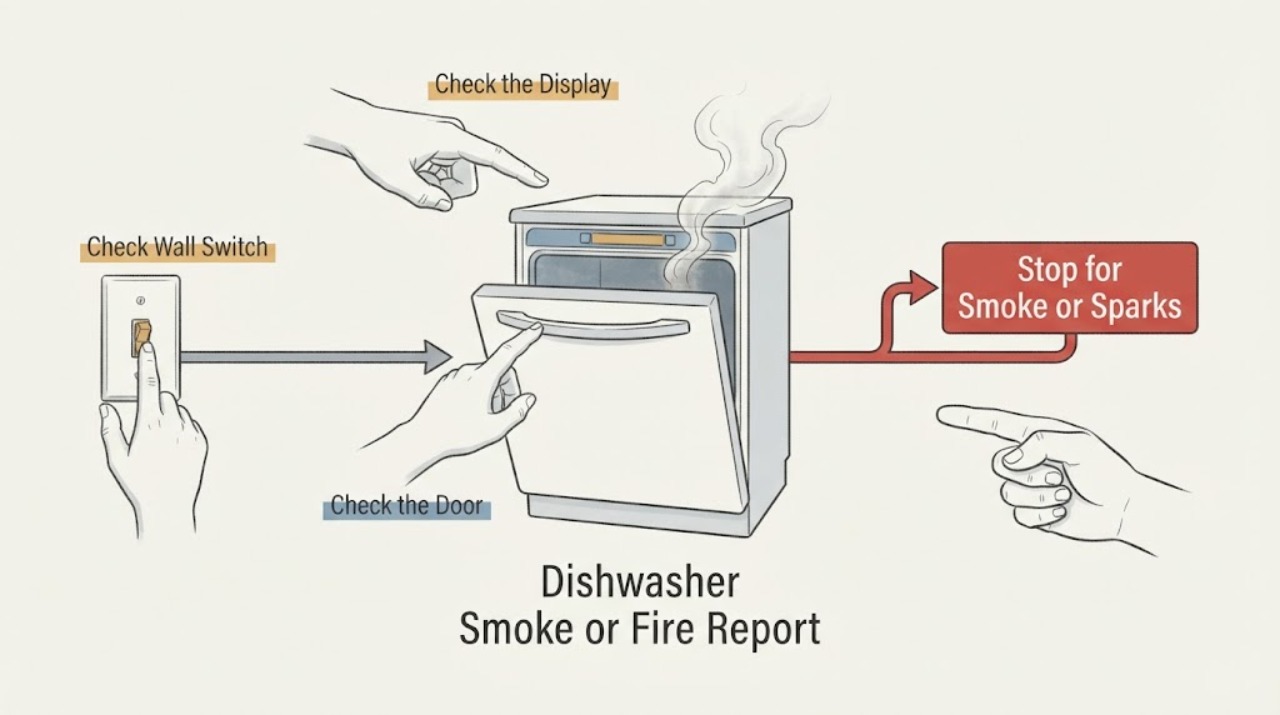
Visible smoke, flames, sparks, scorching, or an acrid electrical smell from an LG dishwasher is a stop-use and fire-safety event, not a normal troubleshooting run. If smoke or fire is present, get people out, close the door behind you if that can be done without approaching the hazard, call 911 from outside, and do not open the dishwasher or pour water on it. If there is no active fire and the power can be isolated without touching a wet or damaged area, turn off the dishwasher at its accessible switch or circuit breaker; close the dishwasher water shutoff if there is a leak. Do not plug it back in, restart a cycle, run an empty test, or remove panels. LG describes a limited temporary odor scenario for some brand-new dishwashers, but that guidance does not make visible smoke, fire, soot, repeated burning smell, or a damaged unit safe to reuse. Photograph the model/serial and damage from a safe position and request LG or qualified service after the fire department or electrician has cleared the area.
Work through in order
Diagnostic checks
Use only checks that match the exact appliance or system and its official guide.
-
Check 1
If there are flames, active smoke, spreading heat, popping, or a smoke alarm, alert everyone, leave the home, close doors behind you only if that is safe, and call 911 from outside. Do not open the dishwasher door, reach behind it, or pour water into or onto the appliance.
Expected result: The hazard is active or has stopped and no smoke/flame is visible now.
Next step: Stay out until emergency responders say it is safe. Do not re-enter to take photos, retrieve dishes, or reconnect power.
Why this matters
Why: Active smoke or flame can involve energized electrical equipment and hidden heat in cabinetry or walls. USFA says to leave and call 911 when it is not clearly safe to use an extinguisher; a stopped visible flame does not prove that the appliance or surrounding structure is safe.
-
Check 2
If there is no active fire and the area is dry and safe to approach, isolate electrical power using the dishwasher's accessible switch, power-strip disconnect, or circuit breaker; use the breaker rather than touching a plug behind a wet or damaged built-in unit. Close the dishwasher water shutoff if water is leaking.
Expected result: Power can be isolated from a dry, safe location, or the floor, outlet, cabinet, or cord is wet, hot, damaged, or inaccessible.
Next step: If power cannot be isolated safely, leave it off at the main or appropriate breaker only if that can be done without entering a hazardous area and contact emergency responders/electrician. Do not pull the built-in dishwasher out or touch damaged wiring.
Why this matters
Why: LG's built-in-dishwasher guidance identifies the accessible switch or power strip as a way to disconnect power when the plug is behind the unit. A wet or damaged electrical area must not be handled by the user, and a water leak adds a separate slip/electrical hazard.
-
Check 3
Keep the dishwasher disconnected and do not restart it, run an empty cycle, test a heating or drying option, reset an error, or plug it in because the smoke has stopped. Do not remove the outer door, toe-kick, control panel, or cabinet panels.
Expected result: The unit appears normal after cooling, or there is soot, melted plastic, discoloration, a damaged cord, a tripped breaker, an odor, or moisture around the unit.
Next step: Leave the unit out of service. Have the fire department, electrician, LG, or a qualified appliance technician determine whether the appliance, circuit, cabinetry, and surrounding wall are safe before any repair or disposal decision.
Why this matters
Why: A quiet or cool appliance after an event does not establish that an internal electrical or heating fault is gone. USFA treats damaged or loose appliance cords as a replacement concern, and LG's public troubleshooting routes persistent burning odor and unresolved faults to service.
-
Check 4
From a safe position, record the LG model and serial label if it is visible without moving the appliance, the date and cycle, where smoke or flame appeared, whether water leaked, what the breaker or smoke alarm did, and photos of exterior damage or residue. Do not move a built-in dishwasher solely to reach the label.
Expected result: The label and exterior can be documented safely, or the label is behind the appliance or the area remains unsafe.
Next step: Give the information to emergency responders, the insurer, LG, or the service technician when the area is cleared. If the label is inaccessible, report that fact rather than pulling the machine out.
Why this matters
Why: Model and serial information lets LG match the correct manual, warranty, service history, and any model-specific safety information. Lack of a label or an unresolved scene is not a reason to restore power.
-
Check 5
After the fire department or qualified professional has cleared the area, arrange LG or qualified appliance service for inspection of the appliance and installation. Report smoke, fire, sparks, odor, water, breaker behavior, and any visible damage; do not accept a remote suggestion to plug the unit back in as a substitute for an inspection.
Expected result: The event was only a faint odor on a genuinely new dishwasher with no smoke, flame, residue, electrical symptom, or recurrence, or the event involved visible smoke/fire or a persistent burn smell.
Next step: For any smoke/fire, keep the dishwasher out of service and obtain an in-person safety decision. For a new-unit odor with none of the hazard signs, follow the exact model manual and contact LG if the odor is severe, persists, or changes into smoke; do not use this branch to excuse a smoke event.
Why this matters
Why: LG documents a limited early-use odor condition for some new dishwashers, but says persistent burnt odor in a product that was not purchased recently needs technician inspection. Visible smoke, fire, soot, repeated odor, or damage exceeds that limited odor guidance.
Use your observations
Decision map
Find the observation that best matches what you see, then follow the next safe action.
-
PATH 01Next step
What you see
Flames, active smoke, spreading heat, or a smoke alarm is present near the dishwasher.
Do this next
Evacuate, close doors only if safe, call 911 from outside, and stay out until responders clear the home. Do not open the dishwasher or use water on an electrical appliance fire.
Why this path and its safety boundary
Why it matters: This is an active home-fire hazard; the appliance should not be approached for diagnosis or a plug-level test.
-
PATH 02Next step
What you see
Smoke has stopped, but there is soot, melted material, scorching, a damaged cord, a tripped breaker, persistent acrid odor, or moisture around the dishwasher.
Do this next
Keep power and water isolated where safe, do not move the built-in unit, and request fire-department/electrician and LG or qualified appliance inspection before reuse.
Why this path and its safety boundary
Why it matters: The event has left evidence of possible heat, electrical, or water damage. A visual return to normal does not establish safe operation.
-
PATH 03Next step
What you see
There was only a mild odor during the first uses of a genuinely new dishwasher, with no smoke, flame, soot, electrical symptom, visible damage, or recurrence.
Do this next
Use only the exact model manual and stop if the odor is severe, persists, changes to smoke, or is accompanied by heat or electrical symptoms. Contact LG service if the condition is not clearly the limited new-product odor scenario.
Why this path and its safety boundary
Why it matters: LG describes a temporary early-use odor for some new dishwashers, but that limited explanation does not cover visible smoke or a repeated burning event.
-
PATH 04Next step
What you see
A remote helper, service chat, or another person suggests plugging the dishwasher back in to see whether it still smokes.
Do this next
Do not reconnect power. Provide photos, model/serial information, the event timeline, and the fire-department or electrician report to LG or qualified service for an in-person decision.
Why this path and its safety boundary
Why it matters: A post-fire restart is an unverified live test that can re-energize a damaged appliance or concealed wiring; it is outside the safe user scope.
Helpful context
Understand the symptom
Smoke changes the decision from troubleshooting to emergency safety
The assigned topic identifies an LG dishwasher used at home and a smoke-detected event, but gives no model. That is enough to define the safety boundary because smoke, flames, sparks, or heat damage must not be tested by running the appliance again. LG's public material distinguishes a possible temporary odor in some new dishwashers from persistent burning odor, while USFA guidance addresses electrical-appliance fire risk and when to leave and call the fire department. The steps below document the event and protect the home; they do not diagnose a heater, motor, control, wiring, or other internal part.
When checks do not resolve it
Need a professional?
For any visible smoke, flame, sparks, soot, melted material, damaged cord, repeated acrid odor, breaker trip, or heat damage, keep the LG dishwasher disconnected and out of service. Call emergency services for active fire or unsafe smoke, then use LG or qualified service only after the site is cleared. Do not restart, reset, pull out, open, or electrically test the unit yourself.
Common questions
FAQ
Can I run the LG dishwasher once to see whether it still smokes?
No. Do not reconnect or restart a dishwasher after smoke, fire, sparks, soot, scorching, or a strong repeated burning smell. Have the area and appliance cleared by the fire department, electrician, LG, or qualified service first.
What should I do if the dishwasher is actively smoking or burning?
Get everyone out, call 911 from outside, and do not open the dishwasher or pour water on it. Only isolate power if it can be done without entering smoke, heat, water, or a damaged electrical area; otherwise wait for responders.
Could a burning odor be normal on a new LG dishwasher?
LG documents a temporary early-use odor for some new dishwashers, but that is a limited odor scenario. Visible smoke, flame, soot, electrical symptoms, severe heat, recurrence, or a persistent odor is outside that explanation and requires the dishwasher to remain out of service.
Should I pull out the built-in dishwasher to inspect the back?
No. Do not pull out or open a built-in dishwasher after smoke or fire. Keep people away, isolate power and water only from safe accessible controls, and let qualified responders or service inspect the installation.
Read the exact guide
Official sources
- LG Direct ServiceLG USA · Used only to route an out-of-service LG dishwasher to trained service after the site is safe. It does not establish a component diagnosis or post-fire reuse procedure.
- Troubleshooting Burning Smell From DishwasherLG USA · The opened page establishes an LG dishwasher-specific support topic but provides no visible technical text beyond the service page. It is used only for the existence of the support route and paired with LG's detailed new-odor page; it does not authorize a restart or component diagnosis.
- Choosing and Using Fire ExtinguishersU.S. Fire Administration, FEMA · Used for the emergency boundary: a person should use an extinguisher only when the fire is small/contained, they are safe from toxic smoke, have alerted others and have a clear escape route; otherwise leave and call 911.
- LG USA Product SupportLG USA · Used only as the official place to locate the exact model manual and support route after the model/serial is documented. It does not support any repair step in a smoke/fire event.
- Appliance and Electrical Fire SafetyU.S. Fire Administration, FEMA · Used for the electrical-appliance safety boundary, direct wall-outlet guidance, damaged-cord warning, and the need to keep damaged appliances out of normal use. It is not an LG-specific repair manual.
- [LG Dios dishwasher] The dishwater that I began to use recently smells like: something is burning, a new product fresh from the factory, or a plastic.LG USA · Used only to distinguish a limited new-product odor from smoke/fire. LG says persistent burnt odor in a product not purchased recently needs technician inspection; this article does not apply that page's continue-running advice to visible smoke, fire, soot, or electrical damage.
- Fire is Everyone's Fight Community Outreach GuideU.S. Fire Administration, FEMA · Used for the general emergency boundary to get out, call 911 from outside, stay out, and avoid opening an appliance during an electrical/appliance fire. It is not an LG repair source.
- [LG Dishwasher] Guide to Error CodesLG USA · Used for LG's explicit accessible power-disconnect route for built-in dishwashers and its warning not to pull a built-in unit after water has entered a heat-dry blower. It does not define a smoke/fire cause or authorize a post-fire restart.
- Lg DishwasherReddit r/Appliances · Used only as an anecdotal report of an LG dishwasher electrical fire and smoke from cabinets, reinforcing the no-restart boundary. Its model and outcome are not transferred to the unspecified assigned topic.
Community feedback
Share a repair observation
Share a plain-text repair observation. Accepted observations are published automatically; this page may take a moment to update.