
On this page
Start here
Quick answer
If you smell gas around an LG gas dryer, stop using the dryer immediately. Do not try to light an appliance, touch electrical switches, use a phone inside the building, or run another cycle to test the smell. Clear everyone and pets from the area, then contact the local gas supplier or gas emergency service from a safe location; call the fire department if the gas supplier cannot be reached. LG identifies installation and service as work for a qualified installer, service agency, or gas supplier. Do not move the dryer, disconnect the gas line, open fittings, relight a burner, or inspect for a leak with a flame. Once the area has been declared safe, arrange qualified dryer service if the odor is not in the building gas line, and provide the model, when the smell occurred, and any display message. A gAS or 9A5 display indicates a gas-supply condition, but it does not make it safe to keep testing.
Before you begin
Safety first
- This article provides emergency recognition and information-gathering guidance only. Do not enter an affected area to investigate, operate electrical controls, relight, disconnect gas fittings, open the dryer, or test the appliance until qualified clearance and service instructions are provided.
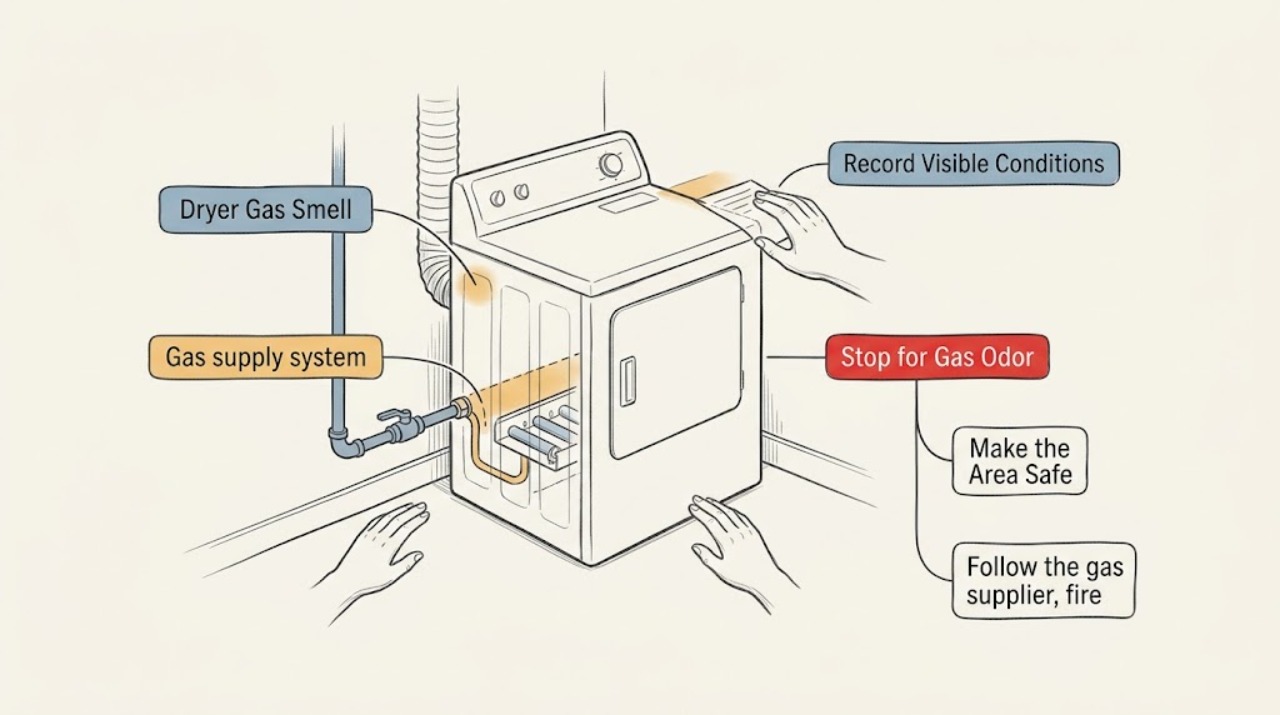
Work through in order
Diagnostic checks
Use only checks that match the exact appliance or system and its official guide.
-
Check 1
Stop the dryer and do not start another cycle. Without operating switches or creating an ignition source, move occupants and pets out of the room, building, or affected area.
Expected result: The odor is present, returns, is strong or spreading, or is accompanied by hissing, dizziness, smoke, flame, or another hazard; or the odor is no longer noticed after people have left.
Next step: From a safe location outside the affected area, contact the local gas supplier or gas emergency service; call the fire department if the supplier cannot be reached or an immediate emergency exists.
Stop if: Do not touch electrical switches, light a flame, smoke, use a phone inside, run the dryer, or re-enter to investigate.
Why this matters
Why: An absent odor does not prove the source is gone. Gas accumulation and ignition risk cannot be ruled out by a brief change in smell or by the dryer appearing normal.
-
Check 2
Follow the gas supplier, fire department, or emergency responder's instructions from a safe location; do not move the dryer or reach behind it to operate a shutoff unless the responsible responder specifically directs a safe action and the area has been assessed.
Expected result: Responders identify a building or appliance gas hazard, declare the area unsafe, isolate the supply, or declare the area safe for a qualified inspection.
Next step: Keep the dryer off and arrange a qualified installer, gas supplier, or authorized appliance service inspection of the gas connection and dryer before any restart.
Stop if: Do not disconnect fittings, tighten or alter gas connections, relight a burner, test with a flame, or bypass a shutoff or safety control.
Why this matters
Why: The smell source may not be the dryer, and the appliance cannot be cleared by a user visual inspection. A declaration that the area is safe is not the same as approval to reconnect, relight, or run the dryer.
-
Check 3
Only after the responsible gas or emergency authority has declared the area safe, record the exact LG model, the time and location of the odor, whether the dryer was running or recently stopped, the selected cycle, and any display message without opening the cabinet.
Expected result: The odor occurred only at startup, during heating, after a cycle, near the connector or room, or with a gAS/9A5 message; or the timing and location are unknown.
Next step: Give the record to the gas supplier or qualified LG service provider and keep the dryer out of service until they provide the repair and restart instructions.
Stop if: Do not return to the appliance to take close-up photos, sniff fittings, remove panels, or reproduce the odor.
Why this matters
Why: Timing and location help the qualified provider distinguish a dryer service issue from a building-supply or installation issue, but they do not prove a diagnosis or make a restart safe.
-
Check 4
If the display can be read without re-entering an unsafe area, record whether it shows gAS, 9A5, another code, or no code; do not clear the message by repeated cycles or attempt a burner test.
Expected result: gAS or 9A5 is displayed on a gas dryer, a different code appears, or no message appears despite the odor.
Next step: Provide the display information to the gas supplier and qualified appliance technician; keep the dryer off until the gas and appliance systems have been assessed.
Stop if: Do not relight, adjust, disconnect, or reconnect gas components, and do not use a phone or electrical control inside a potentially contaminated area.
Why this matters
Why: LG associates gAS/9A5 with an inadequate gas supply, but no code does not rule out a leak and a gas-supply message is not a permission to manipulate the gas system. A different code needs the exact model reference after the immediate gas hazard has been addressed.
-
Check 5
If the odor was described as burning, plastic, rubber, or electrical rather than fuel, still leave the dryer off and treat smoke, flame, sparks, a hot cord, or discoloration as a fire or electrical stop condition; do not use that description to resume drying.
Expected result: There is smoke, flame, sparking, discoloration, a hot cord, or a persistent burning odor; or no such hazard is present and a gas odor remains the concern.
Next step: For an active fire use emergency services from a safe location; otherwise keep the dryer disconnected only if this can be done without entering a hazard and arrange qualified appliance or electrical service.
Stop if: Do not open panels, touch hot or exposed parts, repeatedly reset a breaker, or run the dryer to identify the smell.
Why this matters
Why: LG distinguishes some new-product or heat-related odors from gas odor, but persistent or hazardous burning symptoms can indicate lint, wiring, heater, motor, or another fault that requires service.
-
Check 6
After the gas supplier or qualified service provider has inspected the situation, ask what was found, what repair or installation correction is required, and who is authorized to clear the dryer for use; do not restart based only on odor disappearance.
Expected result: The gas supplier identifies a building-side issue, a qualified installer identifies a connection or conversion issue, LG service identifies a dryer fault, or the source remains unresolved.
Next step: Follow the responsible professional's written or documented restart guidance and retain the model, inspection, and repair record.
Stop if: Do not reconnect, relight, operate, or modify the dryer until the responsible qualified professional has cleared the relevant system.
Why this matters
Why: Each result has a different owner and repair boundary. An unresolved source means the dryer remains unsafe to test, even if a single cycle previously completed.
Use your observations
Decision map
Find the observation that best matches what you see, then follow the next safe action.
-
PATH 01Safety boundary
What you see
Gas odor is present, returns, is strong or spreading, or is accompanied by hissing or physical symptoms.
Do this next
Leave immediately, avoid flames, switches, and phones inside, and contact the gas supplier or fire department from a safe location.
Why this path and its safety boundary
Why it matters: Treat the area as a gas emergency; the source cannot be safely diagnosed by operating the dryer.
Safety stop: Do not re-enter, restart, relight, move, or inspect the dryer until responders provide direction.
-
PATH 02Safety boundary
What you see
The responsible gas or emergency authority has declared the area safe for a qualified inspection.
Do this next
Keep the dryer off and have the gas supplier, qualified installer, or authorized service provider inspect the correct system before restart.
Why this path and its safety boundary
Why it matters: The immediate evacuation phase is over, but the dryer and its gas connection are not automatically cleared for use.
Safety stop: Do not open fittings, disconnect the line, relight, or run a test cycle.
-
PATH 03Safety boundary
What you see
A gAS or 9A5 message appears on an LG gas dryer after the area is safe to observe.
Do this next
Give the exact message and model to the gas supplier or qualified service provider and keep the dryer off.
Why this path and its safety boundary
Why it matters: LG associates the message with the dryer not receiving the proper gas supply; it does not distinguish a building, installation, or appliance fault for the user.
Safety stop: Do not manipulate the gas valve or line, relight the burner, or repeat cycles to clear the message.
-
PATH 04Safety boundary
What you see
The odor is burning or electrical, or smoke, flame, sparks, discoloration, or a hot cord is present rather than a confirmed fuel odor.
Do this next
Leave the dryer off, use emergency services for active fire, and arrange qualified appliance or electrical service for persistent odor or damage.
Why this path and its safety boundary
Why it matters: This is still a fire or electrical stop condition, not a normal-use question.
Safety stop: Do not run another cycle, open panels, touch hot or exposed parts, or repeatedly reset a breaker.
-
PATH 05Safety boundary
What you see
The odor has faded but no qualified person has identified and cleared the source.
Do this next
Keep the appliance out of service and contact the gas supplier or qualified LG service provider with the time, location, model, and display record.
Why this path and its safety boundary
Why it matters: Odor disappearance does not prove the gas connection, building supply, or dryer is safe.
Safety stop: Do not restart to see whether the odor returns or assume a previous successful cycle cleared the fault.
Helpful context
Understand the symptom
Treat any gas odor as an immediate stop condition
The first decision is safety, not diagnosis. A gas smell may come from the dryer connection, the building supply, another appliance, or an outside source, and you cannot identify that safely by repeatedly starting the dryer. Leave the appliance off, avoid ignition sources and electrical switching, and move occupants away before making calls from a safe location.
Do not confuse a gas smell with a warm-dryer odor
LG discusses a temporary odor on a new dryer and a burning smell from heat, lint, or residue as separate situations, but neither explanation should be used to dismiss an odor that smells like fuel. If the smell is uncertain, respond as a gas odor: stop, leave, and obtain gas-safety guidance. Smoke, flame, sparks, or a strong burning odor also require the dryer to remain out of service.
A display code does not authorize a user gas check
A gAS or 9A5 message can indicate that the dryer is not receiving gas, while a damaged or kinked visible supply line may require an installer or gas supplier. Do not remove the rear panel, disconnect the connector, adjust a valve, relight a burner, or use a flame to search for a leak. Once emergency guidance says the area is safe, give the exact message and model to the qualified service provider.
Resume use only after qualified clearance
Do not restart the dryer merely because the odor faded. The gas supplier or qualified service professional must determine whether the building supply, shutoff, connector, dryer gas system, combustion, or exhaust needs attention. If the issue is not in the gas line, LG says the dryer requires service. Keep the appliance off until the responsible professional confirms the safe next step.
Safety boundary
Stop conditions
- Immediately stop the dryer and leave the area for any fuel-like odor; do not light appliances, touch electrical switches, or use a phone inside.
- Do not restart, relight, or run a cycle to reproduce a gas smell or clear a gAS or 9A5 message.
- Do not disconnect, tighten, adjust, or open gas fittings, move the dryer, or inspect for leaks with a flame.
- Keep the dryer off for smoke, flame, sparks, burning odor, a hot cord, discoloration, or a repeated breaker trip and obtain appropriate emergency or qualified service.
- Do not resume use until the gas supplier, qualified installer, or authorized appliance professional has assessed the relevant system and provided the restart path.
When checks do not resolve it
Need a professional?
For any gas smell, leave the area and contact the local gas supplier or gas emergency service from a safe location; call the fire department if the supplier cannot be reached or there is immediate danger. After the area is safe, arrange a qualified installer, gas supplier, or authorized LG appliance service inspection before using the dryer. The technician should assess the building supply, shutoff, connector, installation or gas conversion, dryer gas system, combustion, and exhaust as applicable. Use emergency services for smoke or fire and qualified electrical help for sparks, a hot cord, exposed wiring, or repeated breaker trips.
Safety scope: This article provides emergency recognition and information-gathering guidance only. Do not enter an affected area to investigate, operate electrical controls, relight, disconnect gas fittings, open the dryer, or test the appliance until qualified clearance and service instructions are provided.
Common questions
FAQ
What should I do first if my LG dryer smells like gas?
Stop using it, do not light anything or touch electrical switches, clear the area, and contact the local gas supplier or fire department from a safe location. Do not return to inspect or run another cycle.
Can I turn off the gas valve behind my LG dryer?
Do not reach behind or move the dryer to do so. Follow the gas supplier or emergency responder's instructions; any gas connection or service work must be handled by a qualified party, especially while an odor may be present.
What does gAS or 9A5 mean on an LG gas dryer?
LG associates these messages with the dryer not receiving proper gas supply. They do not identify whether the cause is the building, installation, connector, or appliance, and they do not make it safe to relight or repeatedly test the dryer.
Could a burning smell be mistaken for a gas smell?
LG describes some temporary new-product or heat-related odors separately, but if you are unsure whether an odor is fuel-like, respond as a gas odor. Smoke, sparks, a hot cord, or a persistent burning smell also require the dryer to stay off and receive qualified service.
Can I restart my LG dryer after the smell disappears?
No. Odor disappearance does not identify or remove the source. Keep the dryer off until the gas supplier, qualified installer, or authorized appliance professional assesses the relevant system and provides a safe restart path.
Can I check the LG dryer gas line for a leak myself?
Do not disconnect fittings, open the dryer, or use a flame to look for a leak. Leave the area and contact the gas supplier or qualified service provider; LG requires gas installation and service by qualified professionals.
Read the exact guide
Official sources
- [LG Dryer] A burning smell comes from the dryer during dryingLG USA Support · LG general dryer odor guidance; it does not make a fuel-like gas odor safe and does not replace emergency gas response.
- LG Dryer - What to Do If You Smell Gas Around Your LG DryerLG USA Support · LG USA support guidance for gas odor around an LG dryer; local emergency and gas-supplier instructions control the immediate response.
- LG Dryer - Blinking LED Error CodesLG USA Support · LG support reference for models that show these messages; display names and available diagnostics vary by model.
- Owner's Manual — Gas Dryer Safety InstructionsLG Electronics · LG owner manual for the identified gas-dryer family; exact model instructions and local codes control a particular installation.
Community feedback
Share a repair observation
Share a plain-text repair observation. Accepted observations are published automatically; this page may take a moment to update.