
On this page
Start here
Quick answer
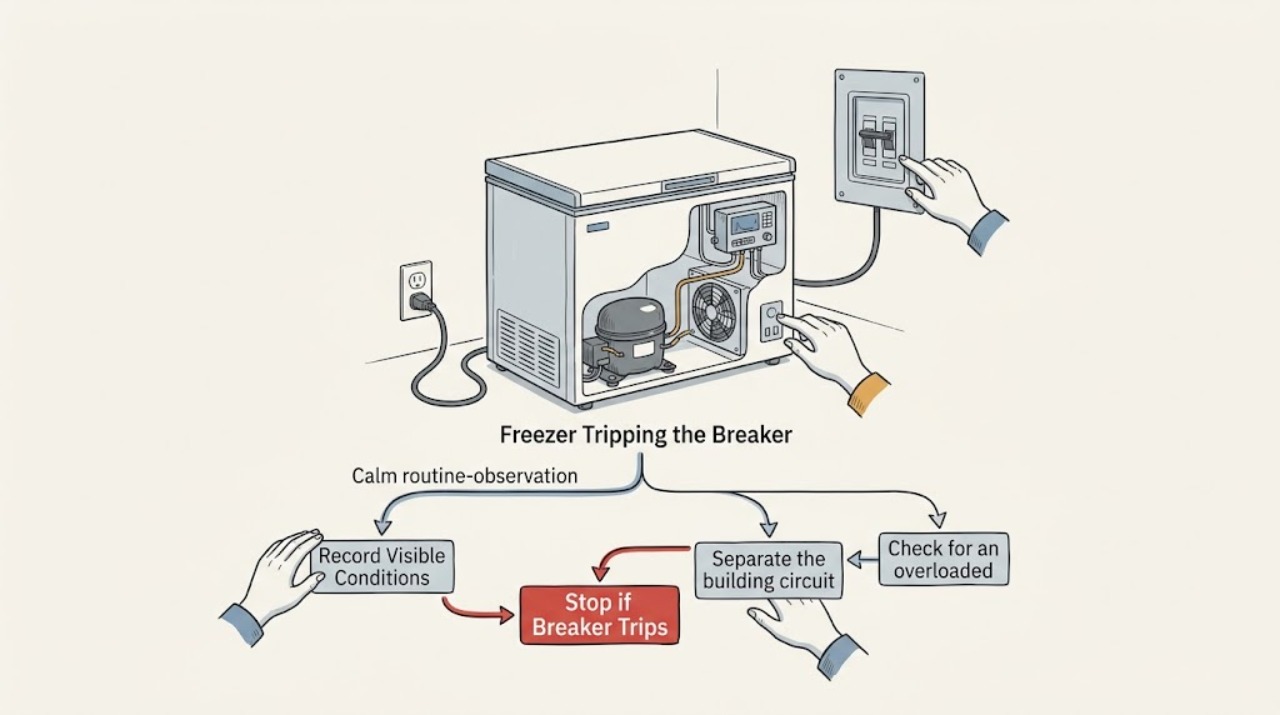
If an LG freezer or refrigerator keeps tripping the circuit breaker, stop repeatedly resetting it. Unplug the appliance only when your hands and the area are dry and the plug is safe to reach, then see whether the breaker can reset with the appliance disconnected. If it still trips with the freezer unplugged, the outlet, wiring, building circuit, or breaker needs a qualified electrician. If the breaker holds until the LG appliance is plugged in or switched on, the appliance or its power cord needs LG service. Make sure the refrigerator is connected directly to the correct dedicated wall outlet rather than an extension cord or overloaded power strip, and check the outlet only with a small appliance from a dry, safe position. Do not open the cabinet, bypass grounding, or make live electrical tests. Stop immediately for smoke, burning odor, sparks, a hot plug or outlet, water near electricity, a damaged cord, or repeated trips; protect frozen food and arrange urgent qualified electrical or appliance service.
Work through in order
Diagnostic checks
Use only checks that match the exact appliance or system and its official guide.
-
Stop the freezer and record the safety symptoms
Do not reset the breaker again while smoke, a burning odor, sparks, a hot plug or outlet, water near electrical parts, a damaged cord, or a repeated immediate trip is present. If none of those symptoms exists and the area is dry, note whether the freezer is still powered, whether food is thawing, and whether the trip occurred at connection, compressor start, or an unknown time.
Expected result: There is an immediate electrical or heat symptom, the breaker trips as soon as power is restored, the freezer runs for a while before tripping, or the event is isolated and the appliance remains off.
Next step: For any hazard, keep clear, isolate power only when safe, protect frozen food without approaching the electrical fault, and obtain urgent qualified help. With no hazard, proceed to the unplugged breaker and outlet separation check.
Stop if: Do not touch a hot or wet plug, smell for a fault at the outlet, continue operation after a burning symptom, or hold the breaker on while it is trying to trip.
Why this matters
Why: Smoke, heat, water, sparks, or a damaged cord can indicate a shock or fire hazard. A trip at connection suggests the power path or appliance input; a trip after operation can involve a motor, compressor, fan, defrost, or control condition, but timing alone does not identify a part.
-
Separate the building circuit from the LG appliance
With dry hands and no visible damage, switch the LG appliance off if its controls allow it, unplug it from the wall outlet, and then reset the breaker once. Observe whether the breaker stays set with the refrigerator disconnected. Do not reconnect the freezer yet if the breaker will not hold.
Expected result: The breaker will not reset with the LG appliance unplugged, the breaker holds while the appliance is disconnected, or the breaker trips before the test can be completed.
Next step: If the breaker will not hold unplugged, leave it off and call a qualified electrician or building manager. If it holds, keep the freezer disconnected and continue with the outlet and connection checks.
Stop if: Do not repeatedly reset the breaker, use a larger fuse or breaker, bypass a safety device, or reconnect the appliance just to reproduce the trip.
Why this matters
Why: LG says a breaker that cannot reset with the refrigerator disconnected can indicate a building electrical problem. A breaker that holds unplugged but trips when the appliance is reconnected shifts suspicion toward the LG product, cord, or its connection.
-
Check for an overloaded or unsuitable connection
Inspect the connection without opening the outlet or appliance. Confirm the LG refrigerator is plugged directly into a wall outlet and not an extension cord, adapter, or power strip shared with other high-power appliances. Check that the plug is fully seated and not loose, hot, wet, pinched, or damaged.
Expected result: The freezer uses an extension cord or shared strip, the plug is loose or damaged, the connection is direct and dry, or the outlet has heat, scorch marks, looseness, or water exposure.
Next step: Remove only the extension or power strip from the setup when safe and use the dedicated wall connection required by the model. For any damage, heat, water, or loose outlet, keep power off and call a qualified electrician.
Stop if: Do not use an extension cord to keep the freezer running, tape a damaged cord, open the outlet, or touch a wet or scorched connection.
Why this matters
Why: LG identifies overloaded strips, extension-cord capacity, loose plugs, and damaged outlets as possible causes of trips or lost power. A hot, scorched, loose, or wet connection is an electrical service issue, not a reason to try another reset.
-
Test the wall outlet without the freezer
Only if the breaker is stable, the outlet is dry and undamaged, and the LG freezer remains unplugged, plug a small known-good appliance into the same outlet from a safe position. Observe whether that appliance operates normally. Do not use a high-load tool, open the outlet, or test an outlet that has heat, water, or scorch marks.
Expected result: The small appliance also fails, it works normally, or the outlet cannot be tested safely.
Next step: For a failed outlet or unsafe outlet condition, leave the breaker off and call an electrician. If the outlet works, do not keep cycling the freezer; arrange LG service if reconnection causes another trip.
Stop if: Do not test with a damaged appliance, touch outlet contacts, use an outlet tester inside an open receptacle, or reconnect the freezer repeatedly after a trip.
Why this matters
Why: LG says another appliance that does not work in the outlet points toward an outlet or building electrical fault. A working outlet does not prove the freezer is safe; it only makes a refrigerator-side cord, input, or internal fault more likely when the breaker trips on reconnection.
-
Record whether a fault code or fan symptom preceded the trip
If the display was visible before power was removed, record the exact code or flashing pattern. Note any abnormal fan noise, compressor clicking, long running, frost around a fan area, or loss of cooling. Do not remove a panel or attempt a live motor or compressor test.
Expected result: An LG fan-related code such as an FF or rF indication was present, a code returns after a safe model reset, the compressor or fan is unusually noisy, or there was no code and the breaker trips on power-up.
Next step: Provide the code and timing to LG service. Use a model-specific reset only when the manual permits and there is no electrical hazard; if the same condition returns, leave the freezer off.
Stop if: Do not open the mechanical compartment, bypass a fan or compressor safety, make live measurements, or keep resetting an error that returns with a breaker trip.
Why this matters
Why: LG associates FF or rF indications with fan-motor abnormalities and directs service when the symptom repeats. A code or mechanical symptom can help the technician, but it does not authorize replacing a fan or compressor without diagnosis.
-
Check recovery and food protection without reproducing the fault
If the breaker and outlet are stable and a qualified professional has cleared the connection, monitor the freezer without opening the cabinet. Record whether it reaches its selected temperature, whether the compressor runs continuously, and whether food is thawing. Keep the doors closed as much as practical while arranging service.
Expected result: The freezer resumes normal cooling without another trip, it trips again when the LG appliance is powered, it runs continuously without cooling, or food is thawing.
Next step: If it trips again, unplug it and leave it off for LG service. If it runs but does not cool or food is thawing, arrange refrigerator service and protect food using a safe alternative; do not keep cycling the appliance.
Stop if: Do not leave the freezer unattended after a trip, operate it with a damaged cord or hot connection, or sacrifice food safety to continue testing a suspected electrical fault.
Why this matters
Why: LG notes that longer operation can occur after relocation, repair, temperature loss, or extended door opening, but a repeated breaker trip is not a normal recovery state. Persistent warm contents or no cooling after a stable power test requires appliance diagnosis.
-
Make the professional handoff
Before contacting service, record the complete LG model number, breaker behavior with the appliance unplugged and connected, outlet test result, connection type, exact code, trip timing, compressor or fan sounds, food temperature condition, and any odor, smoke, heat, water, or cord damage. Do not remove the cover to gather more information.
Expected result: The breaker problem follows the building or outlet, follows the LG appliance, or cannot be separated safely.
Next step: Use a qualified electrician for a breaker that will not hold unplugged or an unsafe outlet. Use LG appliance service when the breaker holds unplugged but trips on the LG appliance, or when internal refrigeration or fan symptoms accompany the trip.
Stop if: Do not re-energize the appliance for a technician-free live test, replace internal parts, or alter the circuit to hide the trip.
Why this matters
Why: The unplugged-versus-connected result gives the electrician or LG technician a useful fault boundary while preserving the appliance and building wiring for safe diagnosis.
Use your observations
Decision map
Find the observation that best matches what you see, then follow the next safe action.
-
PATH 01Next step
What you see
The breaker will not reset while the LG freezer is unplugged.
Do this next
Leave the breaker off and call a qualified electrician or building manager; do not reconnect the freezer.
Why this path and its safety boundary
Why it matters: The building circuit, outlet, wiring, or breaker is more likely involved.
-
PATH 02Next step
What you see
The breaker holds unplugged but trips when the LG freezer is connected or switched on.
Do this next
Keep the freezer unplugged and arrange LG appliance service rather than repeating the connection test.
Why this path and its safety boundary
Why it matters: The appliance, power cord, or its input circuitry needs diagnosis.
-
PATH 03Next step
What you see
The freezer was connected through an extension cord or shared power strip.
Do this next
When safe, remove only the extension or strip and use the dedicated wall outlet required by the model. Call an electrician for damage or heat.
Why this path and its safety boundary
Why it matters: An overloaded or unsuitable connection may be contributing to the trip.
-
PATH 04Next step
What you see
Another small appliance also fails in the outlet while the breaker is stable.
Do this next
Do not use that outlet for the freezer; call a qualified electrician or building manager.
Why this path and its safety boundary
Why it matters: The outlet or building electrical supply may be defective.
-
PATH 05Next step
What you see
An FF or rF fan indication, repeated code, abnormal fan or compressor symptom, or loss of cooling accompanies the trip.
Do this next
Leave the freezer off and provide the code and timing to LG service; do not open the mechanical compartment.
Why this path and its safety boundary
Why it matters: An internal fan, motor, control, or refrigeration issue is possible.
-
PATH 06Next step
What you see
Smoke, burning odor, sparks, a hot or wet plug, damaged wiring, water near electricity, or repeated immediate trips is present.
Do this next
Keep clear, isolate power only when safe without touching the hazard, and obtain urgent qualified electrical or appliance service.
Why this path and its safety boundary
Why it matters: This is an immediate electrical and fire safety stop.
Helpful context
Understand the symptom
The trip pattern is the useful clue
A circuit breaker can trip because of a fault in the refrigerator, its cord, the outlet, the building wiring, or the breaker itself. LG's most useful separation is whether the breaker holds with the appliance disconnected and trips only when the LG refrigerator is reconnected, or whether it trips even with the refrigerator turned off and unplugged. That distinction determines whether to call an electrician or LG appliance service.
Do not turn a protection device into a repeated test
A breaker is opening to interrupt an abnormal electrical condition. Reset it only when the area is dry, no smoke or burning odor is present, and the appliance can be safely disconnected. Never increase fuse capacity, defeat grounding, use a power strip to work around the trip, or keep restoring power to an appliance that immediately trips again.
Safety boundary
Stop conditions
- Never repeatedly reset a breaker, increase fuse or breaker capacity, bypass grounding, or reconnect the LG freezer just to reproduce a trip.
- Stop immediately for smoke, burning odor, sparks, a hot or wet plug or outlet, damaged wiring, water near electricity, or a repeated immediate trip.
- Do not open the refrigerator cabinet or mechanical compartment, make live electrical measurements, bypass a compressor or fan safety, or replace internal parts as a user test.
- Do not use an extension cord or overloaded power strip to keep the freezer operating, and do not use an outlet with scorch marks, looseness, heat, or water exposure.
Only after diagnosis
Potential parts
- power cord or appliance input component
Consider this category only when a qualified diagnosis finds cord, plug, or appliance-input damage and confirms that replacement is safe for the exact model.
Confirm the complete LG model and technician diagnosis before ordering; a breaker trip can originate in the outlet or building circuit instead. - compressor start or control component
Consider this category only when the breaker trips as the compressor starts and qualified service confirms a start-circuit or control fault.
Verify the complete model and service diagnosis before ordering; do not infer a compressor or start component from trip timing alone. - freezer or mechanical-compartment fan component
Consider this category only when a repeated fan-related indication or service test confirms a fan motor, wiring, or related control fault.
Confirm the complete LG model and technician diagnosis before ordering; do not open the mechanical compartment or bypass the fan safety.
When checks do not resolve it
Need a professional?
Call a qualified electrician or building manager when the breaker will not hold with the LG freezer unplugged, another appliance fails in the outlet, or the outlet, cord, wiring, or breaker is hot, wet, loose, damaged, or scorched. Arrange LG appliance service when the breaker holds unplugged but trips with the freezer connected, a fan or compressor code returns, cooling is lost, or the appliance has an internal electrical or refrigeration symptom.
Common questions
FAQ
Why does my LG freezer keep tripping the breaker?
The cause can be the appliance, power cord, outlet, building wiring, breaker, extension cord, or overloaded power strip. The key check is whether the breaker holds while the LG freezer is unplugged; do not keep reconnecting it to reproduce the trip.
What should I do if the breaker trips even when my LG freezer is unplugged?
Leave the breaker off and call a qualified electrician or building manager. LG identifies a breaker that will not reset with the refrigerator disconnected as a possible building electrical problem.
Can I use an extension cord or power strip with an LG freezer?
LG recommends connecting the refrigerator directly to a wall outlet and warns that extension cords or overloaded strips can trip. Use the exact installation guidance for the model and have a damaged or hot connection inspected.
Could an LG freezer fan code be related to a breaker trip?
A repeating FF or rF indication identifies a fan-related abnormality that needs inspection, but it does not prove which part caused the breaker trip. Record the code and leave the appliance off if the symptom returns.
When should I stop using an LG freezer that trips the breaker?
Stop immediately for smoke, burning odor, sparks, a hot or wet plug or outlet, damaged wiring, water near electricity, or repeated immediate trips. Isolate power only when safe and obtain urgent qualified electrical or appliance service.
Read the exact guide
Official sources
- [LG refrigerator power] The refrigerator operates continuously. The refrigerator keeps operating without stopping.LG USA · LG refrigerators and freezer compartments that run continuously or fail to recover after temperature loss
- [LG Refrigerator] Circuit Breaker TripsLG USA · LG refrigerators and freezer compartments where a circuit breaker trips during connection or operation
- [LG refrigerator power] The circuit breaker suddenly tripped.LG USA · LG refrigerators where a breaker trips unexpectedly or will not reset after the product is unplugged
- [LG refrigerator power] Power is not supplied.LG USA · LG refrigerators and freezers with lost power, a tripped breaker, loose plug, or suspect outlet
- LG Refrigerator - Troubleshooting an E FF or E rF Error CodeLG USA · LG refrigerators and freezer compartments displaying FF or rF fan-related indications or repeating fan symptoms
Community feedback
Share a repair observation
Share a plain-text repair observation. Accepted observations are published automatically; this page may take a moment to update.