
On this page
Start here
Quick answer
An Electrolux freezer that trips a breaker should not be kept in service by repeated resets. Electrolux's freezer guidance lists a tripped breaker, loose power connection, a control set to OFF, an outage, and an extension cord as first external possibilities; its electrical-fault guidance says a recurring trip can indicate an electrical or component fault, overload, water, damaged cable, or installation problem and should be handled by a trained technician. Note whether the trip happens as soon as the freezer starts, after it has run, or only with other appliances; check only the accessible plug, outlet or isolator, and household circuit without opening anything. If the breaker trips again, the cord or outlet is damaged or hot, there is moisture, smoke, or a burning odor, or the freezer is newly installed, leave it off and arrange qualified electrical or appliance service.
Before you begin
Safety first
- This article covers symptom classification, safe external isolation, visible connection observation, circuit-load context, and at most one supervised restoration when there is no hazard. Electrical testing, circuit changes, cabinet removal, compressor or control diagnosis, internal parts, and protective-device work require qualified service.
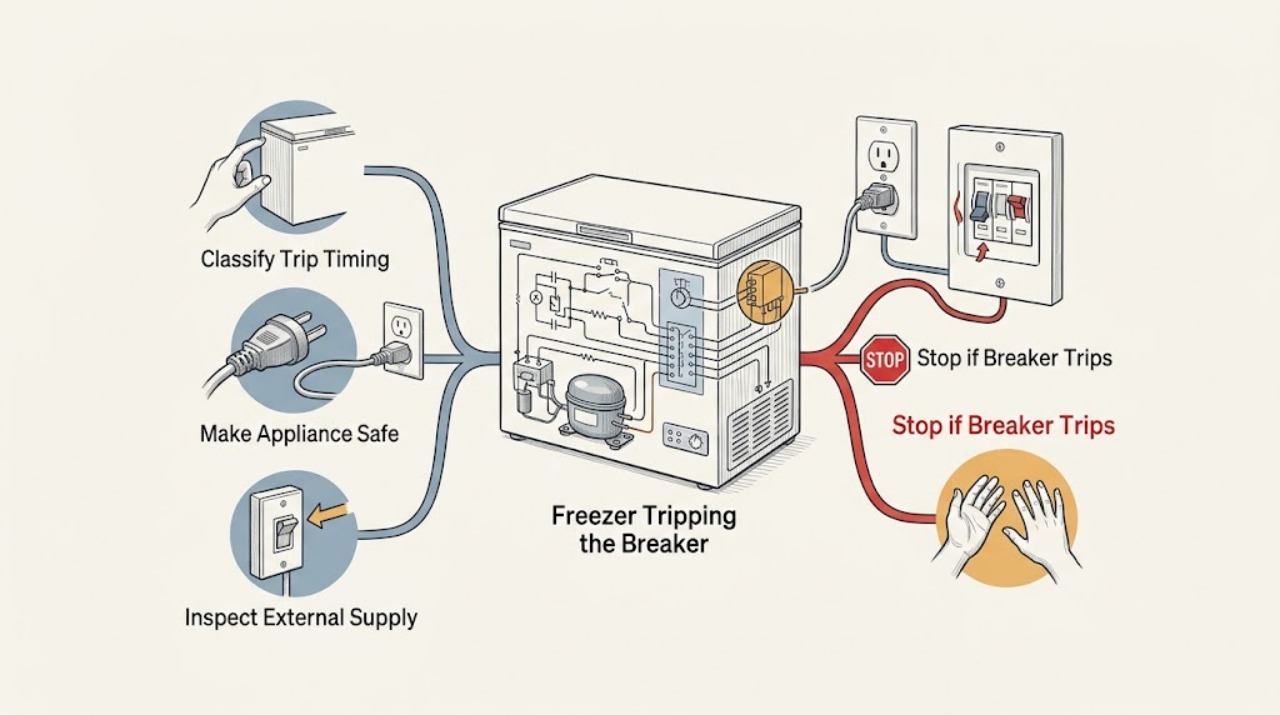
Work through in order
Diagnostic checks
Use only checks that match the exact appliance or system and its official guide.
-
Check 1
Without repeatedly resetting anything, note when the breaker opens: immediately on switching the freezer on, when the compressor starts, after it has run, or only when another appliance is used. Note whether the interior light, display, or alarm also loses power.
Expected result: The trip is immediate, delayed, linked to compressor start, linked to another load, or the freezer has no indicator or light afterward.
Next step: Record the sequence and follow the matching circuit, installation, or service branch. Keep the freezer off until the cause is clear.
Stop if: Stop for smoke, sparking, burning odor, a hot plug or outlet, moisture, damaged insulation, or exposed wiring.
Why this matters
Why: Immediate or compressor-linked trips keep an appliance electrical fault in view; a trip that follows another load may indicate circuit overload. A dark freezer after the trip confirms loss of supply but does not identify the failed component.
-
Check 2
Turn the freezer control to OFF if the model provides an ordinary user control, and disconnect it only if the plug is accessible, dry, and safe to reach without moving a built-in appliance or touching damaged parts.
Expected result: The freezer can be isolated normally, the plug is inaccessible, the outlet or cord looks damaged, or the area is wet or hot.
Next step: Leave the freezer isolated and arrange qualified service when the connection cannot be made safe from outside. Keep the door closed to slow warming of the contents.
Stop if: Do not pull a tight cord, reach behind a built-in unit, handle wet electrical parts, remove covers, or work inside a junction box.
Why this matters
Why: Removing the appliance from the suspected load can help a qualified person distinguish a house-circuit issue from an appliance fault, but an inaccessible, wet, hot, or damaged connection is not a user test area.
-
Check 3
Inspect the visible plug, cord, outlet face, and accessible isolator for looseness, scorch marks, cuts, heat, moisture, or an extension cord. Check whether the outlet or GFI/RCD indicator is tripped only by its normal external control.
Expected result: The plug is loose, an extension cord is present, the outlet or cord is marked or hot, the GFI/RCD is open, or the external supply looks normal.
Next step: Remove an extension cord from service and correct only an obvious external control position when there is no hazard. If damage, heat, moisture, or another trip is present, leave the freezer off and call a qualified electrician or appliance technician.
Stop if: Do not replace a plug, repair insulation, probe the outlet, bypass a GFI/RCD, or use the freezer from a different outlet as a repeated trial.
Why this matters
Why: Electrolux says the cord should fit tightly and that an extension cord should not be used. A damaged, hot, wet, or repeatedly tripping connection can create shock or fire risk; a normal-looking exterior does not clear an internal fault.
-
Check 4
Consider what else shares the circuit and whether the freezer was recently installed, moved, or added alongside another high-load appliance. Check the rating information and installation guide without opening the appliance or changing wiring.
Expected result: The trip began after installation or another appliance was added, several loads share the circuit, the freezer has an individual suitable circuit, or the circuit information is unknown.
Next step: For a new installation, contact the installer or qualified electrician. For an established installation with repeat trips, leave the freezer off and arrange qualified diagnosis; do not alter the circuit yourself.
Stop if: Do not install a larger breaker, substitute a fuse, share a temporary extension lead, or remove an appliance ground.
Why this matters
Why: Electrolux lists overload and faulty installation among possible causes of repeated trips and says applicable freezer models need an individual, properly grounded branch circuit. A circuit that is unknown or overloaded needs electrical assessment rather than a larger fuse or breaker.
-
Check 5
Only when there is no odor, heat, moisture, visible damage, or recent repeat trip, restore the household breaker or normal external supply once according to the household equipment instructions and watch from a safe position as the freezer is switched on.
Expected result: The freezer starts and the breaker stays set, the breaker opens immediately, or it opens again after the compressor attempts to run.
Next step: If it trips at any point, switch the freezer off, keep it isolated, and arrange qualified service. If it remains running, monitor without repeated cycling and seek service if the trip returns or cooling does not resume.
Stop if: Do not reset the breaker again after a second trip, hold it closed, run an ungrounded connection, or continue if the freezer smells hot or electrical.
Why this matters
Why: A stable restart shows only that the fault did not recur during this observation; it does not prove the appliance is repaired. An immediate or repeat trip is evidence that the protective device is responding to an unresolved supply or appliance fault.
-
Check 6
Record the exact model, trip timing, display and light state, compressor or fan sound, recent installation or outage, circuit loads, visible cord and outlet condition, and whether food is warming. Keep the door closed and move contents only if that can be done without handling an unsafe connection.
Expected result: The freezer remains off, cooling does not return, the breaker trips again, or the electrical warning is accompanied by smoke, water, heat, or odor.
Next step: Leave the appliance off and contact Electrolux or qualified appliance service; use a qualified electrician for the household circuit. Give the technician the model and the exact trip sequence.
Stop if: Do not open panels, test capacitors or compressor terminals, replace internal parts, or continue operation after a protective trip with warning signs.
Why this matters
Why: The record helps service distinguish supply or overload from a freezer-side electrical fault without guessing at a compressor, relay, control, or wiring part. A freezer that remains off can lose safe temperature even if the breaker later stays set.
Use your observations
Decision map
Find the observation that best matches what you see, then follow the next safe action.
-
PATH 01Safety boundary
What you see
The breaker opens as soon as the Electrolux freezer is switched on or plugged in.
Do this next
Do not reset it again. Isolate the freezer only by a safe accessible control and arrange qualified electrical or appliance service.
Why this path and its safety boundary
Why it matters: The appliance or its immediate connection may have a fault, although a circuit or installation problem remains possible.
Safety stop: No live testing, outlet substitution, extension cord, fuse change, or cabinet access.
-
PATH 02Safety boundary
What you see
The breaker stays set at first but opens when the freezer starts cooling or after it has run for a while.
Do this next
Leave the freezer off after the trip and arrange qualified service. Provide the delay from startup and any hum, click, heat, or odor that preceded it.
Why this path and its safety boundary
Why it matters: A compressor-start or running-load fault is possible, but the symptom alone cannot identify a compressor, relay, wiring, or control component.
Safety stop: Do not keep cycling the compressor, touch the rear electrical area, or attempt a part replacement.
-
PATH 03Safety boundary
What you see
The breaker opens only when another appliance is used or after a new appliance was added.
Do this next
Stop adding loads and have a qualified electrician assess the circuit, grounding, and installation. Do not fit a larger protective device.
Why this path and its safety boundary
Why it matters: Overload, an unsuitable branch circuit, or an installation issue may be involved rather than a freezer-only fault.
Safety stop: Do not use a multi-outlet adapter or extension lead as a workaround, remove grounding, or rewire the circuit.
-
PATH 04Safety boundary
What you see
The breaker problem began immediately after the freezer was installed, moved, or connected to a different supply.
Do this next
Leave the freezer off and contact the installer or a qualified electrician to verify the connection. Do not pull out a built-in unit or inspect terminals yourself.
Why this path and its safety boundary
Why it matters: Electrolux identifies faulty installation as a possible cause of a recurring trip; the rating plate and local requirements determine the correct supply.
Safety stop: No connection-cover access, cable rewiring, grounding changes, or repeated reset attempts.
-
PATH 05Safety boundary
What you see
The cord or outlet is hot or damaged, there is moisture, smoke, burning odor, exposed wiring, or the breaker trips again after one safe external check.
Do this next
Keep people away, isolate the appliance only by a safe normal control, and arrange prompt qualified electrical or appliance service. Keep the freezer door closed while waiting.
Why this path and its safety boundary
Why it matters: This is a safety event and the protective device may be preventing a more serious electrical hazard.
Safety stop: Do not touch wet or hot electrical parts, reset the circuit again, or use the freezer until cleared by a qualified person.
Helpful context
Understand the symptom
The timing of the trip changes the next check
A breaker that opens immediately when the freezer is switched on points to a different fault path from a trip that occurs only after the compressor has run for a while or when another appliance starts. Record the timing, whether the freezer display or interior light went dark, and whether the breaker stays set with the freezer disconnected. Do not use timing alone to name a failed part.
Treat a repeat trip as a safety event
Electrolux describes recurring appliance trips as potentially related to cable damage, moisture, installation, overload, or an internal component fault and advises trained service. A single reset may establish whether the supply returns when there is no visible hazard; a second trip ends user troubleshooting. Keep the door closed while deciding how to protect the contents.
Installation and model details matter
Electrolux's freezer guidance calls for an individual, properly grounded branch circuit for the applicable models, while exact electrical requirements depend on the rating plate and local installation rules. A newly installed or relocated freezer needs the installer or a qualified electrician to check the connection. Do not infer a fuse rating or move a built-in appliance to another circuit as a test.
Safety boundary
Stop conditions
- Stop immediately for smoke, sparking, burning odor, a hot plug or outlet, moisture near electrical parts, damaged insulation, or exposed wiring.
- Do not repeatedly reset the breaker, install a larger protective device, substitute a fuse, use an extension cord, bypass grounding, or hold a protective device closed.
- Do not open the freezer cabinet, access compressor or control terminals, perform live measurements, or replace an internal electrical part as a user check.
- Stop after one safe external supply observation if the breaker opens again, the freezer remains off, or cooling does not return; arrange qualified service.
When checks do not resolve it
Need a professional?
Arrange qualified appliance or electrical service when the Electrolux freezer trips the breaker again after one safe external check, trips as the compressor starts, remains off, or was recently installed or moved. Use a qualified electrician when other loads or the household circuit appear involved. Stop promptly for smoke, sparking, burning odor, heat, moisture, damaged cord or outlet, or exposed wiring.
Safety scope: This article covers symptom classification, safe external isolation, visible connection observation, circuit-load context, and at most one supervised restoration when there is no hazard. Electrical testing, circuit changes, cabinet removal, compressor or control diagnosis, internal parts, and protective-device work require qualified service.
Common questions
FAQ
Why does my Electrolux freezer trip the breaker immediately?
Do not keep resetting it. Note whether the trip happens as soon as the freezer is switched on, then isolate it only through a safe accessible control and arrange qualified appliance or electrical service. The symptom does not identify a compressor, wiring, or control part by itself.
Can I reset the breaker when my Electrolux freezer trips?
Only one restoration attempt is reasonable when there is no smoke, odor, heat, moisture, damage, or recent repeat trip and the normal household control can be operated safely. If it opens again, leave the freezer off and arrange qualified service; never hold the breaker closed or keep cycling it.
Could another appliance be causing my Electrolux freezer to trip?
Yes, an overloaded or unsuitable shared circuit is one possibility, especially if the problem began after another appliance was added. Stop adding loads and have a qualified electrician check the circuit and installation. Do not use an extension cord or fit a larger protective device.
What should I check on the Electrolux freezer power connection?
Check only the visible plug, cord, outlet or isolator, and any normal GFI/RCD indicator. Electrolux says the plug should fit tightly and an extension cord should not be used. If the connection is hot, wet, loose, marked, or damaged, stop and arrange qualified service.
When should I stop troubleshooting an Electrolux freezer that trips the breaker?
Stop after a repeat trip or for smoke, sparking, burning odor, heat, moisture, damaged insulation, exposed wiring, or a newly installed connection. Leave the freezer off, keep its door closed, and arrange qualified appliance or electrical service rather than opening the cabinet.
Read the exact guide
Official sources
- What should I do if my freezer isn't running?Electrolux · Official Electrolux support article applying directly to freezers; it lists first external checks but does not diagnose a repeated trip or internal part.
- Freezer - Not Freezing or Not CoolingElectrolux · Official Electrolux freezer support article; circuit and power observations are relevant to a breaker-trip symptom, while its cooling-time guidance is used only to explain recovery limits.
- Oven Trips Fuses or Circuit Breaker – Causes & How to FixElectrolux · Cross-appliance Electrolux electrical-safety context, not a freezer-specific component diagnosis; used only for the repeated-trip service boundary and installation or overload cautions.
Community feedback
Share a repair observation
Share a plain-text repair observation. Accepted observations are published automatically; this page may take a moment to update.