
On this page
Start here
Quick answer
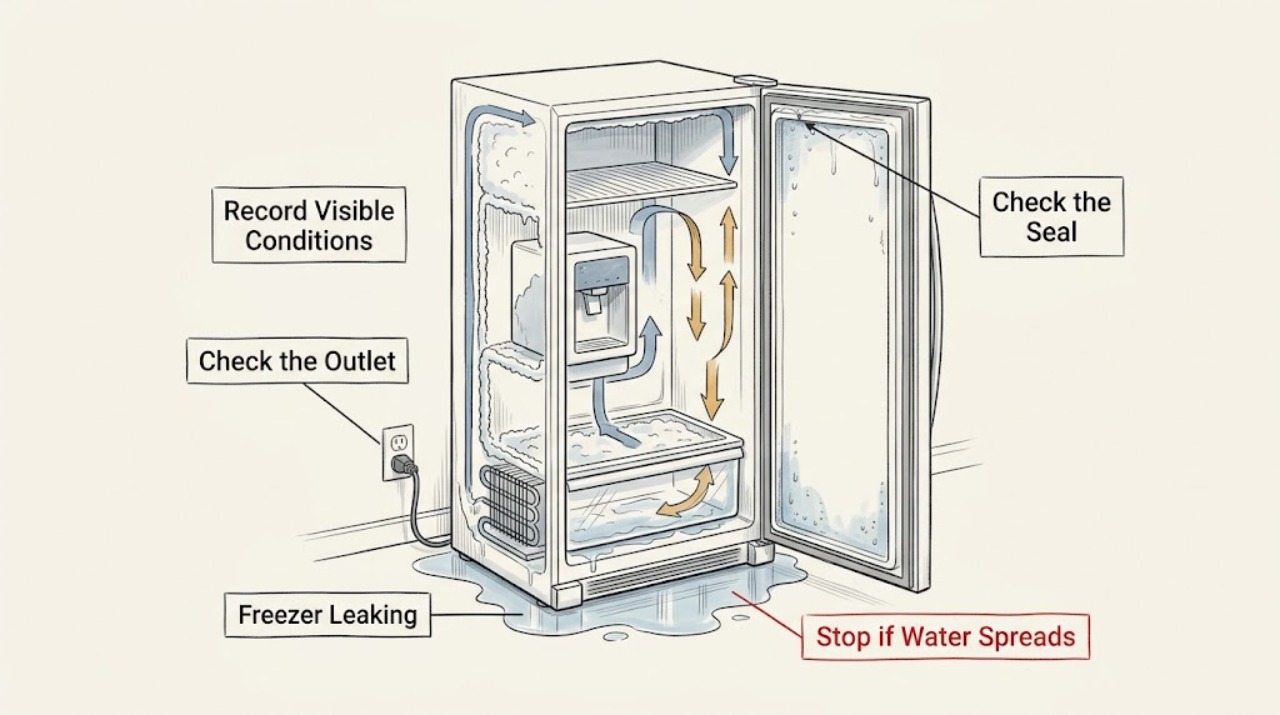
Protect the floor and keep water away from electrical connections, then determine whether the water is inside the cabinet, at the door or lid, on the outside wall, or beneath the freezer. A door or lid left slightly open, a dirty or poorly fitted gasket, blocked airflow, and frost buildup can let warm air enter and create conditions for frost to melt or moisture to form. Check those user-accessible causes without chipping ice or opening panels. If the freezer is not cooling, the leak returns, water comes from an optional water connection, or there is damage or an electrical hazard, stop and arrange qualified service.
Work through in order
Diagnostic checks
Use only checks that match the exact appliance or system and its official guide.
-
Check 1
Keep people away from the wet area, move loose items away from the puddle, and look without touching wet plugs, cords, outlets, or damaged cabinet surfaces. If water is reaching an electrical connection, the cord is damaged, there is smoke or a burning smell, or the cabinet is unstable, stop and do not continue tracing the leak.
Expected result: Water is near electricity, visible damage or smoke is present, or the leak is large or rapidly worsening.
Next step: Keep the freezer out of use and arrange qualified appliance/electrical service. Do not pull the appliance through water, remove covers, or touch wet electrical parts; use an emergency response if there is active smoke or fire.
Why this matters
Why: The immediate concern is shock, fire, or property damage, not a routine gasket check.
-
Check 2
After the area is safe, dry the accessible floor and cabinet surfaces. Note whether new water appears inside the bottom, along the door or lid edge, on the outside wall, underneath the unit, or near an optional ice-maker or water connection. Record whether it follows door opening, a defrost or power event, a long-open lid, or continuous operation.
Expected result: The water returns from the cabinet interior, seal edge, exterior condensation area, underside, or a connected water component.
Next step: Use the matching gasket, frost/airflow, cooling, or connected-water branch below. If the source cannot be located without moving or opening the freezer, stop and schedule service.
Why this matters
Why: Location and timing distinguish melted frost or condensation from a seal, cooling, drain, or water-line problem; the visible puddle may not be the original source.
-
Check 3
Inspect the user-accessible door or lid perimeter for packages, ice, or debris preventing full closure. Check that the gasket is clean, seated, and not visibly cracked, warped, or pulled away; clean it with the method allowed by the manual and close the door or lid fully.
Expected result: The door or lid was held open, the gasket has a visible gap or damage, or it closes fully with a continuous seal.
Next step: Remove only the accessible obstruction and monitor after the seal is restored. If the gasket cannot seal, the door/lid is warped, or water returns despite a good seal, arrange service; do not use tape or an improvised gasket.
Why this matters
Why: Electrolux says an open or poorly sealing door/lid allows warm moist air in, which can produce moisture and frost and may later leave meltwater.
-
Check 4
Look inside without dismantling the freezer for heavy frost, ice obstructing closure, or food blocking the marked air vents. Rearrange only accessible food to leave the vents and door path clear. Do not chip ice with a knife, heat the cabinet with an improvised heater, or remove an interior panel to reach a drain.
Expected result: Frost is heavy or concentrated around the door/air path, vents are blocked, or there is little frost and no visible airflow obstruction.
Next step: Correct only the accessible closure or airflow issue and follow the exact manual for any approved defrost procedure. If frost quickly returns, the leak persists, or a drain path would need disassembly, stop and arrange service.
Why this matters
Why: Electrolux links frost to warm-air entry, poor gasket sealing, very cold settings, and blocked airflow; excess frost can prevent closure and reduce circulation, allowing later meltwater or unstable temperature.
-
Check 5
Check the normal user-facing control, interior light or indicator, and ordinary compressor/fan activity without pulling the freezer away from the wall. If the unit recently lost power, verify the user-accessible plug and breaker once, provided there is no wet electrical hazard; do not use an extension cord or open a service panel.
Expected result: The freezer is running and cold, it is silent with no indicators, it recently lost power, or it runs but remains warm while water accumulates.
Next step: Restore only an obvious user-level power or control condition once. If it does not run, a breaker trips again, or it remains warm after the specified stabilization period, protect the food and arrange qualified service; do not repeatedly reset the circuit.
Why this matters
Why: A non-running or warm freezer can allow stored frost to melt and can make a leak look like a drain failure. Electrolux lists the control being off, a tripped breaker, an unplugged cord, and an outage as possible no-run causes, while persistent no-cooling requires service.
-
Check 6
Only if this Electrolux product is a refrigerator/freezer combination or has an ice-maker or water connection, inspect from the normal accessible position for a wet line, filter housing, or valve area. Do not pull the appliance through a puddle or loosen a connection; use the exact manual for any water shutoff instruction.
Expected result: A connected line or valve area is wet, the water is clearly unrelated to a connection, or the product has no water circuit.
Next step: If an accessible connection is wet, stop using the ice/water feature and arrange service or installer review rather than tightening hidden fittings. If there is no connection, return to the seal, frost, and cooling branches.
Why this matters
Why: Electrolux's water-leak guidance for refrigerator products treats wet connections, valves, filters, and melted ice as separate sources from door-open frost; a standalone freezer may not have those components.
-
Check 7
Stop user troubleshooting when water returns after the seal and airflow checks, frost rapidly rebuilds, the freezer is warm or not running, the source is beneath or behind the cabinet, an optional water connection leaks, or any wet electrical hazard is present.
Expected result: The leak persists or its cause would require moving, tilting, opening, thawing with heat, or testing internal refrigeration or electrical parts.
Next step: Keep the freezer out of service as appropriate and arrange an authorized Electrolux appliance technician. Provide the exact model, leak location, timing, frost pattern, temperature/cooling symptom, power result, and whether an ice-maker or water connection is fitted.
Why this matters
Why: The remaining causes may include a defrost drain or tray, drain heater, gasket/door alignment, cooling control, evaporator, water valve, or internal wiring fault requiring model-specific diagnosis.
Use your observations
Decision map
Find the observation that best matches what you see, then follow the next safe action.
-
PATH 01Next step
What you see
Water is reaching an outlet, plug, cord, or damaged cabinet, or there is smoke or a burning smell
Do this next
Stop immediately and do not touch wet electrical parts or move the freezer through water. Keep it out of use and arrange qualified electrical/appliance service; use emergency response for active smoke or fire.
-
PATH 02Next step
What you see
Water appears at the door or lid edge and the gasket has a gap, debris, or visible damage
Do this next
Clear only accessible obstructions, clean the gasket as the manual allows, and close the door/lid fully. A damaged or poorly sealing gasket that continues to leak needs service or an exact-model replacement.
-
PATH 03Next step
What you see
Heavy frost blocks vents or closure, or water follows a long-open door/lid
Do this next
Restore closure and airflow and follow the exact manual for any approved defrost procedure. Do not chip ice or heat the cabinet; recurring frost or water requires service.
-
PATH 04Next step
What you see
The freezer is not running or remains warm while frost or stored ice melts
Do this next
Check the normal control, plug, and breaker once if dry and safe. If power is absent, a breaker trips again, or cooling does not return after the manufacturer's stabilization guidance, protect food and arrange service.
-
PATH 05Next step
What you see
A connected ice-maker, filter, water line, or valve area is wet
Do this next
Stop using the connected water feature and use the model manual's shutoff guidance if accessible. Do not loosen hidden fittings; arrange service or installer review.
-
PATH 06Next step
What you see
The freezer is cold, the door seal is good, and no connected-water source is wet, but water returns underneath or inside
Do this next
Do not assume the puddle identifies a replaceable part. Keep the appliance out of service as needed and arrange an authorized technician to assess the drain, defrost system, tray, and internal cooling path.
Helpful context
Understand the symptom
The location of the water changes the diagnosis
Water at the door or lid edge suggests a seal or condensation path; water inside the bottom may be melted frost; and water beneath the unit may have travelled from an internal drain or an optional water connection. Dry the area and observe again rather than assuming the wettest spot is the source. Do not move a heavy freezer or remove a rear cover just to trace a leak.
Door seal and frost are connected
Electrolux says a door or lid that is slightly open lets cold air meet warm, moist air and can create outside moisture. Its frost guidance also points to a warped or poorly sealing gasket, blocked vents, and obstructed closure as causes of frost. A gasket check is therefore more useful than immediately replacing a drain or compressor part.
Protect food while you decide whether the freezer is still cooling
If the freezer is warm, not running, or has been without power, keep the door or lid closed as much as practical and assess the food separately. Electrolux notes that a recently reconnected unit may need time to stabilize, but a unit that still does not cool after the manufacturer's stabilization guidance needs service. Do not use a leak as a reason to keep restarting a tripping circuit.
Only after diagnosis
Potential parts
- freezer door or lid gasket
Consider only when inspection and qualified diagnosis confirm that the gasket is damaged, warped, or unable to seal after accessible cleaning and closure checks.
Confirm the exact Electrolux model and approved gasket fit; do not substitute a generic seal or use an improvised repair. - defrost drain, drain heater, or collection tray
Consider only when a technician links recurring interior or underside water and frost to a restricted or failed defrost-water path; a puddle alone does not identify one of these parts.
Drain and defrost components are exact-model and configuration specific and require qualified access and testing. - temperature control, sensor, or defrost control
Consider only after qualified testing finds that the freezer is warm, over-frosted, or repeatedly melting because a control or sensor is not managing the cycle correctly.
Match the exact model and control revision; do not infer compatibility from a similar freezer. - water inlet valve, filter housing, or water line
Consider only for a combination product or model with an ice-maker/water circuit when qualified inspection identifies a wet valve, line, filter housing, or fitting.
Use the exact model, water-system configuration, and approved installation requirements; standalone freezers may not use these parts.
When checks do not resolve it
Need a professional?
Arrange qualified Electrolux service when the leak returns after the door, gasket, frost, and airflow checks; frost rapidly rebuilds; the freezer is warm or not running; water comes from underneath, behind the cabinet, or an optional water connection; or any internal drain, defrost, refrigeration, or electrical diagnosis would be required. Stop immediately for water near electricity, smoke, burning smell, cabinet damage, or an unstable appliance.
Common questions
FAQ
Why is my Electrolux freezer leaking water from the bottom?
First check whether the door or lid was left open, the gasket seals fully, frost is blocking airflow or closure, and the freezer is still cooling. Melted frost can travel before appearing at the bottom. If the freezer is warm, not running, or the water returns after those checks, arrange service rather than opening the cabinet.
Can a bad Electrolux freezer gasket cause leaking?
Yes, an unsealed door or lid allows warm moist air in. Electrolux links poor gasket fit to longer running and frost, while a slightly open door or lid can create moisture. Clean and inspect the accessible gasket; persistent gaps or damage need an exact-model repair.
Should I chip away ice inside a leaking Electrolux freezer?
No. Do not use a knife, sharp tool, or improvised heat to reach an internal drain or evaporator. Follow the exact model manual for any approved defrost procedure; recurring frost or water, or a path that requires panel removal, belongs with qualified service.
What if my Electrolux freezer is leaking and not cooling?
Treat the cooling symptom as part of the diagnosis: check only the normal control, plug, and breaker if the area is dry and safe. Electrolux lists power interruption and a non-running unit as possible causes and directs service when cooling does not return after stabilization guidance. Keep the door closed as much as practical and protect food separately.
What if water is coming from an Electrolux freezer's water line?
That branch applies only to a refrigerator/freezer combination or freezer model fitted with an ice-maker or water circuit. Identify the wet accessible connection without moving the unit through water or loosening hidden fittings, stop using the water feature, and arrange service or installer review.
Read the exact guide
Official sources
- Refrigerators / Freezer - Frost Build UpElectrolux · Official Electrolux support identifying freezer frost symptoms; the page is categorized under refrigerators, so use the exact freezer manual for defrost procedures.
- Refrigerator Water LeaksElectrolux · Official Electrolux guidance for refrigerators, including combination products with freezer, ice-maker, dispenser, filter, or water connections; do not apply water-line checks to a standalone freezer without those features.
- Freezer - Not Freezing or Not CoolingElectrolux · Official Electrolux support for freezers and refrigerators with freezers; use model instructions for installation and electrical details.
- What should I do if my freezer isn’t running?Electrolux · Official Electrolux support for freezers and refrigerators; restrict power checks to normal user-accessible conditions.
- Why is moisture forming on the outside of my freezer?Electrolux · Official Electrolux support for freezers and refrigerators; applies to moisture caused by a slightly open door or lid and humidity.
- Freezers - How can I set my freezer to run less frequently, or for shorter intervals?Electrolux · Official Electrolux support for freezers; gasket and door/lid observations are user-accessible, while exact repair instructions are model-specific.
Community feedback
Share a repair observation
Share a plain-text repair observation. Accepted observations are published automatically; this page may take a moment to update.