
On this page
Start here
Quick answer
A leaking Frigidaire freezer may be showing condensation from a door or lid that is not sealing, meltwater from excess frost, a water connection or filter issue on a refrigerator-freezer model, or an ice-maker or dispenser leak. First locate whether water is on the floor, inside the compartment, around the door, or below an ice or water dispenser, and note when it appears. Check only visible door, gasket, frost, airflow, connection, and ice-path conditions using the exact owner's manual. Stop for a fast leak, water near electrical parts, smoke, burning odor, damaged wiring, severe frost, an unstable appliance, or any need to remove panels or move the freezer; arrange qualified Frigidaire service.
Before you begin
Safety first
- This article covers locating the first wet point, visible door and gasket checks, external airflow and frost observations, ordinary-access water or ice-path inspection, and normal controls only. A qualified technician must handle panels, appliance movement, wiring, live measurement, defrost drains, sealed systems, valves, filters, ice makers, dispensers, and internal leaks.
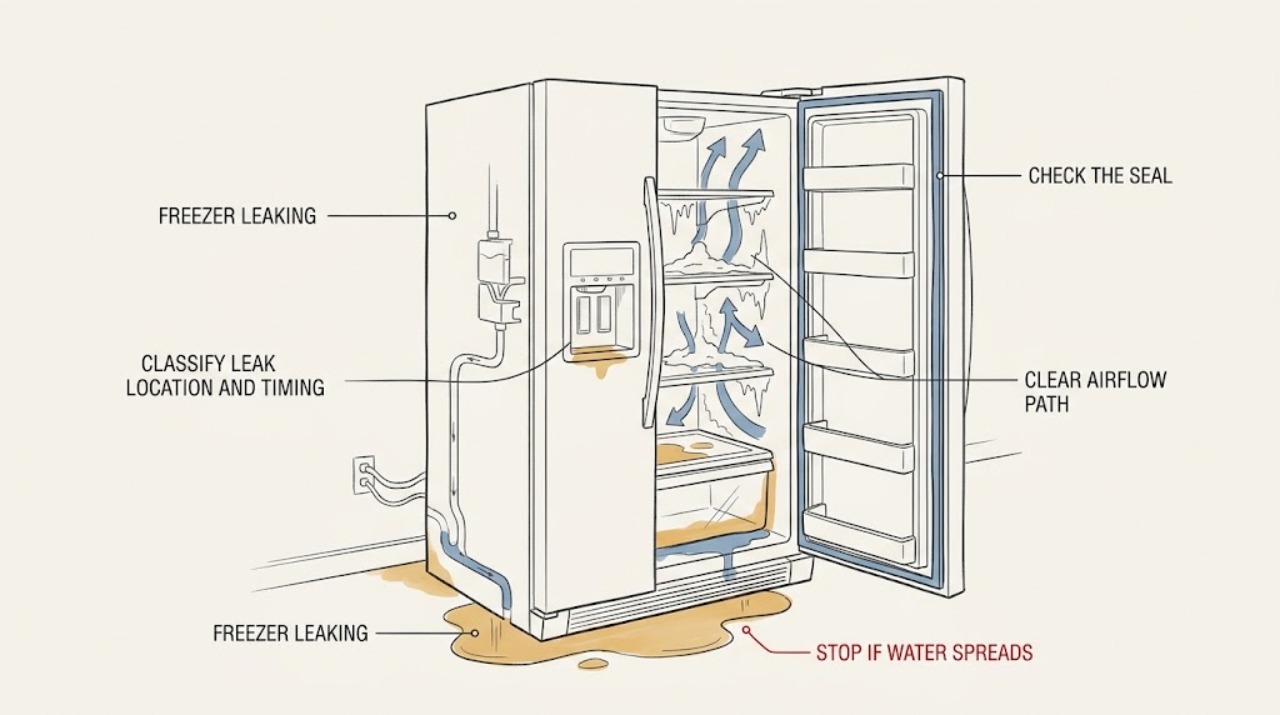
Work through in order
Diagnostic checks
Use only checks that match the exact appliance or system and its official guide.
-
Check 1
From a dry, safe position, locate the first visible water: floor or base, inside the freezer, around the door or lid, at an ice or water dispenser, or at a visible rear connection; note whether it appears during cooling, ice making, dispensing, or while idle.
Expected result: Record a small condensation film, a puddle at the base, water under an interior vent or drawer, water from a chute, a wet connection, or a fast or recurring leak.
Next step: Keep the freezer closed and out of operation if water continues. Use the observation to choose the applicable door, frost, connection, or dispenser branch and provide it to service.
Stop if: Do not run repeated cycles to reproduce a leak, touch wet electrical areas, or reach underneath a powered appliance.
Why this matters
Why: The location and timing separate door moisture, frost melt, dispenser or water-path issues, and internal leaks, but they do not identify a failed component.
-
Check 2
Confirm that the freezer door or lid closes fully and inspect the visible gasket for a gap, dirt, crack, distortion, or package preventing contact; do not remove the gasket or force the door.
Expected result: Record a clean continuous seal and normal closure, a package obstruction, a gasket gap or damage, or a door that does not align or stay closed.
Next step: Move only a visible package that blocks closure and clean the gasket with the manual-approved method. Arrange service for a damaged gasket, misaligned door, recurring moisture, or a door that will not seal.
Stop if: Do not pry the door, remove the gasket, shim the cabinet, or keep operating with a failed seal and warming food.
Why this matters
Why: Frigidaire explains that a slightly open door or lid lets warm humid air meet cold surfaces and can produce moisture; a non-sealing door can also destabilize freezer temperature and contribute to frost.
-
Check 3
Inspect visible vents and shelves for packages blocking airflow and look for heavy frost that interferes with the door or air path; check normal indicators and cooling behavior without removing an interior cover.
Expected result: Record clear vents and normal cooling, frost around an air path, frost preventing door closure, a high-temperature condition, unusual silence, or food beginning to soften.
Next step: Move only an accessible package obstruction and follow the exact manual's approved defrost guidance. Arrange service for recurring heavy frost, warming food, or a condition that requires panel access.
Stop if: Do not scrape frost with a sharp tool, use a heater or flame, pour hot water into the freezer, or dismantle the liner.
Why this matters
Why: Frigidaire says over-frosting can reduce airflow or prevent proper door closure, and a warm freezer is a cooling concern that may cause meltwater. Frost pattern alone does not identify a defrost or sealed-system part.
-
Check 4
Only on a refrigerator-freezer or freezer model with water hardware, inspect the visible supply tubing, valve area, filter housing, and floor for wet tracks, a loose-looking connection, a cracked filter, or water that starts during filling or dispensing; do not loosen fittings.
Expected result: Record no water hardware, a dry intact path, a wet connection, a recently changed filter, a cracked or poorly seated filter, or an active leak.
Next step: If the path is dry and correctly seated, continue with the ice-path or cooling checks. For a leak, cracked filter, damaged tubing, or inaccessible valve, stop the water feature if the manual provides a normal control and arrange qualified service.
Stop if: Do not disconnect tubing, pull the appliance from the wall alone, replace a valve, or operate with water near electrical components.
Why this matters
Why: Frigidaire identifies loose water connections and an incorrectly installed or cracked filter as possible leak paths on applicable models. This branch does not apply to a freezer without water hardware.
-
Check 5
Only when the model has an ice maker or dispenser, inspect the ordinary-access bin and chute for visible frost, a loose cube, or water droplets at the dispenser tip; keep fingers and tools out of the mechanism.
Expected result: Record no ice hardware, a clear dry chute, frost or ice at the chute, a wet dispenser tip, a leaking bin or ice maker, or an obstruction that cannot be removed normally.
Next step: Follow the exact manual for a visible loose obstruction only. Stop using the water or ice feature and arrange service for a crack, recurring leak, fixed jam, or leak inside the freezer compartment.
Stop if: Do not force an auger, insert tools into the chute, remove the ice maker, or apply heat to melt a blockage.
Why this matters
Why: Frigidaire says ice or frost in a chute can melt and leak, and air in a water line can cause dispenser drips. A leak from the ice-maker housing or a fixed obstruction needs model-specific service diagnosis.
-
Check 6
Check ordinary indicators such as interior light, control response, normal compressor or fan sound, and whether stored food remains frozen; inspect only the accessible plug and outlet area.
Expected result: Record normal cooling, no power response, a recent outage, repeated protection trip, unusual heat, or food warming with water or frost present.
Next step: If power is absent, protection trips, or cooling is abnormal, stop and arrange qualified appliance or electrical service. If cooling is normal, continue only with the applicable external leak branch.
Stop if: Do not probe the outlet, open electrical covers, repeatedly reset a tripping circuit, or operate a rapidly warming freezer as a leak test.
Why this matters
Why: Frigidaire lists power and cooling conditions as separate checks and notes that frost, door sealing, and airflow affect temperature. A freezer that is warming can produce meltwater and requires food-safety attention.
-
Check 7
Only when the leak has stopped, the freezer is dry and stable, no hazard exists, and the manual-approved external correction is complete, observe one normal cooling or ice cycle from outside without opening covers.
Expected result: Record no renewed water, water returning from the same location, a new wet area, recurring frost, a temperature alarm, or a protection trip.
Next step: Stop at the first renewed water and provide service with the location, timing, model, door, frost, cooling, and water-feature observations. Do not repeat the test to collect more evidence.
Stop if: Do not operate with an active leak, smoke, odor, exposed wiring, water near electrical parts, or food-safety concern.
Why this matters
Why: A dry observation after a clear door, airflow, or visible connection correction supports a resolved external condition but does not rule out an intermittent internal leak or defrost fault.
Use your observations
Decision map
Find the observation that best matches what you see, then follow the next safe action.
-
PATH 01Safety boundary
What you see
Moisture is on the outside or near the base and the door or lid is slightly open, obstructed, dirty, or not sealing.
Do this next
Clear only a visible obstruction and clean the gasket as the manual permits. Request service for a damaged gasket, misalignment, recurring moisture, or warming food.
Why this path and its safety boundary
Why it matters: Frigidaire explains that warm humid air entering around a door or lid can create moisture and that a non-sealing door can destabilize temperature.
Safety stop: Do not remove the gasket, force the door, or keep operating with a failed seal.
-
PATH 02Safety boundary
What you see
Water appears below an interior frost area or after the freezer has been warm, and frost blocks an airflow or door path.
Do this next
Follow only the exact manual's approved defrost guidance and protect food. Arrange service for recurring frost, persistent warming, or any required panel access.
Why this path and its safety boundary
Why it matters: Excess frost can reduce airflow or prevent closure; meltwater may follow, but the frost does not identify whether defrost, sealing, or cooling hardware is at fault.
Safety stop: Do not scrape, heat, or dismantle the freezer interior.
-
PATH 03Safety boundary
What you see
The applicable refrigerator-freezer has water hardware and water is visible at a supply connection, valve area, filter housing, or floor.
Do this next
Stop the water feature through the normal manual-approved control if available and arrange qualified service for the connection, filter housing, tubing, or valve.
Why this path and its safety boundary
Why it matters: Frigidaire identifies loose water connections and a damaged or poorly seated water filter as possible leak paths on applicable models.
Safety stop: Do not loosen fittings, remove a valve, or touch wet electrical components.
-
PATH 04Safety boundary
What you see
Water appears at an ice chute, dispenser tip, ice bin, or freezer ice-maker area on a model equipped with those features.
Do this next
Inspect only the ordinary-access chute or bin and follow the exact manual for a loose obstruction. Stop the feature and request service for recurring water, cracks, or a fixed obstruction.
Why this path and its safety boundary
Why it matters: Frigidaire says ice or frost in the chute can melt and leak, and air in the water line can cause dispenser drips; a housing leak remains a service issue.
Safety stop: Do not force the auger, remove the ice maker, or apply heat to the chute.
-
PATH 05Safety boundary
What you see
The freezer is warming, lacks normal power response, has a repeated protection trip, or shows abnormal cooling with meltwater.
Do this next
Protect food according to food-safety guidance and arrange qualified appliance or electrical service.
Why this path and its safety boundary
Why it matters: A cooling or power condition may be producing meltwater and is more urgent than locating a minor puddle.
Safety stop: Do not probe circuits, open covers, repeatedly reset protection, or continue operation with smoke or burning odor.
-
PATH 06Safety boundary
What you see
Water appears underneath or inside without a clear external source, returns after visible checks, or requires moving the appliance or removing a panel.
Do this next
Stop using the freezer and arrange qualified Frigidaire leak diagnosis with the timing, location, cooling, frost, and water-feature record.
Why this path and its safety boundary
Why it matters: An internal drain, defrost path, hose, valve, seal, ice maker, or cabinet fault remains possible and cannot be selected from the puddle location.
Safety stop: Do not move the appliance alone, remove the liner, scrape ice, or investigate behind covers.
-
PATH 07Safety boundary
What you see
There is a fast uncontrolled leak, water near electrical parts, smoke, burning odor, exposed wiring, repeated protection trips, severe physical damage, or food-safety risk from a warm freezer.
Do this next
Stop using the appliance, keep people clear, and contact qualified appliance or electrical service; leave and contact local emergency services if there is fire or immediate danger.
Why this path and its safety boundary
Why it matters: These signs indicate a potential electrical, fire, water, or food-safety hazard beyond ordinary leak troubleshooting.
Safety stop: Do not restart the freezer, touch wet electrical parts, pour liquid into the unit, or investigate behind covers.
Helpful context
Understand the symptom
Locate the first wet point before choosing a cause
Water on the floor, water under a drawer, moisture on the outside, and water from a dispenser do not share one diagnosis. Frigidaire's guidance separates door or lid moisture, water connections, filters, frost, and ice-chute conditions. Wipe only accessible surfaces if it is safe, keep the door closed, and record whether the leak appears during cooling, defrosting, ice making, dispensing, or while the appliance is idle.
A freezer with a water feature has extra branches
A standalone freezer may have no water plumbing, while a refrigerator-freezer may have an ice maker, dispenser, or filter. Water connections and ice-chute checks therefore apply only when that hardware is present. Frigidaire says model features and controls vary, so the exact use-and-care manual controls whether a filter, bin, chute, or drain procedure is user-accessible.
Persistent water or recurring frost needs diagnosis
If the door seals, visible connections are dry, airflow is clear, and water returns, the fault may involve an internal drain, defrost system, hose, valve, ice maker, dispenser, or cabinet seal. Frigidaire directs unresolved leak and cooling conditions to service. Do not remove panels, melt frost with a heater, or choose a part from the puddle location alone.
Safety boundary
Stop conditions
- Stop immediately for a fast or recurring leak, water near electrical components, smoke, burning odor, exposed or damaged wiring, repeated electrical trips, severe physical damage, or food warming in the freezer.
- Do not remove interior or rear panels, move the appliance alone, probe live circuits, or access a defrost drain, fan, valve, or sealed system.
- Do not scrape frost with sharp tools, use a heater or flame, pour hot water into the freezer, force an ice chute, or remove an ice maker.
- Do not loosen water fittings, remove a filter housing, pull the appliance from the wall, or touch wet electrical areas.
- Do not select a replacement gasket, filter, valve, drain, fan, defrost component, or ice-maker part from the puddle location alone; use exact model diagnosis.
Only after diagnosis
Potential parts
- door or lid gasket
Consider this category only when qualified inspection confirms that a damaged or non-sealing gasket is allowing moisture or meltwater conditions after visible closure checks.
Confirm the exact Frigidaire model and technician diagnosis; do not remove or reshape the gasket as a first check. - water filter housing or inlet valve
Consider this category only on models equipped with water hardware and only after diagnosis locates the leak at the filter housing, valve, or connection.
Confirm exact model fit and water-system diagnosis; water-line disconnection and valve access are service work. - ice-maker or dispenser assembly
Consider this category only when qualified inspection finds a leak or damaged component in the model's ice maker, bin, chute, or dispenser path.
Confirm the exact model and professional diagnosis; do not force the auger or remove the ice maker. - defrost drain or cooling assembly
Consider this category only when service diagnosis links recurring internal water, frost, or meltwater to a drain, defrost, fan, or cooling fault after external conditions are ruled out.
Confirm exact model and technician diagnosis; interior and sealed-system access are not user troubleshooting.
When checks do not resolve it
Need a professional?
Arrange qualified Frigidaire service when the leak is underneath or internal, returns after a visible door, frost, airflow, connection, or chute check, involves a water valve, filter housing, ice maker, or dispenser, causes abnormal cooling, or presents any electrical, fire, water, or food-safety hazard.
Safety scope: This article covers locating the first wet point, visible door and gasket checks, external airflow and frost observations, ordinary-access water or ice-path inspection, and normal controls only. A qualified technician must handle panels, appliance movement, wiring, live measurement, defrost drains, sealed systems, valves, filters, ice makers, dispensers, and internal leaks.
Common questions
FAQ
Where should I look first when my Frigidaire freezer is leaking?
Locate the first wet point at the floor, inside compartment, door or lid, water connection, ice maker, or dispenser and note when it appears. The location narrows the branch but does not identify a failed part.
Can a Frigidaire freezer door gasket cause water outside the unit?
Yes. Frigidaire explains that a slightly open or non-sealing door lets warm humid air in, which can create moisture and frost. Check only visible closure and gasket contact; service is needed for damage, recurring moisture, or warming food.
Could frost make a Frigidaire freezer leak?
It can contribute to water when frost blocks airflow or prevents the door from sealing and later melts. Follow only the exact manual's approved defrost guidance; do not scrape or heat the freezer interior.
What if my Frigidaire freezer has an ice maker or dispenser?
On applicable refrigerator-freezer models, Frigidaire identifies loose water connections, a filter problem, ice or frost in the chute, and dispenser-line drips as possible water paths. Inspect only ordinary-access areas and arrange service for a recurring leak or damaged mechanism.
What if the freezer is leaking and not staying cold?
Treat cooling and food safety as the priority. Check only visible power, door, frost, and airflow conditions, keep the door closed, and arrange qualified service for persistent warming, heavy frost, or meltwater.
When should I stop using a leaking Frigidaire freezer?
Stop for a fast or recurring leak, water near electrical parts, smoke, burning odor, damaged wiring, repeated protection trips, severe frost, an unstable appliance, a warm freezer with food at risk, or any need to remove panels or move the appliance.
Read the exact guide
Official sources
- Freezer - Not Freezing or Not CoolingFrigidaire · Frigidaire support guidance for freezers and refrigerator freezer sections; exact model manual controls settings and installation requirements.
- What should I do if my freezer isn’t running?Frigidaire · Frigidaire support guidance for freezers and refrigerators; the model's electrical installation and controls remain authoritative.
- Why is moisture forming on the outside of my freezer?Frigidaire · Frigidaire support guidance for freezers and refrigerators; it supports the door, lid, and condensation branch rather than identifying an internal leak component.
- Refrigerator Water LeaksFrigidaire · Frigidaire support guidance for refrigerators with freezer sections and water or ice hardware; apply the water-feature branches only when the exact freezer configuration includes them.
Community feedback
Share a repair observation
Share a plain-text repair observation. Accepted observations are published automatically; this page may take a moment to update.