
On this page
Start here
Quick answer
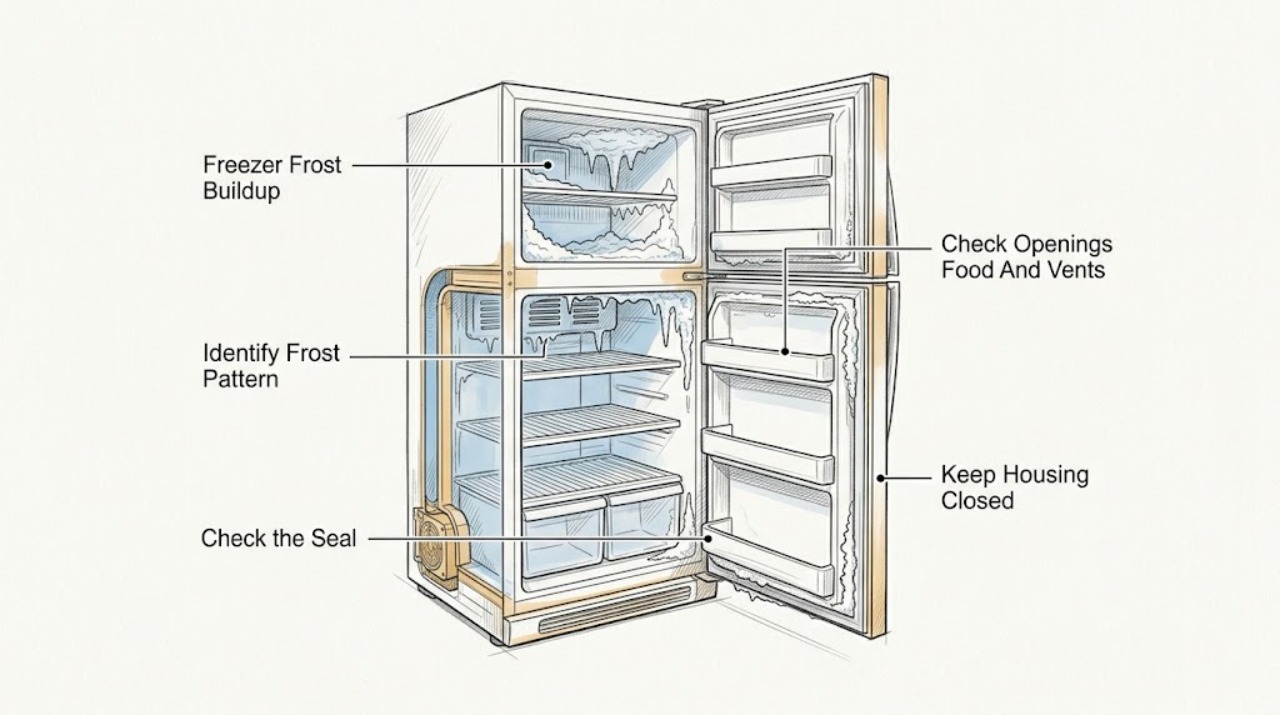
Some frost can be normal in an Electrolux Low Frost freezer, because moisture enters when the door opens; a No Frost model should not develop ongoing ice during normal operation. Start by identifying which design your model has, then check that the door or lid closes and seals, food is not blocking the seal or internal vents, openings are not unnecessarily frequent, and food is covered. If the model is not No Frost and its manual allows user defrosting, disconnect it through a normal accessible point, move the food, let ice melt naturally, protect against water, dry the interior, and never chip ice with a sharp tool. Repeated frost, a damaged seal, frost in a No Frost model, food thawing, or any check that requires a panel or internal defrost-system access calls for authorized service.
Before you begin
Safety first
- This article covers ordinary-access observation, loading changes, seal inspection, and manual-approved natural defrosting only. A qualified technician must handle panels, automatic defrost parts, fans, controls, wiring, refrigerant, and sealed-system diagnosis.
Work through in order
Diagnostic checks
Use only checks that match the exact appliance or system and its official guide.
-
Check 1
From ordinary access, identify whether the Electrolux freezer is a Low Frost or No Frost design using its model documentation, and photograph or describe where frost appears: walls, shelves, food packages, vents, door edge, or one localized area.
Expected result: Record occasional wall frost on a Low Frost model, ongoing ice on a No Frost model, a sheet that blocks airflow, frost concentrated around the door seal, or frost that returns soon after defrosting.
Next step: Continue to the closure and vent checks when the frost is limited and there is no food-warming or safety concern. Arrange service for a No Frost buildup, rapid recurrence, food thawing, or any pattern that would require internal access.
Stop if: Do not remove interior panels, probe hidden ice, or use a sharp tool to decide whether the frost is normal.
Why this matters
Why: Occasional frost can be expected on Low Frost models. Frost in a No Frost model, frost that blocks airflow, rapid recurrence, or a door-edge pattern points to a sealing, usage, airflow, or defrost-system problem rather than ordinary accumulation.
-
Check 2
Inspect the door or lid, gasket, hinges, and surrounding frame without removing parts; make sure packages are not protruding and preventing complete closure, and use a sheet of paper at several accessible points to see whether the closed seal holds it with some resistance.
Expected result: Record a clean, continuous seal and secure closure, or a gap, torn or deformed gasket, dirty sealing surface, hinge misalignment, or paper that slides out without resistance.
Next step: Remove only the package or loose residue that is visibly preventing closure and wipe the accessible seal as the manual permits. If the seal remains open, damaged, or misaligned, keep the freezer closed as much as possible and arrange authorized service.
Stop if: Do not force the door or lid, stretch or cut the gasket, remove hinges, or use heat to reshape a seal unless the exact manual explicitly provides that procedure.
Why this matters
Why: A poor seal lets warm moist air enter and can create frost and unstable temperature. A package or dirty surface may be correctable at user level; a damaged gasket, hinge, or frame needs model-specific replacement or service.
-
Check 3
Review recent use and visible loading: note whether the door was left open, warm or uncovered food was added, strong moisture entered, food packages touch the door or rear wall, or internal air vents are covered.
Expected result: Record a closed door with covered food and clear vents, or frequent/prolonged opening, uncovered food, a warm large load, packages blocking vents, or frost attached to food and air passages.
Next step: Cover food, reorganize only loose packages to restore visible airflow, close the door promptly, and follow the manual for any needed defrost. If food is softening or airflow remains blocked by ice, stop relying on the freezer and arrange service.
Stop if: Do not force packages past ice, scrape frost from vents, or keep opening the door to repeatedly inspect a warming freezer.
Why this matters
Why: Electrolux links warm moist air, uncovered food, frequent opening, blocked vents, and large warm loads with frost or reduced cooling performance. Correcting a visible loading or usage condition may prevent new frost but does not remove established ice safely.
-
Check 4
Only for a model that is not No Frost and only when its manual permits user defrosting, move frozen food to a suitable cool place, switch the appliance off through the normal accessible power point, leave the door open for natural melting, and protect the floor from water.
Expected result: Record whether ice melts normally, water drains without reaching electrical areas, the interior can be dried fully, or melting reveals damaged liners, a blocked drain, persistent ice behind a cover, or a part that cannot be reached without tools.
Next step: Dry the interior and restart only according to the manual before returning food. If the model is No Frost, the frost returns quickly, or the procedure cannot be completed safely, keep the door closed and arrange authorized service.
Stop if: Never use a knife, screwdriver, heater, hair dryer, mechanical device, or other artificial force to remove ice; do not pour water into vents or remove panels.
Why this matters
Why: A complete manual-approved defrost can restore airflow on a Low Frost or manual-defrost model. Ice that cannot be removed without force, hidden ice in a No Frost model, water near electrical parts, or damage indicates professional work.
-
Check 5
After the applicable seal, loading, vent, and manual-approved defrost checks, monitor the freezer with the door closed and record frost recurrence, food firmness, unusual alarms, fan or compressor behavior, and any change in temperature stability.
Expected result: Record stable cold with no new abnormal frost, or frost returning quickly, food softening or thawing, a warning, unusual noise, continuous operation, or failure to hold the selected temperature.
Next step: Arrange service promptly for recurring frost or declining freezing performance, and keep food in a known-safe cold-storage location while the freezer is unreliable. Provide the model, frost pattern, seal result, and defrost history to the technician.
Stop if: Do not keep operating a freezer that cannot keep food frozen, repeatedly alarms, leaks toward electrical parts, or needs internal defrost-system access.
Why this matters
Why: Stable operation after a correct defrost supports an airflow or moisture-entry contributor. Recurring frost, unexpected thawing, persistent temperature problems, or unusual noise can indicate a seal, airflow, defrost, control, or cooling-system fault.
-
Check 6
If the model is No Frost, frost is behind a cover, or safe checks do not explain the buildup, stop at the visible evidence and document the model, location, speed of buildup, food temperature change, and any alarm or noise.
Expected result: Record a recurring or localized buildup that cannot be reached without panels, a fan or airflow noise change, a defrost warning, or no improvement after a correct user-level procedure.
Next step: Leave the appliance for authorized diagnosis and follow the technician's food-storage advice. Do not reset or dismantle repeatedly to reproduce the frost.
Stop if: Do not remove evaporator or rear covers, bypass a defrost control, or test energized components.
Why this matters
Why: Hidden ice or recurring frost in a No Frost appliance may involve the automatic defrost, airflow, sensor, seal, or cooling system; it is not a safe invitation to dismantle the freezer.
Use your observations
Decision map
Find the observation that best matches what you see, then follow the next safe action.
-
PATH 01Safety boundary
What you see
The freezer is a Low Frost model, the frost is limited and occasional, the door seals, vents are clear, and food remains properly frozen.
Do this next
Follow the owner's defrost and food-covering instructions and monitor for a change in pattern.
Why this path and its safety boundary
Why it matters: Some frost can be normal for this design and is not automatically a component failure.
Safety stop: Arrange service if frost becomes rapid, thick, recurrent after correct defrosting, or accompanied by warming food or a poor seal.
-
PATH 02Safety boundary
What you see
The gasket is dirty or visibly displaced, packages block closure or vents, or frequent opening and uncovered or warm food are present, without immediate food-safety or electrical danger.
Do this next
Correct only the visible closure, loading, and food-covering condition, then follow the manual for defrosting if needed; monitor one normal operating period.
Why this path and its safety boundary
Why it matters: Moisture entry and restricted air circulation are plausible contributors to the frost.
Safety stop: Do not force the seal, scrape frost, or keep using the freezer if it cannot close or food is warming.
-
PATH 03Safety boundary
What you see
The model is not No Frost, the manual permits defrosting, the ice melts naturally, and the interior can be dried without touching hidden components.
Do this next
Restart and return food only according to the manual; keep the door closed and monitor frost recurrence and freezing performance.
Why this path and its safety boundary
Why it matters: Accumulated ice may have reduced airflow and the manual-approved defrost may restore normal operation.
Safety stop: Do not use sharp tools, artificial heat, mechanical force, or panel removal to accelerate or complete defrosting.
-
PATH 04Safety boundary
What you see
Frost appears in a No Frost model, returns quickly after correct defrosting, forms behind a cover, or blocks airflow again.
Do this next
Keep the freezer closed as much as possible and arrange authorized service; provide the frost location, model, recurrence timing, and food-temperature change.
Why this path and its safety boundary
Why it matters: An automatic defrost, airflow, sensor, seal, or cooling-system problem remains possible and is not safely distinguishable by visible frost alone.
Safety stop: Do not remove covers, bypass a defrost device, or keep scraping and restarting the appliance.
-
PATH 05Safety boundary
What you see
Food is softening or thawing, an alarm or warning persists, the freezer runs abnormally, or unusual noise accompanies recurring frost.
Do this next
Move food to known-safe cold storage where possible, leave the freezer out of service if it cannot hold cold, and arrange service promptly.
Why this path and its safety boundary
Why it matters: Freezing performance may no longer be reliable and a cooling, control, airflow, or defrost fault needs professional assessment.
Safety stop: Do not rely on a frost scrape or temperature reset to keep food safe, and do not test electrical or sealed-system parts.
Helpful context
Understand the symptom
First identify the freezer's frost design
Electrolux distinguishes Low Frost from No Frost. Low Frost models can form ice on the walls and need defrosting from time to time; a No Frost model should not have ongoing ice buildup during normal operation. Frost itself is moisture that has entered and frozen, so the pattern matters: a thin, occasional layer is different from a fast-growing sheet, ice around the door edge, or frost that blocks airflow and changes food temperature.
Seal and airflow checks come before a defrost decision
A door or lid that does not seal lets warm, moist air enter repeatedly. Packages can also hold the door open or cover an internal vent. Inspect the seal, closure, and visible vents without removing trim. If the seal is torn, deformed, loose, or cannot hold a sheet of paper with ordinary closure, do not treat recurring frost as a cleaning issue; the seal or alignment needs model-specific service.
Defrost only within the model's safe procedure
For a freezer that is not No Frost, use the owner's manual for the defrost method and food handling. Electrolux advises switching the appliance off, removing food, allowing ice to melt, collecting water, and drying the interior before restarting. Never use a knife, screwdriver, or other sharp object, and do not remove interior covers to reach a hidden evaporator or defrost component. If frost returns quickly after a correct defrost and seal or airflow checks, arrange professional diagnosis.
Safety boundary
Stop conditions
- Stop and arrange service for frost in a No Frost model, rapid recurrence after a correct defrost, food softening or thawing, a persistent temperature alarm, a damaged or nonsealing gasket, or ice behind a cover.
- Do not use knives, screwdrivers, sharp or metal tools, heaters, hair dryers, mechanical devices, or artificial force to remove frost or ice.
- Do not remove interior, rear, evaporator, fan, or defrost-system covers, bypass a control, or perform live electrical or sealed-system tests.
- Keep water away from outlets, controls, wiring, and other electrical areas; stop if defrost water cannot be contained safely.
- Do not keep opening or repeatedly restarting a freezer that cannot hold food cold; move food to known-safe storage and arrange qualified diagnosis.
Only after diagnosis
Potential parts
- freezer door or lid gasket
Consider this category only if inspection confirms a torn, deformed, displaced, or nonsealing gasket is allowing moisture entry and the exact model requires replacement.
Confirm the exact Electrolux model and manufacturer's fit information; do not cut, stretch, or force the seal as a substitute for correct fit. - defrost sensor or control assembly
Consider this category only after qualified diagnosis finds recurring frost in a frost-free model and confirms an automatic defrost or sensing fault.
Confirm the exact model and professional diagnosis before selecting a part; access and testing are not user troubleshooting steps. - airflow fan or cooling-system assembly
Consider this category only when a qualified technician identifies an airflow, fan, control, or cooling-system fault after seal, loading, vent, and defrost causes are assessed.
Confirm the exact model and service diagnosis; do not open the sealed system or replace a component based on frost pattern alone.
When checks do not resolve it
Need a professional?
Arrange authorized Electrolux service when frost builds in a No Frost model, returns quickly after manual-approved defrosting, blocks airflow, accompanies food thawing or temperature alarms, or persists despite a clean seal, clear vents, suitable loading, and correct use. Professional diagnosis is required for hidden ice, automatic defrost, sensor, fan, control, cooling-system, gasket-alignment, or sealed-system work.
Safety scope: This article covers ordinary-access observation, loading changes, seal inspection, and manual-approved natural defrosting only. A qualified technician must handle panels, automatic defrost parts, fans, controls, wiring, refrigerant, and sealed-system diagnosis.
Common questions
FAQ
Is some frost normal in an Electrolux freezer?
It can be normal on a Low Frost model, which may need occasional defrosting. Ongoing ice in a No Frost model, rapid recurrence, blocked airflow, or food warming needs further investigation and possibly service.
Can a bad freezer door seal cause frost buildup?
Yes. A poor seal lets warm moist air enter. Check closure, package interference, gasket condition, and whether a sheet of paper is held with some resistance; arrange service for a damaged or nonsealing gasket.
Can I chip ice off an Electrolux freezer wall?
No. Electrolux warns against knives, screwdrivers, and other sharp tools. Use only the model manual's natural defrost procedure, and do not remove covers or use artificial heat.
What should I do if frost returns after defrosting?
Recheck the door seal, visible vents, loading, and opening habits. If frost returns quickly, appears in a No Frost model, blocks airflow, or accompanies softening food or an alarm, stop relying on the freezer and arrange authorized service.
When does Electrolux freezer frost buildup need a technician?
Use professional service for recurring or hidden frost, a damaged seal or hinge, food thawing, persistent temperature alarms, unusual noise, or any issue requiring panel removal, automatic-defrost, fan, control, electrical, or cooling-system diagnosis.
Read the exact guide
Official sources
- There is frost or ice on the sides and edges of my freezerElectrolux · Electrolux support guidance specifically for freezers with frost or ice on sides and edges; exact model technology and manual control the procedure.
- Freezer Tips: Expert Repair & Maintenance AdviceElectrolux · Electrolux repair and maintenance guidance for freezers; it is general support advice and does not replace the exact user manual.
- Defrosting of fridge / freezerElectrolux · Electrolux support guidance for fridge and freezer defrosting; the owner's manual controls model-specific features and procedures.
- Freezer - Not Freezing or Not CoolingElectrolux · Electrolux owner support guidance for freezer cooling problems; exact model settings and procedures remain in the owner's manual.
Community feedback
Share a repair observation
Share a plain-text repair observation. Accepted observations are published automatically; this page may take a moment to update.