
On this page
Start here
Quick answer
A small amount of frost can be normal, but heavy or rapidly returning frost on a Bosch freezer usually points first to a door-seal or loading problem; after those checks, perform only the model-approved unplugged defrost procedure and arrange service if frost returns or the freezer is not holding temperature.
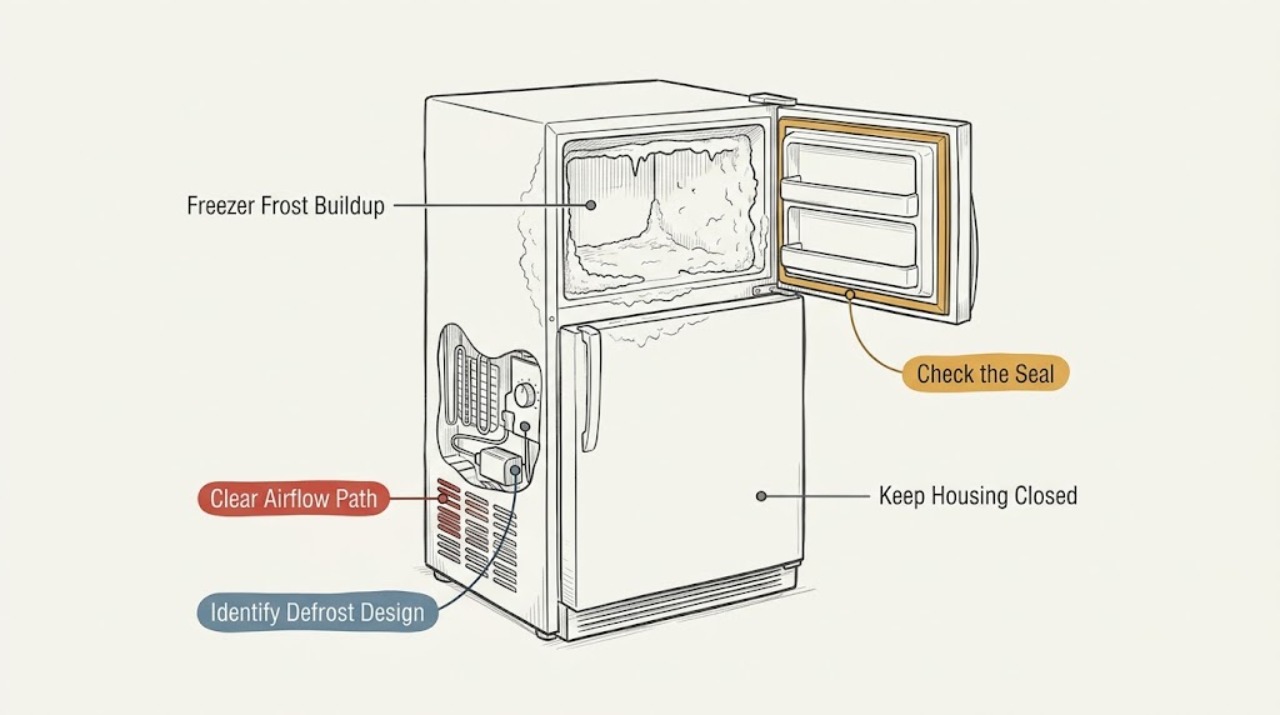
Work through in order
Diagnostic checks
Use only checks that match the exact appliance or system and its official guide.
-
Check 1
Read the Bosch rating label and owner manual to identify whether this freezer is frost-free, low-frost, or manual-defrost, and note whether the manual gives a specific defrost instruction.
Expected result: The manual identifies a defrost design or says that a particular amount of frost is expected.
Next step: Continue with the door and airflow checks. Do not remove an interior cover or use an improvised defrost method.
Stop if: Stop if the model identity is missing or the manual is unavailable and the proposed action would require opening a panel or applying heat.
Why this matters
Why: The safe next step depends on the model; a frost-free model with unusual buildup needs a different diagnosis from a manual-defrost model that has reached its normal defrost interval.
-
Check 2
Close the freezer door slowly and inspect the gasket all the way around for a folded section, food residue, package interference, torn rubber, or a visible gap.
Expected result: The door closes evenly and the gasket contacts the cabinet continuously, or a gap/interference is visible.
Next step: Remove only the item blocking closure, clean and dry the accessible gasket, then close the door and observe whether it remains fully latched. If the gasket is torn or the door is misaligned, arrange service.
Stop if: Stop if the door, hinge, cabinet, or gasket is structurally damaged and do not force the door closed.
Why this matters
Why: A gap allows moist air into the cabinet and is a common reason for frost to return; a continuous seal makes loading, airflow, and defrost controls more likely.
-
Check 3
Compare the load with the manual's clearance guidance; move packages away from the door, rear wall, and visible air vents without dismantling anything.
Expected result: A package is preventing closure or covering a vent, or the load has clear space around the vents and door.
Next step: Rearrange the load to restore the documented clearances, close the door, and monitor whether new frost stops forming. If frost is concentrated behind an inaccessible cover, escalate rather than prying it loose.
Stop if: Stop if removing ice or a panel is required to reach the vent, or if the fan area is inaccessible without tools.
Why this matters
Why: Blocked airflow or a door held slightly open can create localized frost and uneven temperatures even when the cooling system is operating.
-
Check 4
If the manual permits user defrosting, disconnect the freezer from power, remove food and drawers as directed, place towels or a tray to catch water, leave the door open, and let the frost melt naturally before cleaning and drying the cabinet.
Expected result: The ice melts without force and the cabinet can be fully dried before the appliance is restarted according to the manual.
Next step: Restart using the manual's procedure and observe the seal, temperature behavior, and frost pattern over the next normal operating period. If the manual does not authorize this procedure, stop and arrange service.
Stop if: Never chip or pierce ice, use a sharp object, use an unapproved heat source, or reconnect power while water is near electrical parts.
Why this matters
Why: A complete, controlled defrost can restore airflow temporarily and helps distinguish an isolated accumulation from a recurring fault.
-
Check 5
Check only that the plug is seated, the outlet has power, and the thermostat or temperature control has not been changed; record whether the freezer is actually keeping food frozen and whether frost is localized or widespread.
Expected result: Power is present and the control is set as expected, but the freezer is warm or frost returns quickly; or the freezer is cold and no new frost appears after the door/load correction.
Next step: For persistent warmth or rapid recurrence, stop adjusting controls and arrange qualified service. If operation is stable, continue monitoring and keep the door closed as much as practical.
Stop if: Do not remove covers, bypass controls, or make live-voltage measurements.
Why this matters
Why: A warm cabinet or rapid recurrence after a safe defrost raises concern for a defrost, sensor, fan, control, or sealed-system fault that cannot be confirmed by a visual check.
-
Check 6
Record the complete Bosch model/E-Nr, the frost location and thickness, when it began, whether the door was ajar, any recent power interruption, and what happened after a model-approved defrost.
Expected result: The same frost pattern returns, the freezer cannot hold temperature, or the symptom is accompanied by unusual noise, water, or an electrical odor.
Next step: Give the record to Bosch or a qualified appliance service provider and follow the model-specific service instructions.
Stop if: Stop using the appliance and disconnect it if the cord or plug is damaged, there is scorching, a burning smell, smoke, or water reaching electrical components.
Why this matters
Why: A repeatable timeline helps a technician separate an air-leak or airflow issue from a defrost, fan, control, or refrigeration-system problem.
Use your observations
Decision map
Find the observation that best matches what you see, then follow the next safe action.
-
PATH 01Next step
What you see
The gasket has a visible gap, is damaged, or the door cannot close around its full perimeter.
Do this next
Remove the obstruction if it is only a package; otherwise stop forcing the door and arrange service for gasket, hinge, or alignment work.
Why this path and its safety boundary
Why it matters: Humid room air can continuously enter and freeze inside the cabinet.
-
PATH 02Next step
What you see
Packages touch the door, rear wall, or a visible vent, and the gasket itself appears intact.
Do this next
Restore the manual's clearances, close the door, and monitor the frost pattern before considering a deeper repair.
Why this path and its safety boundary
Why it matters: The load may be holding the door open or restricting cold-air circulation.
-
PATH 03Next step
What you see
The manual identifies a manual-defrost design and the frost has accumulated gradually without a door-seal fault.
Do this next
Follow the Bosch manual's unplugged defrost procedure, allowing ice to melt safely and drying the cabinet before restart.
Why this path and its safety boundary
Why it matters: The buildup may be an expected maintenance condition rather than a failed component.
-
PATH 04Next step
What you see
A frost-free or low-frost model develops heavy frost, or frost returns soon after a complete model-approved defrost.
Do this next
Stop removing panels or testing live circuits and arrange qualified appliance service with the model number and symptom timeline.
Why this path and its safety boundary
Why it matters: Persistent accumulation suggests an air-leak, airflow, defrost, sensor, fan, control, or refrigeration-system issue beyond a safe visual check.
-
PATH 05Next step
What you see
The freezer is not keeping food frozen, the temperature control appears normal, or cooling does not recover after the basic checks.
Do this next
Verify only plug, outlet, and visible control settings; then arrange service if the freezer remains warm.
Why this path and its safety boundary
Why it matters: The frost may be a symptom of a cooling or control problem rather than the root cause.
-
PATH 06Next step
What you see
There is a damaged cord or plug, scorching, smoke, a burning smell, or water near electrical components.
Do this next
Stop using the freezer; disconnect power only if it can be done without contacting water or damaged wiring, and arrange qualified service.
Why this path and its safety boundary
Why it matters: This is an electrical or water hazard, not a routine frost diagnosis.
Helpful context
Understand the symptom
Start with the least invasive explanation. Frost can be normal in limited amounts, but a thick layer reduces efficiency and can affect stored food. Identify whether the appliance is a frost-free, low-frost, or manual-defrost model from its rating label and owner manual before deciding what to open or adjust.
A door that is not fully closing lets humid room air enter and can create a repeating frost pattern. Crowded baskets, a package touching the gasket, or an obstructed internal vent can produce the same symptom. These are visible checks; they do not require removing a cover or making an electrical measurement.
If a model-approved defrost is needed, protect the floor and food, disconnect power, allow the ice to melt safely, dry the cabinet, and restart according to the manual. If the buildup returns quickly, the freezer remains warm, or there is any electrical or burning-symptom concern, stop troubleshooting and provide the model information to a qualified appliance service professional.
Safety boundary
Stop conditions
- Do not chip, pierce, or pry at ice because a hidden refrigerant line or wiring could be damaged.
- Do not remove covers, bypass controls, or make live-voltage measurements as part of this diagnosis.
- Stop immediately for a damaged cord or plug, scorching, smoke, burning odor, or water near electrical components.
- If heavy frost returns quickly or the freezer remains warm after the documented basic checks, leave deeper diagnosis to qualified service.
- Protect food during a prolonged outage or defrost and follow current food-safety guidance for any food that has thawed; do not rely on the freezer repair article as a food-safety determination.
When checks do not resolve it
Need a professional?
Call Bosch or a qualified appliance service professional when the gasket or door is damaged, frost returns rapidly after a model-approved defrost, a frost-free freezer has heavy buildup, the freezer is warm, or any electrical/water hazard is present.
Have this ready
- Complete Bosch model/E-Nr, frost location and approximate thickness, symptom start date, door/load observations, recent power events, temperature behavior, and the result of any model-approved defrost.
Common questions
FAQ
Is a little frost normal in a Bosch freezer?
Bosch notes that some frost can be normal, but heavy frost is a problem because it reduces efficiency and may affect food storage. Check the door seal, closure, and loading first.
Can a bad door seal cause freezer frost?
Yes. A door that does not close fully or a gasket with a gap can admit humid air, which then freezes. Remove visible obstructions and arrange service for a damaged gasket or misaligned door.
How should I defrost a Bosch freezer?
Use the model manual first. Where Bosch permits user defrosting, disconnect power, remove food and drawers as directed, protect the floor, leave the door open, allow the ice to melt, clean and dry the cabinet, and restart as directed.
Should I use a knife or heat gun to remove freezer ice?
No. Do not chip or pierce the ice or use an unapproved heat source. A hidden line, wiring, cabinet, or electrical component could be damaged; use the documented defrost method or call service.
When does frost buildup require service?
Arrange service when heavy frost returns quickly after a safe model-approved defrost, a frost-free model has unusual buildup, the freezer is not holding temperature, the ice is behind an inaccessible cover, or there is any electrical or water hazard.
Read the exact guide
Official sources
- Common Freezer problemsBosch Home Appliances · Bosch's general freezer guidance says that some frost is normal, excessive frost indicates a problem, and the door seal/closing and thermostat should be checked before professional help.
- Fridge freezer not coolingBosch Home Appliances · Bosch's cooling checklist covers visible power, thermostat, and condenser checks and directs persistent cooling faults to the manual or service.
- How to defrost a fridge freezerBosch Home Appliances · Bosch's defrost procedure covers disconnecting power, removing food and drawers, protecting the floor, allowing ice to melt, cleaning/drying, and restarting; it also explains why thick ice matters.
Community feedback
Share a repair observation
Share a plain-text repair observation. Accepted observations are published automatically; this page may take a moment to update.