
On this page
Start here
Quick answer
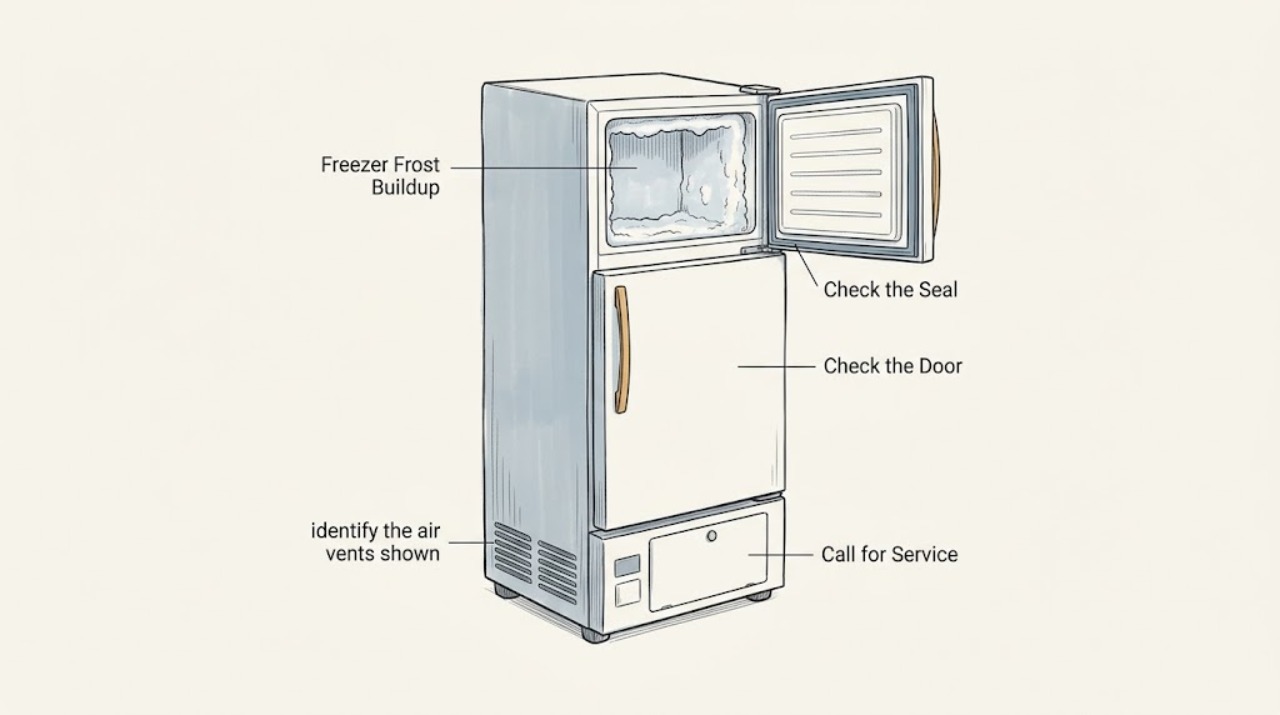
Amana freezer frost usually means humid air is entering, the door or lid is not sealing, airflow is blocked, or the freezer needs the model-approved defrost procedure. Start by checking the closure and gasket, then look for blocked vents and habits that add warm moisture. If frost is thick, follow the Amana instructions for your exact model rather than scraping it with a sharp tool or using a hair dryer. Frost that returns quickly after a complete, correct defrost, a freezer that cannot hold temperature, or damage behind an interior panel needs appliance service.
Work through in order
Diagnostic checks
Use only checks that match the exact appliance or system and its official guide.
-
Check 1
Close the Amana freezer door or lid normally and inspect the entire visible gasket for food particles, cracks, tears, flattening, or a package that prevents closure. Place a sheet of paper between the gasket and cabinet at several points, close the door, and pull the paper out gently.
Expected result: The paper has noticeable tension around the seal, or it pulls out easily at one or more sections; the door or lid may also spring back or fail to close fully.
Next step: Remove only the visible obstruction and clean the gasket with the model-approved method, then retest. If the gasket is damaged or the paper remains loose, do not force or reshape it; arrange a model-specific gasket or appliance service.
Why this matters
Why: A loose paper test or an obstructed closure allows warm, humid air into the freezer and can create frost. A consistent seal shifts attention away from a simple door leak and toward airflow, usage, or a defrost and cooling fault.
-
Check 2
Review the frost onset against door use: note whether the door or lid was left open, opened often, or loaded with warm or uncovered food, and whether the room has been unusually humid. Keep the door closed while observing whether new frost growth slows.
Expected result: Frost began after extended or frequent opening, warm or uncovered food, or a humid period; new frost slows when openings are minimized.
Next step: Organize food so the door closes promptly, cover food appropriately, and monitor the freezer after normal use. If frost continues to grow despite a closed, properly sealed door, continue to the airflow and defrost checks.
Why this matters
Why: Warm, moist air entering the compartment can condense and freeze on cold surfaces. A clear timing relationship supports moisture entry rather than immediately proving a failed cooling component.
-
Check 3
With the freezer door open only briefly, identify the air vents shown in the Amana manual and check that packages or frost are not covering them. Do not force food past a vent or remove an interior panel to reach a concealed fan or duct.
Expected result: A package or visible frost blocks a vent, or the vents are open but frost and temperature problems continue.
Next step: Rearrange only accessible packages to restore the clearance shown in the manual and observe the next cooling cycle. If the obstruction is behind a panel or the issue persists, stop disassembling and schedule appliance service.
Why this matters
Why: Blocked vents reduce circulation between compartments and can contribute to moisture buildup and excessive frost. Open vents do not rule out a hidden evaporator, fan, or defrost problem.
-
Check 4
Estimate the frost thickness without scraping it. If the layer is approaching the thickness identified in the Amana guidance, confirm from the owner manual whether this freezer is manual-defrost or frost-free and read the complete defrost procedure before starting.
Expected result: Frost is about 1/4 inch (6 mm) or more, or the model instructions say the freezer should not require routine manual defrosting.
Next step: For a manual-defrost model, follow the model's power-off, food-storage, drain, and water-containment instructions; use only a plastic or wooden scraper if the manual permits it. For a frost-free model or any uncertain procedure, arrange service instead of opening panels.
Why this matters
Why: Amana advises defrosting and cleaning many freezers at about 1/4 inch of frost, while a frost-free model with heavy recurring frost may have a different fault. Thickness alone does not identify a failed part.
-
Check 5
After a complete model-approved defrost and a confirmed door seal, monitor whether frost returns quickly and whether the freezer maintains its normal temperature. Record where the new frost appears and whether food begins to soften.
Expected result: Frost returns quickly, temperature remains unstable, frost forms behind or around an inaccessible panel, or food is no longer staying frozen.
Next step: Protect the food as appropriate, stop disassembling the freezer, and arrange a qualified appliance technician with the model number, frost location, temperature behavior, and defrost history.
Why this matters
Why: Rapid recurrence after moisture and visible airflow causes are addressed points to a possible defrost, fan, sensor, refrigerant, or sealed-system problem that cannot be diagnosed safely from the cabinet interior.
Use your observations
Decision map
Find the observation that best matches what you see, then follow the next safe action.
-
PATH 01Next step
What you see
The paper pulls out easily or the door or lid is obstructed
Do this next
Clear the visible obstruction and clean the gasket; if the seal remains loose or damaged, arrange model-specific gasket or appliance service.
-
PATH 02Next step
What you see
Frost follows frequent openings, warm food, or humid conditions and the seal is good
Do this next
Reduce warm-moisture entry, keep the door closed, and monitor. Escalate if frost continues to grow despite normal closure and a clear gasket.
-
PATH 03Next step
What you see
A visible air vent is blocked by food or frost
Do this next
Restore only the accessible airflow clearance described in the model manual. Do not remove panels; call for service if the blockage is concealed or returns.
-
PATH 04Next step
What you see
Frost is about 1/4 inch (6 mm) or more on a manual-defrost model
Do this next
Follow the exact Amana manual-defrost procedure, including safe power-off and water containment. Never use sharp tools or a hair dryer.
-
PATH 05Next step
What you see
A frost-free model frosts heavily, frost returns quickly after correct defrosting, or temperature is unstable
Do this next
Stop cabinet disassembly and arrange qualified appliance service for the cooling and defrost system.
Helpful context
Understand the symptom
Read the frost pattern first
A thin amount of frost can appear in humid conditions, but a growing layer usually tells you that moisture is entering or that cold-air circulation is being restricted. Frost concentrated along the door edge makes the seal and closure more important; frost paired with blocked vents or a temperature change makes airflow and defrosting more important. A visible pattern narrows the next check but does not prove which hidden part is faulty.
Use model-specific instructions
Amana freezer designs differ: some require manual defrosting and some are frost-free. Find the model number and use its owner manual before disconnecting power or opening drain components. Never chip stubborn ice with a knife or ice pick, and do not use a hair dryer, heater, or other electrical appliance to speed melting.
Only after diagnosis
Potential parts
- freezer door or lid gasket
Consider this only if the paper test remains loose after visible obstructions are removed and the gasket is cracked, torn, or no longer sealing.
Confirm the exact Amana model and gasket profile from the owner manual or manufacturer parts information before ordering. - freezer defrost system component
Consider this only after a qualified technician confirms that recurring frost on a frost-free model is caused by a specific defrost component rather than door leakage or blocked airflow.
Defrost components are model-specific and require professional diagnosis and installation; do not select a generic heater, sensor, or control.
When checks do not resolve it
Need a professional?
Use professional service for a failed door seal that needs replacement, recurring frost after a complete correct defrost, frost-free models with heavy frost, unstable temperature, or any concealed electrical or refrigerant diagnosis.
Common questions
FAQ
How do I know whether the Amana freezer gasket is causing frost?
Place paper between the gasket and cabinet at several points and pull it out gently. If it slides out with little or no tension, or food and frost prevent full closure, the seal may be allowing humid air in.
Can I scrape Amana freezer frost with a knife?
No. Follow the model's defrost instructions and use only an approved plastic or wooden scraper if appropriate. Amana warns against knives, ice picks, sharp tools, hair dryers, and heaters because they can damage the freezer or create a hazard.
How thick can frost get before I defrost an Amana freezer?
Amana guidance for many freezers recommends defrosting and cleaning at about 1/4 inch (6 mm), but the exact model manual controls because some freezers are frost-free and others are manual-defrost.
Why does frost return after I defrost the freezer?
Check the door seal, closure, humid-air entry, and visible vent clearance first. If frost returns quickly after a complete, model-approved defrost, the freezer is frost-free, or temperature is unstable, arrange qualified appliance service for the hidden defrost or cooling system.
Read the exact guide
Official sources
- Freezer door is Sealing - Forming Frost - Upright FreezerAmana Product Help · Amana upright freezer gasket sealing, door opening, frost thickness, and service escalation
- FREEZER NOT FREEZING? SOLVE THIS AND OTHER FREEZER PROBLEMSAmana · Amana freezer frost buildup related to door sealing, frequent opening, location, airflow, and need for professional repair
- How to Defrost the FreezerAmana Product Help · Manual-defrost freezer frost removal, drainage, water containment, and prohibited defrosting tools
- Frosting in the Freezer Section - Top Freezer RefrigeratorAmana Product Help · Door opening, gasket sealing, air-vent blockage, and service escalation for frost in the freezer section
- How to Avoid Frost Build UpAmana Product Help · Amana chest and upright freezer frost buildup caused by humidity, sealing, food loading, and frost thickness
Community feedback
Share a repair observation
Share a plain-text repair observation. Accepted observations are published automatically; this page may take a moment to update.