
On this page
Start here
Quick answer
Start by checking whether your Beko freezer is a manual-defrost or Frost Free model, where the frost is forming, and whether the door closes and seals completely. Beko says warm humid air entering during frequent or prolonged openings, gaps or damage in the door seal, warm food, blocked airflow, and an unsuitable temperature setting can increase frost. Clean an accessible gasket with a soft cloth and warm water, remove only food that blocks the door or vents, and follow the exact manual. If the model is not Frost Free and the manual permits user defrosting, switch it off, protect the frozen food, let the ice melt naturally with towels and containers, and never use a knife, ice pick, hair dryer, heat gun, or other sharp/electrical heating device. If a Frost Free freezer ices up again, the seal is cracked or loose, the fan/airflow is restricted, food is thawing, or the frost returns after a correct defrost, leave the door closed as much as possible and arrange authorized appliance service.
Before you begin
Safety first
- User checks are limited to identifying the model and defrost type, inspecting/cleaning the accessible gasket, clearing obvious door or vent obstructions, checking a user temperature setting, protecting food, and following the exact manual's natural defrost procedure where permitted. Do not chip or pry ice, use sharp objects, heat guns, hair dryers, electrical heaters, solvents, panels, live electrical tests, refrigerant work, fan work, or defrost-component replacement.
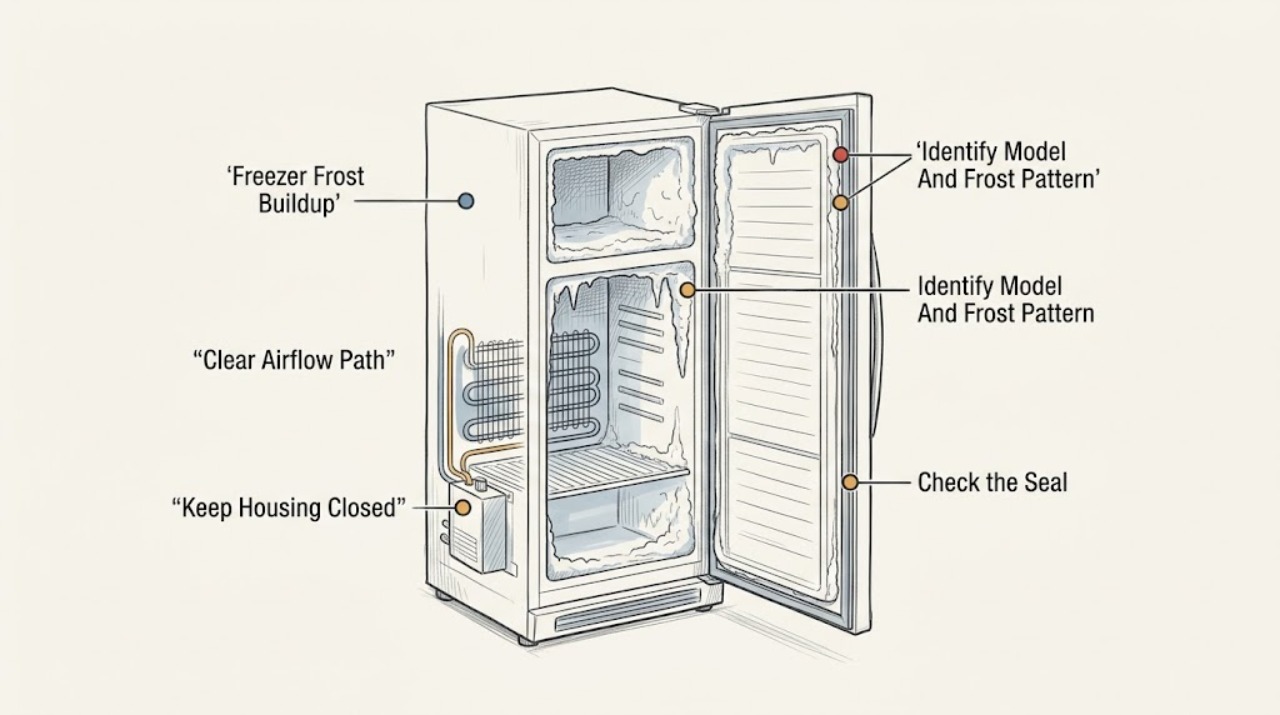
Work through in order
Diagnostic checks
Use only checks that match the exact appliance or system and its official guide.
-
Check 1
Record the Beko model from its normal label location without removing panels, and check the manual or control labels to determine whether the freezer is manual-defrost, Auto Defrost, or Frost Free. With the door open briefly, note whether frost is light or heavy, whether it covers a whole wall or one area, and whether it blocks an air vent, drawer, or door edge.
Expected result: The freezer is manual-defrost with a general frost layer; it is Frost Free with heavy or localized frost; frost blocks airflow or storage; or the model/defrost type is unclear.
Next step: Use the matching branch below and follow the exact Beko manual. Do not remove an evaporator cover, fan cover, heater, sensor, or rear panel to identify the frost source.
Stop if: Stop if food is thawing rapidly, the cabinet is damaged, water reaches electrical parts, the door cannot close, or identifying the frost pattern would require dismantling the freezer.
Why this matters
Why: Beko expects some models to require manual defrosting while Frost Free models use a system intended to prevent ice buildup. Frost that blocks airflow or returns on a Frost Free model points beyond ordinary door-opening habits and may involve a seal, fan, or defrost system.
-
Check 2
Close the freezer door normally and inspect the entire accessible gasket and cabinet contact area for gaps, cracks, tears, loose sections, food residue, ice, or a package/drawer preventing closure. Clean the gasket gently with a soft cloth or sponge and warm water if residue is visible, then dry it. Do not pull, stretch, pry, glue, or remove the seal.
Expected result: The seal contacts the cabinet all the way around; residue or a small obstruction prevents closure; there is a gap, crack, tear, loose gasket, or misaligned door; or the seal looks normal but frost persists.
Next step: Remove only the plainly visible food or drawer obstruction and close the door. If the seal is damaged or a gap remains, keep openings brief and arrange authorized service; do not use tape or an improvised gasket.
Stop if: Stop for a torn seal, bent door, damaged cabinet, persistent gap, ice that prevents closure, or any need to disassemble the door or hinge.
Why this matters
Why: A seal that does not close allows warm humid air in, which Beko identifies as a cause of frost. Cleaning can remove residue that interferes with contact, but a loose, cracked, or misaligned seal needs model-specific repair or replacement rather than repeated cleaning.
-
Check 3
With the door open only briefly, check that packages are not pressed against interior air vents, that the freezer is not overloaded, and that hot or uncovered food has not recently been added. Note whether the frost appeared after frequent or prolonged door openings, a door left ajar, or a change in room humidity. Do not chip ice from a vent or rearrange items with force.
Expected result: Packages block a vent or door; the freezer is overfilled; warm or uncovered food was added; the door was open often or left ajar; or none of these conditions applies.
Next step: Move only accessible items that plainly block the door or vent, allow hot food to cool before storage, and minimize door-open time. If frost still blocks airflow, follow the manual-defrost or service branch; do not remove internal covers.
Stop if: Stop if drawers or packages are frozen in place, ice blocks a fan or vent, food is thawing, or clearing the obstruction would require a tool or force.
Why this matters
Why: Beko says frequent/prolonged openings and moisture from warm food can create frost, while an overloaded freezer can affect circulation and door closure. If usage and loading are normal but frost is substantial, a seal or internal defrost/airflow fault becomes more likely.
-
Check 4
Check the freezer's displayed or manual temperature setting and, if available, an appliance thermometer without changing any service controls. Note whether the temperature is around the Beko guidance for the model, whether a high-temperature alarm is active, and whether food remains hard-frozen, has ice crystals, or is partially thawed. Keep the door closed while observing.
Expected result: The setting is warmer than intended; the temperature/alarm indicates warming; food is still hard-frozen; or food is partially thawed and the freezer is not recovering.
Next step: Use the model manual to correct only a user setting if appropriate. If the freezer is warming, keep the door closed and arrange service; do not compensate by choosing an extreme setting or repeatedly opening the door.
Stop if: Stop troubleshooting if food is thawing, the temperature is rising, the compressor behaves abnormally, or an alarm persists after the manual's normal recovery period.
Why this matters
Why: Beko says frost can increase when the freezer is warmer or colder than needed, and excessive frost can restrict airflow and reduce performance. Warming food changes the priority from cosmetic frost prevention to protecting food and diagnosing the appliance.
-
Check 5
If the exact Beko manual says the model is not Frost Free and permits manual defrosting, switch the freezer off using the normal user-accessible control and unplug it at the wall if safe. Transfer food to an insulated cold container or another freezer, remove only drawers or shelves that release normally, place towels and a suitable container for meltwater, and let the ice melt naturally; dry the interior before restarting as the manual directs.
Expected result: The frost melts and the freezer restarts normally; drawers or shelves are stuck; ice will not clear naturally; or the model is Frost Free or the manual does not authorize user defrosting.
Next step: Restart only as the manual specifies and allow the freezer to return to temperature before replacing food. If the model is Frost Free, the manual is unclear, or frost returns, leave panels and controls intact and arrange authorized service.
Stop if: Never use a knife, ice pick, scraper, hair dryer, heat gun, electrical heater, or flame; stop for water near electrical parts, a damaged liner, stuck drawer, or any need to remove a panel.
Why this matters
Why: Beko's defrost procedure is model-dependent and warns not to force drawers/shelves, accelerate melting unsafely, or use sharp objects. A successful defrost may restore airflow on a manual-defrost model, but recurrence on a Frost Free model or after a correct defrost points to service.
-
Check 6
After the seal, loading, temperature, and—only where permitted—natural defrost checks, decide whether the door seals, airflow is unobstructed, frost stays absent or within the model's expected pattern, and food remains frozen. Record the model, frost location/thickness, seal condition, temperature reading, defrost type, and whether frost returned.
Expected result: Frost remains or returns quickly; the freezer is Frost Free but ices up; food is warming; the seal remains damaged; or the freezer operates normally after an approved defrost.
Next step: For recurrent frost, warming food, a damaged seal, or a Frost Free unit that ices up, leave the door closed as much as possible and arrange authorized appliance service. Do not open internal panels or replace a defrost component yourself.
Stop if: Do not bypass a defrost control, force the fan, remove panels, test live parts, cut the liner, or continue using the freezer if water reaches electrical components or food safety is uncertain.
Why this matters
Why: Normal operation after a correct manual defrost can support monitoring, but recurring or localized frost may reflect a gasket, door alignment, fan, sensor, defrost heater/control, or sealed-system issue. Those causes cannot be confirmed by exterior checks and should not be guessed from frost alone.
Use your observations
Decision map
Find the observation that best matches what you see, then follow the next safe action.
-
PATH 01Next step
What you see
The Beko freezer is not Frost Free and has a substantial, general frost layer.
Do this next
Follow the exact Beko manual's safe defrost procedure: protect food, disconnect power safely, let ice melt naturally with towels/containers, dry the interior, and restart as directed. Never use sharp or electrical heating tools.
-
PATH 02Next step
What you see
The freezer is Frost Free or Auto Defrost and frost is heavy, localized, blocks airflow, or returns soon after a correct defrost.
Do this next
Keep the door closed as much as possible and arrange authorized service. Do not remove the evaporator cover or attempt fan, heater, sensor, or control work.
-
PATH 03Next step
What you see
The gasket has a gap, crack, tear, loose section, residue, ice, or an item prevents full door closure.
Do this next
Remove only the accessible obstruction and clean the gasket gently with warm water and a soft cloth. If the gap or damage remains, arrange authorized service for a model-confirmed seal or door repair.
-
PATH 04Next step
What you see
Frost follows frequent/prolonged openings, warm or uncovered food, overloading, or packages blocking vents.
Do this next
Minimize door-open time, allow food to cool before storage, keep the freezer loaded without overpacking, and clear only plainly accessible obstructions. Monitor temperature and call service if frost persists.
-
PATH 05Next step
What you see
Food is partially thawed, the freezer temperature is rising, or a high-temperature alarm persists.
Do this next
Keep the door closed and arrange prompt appliance service. Use a thermometer or ice-crystal evidence to assess food safety; do not rely on appearance or odor alone and do not refreeze food whose safety is uncertain.
-
PATH 06Next step
What you see
The seal, loading, temperature, and door habits look normal but frost is substantial or keeps returning.
Do this next
Stop user troubleshooting and arrange authorized service to diagnose airflow, defrost, temperature-sensing, door-alignment, or refrigeration faults without dismantling the appliance.
Helpful context
Understand the symptom
Frost location changes the next check
A small amount of frost on a manual-defrost freezer is different from heavy frost that covers an interior wall, blocks vents, or returns quickly on a Frost Free model. Frost generally means moisture from warmer room air has frozen inside, but the decision path depends on the door seal, usage, airflow, temperature, and whether the automatic defrost system is expected to operate. Do not remove an interior panel to inspect the evaporator or defrost parts.
Protect the appliance while defrosting
If the exact Beko manual allows manual defrosting, move food to an insulated cold container or another freezer, disconnect the appliance using the normal user-accessible method, and let the ice melt with towels and suitable containers. Beko warns not to force drawers or shelves and not to use sharp objects. Do not use a knife, ice pick, hair dryer, heat gun, or electrical heater against the liner or ice, and keep water away from electrical connections.
Know when frost is a service symptom
A clean seal and correct loading may reduce frost caused by air leakage, but they cannot repair a cracked gasket, misaligned door, blocked internal fan, sensor, heater, control, or sealed refrigeration fault. Frost that returns quickly on a Frost Free model, frost concentrated around one hidden area, poor cooling, or thawing food warrants service. Keep the door closed while arranging help and document the temperature and frost pattern.
Only after diagnosis
Potential parts
- Beko freezer door gasket
Consider this only when the exact model's gasket is confirmed cracked, torn, loose, or unable to seal after cleaning and door-obstruction checks.
Confirm the exact Beko model and manufacturer fit information before ordering; recurring frost can instead involve door alignment or an internal defrost/airflow fault. - freezer defrost sensor or heater
Consider these components only after an authorized technician diagnoses a Frost Free freezer that repeatedly ices up despite a sound seal, correct loading, and unobstructed airflow.
Do not infer a part from frost location or order by appearance; the exact Beko model, diagnostic result, and manufacturer service specification must be confirmed by the technician.
When checks do not resolve it
Need a professional?
Arrange authorized appliance service for a damaged or persistently leaking door seal, a Frost Free freezer that ices up again, frost that blocks airflow after an approved defrost, persistent high-temperature alarm, warming or thawing food, a fan or control symptom, water near electrical parts, or any condition requiring panel removal.
Safety scope: User checks are limited to identifying the model and defrost type, inspecting/cleaning the accessible gasket, clearing obvious door or vent obstructions, checking a user temperature setting, protecting food, and following the exact manual's natural defrost procedure where permitted. Do not chip or pry ice, use sharp objects, heat guns, hair dryers, electrical heaters, solvents, panels, live electrical tests, refrigerant work, fan work, or defrost-component replacement.
Have this ready
- Provide the Beko model, manual-defrost/Frost Free type, frost location and approximate extent, seal and door-closure observations, temperature/alarm state, food condition, loading and door-opening changes, and whether an approved natural defrost changed the symptom. Do not remove panels to obtain details.
Common questions
FAQ
Why is my Beko freezer building up frost?
Beko points to warm humid air entering through frequent or prolonged openings, a door seal that does not close, warm food, overloading or blocked airflow, and a temperature setting that is not appropriate for the model. Frost on a Frost Free model or frost that returns quickly needs service investigation.
How do I safely defrost a Beko freezer?
First confirm the model is not Frost Free and that its manual permits user defrosting. Protect the food, switch off and unplug using the normal safe method, let the ice melt naturally with towels and containers, dry the interior, and restart as directed. Do not force drawers or use sharp objects, hair dryers, heat guns, or electrical heaters.
Can a damaged Beko freezer gasket cause frost?
Yes. Beko says gaps, cracks, or tears in the door seal can let warm air in. Clean visible residue gently with warm water and a soft cloth; if the gasket is loose, cracked, or still leaves a gap, arrange authorized service rather than improvising a repair.
What if frost returns on my Beko Frost Free freezer?
A Frost Free freezer that develops heavy, localized, or recurring frost after the door seal and loading checks needs authorized diagnosis. Do not remove the interior panel or attempt fan, heater, sensor, control, or refrigeration work.
Is partially thawed freezer food safe?
Keep the freezer door closed and use an appliance thermometer or ice-crystal evidence to assess the food. FDA says not to rely on appearance or odor alone; when food safety is uncertain, do not serve or refreeze it without following current food-safety guidance.
Read the exact guide
Official sources
- After a Storm or Flooding: Key Tips for Consumers About Food SafetyU.S. Food and Drug Administration · U.S. consumer food-safety guidance for a refrigerator/freezer power or cooling emergency.
- How to defrost a freezerBeko · Beko integrated and freestanding freezer guide; exact appliance manual controls model-specific instructions.
- How to prevent frost build-up in my freezerBeko · Beko freezer guidance; exact model manual controls defrost features and settings.
- My Beko freezer is no longer running?Beko · Beko freezer troubleshooting FAQ; model manual controls exact operation and defrost method.
Community feedback
Share a repair observation
Share a plain-text repair observation. Accepted observations are published automatically; this page may take a moment to update.