
On this page
Start here
Quick answer
Frigidaire says frost forms when warm, moist air meets the cold freezer interior. Start by making sure the door or lid closes fully, nothing is obstructing it, and the gasket seals around the entire opening. If the model has an ice chute, make sure its flap closes; keep food away from vents and use the model's recommended temperature setting. If frost is already preventing the door from sealing or blocking airflow, follow the exact owner's manual for safe defrosting rather than chipping ice or applying heat. Arrange service if the seal is warped or damaged, frost returns after these checks, cooling is unstable, or the cause is not clear.
Before you begin
Safety first
- This article supports brief ordinary-access inspection, visible gasket care, vent clearance, and model-directed controls only. Do not chip or heat ice, puncture the liner, remove panels, access refrigerant or electrical parts, force the door, or improvise a defrost procedure.
Work through in order
Diagnostic checks
Use only checks that match the exact appliance or system and its official guide.
-
Check 1
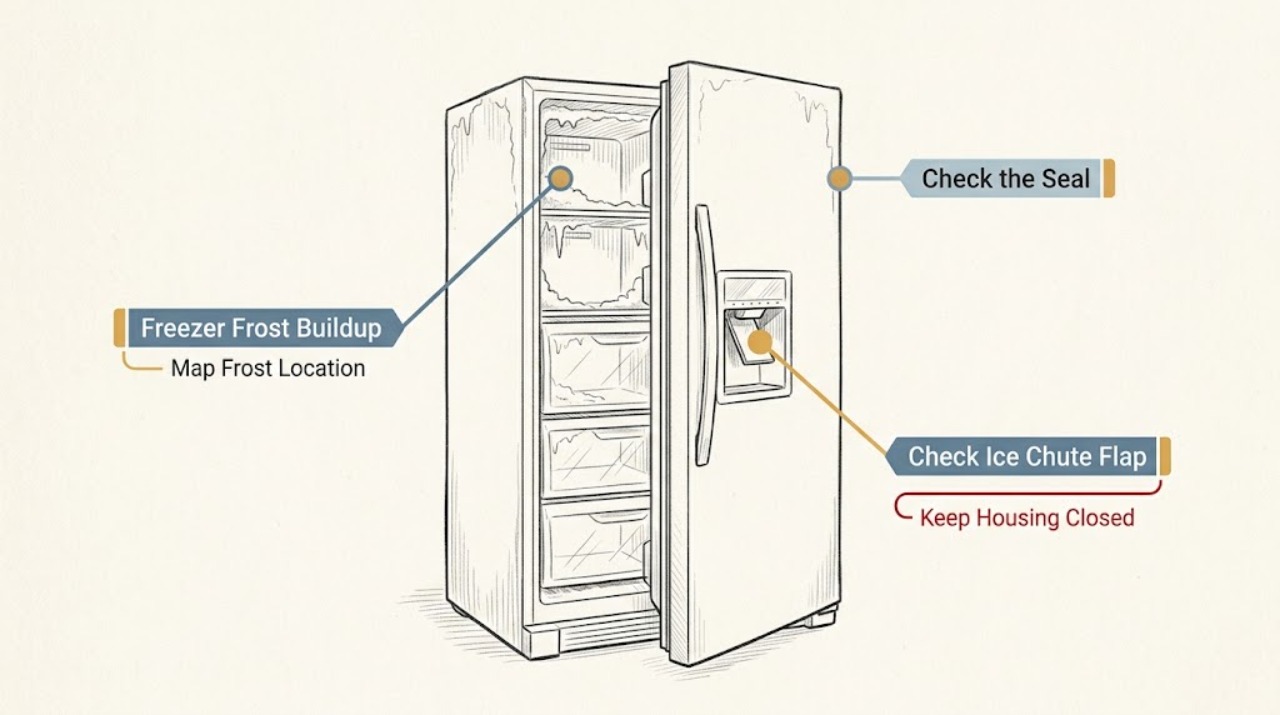
With the freezer opened only briefly, photograph and classify where frost is building: around the door or lid edge, on the rear or side wall, around a vent, near an ice chute, or directly on stored food; do not scrape it.
Expected result: Record whether frost is a thin film, a thick ridge at the opening, a localized patch near a vent or chute, or widespread ice that is already interfering with the door or shelves.
Next step: Use the pattern to perform the matching checks below and keep the photos for the manual or technician. Do not choose a component solely from the frost location.
Stop if: Stop for a cracked liner, puncture, water intrusion, an unstable shelf, or frost that makes the door or lid unsafe to operate.
Why this matters
Why: A perimeter ridge supports a door-seal or obstruction check; frost near a vent or food supports an airflow check; frost at an ice chute supports a flap check. Widespread frost that blocks closure or airflow needs the model's defrost procedure and may require service.
-
Check 2
Inspect the full door or lid gasket and the mating cabinet surface from ordinary access, then close the freezer gently to verify that no package, basket, ice ridge, or misalignment prevents a complete seal; clean only visible gasket soil with the care method in the manual.
Expected result: Record whether the gasket is clean and continuous, torn, warped, loose, cracked, flattened, or separated from the cabinet; note any point where the door springs back or leaves a visible gap.
Next step: Remove only the obstruction that is clearly outside the gasket and retest closure. If the gasket or door is damaged, do not force it closed; record the model identity and arrange service or exact-model seal replacement guidance.
Stop if: Stop for a warped door, a torn gasket that cannot seat, a hinge or cabinet problem, a sharp ice ridge, or any need to remove the door or hinge.
Why this matters
Why: A gap or damaged gasket lets warm air enter and can create recurring frost and unstable temperature. A clean, continuous seal shifts attention to the ice chute, vents, setting, usage history, or an internal fault.
-
Check 3
If this Frigidaire model has an ice dispenser, inspect the chute opening from the normal user position and verify that the flap closes fully without an ice fragment holding it open; do not pry the flap or reach into the mechanism.
Expected result: Record whether the flap is fully closed, visibly held open by ice, damaged, misaligned, or not present on this model; note frost concentrated around the chute.
Next step: Remove only loose ice that the model's manual says is user-accessible, then check closure again. If the flap is damaged, repeatedly sticks, or cannot be judged without disassembly, arrange service.
Stop if: Stop for a broken flap, exposed mechanism, a jam that needs tools, or any need to disassemble the dispenser.
Why this matters
Why: A flap that does not close can admit warm air and create localized frost. If the flap is intact and closed, the chute is less likely to explain widespread frost and the door, airflow, setting, or service branches remain.
-
Check 4
Compare stored items with the visible interior vents and air channels, and move only items that are clearly touching or covering a vent while keeping the shelves and bins stable; do not remove interior panels.
Expected result: Record whether food blocks a vent, is packed directly against a cold-air outlet, or leaves normal space around the airflow paths; note whether frost is concentrated where a vent was blocked.
Next step: Rearrange only enough to restore visible airflow and observe the freezer after the model's normal stabilization period. If frost or temperature problems persist, arrange service rather than opening the air channel.
Stop if: Stop for a solid ice wall, a seized fan sound, damaged shelves or liner, or any need to remove a panel or fan cover.
Why this matters
Why: Frigidaire says blocked airflow pathways and items placed directly in a cold-air stream can contribute to frost, and over-frosting can decrease airflow. Clearing a visible blockage may help, but it cannot confirm an internal fan or defrost fault.
-
Check 5
Read the current temperature setting and review whether the door was left open, opened unusually often, the freezer was recently reconnected, or a large amount of warm food was added; compare the setting with the exact owner's manual.
Expected result: Record the setting, recent power or installation event, door-opening history, and whether warm food was recently loaded; do not make repeated large adjustments while the freezer is heavily frosted.
Next step: Return the control to the model's recommended setting, limit door opening, and allow the manual's stabilization period. If frost continues to grow or food temperature is not maintained, request service.
Stop if: Stop for a warm freezer with unsafe food conditions, an alarm that persists, a setting that cannot be controlled, or any electrical or cabinet fault.
Why this matters
Why: Frigidaire links frequent door opening, a leaking gasket, recent reconnection, and warm food with longer operation or warm-air entry; its frost guidance also identifies an overly cold setting as a possible contributor. These clues can explain a temporary change but do not prove the freezer is healthy.
-
Check 6
From outside normal operation, note whether the freezer has normal indicator lights and compressor or fan activity, whether the door remains sealed, and whether frost returns after the seal, chute, airflow, and setting checks; do not remove covers or probe the cooling system.
Expected result: Classify the result as frost stops, frost returns at the seal or chute, frost remains widespread, the freezer is not maintaining temperature, or the unit is silent or repeatedly alarming.
Next step: Provide the frost photos, gasket and chute observations, vent arrangement, setting, recent-use history, and temperature symptom to Frigidaire or a qualified appliance technician.
Stop if: Stop for smoke, burning odor, exposed wiring, refrigerant or oil residue, a cracked liner, a failing compressor sound, or food-safety concern from a warm freezer.
Why this matters
Why: Frost that returns at the same gap keeps the seal or chute branch active. Widespread frost with reduced airflow or poor cooling may need model-specific defrost or refrigeration diagnosis. Frigidaire directs service when the unit remains unresolved after its checks.
-
Check 7
If frost prevents the door from sealing or blocks the vents, find the exact Frigidaire owner's manual and follow only its model-approved defrost and restart procedure; do not chip ice, puncture the liner, or apply direct heat.
Expected result: Record whether the frost clears using the documented procedure, the door and vents become unobstructed, and frost returns during normal use; do not treat temporary clearing as proof of the cause.
Next step: If frost returns, cooling remains unstable, or the manual does not provide a safe procedure, stop and arrange qualified service with the E-Nr and before-and-after observations.
Stop if: Stop immediately if defrosting would require a sharp tool, heat source, panel removal, water near electrical parts, or contact with a damaged liner.
Why this matters
Why: Removing the immediate ice obstruction can restore closure or airflow, but rapid recurrence points back to warm-air entry, a seal or chute problem, usage or setting, or a service-level fault. The exact model controls whether manual defrosting is permitted and how it is done.
Use your observations
Decision map
Find the observation that best matches what you see, then follow the next safe action.
-
PATH 01Safety boundary
What you see
The gasket is torn, warped, loose, visibly separated, or the closed door leaves a gap or is held open by frost or a package.
Do this next
Remove only the obvious external obstruction, keep the door closed without force, and arrange exact-model gasket or door service when the seal is damaged or cannot seat.
Why this path and its safety boundary
Why it matters: Warm air is entering at the opening, which can continually create frost and destabilize temperature.
Safety stop: Do not force the door, remove hinges, or keep operating with a damaged seal that allows frost or temperature loss.
-
PATH 02Safety boundary
What you see
The model has an ice chute and its flap is held open, damaged, or surrounded by localized frost.
Do this next
Follow the model manual for loose-ice clearing; request service if the flap does not close or needs disassembly.
Why this path and its safety boundary
Why it matters: The chute can be admitting warm air at a focused location.
Safety stop: Do not pry, dismantle, or reach into a jammed or damaged dispenser mechanism.
-
PATH 03Safety boundary
What you see
Food touches a vent or blocks an airflow path, and frost is concentrated near that area or cooling is uneven.
Do this next
Restore visible clearance without removing panels, then allow normal stabilization and observe. Request service if the obstruction is gone but frost or temperature trouble persists.
Why this path and its safety boundary
Why it matters: The visible obstruction can reduce circulation and contribute to frost, but it does not diagnose an internal fan or defrost component.
Safety stop: Do not remove a fan cover, interior panel, or solid ice wall to improve airflow.
-
PATH 04Safety boundary
What you see
The frost followed a long-open door, frequent opening, recent reconnection or power loss, or loading of warm food, while the seal and vents are intact.
Do this next
Use the manual's recommended setting, minimize opening, and allow the documented stabilization period. Escalate if frost grows or cooling does not recover.
Why this path and its safety boundary
Why it matters: A recent warm-air or temperature event may explain temporary frost and longer operation, but the freezer still must regain stable operation.
Safety stop: Stop for persistent high temperature, an alarm that does not clear, or food-safety concerns.
-
PATH 05Safety boundary
What you see
The setting is outside the model recommendation, or vents and door use show a recurring airflow or warm-air pattern without visible damage.
Do this next
Return to the manual's recommended setting, keep vents clear, limit door opening, and observe after stabilization.
Why this path and its safety boundary
Why it matters: The control or usage pattern can contribute to frost, but a setting change cannot repair a leak or internal fault.
Safety stop: Do not repeatedly adjust the control to extreme positions or continue when the freezer cannot maintain temperature.
-
PATH 06Safety boundary
What you see
A thick frost layer prevents the door from sealing or blocks vents and the exact manual has a model-approved defrost procedure.
Do this next
Follow only the exact manual's defrost and restart instructions, then monitor whether frost returns. If no safe procedure is available or the frost returns quickly, request service.
Why this path and its safety boundary
Why it matters: The ice itself is now sustaining the closure or airflow problem, so routine rearrangement alone may not restore operation.
Safety stop: Do not chip, puncture, scrape, apply direct heat, or remove interior panels.
-
PATH 07Safety boundary
What you see
The gasket, chute, visible vents, setting, and documented defrost check do not resolve frost, or the freezer is warm, silent, repeatedly alarming, or rapidly refreezes.
Do this next
Arrange Frigidaire or qualified appliance service and provide the E-Nr, photos, frost pattern, temperature behavior, and all checks already completed.
Why this path and its safety boundary
Why it matters: The remaining cause is not established as a user-accessible obstruction and may require model-specific defrost, control, fan, or refrigeration diagnosis.
Safety stop: Keep the unit out of service for smoke, burning odor, exposed wiring, damaged liner, refrigerant residue, or unsafe food temperature.
Helpful context
Understand the symptom
What the frost pattern can tell you
Frost is moisture from warm air that freezes on the cold interior. A band around the door opening or frost that accompanies a door that will not close points first to a seal or obstruction. Frost near vents or around stored food points to airflow being blocked. A model with an ice dispenser can also admit warm air when its chute flap does not close. The pattern narrows the next check, but it does not by itself identify a failed sealed-system or defrost part.
Make the freezer close and circulate air normally
Keep packages from touching the door, gasket, or vents. Clean a visibly dirty gasket with the care method allowed by the owner's manual and verify that the door or lid closes without being pushed past an obstruction. Do not force the door against a thick ice ridge. If an ice chute is present, check only that its flap is visibly closed and unobstructed.
Defrosting is model-specific
A thick frost layer can keep the door from closing and reduce airflow, so simply changing the temperature setting may not clear the immediate restriction. Use the exact Frigidaire owner's manual for whether and how that model may be defrosted. Do not chip ice with a sharp tool, puncture an interior surface, or use an improvised heat source; damage or water intrusion changes the service boundary.
Safety boundary
Stop conditions
- Do not chip, scrape, puncture, or pry frost from the liner, vents, evaporator area, or ice chute.
- Do not apply direct heat, use a sharp tool, remove an interior panel, or place water near electrical parts to speed defrosting.
- Do not force a door or lid against a frost ridge, damaged gasket, misaligned hinge, or package obstruction.
- Stop for smoke, burning odor, exposed wiring, a cracked or punctured liner, refrigerant or oil residue, a failing compressor sound, or a freezer that cannot maintain a safe food temperature.
- If frost returns quickly after the seal, chute, airflow, setting, and model-approved defrost checks, arrange qualified appliance service rather than selecting an internal part from the frost pattern alone.
Only after diagnosis
Potential parts
- freezer door gasket
Consider this category only if inspection confirms that the exact freezer's gasket is torn, warped, loose, cracked, or unable to make a continuous seal after visible obstructions are removed.
Confirm the complete model identity and the manufacturer's fit information before ordering; do not use a generic seal or force a gasket that leaves gaps.
When checks do not resolve it
Need a professional?
Arrange Frigidaire or qualified appliance service when the gasket or door is warped or damaged, an ice-chute flap will not close, frost returns quickly after the visible seal and airflow checks, frost blocks closure or vents and the manual offers no safe procedure, the freezer is not maintaining temperature, an alarm persists, or any panel, electrical, sealed-system, or refrigerant access would be required. Treat smoke, burning odor, exposed wiring, a punctured liner, refrigerant residue, or unsafe food temperature as urgent stop conditions.
Safety scope: This article supports brief ordinary-access inspection, visible gasket care, vent clearance, and model-directed controls only. Do not chip or heat ice, puncture the liner, remove panels, access refrigerant or electrical parts, force the door, or improvise a defrost procedure.
Common questions
FAQ
Why is my Frigidaire freezer building up frost?
Frigidaire says frost forms when warm air meets the cold interior. Common checks are a door or lid gasket that does not seal, an obstruction or ice ridge keeping the opening ajar, an ice-chute flap that stays open, blocked vents, a setting outside the model guidance, or recent warm-air entry from use or reconnection.
How do I check the Frigidaire freezer gasket?
Inspect the entire gasket and cabinet mating surface for soil, tears, warping, looseness, cracks, or gaps after the door closes. Remove only obvious package or ice obstructions without force, clean visible soil according to the manual, and arrange exact-model service if the gasket still cannot seal.
Can blocked vents cause frost in a Frigidaire freezer?
Yes. Frigidaire says food touching vents can disrupt airflow, and its frost guidance says blocked airflow pathways can contribute to frost. Move only items that visibly block a vent; do not remove panels or a solid ice wall to reach an internal fan or air channel.
Should I chip the ice out of my Frigidaire freezer?
Do not chip, scrape, puncture, pry, or apply direct heat to frost. Find the exact owner's manual and follow only its model-approved defrost procedure. If frost blocks closure or vents and no safe procedure is provided, arrange qualified service.
When does frost buildup require service?
Arrange service when the gasket or door is damaged, an ice-chute flap will not close, frost returns quickly after visible seal and airflow checks, the freezer is warm or repeatedly alarming, or any panel, electrical, cooling, or refrigerant access would be required. Stop immediately for smoke, burning odor, exposed wiring, a punctured liner, or unsafe food temperature.
Read the exact guide
Official sources
- Freezer Too ColdFrigidaire · Frigidaire official freezer control and airflow guidance; use the exact model manual for the control's location and behavior.
- Freezer - Not Freezing or Not CoolingFrigidaire · Frigidaire official support guidance for freezers and refrigerators with freezers; model-specific controls and defrost procedures may differ.
- Freezers - How can I set my freezer to run less frequently, or for shorter intervals?Frigidaire · Frigidaire official freezer usage and temperature-stabilization guidance used to interpret recent warm-air events; it does not diagnose internal faults.
- Refrigerators / Freezer - Frost Build UpFrigidaire · Frigidaire official support article that explicitly applies its issue list to refrigerator or freezer frost; exact model instructions still control defrosting.
Community feedback
Share a repair observation
Share a plain-text repair observation. Accepted observations are published automatically; this page may take a moment to update.