
On this page
Start here
Quick answer
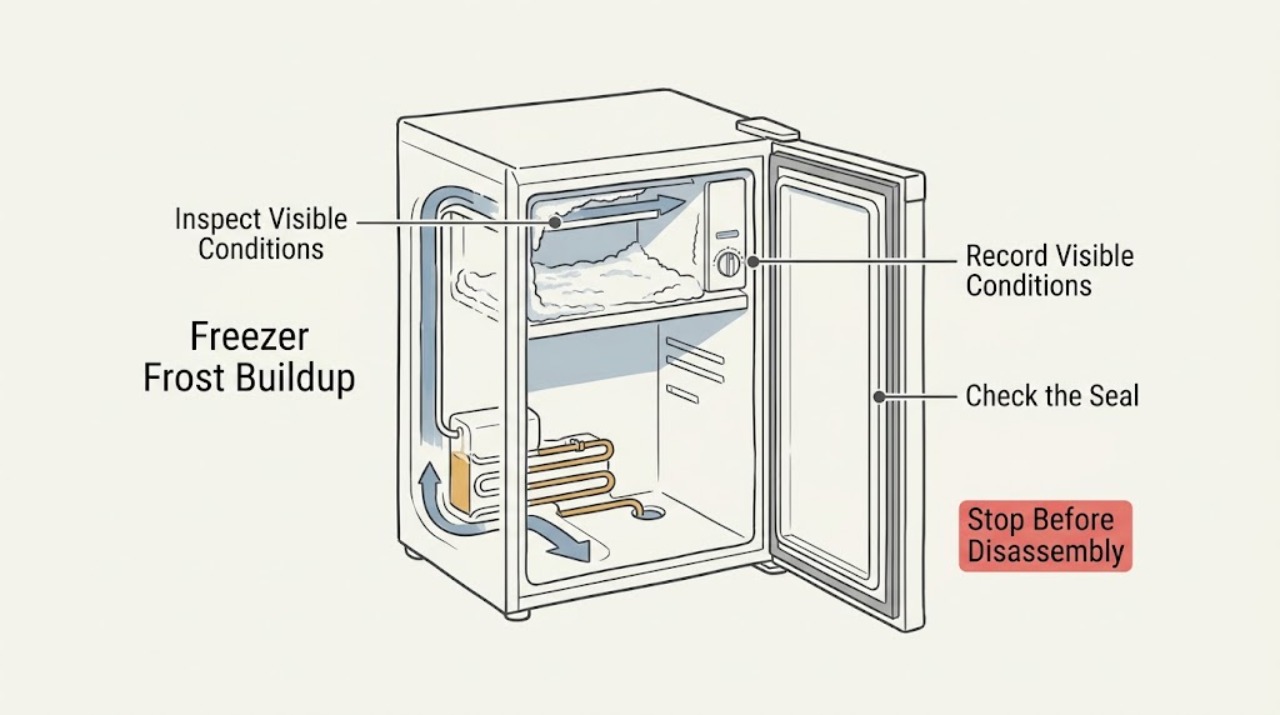
Some light, even frost can be normal, especially after humid air enters or on a manual-defrost freezer. Thick, fast-growing, one-sided, or recurring frost usually means warm air is entering through the door seal, packages are holding the door open, vents are blocked, loading or temperature is causing poor circulation, or an automatic defrost or fan path needs service. First protect food and stop for water near electrical parts, a damaged cord, sharp ice, abnormal heat, smoke, or a freezer that cannot hold a safe temperature. Record where the frost is and whether it is a thin dusting, a rear-wall sheet, a solid block around a vent, or ice at the door edge. Check the gasket, closure, vents, load, and model setting; if a manual defrost is permitted, unplug and melt ice safely with no sharp tools, open flame, or electric heater. Persistent frost after a complete safe defrost needs qualified refrigeration service.
Work through in order
Diagnostic checks
Use only checks that match the exact appliance or system and its official guide.
-
Check 1
Check the food temperature and appliance condition before touching the frost. Look for water near electrical connections, a damaged cord, smoke, a hot cabinet, a sharp ice edge, or a freezer that is no longer keeping food safely frozen.
Expected result: Food is soft or warming, water is near power, the cord or cabinet is damaged, ice is sharp or collapsing, or smoke or abnormal heat is present.
Next step: Keep the door closed while deciding how to protect food, isolate power only when safe, and do not touch wet electrical parts or continue operation with smoke, damage, or abnormal heat. Move food to a safe cold-storage option and obtain qualified appliance service when temperature control or electrical safety is uncertain.
Why this matters
Why: Food safety, electrical, cut, or fire risk takes priority over frost removal.
-
Check 2
Map the frost with the freezer closed as much as possible: note whether it is a thin even layer, near the back wall, at a vent, along the door edge, on packages, or a solid block in one area. Record when it returns and whether it appeared after a move, outage, warm load, or high-humidity period.
Expected result: The pattern is light and even, concentrated by a vent or rear wall, follows the gasket or door edge, covers food packages, or returns quickly after defrosting.
Next step: Use the corresponding branch below. Do not remove a rear panel or assume a defrost part is failed from frost location alone.
Why this matters
Why: Pattern and timing separate normal moisture from an air leak, blocked circulation, warm load, control issue, or defrost or fan fault.
-
Check 3
Inspect the closed door or lid from the outside for packages, baskets, shelves, or ice preventing closure. When the area is clean and safe, examine the gasket for dirt, gaps, tears, brittleness, folding, or uneven contact with the cabinet.
Expected result: The door is held open, the gasket does not contact evenly, the seal is damaged, or the door closes and seals uniformly.
Next step: Remove only the visible obstruction and clean the gasket with the model-approved method. Do not force a warped door or improvise a gasket repair; arrange service for a torn seal, misalignment, or recurring frost after a good seal.
Why this matters
Why: A small opening admits warm humid air that freezes on cold surfaces; a sound seal makes door leakage less likely and shifts attention to loading, vents, temperature, or defrost.
-
Check 4
Reorganize the freezer without overpacking: keep packages away from vents and the rear wall, leave the airflow gaps specified by the manual, cover liquids, and let hot food cool before storage. Note whether the frost is mainly on unwrapped food or near blocked vents.
Expected result: Packages rest against a cold wall, vents are covered, food was warm or uncovered, the compartment is tightly packed, or the load and vents are arranged correctly.
Next step: Restore the model's airflow clearance and use freezer-safe moisture-resistant wrapping. If thick frost continues with a reasonable load and clear vents, continue to the temperature and defrost checks.
Why this matters
Why: Warm or uncovered food adds moisture, while blocked vents and tight packing create temperature and moisture pockets that can promote frost and reduce circulation.
-
Check 5
Read the exact temperature setting and identify whether the freezer is manual-defrost or automatic-defrost. Confirm the control has not been changed, allow the model's stated stabilization period after an adjustment, and note whether a fan or airflow sound is absent when the manual says it should run.
Expected result: The control is set unusually warm or cold, the freezer recently had an outage or large load, a fan is not running, or the setting and airflow match the manual.
Next step: Make only the model-approved control adjustment and do not block vents. If a fan is silent when operation calls for it, food temperature is unsafe, or frost keeps returning, stop and request qualified service.
Why this matters
Why: Temperature and environment changes can create temporary moisture or frost; a missing fan or repeated frost in an automatic-defrost model is more consistent with a service-level airflow or defrost problem.
-
Check 6
If the manual permits a full manual defrost, transfer food to safe cold storage, disconnect power, prepare towels or the specified drain and a pan for meltwater, and let ice soften naturally or with the manual's safe method. Never use a knife, ice pick, sharp tool, open flame, hair dryer, or space heater.
Expected result: Ice melts and drains normally, water threatens to overflow, the drain is blocked, the inner liner is damaged, or the model does not permit this user procedure.
Next step: Keep water away from electrical parts, empty the pan before overflow, and stop if the liner or tubing is damaged. Reconnect power only after the manual's cleaning and drying steps; use service instead of improvised heat or force.
Why this matters
Why: A complete safe defrost can restore blocked airflow, but an overflow, damaged liner, blocked drain, or non-user-serviceable automatic-defrost system needs professional handling.
-
Check 7
After a complete safe defrost and correct loading, monitor the same frost locations without opening the door repeatedly. Record whether frost returns quickly, whether cooling is normal, whether the fan runs, and whether water appears at the drain or floor.
Expected result: Frost stays away, returns at the gasket or vent, returns as a rear-wall block, cooling is poor, the fan is absent, or water leaks after defrost.
Next step: Stop using the freezer for unsafe temperature, leaking water near power, damaged liner, persistent frost after a full defrost, or a missing fan. Give service the frost map, model, temperature history, gasket result, and defrost observations.
Why this matters
Why: A lasting improvement supports a moisture or airflow cause; rapid or localized recurrence makes a seal, fan, defrost, drain, sensor, or control fault more likely.
Use your observations
Decision map
Find the observation that best matches what you see, then follow the next safe action.
-
PATH 01Next step
What you see
Food is warming, water is near electrical parts, smoke or abnormal heat is present, the cord or liner is damaged, or sharp ice creates a cut hazard.
Do this next
Protect the food, stop unsafe handling, isolate power only when safe, and obtain qualified appliance service. Do not continue operation or chip ice near the liner or wiring.
-
PATH 02Next step
What you see
The frost is light and even or a small dusting near vents, and the freezer is holding temperature normally.
Do this next
Minimize door openings, keep food covered, leave airflow gaps, and observe the pattern. Use the manual for the model's normal defrost behavior.
-
PATH 03Next step
What you see
Frost follows the door edge, the door is held open, or the gasket has a gap, tear, fold, or uneven contact.
Do this next
Remove visible obstructions and clean the gasket using the manual. Do not force the door or patch a damaged seal; arrange service if the seal or alignment remains abnormal.
-
PATH 04Next step
What you see
Frost is concentrated around a vent or rear wall, packages block circulation, or food was warm or uncovered.
Do this next
Reorganize for the specified airflow, cover food, and let warm items cool before storage. If the pattern returns despite clear vents and a good seal, have airflow and defrost operation assessed.
-
PATH 05Next step
What you see
A complete model-permitted defrost clears the ice, but frost returns quickly or the freezer does not cool normally.
Do this next
Stop repeated manual defrost cycles as a substitute for repair. Request qualified diagnosis of the gasket, fan, defrost heater or sensor, drain, temperature control, or sealed cooling system.
-
PATH 06Next step
What you see
The model is automatic-defrost, the fan is not running when expected, the drain overflows, or water reaches the floor or power area.
Do this next
Keep food safe and the appliance off if water or temperature is unsafe. Do not remove panels or clear hidden tubing; arrange qualified refrigeration service.
Helpful context
Understand the symptom
Frost location is a useful clue. A light, even film or a small dusting near vents can be normal; a thick sheet on one wall, ice around the door perimeter, frost packed around a vent, or a return soon after defrosting points to a different next check. Photograph the pattern before moving food so a technician can see whether the ice is localized or widespread.
Freezer designs differ: chest, upright, refrigerator-freezer, manual-defrost, and automatic-defrost models do not share the same drain, fan, or defrost access. Use the exact owner manual for the model. Keep the appliance unplugged for any permitted cleaning or defrost work, and never chip ice with a knife, pick, or other sharp object or melt it with an open flame or electric heater.
Only after diagnosis
Potential parts
- freezer door or lid gasket
Relevant only when a qualified check confirms an uneven, torn, brittle, or ineffective seal after visible obstruction and cleaning checks.
Confirm the exact freezer model and gasket profile before replacement. - evaporator or circulation fan
Relevant only when airflow is absent or frost returns in a pattern that qualified testing links to a fan or fan-control fault.
Fan design and access differ by freezer type and model; do not remove panels as a first check. - defrost heater, sensor, or control
Relevant only when an automatic-defrost freezer repeatedly re-ices after a complete safe defrost and professional testing isolates the defrost circuit.
Verify the model-specific defrost system and qualified fit information before replacement. - defrost drain or drain-pan component
Relevant only when meltwater backs up or leaks after defrost and a qualified check confirms a drain-path fault.
Drain routing varies by model; do not push tools into hidden tubing or electrical areas.
When checks do not resolve it
Need a professional?
Stop and seek qualified help for unsafe food temperature, water near electrical parts, a damaged cord or liner, smoke, abnormal heat, sharp or collapsing ice, a torn or ineffective gasket, a fan that is not running, a blocked or overflowing drain, poor cooling, or frost that returns quickly after a complete model-approved defrost. Do not use a knife, ice pick, sharp tool, open flame, hair dryer, or space heater; do not remove panels or work on a sealed cooling or electrical system.
Common questions
FAQ
Is a small amount of freezer frost normal?
A light, even layer or a small dusting near vents can be normal depending on the freezer's defrost design, humidity, recent door openings, and warm food loads. Thick, fast-growing, one-sided, or recurring buildup needs a seal, airflow, setting, or defrost check.
Why is frost forming around the freezer door?
Warm humid air can enter when packages hold the door open or the gasket does not contact evenly. Remove visible obstructions and clean the seal as the manual permits. A torn or ineffective gasket needs service.
Can blocked vents cause freezer frost?
Yes. Official guidance links blocked vents and overpacking with poor circulation, moisture pockets, and excess frost. Leave the model-specified space around vents and do not cover the rear wall with packages.
How can I defrost a freezer safely?
Follow the exact manual: protect the food, disconnect power when permitted, manage meltwater with the specified drain or pans, and let ice soften naturally or with the manual's safe method. Never use a knife, ice pick, sharp tool, open flame, hair dryer, or heater.
When does recurring freezer frost require service?
Arrange service when frost returns quickly after a complete safe defrost, the fan is not running, cooling is poor, the drain overflows, the gasket cannot seal, or water reaches electrical areas. Keep food safe and do not remove panels or repair a sealed cooling system yourself.
Read the exact guide
Official sources
- How to Avoid Frost Build UpWhirlpool Product Help · Official multi-brand freezer guidance on frost causes, door seals, airflow, load organization, and safe prevention
- Checking for Items Preventing Door or Lid ClosureWhirlpool Product Help · Official multi-brand freezer guidance on door or lid obstruction, seal damage, leveling, and frost-related closure
- Frosting in the Freezer Section - Quad DoorWhirlpool Product Help · Official multi-brand freezer guidance on door opening, gaskets, air vents, leveling, and frost service
- What's Normal Condensation or FrostWhirlpool Product Help · Official multi-brand refrigerator and freezer guidance on normal frost, humidity, door seals, airflow, temperature, and food loading
- How to Defrost the FreezerWhirlpool Product Help · Official multi-brand freezer guidance on food protection, power isolation, drain handling, natural defrost, and prohibited sharp or heated tools
- Preventing Frost or Ice Crystals on FoodWhirlpool Product Help · Official multi-brand freezer guidance on food moisture, wrapping, door openings, seals, temperature, and frost crystals
- Refrigerator & Freezer - Ice on Freezer WallGE Appliances · Official manufacturer guidance on freezer-wall ice, humidity, door openings, warm loads, gasket sealing, fan checks, and service
Community feedback
Share a repair observation
Share a plain-text repair observation. Accepted observations are published automatically; this page may take a moment to update.